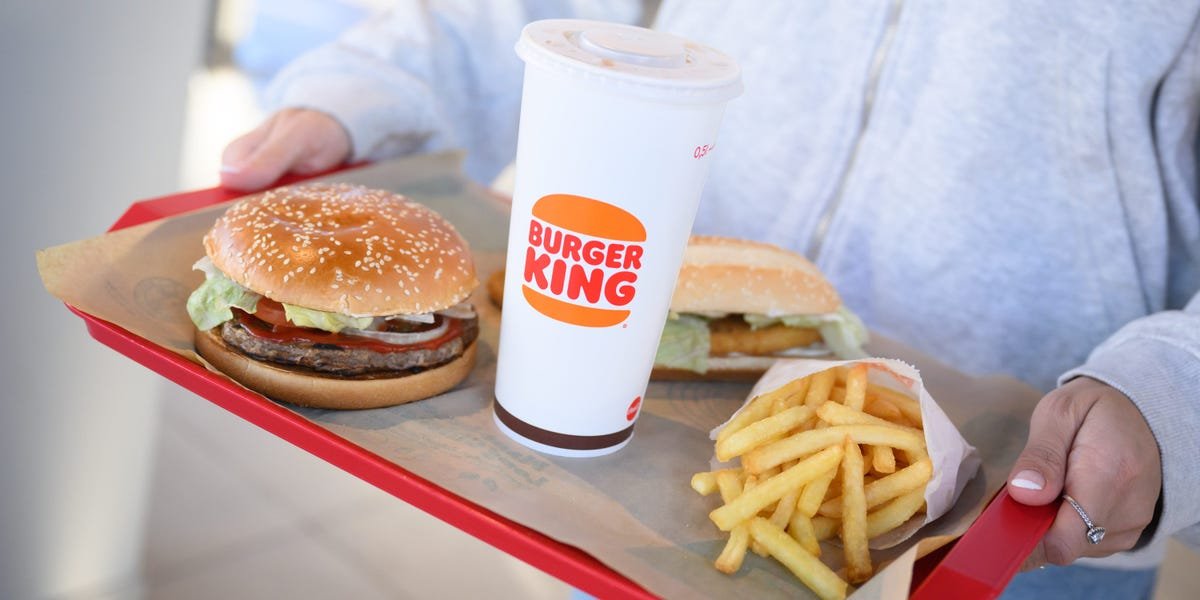
Burger King is tweaking its Whopper — and the changes don’t just freshen a decades-old recipe; they also reposition its flagship product as part of the fast-food industry’s broader premiumization push amid years of value wars.
The chain is betting that highly visible upgrades — including what a press release described as “a more premium, better tasting bun,” and packaging designed to prevent the dreaded squish — can compete against its fellow quick-service restaurants as diners increasingly demand both quality and value.
The changes mark the first meaningful refresh of the Whopper in nearly a decade and came as a response to a campaign that allowed customers to call or text Burger King US and Canada president Tom Curtis directly.
Curtis heard those calls and told Business Insider the company received nearly 20,000 voicemails and texts, with the Whopper “consistently one of the top topics,” underscoring how central it remains to the brand’s identity.
A battle between value and quality
The fast-food industry has been locked in an intense value war that has intensified since the summer of 2024 as inflation and economic pressures pushed consumers to seek the lowest-priced options. However, as chains lean into discounts, they also face a ceiling: consistently cutting prices can erode margins and dull brand appeal.
In response, competitors have begun pushing premium upgrades to core menu items.
McDonald’s has tweaked its burgers — with changes like cooking patties in smaller batches, glaze-like sauces, and richer buns — as part of its broader menu refresh and McValue strategy. Taco Bell’s Luxe Cravings boxes and premium limited-time offerings signal a similar attempt to mix higher-end cues with value structures. Wendy’s has spiced up its lineup with elevated sandwiches, such as the Mushroom Bacon Burger, and premium nugget varieties amid its ongoing value promotions.
Burger King’s Whopper upgrades fall right in line with the trend. Curtis framed the move as refinement, not reinvention.
“Guests today expect higher-quality execution without losing the familiarity of their favorites,” Curtis told Business Insider. “These changes are about elevating the experience and maintaining the core attributes that make the Whopper a category leader. It’s a reflection of rising consumer expectations across the industry.”
Reinventing a classic is risky
“Anytime a brand changes its most iconic product, there is risk,” Kelly O’Keefe, founding partner at Brand Federation, told Business Insider, pointing to New Coke as a cautionary tale: “consumers were furious, and the new product was killed faster than a new Cracker Barrel logo.”
Still, he said, ignoring evolving expectations can be just as dangerous.
“In the burger category, premium players like Five Guys and Shake Shack are thriving, and Burger King is playing catch-up,” O’Keefe said. “If they don’t stray too far from what their customers love about a Whopper, I think this could be very successful.”
Asit Sharma, an analyst at The Motley Fool, said his immediate reaction to the Whopper changes was: “What took you so long?!”
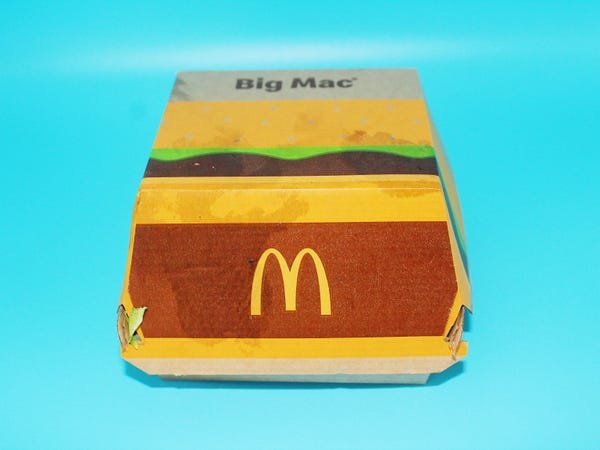
He pointed to McDonald’s 2023 efforts to refresh the Big Mac — including steps to improve texture, sauce quality, and buns — as evidence that even the biggest chains see premiumization as table stakes.
Sharma also suggested that Burger King’s narrative about listening to fans likely intersects with franchisee pressure, noting that, by parent Restaurant Brand International’s admission, the development process took years. Curtis didn’t dispute franchisee involvement, saying franchisees “were an important part of this process,” and adding that their operational input helped ensure the changes could be executed consistently.
Analysts say that premiumization, when done right, can help brands protect traffic and pricing power even as consumers remain value-focused. Sharma described the dynamic as a potential “glass half-empty” defensive move — one that prevents customers from moving to higher-end competitors — or a “glass half-full” opportunity to draw in diners who are trading down but still demand quality.
“Substituting a few ingredients for the trappings of a more premium burger (including cardboard packaging) is a way to entice more affluent customers who may be trading down in a tough economy,” Sharma said.
Mike Perry, founder of the creative agency Tavern, which has worked on rebranding efforts with companies including Burger King, described the clamshell-style box as “the most innovative thing they’ve done” because it signals care and structure that customers remember from earlier eras of fast food.
For Burger King, Curtis said the company is “more excited than ever” to act on what it heard through its feedback initiative, adding that the Whopper is the first of what the brand anticipates will be many “thoughtful updates” to the menu over time.
If the bet works, Burger King could demonstrate a path forward for legacy fast-food brands trying to thread a needle: keep the value-minded core, win back lapsed customers who’ve traded up, and do it all without breaking the emotional contract customers have with an icon.
This story is available exclusively to Business Insider
subscribers. Become an Insider
and start reading now. Have an account? .
I tried the signature burgers from three fast-food chains: McDonald’s, Wendy’s, and Burger King.
I thought McDonald’s Big Mac was underwhelming and needed more sauce.
I liked the smoky flavor of Burger King’s Whopper, even though it was the priciest burger.
As a food reporter, I’ve tried and tested many burgers over the years.
But for my latest taste test, I decided to go back to basics.
While I’ve compared the biggest burgers at fast-food chains and practically every fast-food double cheeseburger, I wanted to see if the signature burgers from three of America’s most beloved chains really are classics.
I tried the McDonald’s Big Mac, the Wendy’s Dave’s Single, and the Burger King Whopper to determine which is best in terms of taste and value.
My least favorite of the signature burgers I tried was McDonald’s Big Mac.
The McDonald’s Big Mac was released in 1968. Erin McDowell/Business Insider
Arguably the most iconic fast-food burger, the Big Mac is a staple on McDonald’s menu. Created by owner and operator Jim Delligatti of Pittsburgh in 1967, the first “Big Mac” featured a triple-decker burger and sold for 45 cents, according to McDonald’s.
The burger rolled out across the US in 1968 and quickly became the chain’s signature burger.
Today, an estimated 900 million Big Macs are sold each year around the world.
A Big Mac comes with two 1.6-ounce beef patties, pickles, shredded lettuce, chopped onions, a slice of American cheese, and layers of Big Mac sauce on a sesame-seed bun.
The burger came topped with lettuce, pickles, and Big Mac sauce. Erin McDowell/Business Insider
The Big Mac cost me $8.29, excluding tax, at my local McDonald’s in Brooklyn, New York.
Right away, I wasn’t obsessed with the flavors or texture of this burger.
The extra bun made the burger taste dry. Erin McDowell/Business Insider
The burger I received was mostly lettuce, which covered up the flavors of the cheese, meat, and sauce. I wanted more of a tangy flavor from ketchup, mustard, or simply more Big Mac sauce.
My second-favorite burger was the Dave’s Single from Wendy’s.
Wendy’s Dave’s Single with cheese is considered its signature burger. Erin McDowell/Business Insider
Named after Wendy’s founder, Dave Thomas, Dave’s Single is Wendy’s signature burger. It is available in multiple sizes, from a single to a triple-stacked burger.
It features one of Wendy’s signature square patties and is the chain’s take on a classic cheeseburger.
The Dave’s Single burger comes with a quarter-pound beef patty, a slice of American cheese, lettuce, tomato, pickles, ketchup, mayo, and onions.
The burger came with classic toppings like cheese, lettuce, and tomato. Erin McDowell/Business Insider
The burger cost me $8.74, excluding tax, at my local Wendy’s in Brooklyn.
The burger was noticeably saucier than both the Whopper and the Big Mac.
The burger was much saucier than the Big Mac. Erin McDowell/Business Insider
It was practically dripping with sauces, which I didn’t necessarily mind. Some of the flavors were slightly covered up by the two condiments, but I thought the cheese was tangy and the onions cut through the sweeter elements of the burger.
There was also a generous serving of pickles and a large slice of tomato.
Overall, I thought this was a good, classic cheeseburger.
The burger checked a lot of boxes. Erin McDowell/Business Insider
However, if I had to change one thing, I might remove or ask for a half-serving of mayonnaise.
I thought it was an overall solid choice for a late-night snack.
My favorite burger was the Whopper with cheese from Burger King.
The Whopper has been around since 1957. Erin McDowell/Business Insider
Burger King’s signature burger has been around for decades. Released in 1957, just four years after the chain opened, the Whopper was 37 cents compared to Burger King’s original burger, which cost 18 cents.
Whoppers — and all Burger King burgers, for that matter — are flame-grilled, giving their burgers a distinct smoky flavor.
You can order a Whopper with or without cheese.
The burger came without cheese, but I added it to my order. Erin McDowell/Business Insider
For the sake of this experiment, I decided to order a Whopper with cheese to ensure a fair comparison with the other signature burgers.
The Whopper cost me $9.17, excluding tax, at my local Burger King in Brooklyn.
A Whopper comes with a quarter-pound beef patty, pickles, onions, lettuce, tomato, ketchup, and mayonnaise on a sesame-seed bun.
The burger came with pickles, onions, lettuce, tomato, ketchup, and mayonnaise. Erin McDowell/Business Insider
Right away, I could tell this burger was going to pack tons of flavor. Thick layers of ketchup and mayonnaise oozed out of the sides of the burger, while the bun was large and held the other ingredients together perfectly.
The flavorful burger was my favorite for both taste and texture.
This burger impressed me with its smoky flavor and size. Erin McDowell/Business Insider
The lettuce, tomatoes, and onions all tasted very fresh, adding a delicious crunch to the burger.
The burger patties had a smoky, savory flavor that made the sandwich taste fresh off the grill. I also thought the patty’s shape, which was larger in circumference but flatter than some of the other burgers, made the sandwich easier to eat.
Overall, I think the burger was worth the higher price tag.
When comparing the three signature burgers, I found myself feeling like a fast-food-eating Goldilocks: One burger was too dry, one was too moist, and one was just right.
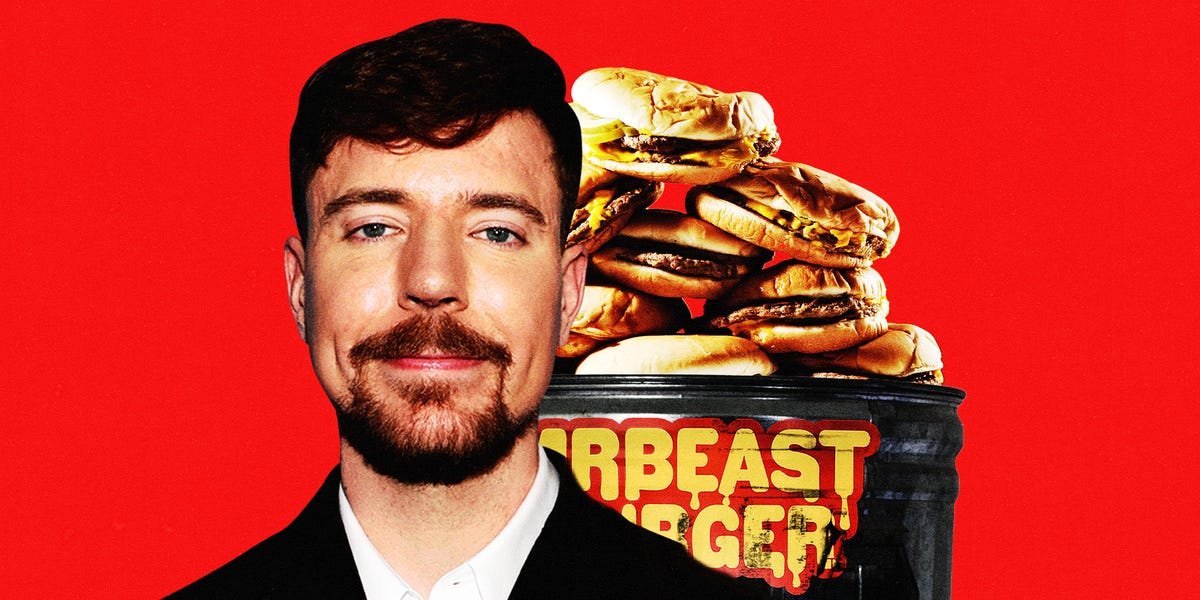
It was nearly six in the morning on a Tuesday in mid-2023, and Jimmy Donaldson, better known to the world as MrBeast, had been up for hours sending a stream of frustrated texts about MrBeast Burger, his nearly three-year-old food venture.
The YouTuber was furious with his business partners over customer complaints of undercooked burgers, and tensions had reached a breaking point.
He was done.
“As long as I have no control, I couldn’t care less about it,” Donaldson, who is known to be exacting and kill projects he doesn’t believe are up to snuff, texted a friend.
These texts — revealed as evidence in a legal battle between MrBeast and his partner Virtual Dining Concepts that could go to trial later this year — represent a stark departure from the grand ambitions Donaldson had described for the brand just six months earlier. They are part of thousands of pages of contracts, messages, and depositions that show how the partnership imploded and reveal a confrontational side of Donaldson far different from his polished, smiley persona on camera.
MrBeast Burger, a largely delivery-only venture that sells burgers and fried chicken sandwiches, was meant to be a cornerstone of a food empire that would “run circles” around Nestlé, Donaldson said in a text exchange with his cousin in December 2022.
“I want to go down the food rabbit hole and become a god in this space,” he wrote. “The king of healthy food innovation.”
By mid-2023, the promising fast-food endeavor had become a colossal headache for Donaldson.
“I was getting destroyed online, and it was impacting how people viewed me, and it made me chronically depressed,” he later said of the experience in a deposition.
The MrBeast Burger saga provides a cautionary tale for independent creators about the potential downsides of handing over control to third parties, and to brands about working with influencers who insist on tight creative oversight.
A promising start or a recipe for disaster?
Plenty of celebrity-brand deals have been fruitful, but for every Kim Kardashian and Skims partnership, there’s a Kanye West and Gap flameout. Each partnership brings its own nuances and complexities, and “virtual dining” businesses like MrBeast Burger come with built-in risks.
MrBeast Burger’s food is made by various “ghost kitchen” partners ranging from 7-Eleven and Red Robin to local mom-and-pops. That meant low overhead and few barriers to entry for the brand, but the potential for uneven food quality.
For social media creators, whose livelihoods depend on their relationships with fans, reputation is paramount.
“The inherent risk is, when you do these licensing deals, the creator’s name is the product,” said Keith Gelman, founder of entertainment marketing agency Talent Partnership Advisors, who has negotiated partnerships with celebrities including Snoop Dogg and Reba McIntyre. “The audience doesn’t distinguish between the operator and the creator.”
MrBeast and VDC came from different business and cultural worlds.
Donaldson was 22 when MrBeast Burger launched in 2020. He’d soared to internet fame through videos involving cash giveaways and stunts like being buried alive. His business was mainly run by family members, a close circle of friends, and his management team at Night Media.
VDC’s founder, Robert Earl, is a British expat restaurateur and TV personality best known for founding Planet Hollywood before moving with his son into the virtual dining business. Often seen sporting colorful shirts, Earl is at home with movie stars like Arnold Schwarzenegger and Bruce Willis. YouTubers like MrBeast were not in his orbit when his son signed the influencer for a burger partnership.
Robert Earl, front, with celebrity pals.
Denise Truscello/WireImage
MrBeast Burger launched in 2020 with a bang.
Donaldson set up a pop-up version of the restaurant near his hometown of Greenville, North Carolina, where he slid wads of cash into burger bags and handed out free iPads. He posted a video of the event, which crossed 200 million views on YouTube — a marketer’s dream.
“We were beyond slammed and ill-prepared for his incredible following and demand that ensued,” Earl told Business Insider shortly after MrBeast Burger’s launch. “It was beyond any expectation.”
After selling over 1 million sandwiches in just a couple of months, the company expanded to over 1,000 restaurants in 2021.
Donaldson was giddy with excitement about the possibilities. Early on, he began musing about merging MrBeast Burger with his candy brand Feastables and going public.
He imagined a $10 billion IPO — and he wanted an even bigger stake in the business.
“I’ll get my equity, everyone who built the channel will get their equity, and the investors will get sick returns,” he wrote in a text in late 2022.
Fans gather at the first physical MrBeast Burger restaurant opening in 2022.
Dave Kotinsky/Getty Images for MrBeast Burger
Raw burgers and soggy fries
Despite a hot start, there were early signs of trouble.
Customer complaints about product quality — including undercooked burgers, soggy fries, and incorrect orders — began appearing on social media almost immediately.
The worst part for Donaldson: There was little he could do about it.
Many of the hundreds of restaurants that sold MrBeast Burger’s food operated independently, which meant tracking down any mistakes was like playing a game of whack-a-mole.
The problems MrBeast Burger ran into are common for ghost kitchen brands with many locations, Rich Shank, a senior principal at the food-service consultant and research firm Technomic, told Business Insider.
“There’s just a lot of variances and nuances in the ghost kitchen space that make it challenging,” he said, including standardizing ingredients, cooking processes, and other factors that differ from kitchen to kitchen.
Complaints about MrBeast Burger started appearing soon after its launch.
Beast Investments vs. Virtual Dining Concepts
VDC used a variety of methods to monitor quality issues, including working with the guest feedback platform Tattle to analyze customer satisfaction. It hired a third-party firm, Intellishop, to send “mystery shoppers” to order from various MrBeast Burger locations and see what they delivered. At one time, about 5% of orders were coming back wrong, more than double VDC’s target rate of around 2%, according to an email from VDC CEO Stephanie Sollers.
Sollers said in a deposition that incorrect orders were an unfortunate feature of “most restaurant businesses.” For Donaldson, the complaints were personal.
“People were ridiculing me and saying I didn’t care,” Donaldson said in a deposition.
Donaldson’s lawsuit compared his philosophy to that of Yankee great Joe DiMaggio: “There is always a kid who may be seeing me for the first time. I owe him my best.”
Donaldson’s solution was the same one he applies to his YouTube content: “obsess over it” until he figures out an answer.
He proposed to VDC that each restaurant could submit a photo of every item to verify its quality before sending it to customers, and he wanted to hire someone to make quality control their obsession.
That kind of micromanaging wouldn’t be “operationally prudent” and would be “a very quick way of having your line cooks want to quit,” Shank said.
Jimmy Donaldson poses with fans at the opening of the first physical MrBeast Burger restaurant in 2022.
Dave Kotinsky/Getty Images for MrBeast Burger
The beef enters the boardroom
Undercooked food was not the only source of tension in MrBeast Burger land.
Donaldson accused VDC in his lawsuit of having used his name, image, and likeness in social posts and trademarks without his consent. He also told associates he wanted a larger ownership stake to gain control over MrBeast Burger’s destiny and get out of what he called in a text a “fucked deal.”
In November 2022, Donaldson made the first in a series of attempts to acquire nearly all of the company from VDC.
The stakes were high. Tech billionaire Chamath Palihapitiya, an investor in MrBeast’s company, said in a 2023 email that the creator’s media business was a break-even proposition that had “some enterprise value but not much.”
“The real value is using it as a platform to launch CPG and other kinds of companies,” Palihapitiya wrote. “We need to own at least 80% of each company.”
The problem: Donaldson’s company only owned 50% of MrBeast Burger, and the newest deal he’d signed made that agreement indefinite.
The negotiations, which dragged on for months, led to the complete fracturing of MrBeast’s relationship with VDC.
During one meeting with VDC, Donaldson banged a clothes hanger on the table out of frustration. In another, the YouTuber claimed Earl showed him a desk drawer of lawsuits to make the point that he wasn’t afraid of being sued. (Earl denied this.)
“Let’s throw a grenade in the room of VDC,” Donaldson wrote in one text as negotiations continued.
In the background, Donaldson took other steps to try to seize control. His lawyers shot a letter to VDC alleging breach of contract, and his team changed the passwords on the MrBeast Burger social accounts, cutting off VDC’s access.
“Robert is dead to me once the deal closes,” he texted his cousin during the negotiations.
“Fuck those pieces of shit,” he wrote to a friend.
In June 2023, his rage went from texts to tweets when he fired off a string of posts about MrBeast Burger that would become central to VDC’s countersuit.
MrBeast tweeted that if he had the ability to shut down MrBeast Burger, he “would have done so a long time ago sadly.” He added that sometimes when you’re young, “you sign a shit deal.”
After Donaldson’s tweets, one VDC investor pronounced the venture “dead and buried.” VDC’s complaint called it “sabotage.”
Amid the feud, MrBeast Burger’s ghost kitchen revenue fell from around $64 million in 2022 to about $45 million in 2023, court documents said.
Behind the scenes, Donaldson was working on his ‘new giga brain play’
As the negotiations stalled, Donaldson hatched a new plan. The first step was to go to court and request termination of the partnership and a ban on VDC using his name or image.
In a series of text messages, he called it “the new giga brain play.”
The full plan went something like this: Win the VDC lawsuit, make a deal with Burger King or McDonald’s for MrBeast Burger 2.0, do $100 million in sales, and eventually be bought out for $300 or $400 million.
The result, he wrote, would be “a legendary dub” — online speak for “win.”
In July 2023, Donaldson’s company sued VDC, portraying the YouTuber as a victim seeking to escape an unfair contract that had tarnished his reputation as a philanthropic, family-friendly entertainer.
VDC fired back soon after with its own lawsuit, saying Donaldson had walked away from a promising deal and failed to meet various contractual obligations, including appearances and promos.
“But for Donaldson’s opportunism, disparagement, and interference, MrBeast Burger would have continued its explosive growth,” VDC’s suit says.
The MrBeast Burger brand lost customers and market partners after Donaldson went scorched earth, Earl said in a deposition. A deal with Red Robin fell through, and a plan to distribute the burgers in supermarkets, which could bring in $500 million a year, never materialized, he added.
Donaldson’s lawsuit said that VDC had earned millions from the endeavor, while the creator hadn’t earned “a dime.” Earl said in a deposition that Donaldson’s mother and financial manager instructed VDC to reinvest the money in the business.
Donaldson has been doubling down on his Feastables candy line, which launched after MrBeast Burger.
Don Arnold/WireImage
MrBeast enters a new era
Donaldson, meanwhile, moved on. By the time of the lawsuit, his focus had turned to Feastables, the candy line he launched in 2022.
“I’m never giving up control of Feastables so I can always do what’s best for my fans,” he said in a July 2023 tweet contrasting the business with MrBeast Burger. “Harsh lesson to learn.”
So far, it’s been a winning strategy. Feastables generated over $200 million in 2024 and was profitable, according to investor materials from early 2025 viewed by Business Insider.
“I just obsess over the product,” he said during a deposition when asked why Feastables had been successful.
Donaldson has taken more control of his company, Beast Industries. The company, now some 450 employees strong, is mostly centralized in Greenville. Donaldson made Silicon Valley vet Jeff Housenbold his in-house CEO and parted ways with his external management company.
In large part thanks to Feastables, Beast Industries was valued at about $5 billion in a 2024 capital raise.
Donaldson’s plans for Beast Industries will again put control at odds with expansion.
His road map includes launching in new categories like mobile phones and financial services — with help from $200 million in fresh funding from a crypto company — that will require bringing on partners.
In investor pitch materials from early 2025, Beast Industries said its plan for Beast Financial was to partner with a “scaled fintech partner to white label a suite of products,” tailored to MrBeast’s audience and supported by financial literacy content. Partnership is simply a necessity for creators with big business ambitions.
“There’s no way that a lot of these creators could just on their own build and run a hundred million or billion dollar brand,” Eric Bogard, CEO of talent-firm UnderCurrent Management, which operates a product division called Viral Goods, told Business Insider. “You absolutely need a third party.”
As for MrBeast Burger, it marches on amid the winding legal fight, long after Donaldson stopped promoting it. You can still order his Beast Style crinkle-cut fries and smash burgers from hundreds of ghost kitchens around the world — from Singapore to Switzerland — according to its website, which still features photos of a beaming Donaldson.
MrBeast’s zombie brand lives on, even if it’s dead to its creator.