
Burned-out-in-her-50s-she-left-corporate-life-Starting.jpeg

Burned out in her 50s, she left corporate life. Starting over in Korea helped her heal.

Jane Newman spent her evenings watching K-dramas on her recliner during the pandemic lockdowns. She didn’t expect they’d spark a curiosity about South Korea that would eventually lead her to move there and start over.

In 2023, Newman was working for a consulting firm in Brisbane, Australia. As a manager, her heavy workload didn’t let up even as the world began to return to normal.

After months of long hours spent in front of a screen, she was burned out and beginning to feel the strain.

“I started out with a whole lot of shoulder and back pain, and then it developed into arm pain, and I couldn’t use my mouse,” Newman, now 60, told Business Insider.


A woman posing in a red suit in South Korea,

Jane Newman said she burned out from her corporate job in Australia.


Greg Samborski.


Standing desks and different chairs fixed little, so she took a sabbatical.

Newman had first visited South Korea the previous year, curious about the country she’d only seen on TV. Remembering how much she had enjoyed that trip, she decided to return for a two-month break.

When she went back to work, the symptoms didn’t take long to resurface. This time, Newman found herself struggling mentally and emotionally, too.

“I found it more and more difficult to do my work,” she said. By July 2024, she and her employer agreed it was best for her to step away from the company.

“I knew that South Korea was a place that I loved, and it made me feel good,” Newman said. “So I made the decision to go back and stay for a few months to see how it felt.”

New career, new home

For three months, she lived in an Airbnb in Gwacheon, a city just outside Seoul. Newman lived with her host, a local woman who had invited her to participate in the community events.

There, she joined a group supporting former US military “comfort women,” as well as two English clubs where members met to discuss news, read English fiction together, and give weekly presentations on various topics.

“I met the most wonderful people, and they really invited me into their conversations. And I got to know a lot more about Korea itself, and its history,” she said.


A woman leaning against a tree in South Korea.

Newman says she found healing in a small community outside Seoul, where she learned more about South Korean history and culture.


Greg Samborski.


“All of those things made me feel really welcomed, and at home, and part of a community, which is what I was really lacking back in Australia,” Newman added.

In Brisbane, her social life largely revolved around people she knew at work, or old friends she’d kept in touch with from her years living in the UK when her daughters were young. She was part of a bushwalking community and a social dining community, but most of those groups faded after the pandemic.

As Newman considered her next career steps, she found herself drawn toward public speaking and coaching to help people navigate the pressures of modern society and technology.

That focus also eventually led her to begin developing a tech startup in South Korea aimed at helping young people struggling with social isolation.

By February 2025, Newman moved to Seoul to begin her next phase of life.

She said her Gen Z daughters weren’t surprised by her decision since they already knew how much she loved South Korea. Both had already taken trips to visit her there.

When it was time for Newman to look for an apartment, she wanted a place that was close to public transport, with separate spaces for living and sleeping, and a good view.

It took her about two weeks to find a place. She now lives in Dongdaemun, a popular neighborhood, where her two-bedroom apartment costs 1.43 million Korean won, or about $1,000, a month.


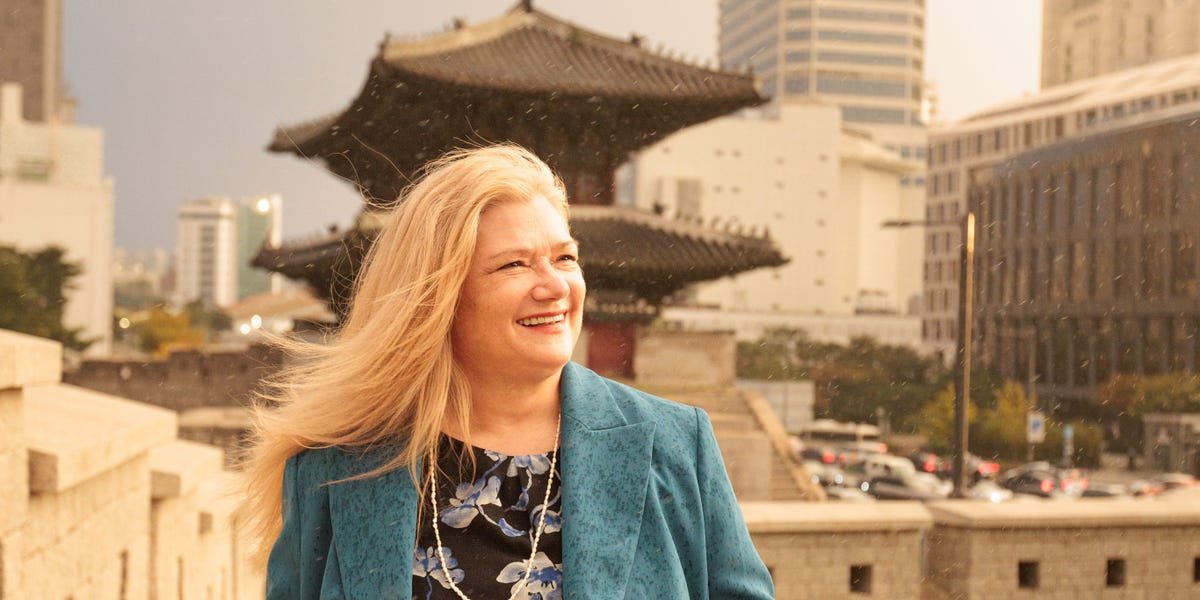
Skyline from Seoul City Wall at Dongdaemun.

Newman lives in Dongdaemun, a popular neighborhood in Seoul.


Jane Newman.


Building a new life from scratch

South Korea has become an increasingly popular choice for foreigners in recent years.

Data from the Ministry of Justice showed that the number of foreigners living in South Korea at the end of 2024 stood at 2.65 million, a 5.7% increase from the year before.

For Newman, building friendships in Seoul came more naturally than she expected.

“I’ve found that every time I’ve come to Korea, I’ve made new friends,” Newman said, adding that this included people she met through a fan group for a Korean actor she admired.


A photo of Cheonggyecheon stream in Seoul.

Newman says she makes it a point to get out of the house once a day to enjoy her surroundings.


Jane Newman.


These days, Newman’s routine is a mix of work and settling into life in Seoul.

She starts her mornings with a coffee from the Starbucks across the street before diving into her coaching sessions and working on getting her startup off the ground.

Compared to her previous job, where working 60 hours a week was common, Newman says she now works around 20 to 30 hours a week.

With the more flexible schedule, she has time to exercise, meet people, and sometimes work from libraries or cafés.

“But I do make sure I get out once a day to go out and enjoy this beautiful place I’m living in,” she said.

Do you have a story to share about relocating to a new city? Contact this reporter at agoh@businessinsider.com.


Source link

Women-at-the-top-are-exhausted-and-burned-out-according.jpeg

Women at the top are exhausted and burned out, according to a McKinsey and Lean In report

Women are hitting the top of the corporate ladder only to find something waiting for them: exhaustion.

According to a report published Tuesday by McKinsey and LeanIn.org, a nonprofit founded by Sheryl Sandberg, burnout among senior-level women is the highest it has been in the past five years.

Around 60% of these women said they have frequently felt burned out at work in the past few months, compared with 50% of senior-level men, per numbers from the “Women in the Workplace” 2025 study.

Women who are newer to leadership roles are feeling the strain more acutely. Among senior-level women who have been at their companies for five years or less, 70% reported frequent burnout, and 81% said they are concerned about their job security.

“These high levels of concern align with research that shows women often face extra scrutiny when they’re new to organizations and have to work harder to prove themselves,” the report said, adding that Black women in leadership face exceptionally high burnout and job insecurity. “In contrast, when women and men in leadership have longer tenures, their levels of burnout and job security are quite similar.”

The report, an annual study of women in corporate America, surveyed 9,500 employees across 124 companies between July and August. The study also includes interviews with 62 HR executives and company-reported data from 124 organizations that together employ about 3 million people.

LeanIn.org launched a study with McKinsey in 2015 to track how women progress through the corporate pipeline and where companies fall short. The group is named after Sandberg’s 2013 book “Lean In,” which sparked a national debate about women’s ambition, leadership, and workplace equality.

This year’s findings paint a bleak picture for women at the top. Senior-level women who are hesitant to advance their careers say they see a steeper path forward compared to their male counterparts. Eleven percent of senior women who don’t want to advance say they don’t see a realistic route to promotion, compared with 3% of senior men. And 21% say more senior-level people look burned out or unhappy, nearly double the share of men who say the same.

It’s not because women are less committed — the report found that women and men are equally locked in. What differs is the desire to keep climbing, per the report.

The data shows a clear ambition gap: 80% of women want to be promoted to the next level, compared with 86% of men. That gap is widest at the beginning and the top of the pipeline — 69% vs. 80% at the entry level, and 84% vs. 92% among senior leaders.

This is the first time in the report’s 11-year history that women have shown lower interest in promotion than men, it said.

This gap in ambition to advance falls away “when women receive the same career support that men do,” the report added. In other words, companies are responsible for creating the burnout problem for women.

“This is only happening in the companies that aren’t doing the right thing when women get the full support and the same stretch opportunities. They’re not leaning out at all,” Sandberg said in a Tuesday interview with Bloomberg Television.

“What’s happening is that women face more barriers at every level of the career,” she added.

More companies are cutting back on DEI and support for women

Even as companies say they are committed to diversity and inclusion, at least one in six have reduced the teams or resources behind those efforts, the report said.

About 13% of employers have pulled back or eliminated women-focused career-development programs, and another 13% have cut formal sponsorship programs, which play a key role in helping employees advance, it added.

“Women overall are less likely to have sponsors — and this really matters. Employees with sponsors are promoted at nearly twice the rate of those without,” the report said.

The report also found that companies are rolling back remote and flexible work options, which can hinder women’s ability to stay and advance in their careers. One in four has scaled back remote or hybrid work arrangements, and 13% have reduced flexible working hours over the past year.

At the same time, the report said that women who work remotely most of the time are “less likely to have a sponsor and far less likely to have been promoted in the last two years than women who work mostly on-site.” Meanwhile, men receive more similar levels of sponsorship and promotions regardless of their work arrangement.

At the entry level, a stage where advocacy and visibility are essential, women are also less likely than men to receive stretch assignments and other opportunities, the report added.

Last year, the “Women in the Workplace” study found that more women were advancing to senior leadership roles. By 2024, women held 29% of C-suite roles, up from 17% in 2015.

However, progress fades at the entry and management levels, per the report. “For every 100 men promoted to manager in 2018, 79 women were promoted. And this year, just 81 women were,” it added.


Source link