NATO members aren’t regularly buying weapons together, limiting how quickly and cheaply they can build up stockpiles, a senior alliance official said.
Tarja Jaakola, NATO’s assistant secretary general for defense industry, innovation, and armaments, said that allies can acquire weaponry most cost-effectively by jointly purchasing it.
Having multiple countries trying to independently develop similar weaponry means fewer resources per program and higher per-unit costs than working together.
But she said that’s often not what is happening.
“When I talk with the industry, the industry keeps telling me many nations still approach them individually with their individual requirements. And that is something that we should avoid,” she told UK think tank Chatham House.
Every time Sinéad publishes a story, you’ll get an alert straight to your inbox!
Stay connected to Sinéad and get more of their work as it publishes.
Instead, “we should look at how much can we collaborate, work together,” Jaakola said. She said shared systems also make it easier for allies to operate together in a war.
She said that countries need to “make sure that we use the taxpayer’s money cost efficiently,” especially given that “the cost escalation within defense systems is higher than in the civilian market.”
She said that allies should be embracing collaboration, co-production, and joint procurement: developing, building, and buying weapons together. NATO is made up of 32 countries, some of which are small. Internal competition for resources and contracts isn’t desirable.
Russia’s invasion of Ukraine has driven worries of wider war across the alliance and a flurry of defense spending. As more money flows into defense, questions are being raised about traditional development and acquisition processes.
The traditional defense development cycles are too slow, and the resulting arsenals are too small. Ukraine is demonstrating that it can build and modify weapons more quickly and cheaply than its partners typically can.
Officials across the alliance have noted the issue and advocated for joint production.
NATO has been increasingly pushing for greater joint production and encouraging allies to take out multinational contracts. The alliance said last year that member states are invited to “make joint procurement the preferred procurement choice.” The European Union, where most of NATO’s members are based, has also changed rules to incentivize joint procurements.
NATO Secretary General Mark Rutte said that joint procurement should reduce costs for alliance members when buying gear.
Many leaders in Europe feel the same. Ursula von der Leyen, the president of the European Commission, said last year that joint procurement would “reduce costs, reduce fragmentation, increase interoperability, and strengthen our defence industrial base.”
“We are living in the most momentous and dangerous of times,” she warned. “The real question in front of us is whether Europe is prepared to act as decisively as the situation dictates. And whether Europe is ready and able to act with the speed and the ambition that is needed.”
Jaakola said that one “very good example” of effective joint production is the interceptor missiles for the US MIM-104 Patriot air defense system. There is increasing co-production for them, including Germany’s establishment of facilities to produce missiles there. But her comments suggest there is much more to be done.
A briefing presented last year to European Parliament members revealed that joint procurement across the union was far below targets, even though it said doing so would allow for better industrial leverage, better interoperability, and annual savings of several billion euros.
Jaakola also said that NATO militaries need to change how they develop weapons. She said Ukraine has shown how weapons can be developed and fielded far faster than in NATO systems.
She said it’s an “important lesson that we need to learn from Ukraine” and that NATO needs to “actually see how we can change our own mindset and our own way of working when we talk about capability development.”
Just checking in — yup, it seems everyone is still obsessed with protein.
The new year means new health goals, and the government’s new dietary guidelines echoed what many have been calling a widespread protein obsession.
The Dietary Guidelines for Americans, released Wednesday, emphasized the role of protein and dairy products in its recommended daily diet, although dietitians have cautioned against protein-maxxing at the expense of other nutrients.
Whether it’s thanks to social media gym bros or Ozempic, more people are reaching for ultra-high-protein products, and if you remember the 1990s’ meal-replacement milkshake craze, this might feel a bit familiar.
Nutritional shakes — whether they’re used by athletes seeking nutrients on the go, parents to supplement their growing children’s diets, or adults with dietary needs seeking to pack in as many nutrients in a compact, easily digestible form — aren’t new to everyone’s diets.
As high-protein products, from protein pasta to protein beer, continue to take over grocery stores, the list of high-protein drinks continues to grow.
To better understand the high-protein drinks on sale today, I visited two New York City grocery stores and picked up every drink that advertised its protein content, with the lowest having 12 grams of protein, which is as much as two eggs.
I tried every brand’s chocolate flavor to best compare their taste and ranked all 14 based on flavor, as well as taking into consideration their nutritional content.
In general, I looked for drinks that tasted chocolatey, were sweet enough to serve as a sweet treat without going overboard, and were overall enjoyable to drink on their own.
It’s worth noting that many shakes on the market are considered ultra-processed foods, which the new government guidelines recommend avoiding.
Here’s how I ranked them, from lowest to highest.
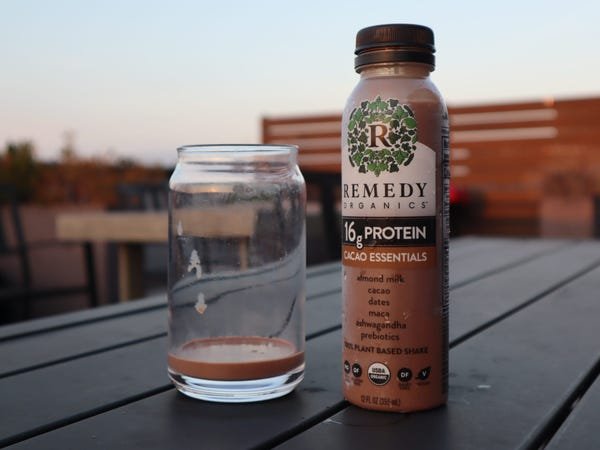
14. Remedy Organics Cacao Essentials Protein Shake
Remedy Organics Cacao Essentials Protein Shake had my least favorite flavor in the ranking. Kristine Villarroel/Business Insider
Cost: $4.99 for 12 fluid ounces
Calories: 210 calories
Protein: 16 grams
Added sugar: 7 grams
The taste of the Remedy Organics Cacao Essentials Protein Shake was what I could best describe as healthy.
The date-sweetened drink is packed with plant-based ingredients, including adaptogens like ashwagandha and maca root powders as well as tapioca prebiotic powder.
But taste-wise, they weren’t as sweet-treat-like as some of the other shakes. It tasted strongly of cacao, but it felt a little chalky, and seemed saltier than it did sweet.
While I liked the drink’s ingredients, I really disliked the taste. If you’re looking for a plant-based, adaptogen-full drink that will also help you reach protein goals, this could be an option for you — but don’t go into it expecting a sweet chocolate milk type of drink.
Flavor rating: 1/10
Overall rating: 6/10
13. Muscle Milk Zero Sugar Chocolate Protein Shake
I found the Muscle Milk Zero Sugar Chocolate Protein Shake to be overly sweet. Kristine Villarroel/Business Insider
Cost: $3.99 for 14 fluid ounces
Calories: 170 calories
Protein: 25 grams
Added sugar: 0 grams
When I first poured the Muscle Milk Zero Sugar shake, I noticed just how dark and thick it was. Tasting it, I found that it was way too sweet for my taste. This, combined with the thick texture, made for a pretty interesting drinking experience — I had to wash down the shake with some water to follow up the sweet taste left in my mouth.
Although I couldn’t finish drinking the small taste I’d poured myself, it also had the fewest calories and grams of sugar in the ranking, the highest fiber, and I felt like the protein payoff was great, which made the overly sweet taste feel more like a trade-off.
If you’re trying to get half of your daily protein in as few calories as possible while also watching out for sugar content, this drink might be good to have on your radar … but you’ll have to remind yourself of the nutrients in every sip.
Do it for the protein, bro.
Flavor rating: 3/10
Overall rating: 6/10
12. Koia Cacao Bean Protein Shake
I also did not love the taste of the Koia Cacao Bean Protein Shake. Kristine Villarroel/Business Insider
Cost: $4.99 for 12 fluid ounces
Calories: 190 calories
Protein: 18 grams
Added sugar: 4 grams
Compared to some of the other protein drinks, I found Koia’s Cacao Bean protein shake to be very thin and light in color when I first poured it.
Its flavor, as the name would indicate, is very cacao-bean forward. To me, it tasted exactly like cacao nibs, which can lean more nutty and earthy than chocolate-y.
In a statement to Business Insider, Koia said the Cacao Bean protein shake is “crafted to highlight cacao’s naturally bold, slightly bitter profile rather than masking it with excessive sweetness or artificial flavoring,” resulting in a flavor that “may be less sweet than traditional protein shakes.”
The almond-based, monk-fruit-sweetened drink, which isn’t too sweet and packs in plant-based ingredients like rice, pea, and chickpea protein and a prebiotic blend, wasn’t one of my favorites for taste, although it was fairly competitive with the other options in terms of nutrients.
Flavor rating: 4/10
Overall rating: 5/10
11. Chocolate Sport Shake
Although enjoyable and tasty, Sport Shake’s high sugar content wasn’t a worthy trade-off for me. Kristine Villarroel/Business Insider
Cost: $2.00 for 11 fluid ounces
Calories: 350 calories
Protein: 12 grams
Added sugar: 39 grams
I found the flavor of the chocolate Sport Shake to be one of the most enjoyable in the ranking, and it reminded me a lot of plain chocolate milk — it was very, very sweet. I also liked that it didn’t taste too much like dairy, something that bothered me with other drinks in the lineup.
However, the drink’s sweet and tasty flavor was overshadowed by its ultra-high added sugar content of 39 grams, or more than 9 teaspoons.
While the drink has some fiber in it, coming in with 3 grams, and it was the cheapest of the ranking, I couldn’t justify that much sugar. I will probably not reach for this again.
Flavor rating: 8/10
Overall rating: 1/10
10. Nesquik Chocolate Low Fat Milk
The Nesquik Chocolate Milk was a fun and nostalgic add to this lineup, although it wasn’t the best for protein. Kristine Villarroel/Business Insider
Cost: $2.50 for 14 fluid ounces
Calories: 250 calories
Protein: 14 grams
Added sugar: 18 grams
I was shocked when I learned that Nesquik’s classic chocolate milk could be considered a nutritional drink.
At 14 grams of protein, as advertised on the bottle, the drink has more grams of protein per serving than other drinks labeled as protein drinks.
Tasting it was just as nostalgic as expected. Compared to some of the other drinks, however, I noticed it had a stronger dairy taste and was very sweet, with a total of 18 grams of added sugar.
I also noticed that the bottle recommended a portion of half a bottle, probably due to the drink’s high sugar content, which would also result in half the protein intake overall.
I probably wouldn’t have reached for this in adulthood if not to compare it here, and I probably won’t really reach for it again.
Flavor rating: 6/10
Overall rating: 4/10
9. Muscle Milk Pro Knockout Chocolate Protein Shake
The Muscle Milk Pro packs an impressive 40 grams of protein. Kristine Villarroel/Business Insider
Cost: $5.99 for 14 fluid ounces
Calories: 220 calories
Protein: 40 grams
Added sugar: 0 grams
Like its low-sugar version, the Muscle Milk Pro looked dark and thick. Taste-wise, the drink was sweeter than chocolate-y, and I didn’t love the flavor.
Although the drink packs an impressive 40 grams of protein in 14 ounces and 220 calories, has the highest ratio of protein to fluid ounces, and also has the highest fiber content in the list, the taste was one of my least favorites, and I had to wash it down with some water after tasting, as it had such a lingering flavor on the tongue.
When considering the nutritional aspects of the drink, however, I felt like the taste was a solid trade-off for one of the most protein-efficient drinks in the ranking, having the second-highest amount of grams of protein in a single bottle.
But if you’re strictly going for the ultra-high-protein option, the Fairlife Core Power Elite — which comes later in this ranking — might be a better bet for flavor.
Flavor rating: 4/10
Overall rating: 7/10
8. OWYN Pro Elite Chocolate Protein Shake
I felt that the plant-based OWYN Pro Elite tasted a bit weird for my taste. Kristine Villarroel/Business Insider
Cost: $4.49 for 12 fluid ounces
Calories: 200 calories
Protein: 32 grams
Added sugar: 0 grams
When I first poured the OWYN — which stands for Only What You Need — Pro Elite Protein Shake, it looked much thicker than some of the other drinks in the ranking.
It tasted vastly different from the others, too. The ingredients gave some clues as to why: The main ingredients — water, pea protein, pumpkin protein, and flaxseed oil — were completely different from the other shakes.
The plant-based, dairy-, soy-, and wheat-free drink, which contains 3 grams of prebiotics, uses monk fruit extract to sweeten its cocoa-heavy flavor, and also has a greens blend that includes spinach, kale, and broccoli.
I figured that the odd flavor I experienced was perhaps due to some of its most health-forward ingredients, like the greens blend.
In a statement to Business Insider, OWYN said that the exclusion of artificial sweeteners and sugar alcohols in the formula “sometimes means a more natural, earthy taste profile,” when compared to their regular shake, which uses a blend of organic cane sugar and monk fruit.
Ultimately, I wasn’t a fan of the taste and probably wouldn’t reach for this drink again, although nutrition-wise, it was a solid ultra-high-protein plant-based option.
Flavor rating: 5/10
Overall rating: 6/10
7. Fairlife Core Power Elite Chocolate High Protein Milk Shake
I found the Fairlife Core Power Elite to have a very strong dairy taste that I didn’t love. Kristine Villarroel/Business Insider
Cost: $5.99 for 14 fluid ounces
Calories: 230 calories
Protein: 42 grams
Added sugar: 0 grams
One of three protein shakes in Fairlife’s line, the Core Power Elite shake was a bit thinner than many of the other drinks I tried.
It was less sweet than Fairlife’s regular chocolate milk, which I didn’t mind. However, it had a much stronger dairy taste — I don’t love the taste of dairy milk, so this worked against the drink for me.
Still, its insane amount of protein — as much as a whole chicken breast — earned it extra points in my ranking.
This drink was something I didn’t mind drinking, even if I wouldn’t usually go for it. Even as a non-gym-bro, I would probably reach for this drink if I were trying to get well over half of my needed protein for the day in a single serving.
Flavor rating: 5/10
Overall rating: 8/10
6. Chocolate Nutrament
The chocolate Nutrament was tasty, although packed in added sugar. Kristine Villarroel/Business Insider
Cost: $2.50 for 11 fluid ounces
Calories: 330 calories
Protein: 15 grams
Added sugar: 29 grams
When I poured the chocolate Nutrament, I noticed its consistency was among the runniest in the ranking.
The drink, the second-cheapest drink in the lineup, tasted just like chocolate milk, although it was still a bit too sweet for me.
I also noticed it had a long ingredients list with many unfamiliar terms, but on closer inspection, some seemed to be added vitamins and minerals. The drink also had the second-highest added sugar content at 29 grams.
The high sugar and comparatively low protein knocked this drink down a few points for me, and although I enjoyed it, I probably wouldn’t reach for this.
Flavor Rating: 9/10
Overall Rating: 5/10
5. Fairlife Chocolate Ultra-filtered Milk
Fairlife’s chocolate milk has 23 grams of protein in a 14-ounce bottle. Kristine Villarroel/Business Insider
Cost: $3.29 for 14 fluid ounces
Calories: 250 calories
Protein: 23 grams
The second in Fairlife’s line, its chocolate ultra-filtered milk, was another nostalgic offering.
It was very sweet, but if I were craving chocolate milk, this is definitely the option I would choose.
While it’s not marketed as a protein drink, it contains 23 grams in a 14-ounce bottle and has the second-lowest cost per gram of protein.
Flavor rating: 7/10
Overall rating: 7/10
4. Rich Chocolate Boost Plus Nutritional Drink
Aimed at weight gain or maintenance, Boost Plus is a tasty and enjoyable option. Kristine Villarroel/Business Insider
Cost: $18.99 for a six-pack of 8-ounce bottles (or $3.17 for 8 fluid ounces)
Calories: 360 calories
Protein: 14 grams
Added sugar: 18 grams
While some of the drinks in this lineup are aimed at the ultra-protein-efficient crowd and others are more directed at children, the Boost nutritional drink line is marketed toward adults with specific nutritional needs. The Boost Plus product, specifically, is aimed at adults hoping to gain or maintain weight.
Taste-wise, this was one of my favorites. The sweet and rich drink was very chocolatey, and it felt like a nice sweet treat.
With the product’s purpose in mind, the drink’s higher calories didn’t bother me, and I was pleased to see its nutrition label flooded with vitamins and minerals.
Out of many of the options, this is one I could see myself reaching for solely based on its taste, even though I wish it had a higher protein content.
Flavor rating: 9/10
Overall rating: 7/10
3. Nesquik Protein Power Chocolate Milk Beverage
I liked the taste of Nesquik’s Protein Power more than its classic chocolate milk. Kristine Villarroel/Business Insider
Cost: $3.00 for 14 fluid ounces
Calories: 290 calories
Protein: 23 grams
Added sugar: 18 grams
When I poured this drink, I was surprised by how runny it was compared to some of the other options. I really enjoyed the taste, even if it wasn’t exactly the same as the nostalgic chocolate-milk flavor of Nesquik’s classic option.
In fact, I actually liked this one more, even before factoring in the added nutritional value. It was adequately sweet, not too dairy-tasting, and it didn’t have the aftertaste that had put me off the classic option.
With 23 grams of protein, this drink could compete with some of its more nutrition-leaning counterparts. At $3 for a bottle, it was also one of the cheapest options with the highest protein content.
I could totally see myself reaching for this.
Flavor rating: 8/10
Overall rating: 8/10
2. OWYN Dark Chocolate Protein Shake
The OWYN Dark Chocolate Protein Shake was my favorite plant-based drink and my second-favorite overall. Kristine Villarroel/Business Insider
Cost: $4.29 for 12 fluid ounces
Calories: 180 calories
Protein: 20 grams
Added sugar: 4 grams
Compared to the higher-protein drink on OWYN’s line, the regular protein shake wasn’t as dark or as thick when I poured it.
While the OWYN Pro Elite had a taste I didn’t like, the OWYN Dark Chocolate Protein Shake had a simpler flavor that reminded me of chocolate milk.
It was very tasty and chocolatey, and I liked that it also had 3 grams of fiber.
Overall, this felt like a very solid option that I could see myself reaching for. It was also my favorite plant-based drink.
Flavor rating: 8/10
Overall rating: 10/10
1. Fairlife Core Power Chocolate High Protein Milk Shake
Fairlife’s Core Power shake was my favorite overall. Kristine Villarroel/Business Insider
Cost: $4.99 for 14 fluid ounces
Calories: 170 calories
Protein: 26 grams
Added sugar: 0 grams
While this drink didn’t exactly feel like a dessert or chocolate milk since it leaned more chocolatey and cocoa-tasting than sweet — and it did have somewhat of a dairy taste — I still found it very enjoyable and a very nice pick for both taste and protein.
Tied with the Muscle Milk Zero Sugar for the lowest calories in the ranking, I found the Fairlife Core Power shake much more enjoyable and even winning by a gram in the protein category.
Overall, this drink had the best balance between flavor and nutrition, and I can see myself reaching for it whenever I need a quick post-workout pick-me-up or just want to get a significant portion of my daily protein on the go.
If Greenlanders weren’t concerned by President Donald Trump’s threats to annex the territory in his first term, many of them are now.
In the days since the United States’ surprise raid into Venezuela, there’s been a renewed focus on Trump’s interest in the island, sparking fear among locals.
“I don’t know what he’s able to do. Most of me is trying to tell myself, ‘Don’t worry, everything’s going to be fine,’ but still I’m worried,” Tupaarnaq Kreutzmann Kleist, a sheep farmer in South Greenland, told Business Insider’s Sarah Andersen on Tuesday.
Casper Frank Møller, CEO and cofounder of Greenland tourist company Raw Arctic, echoed Kleist’s concerns, saying that he and many of his peers are worried about how the situation may affect their finances.
Casper Frank Møller, CEO and cofounder of Raw Arctic.
Raw Arctic
“We’ve made investments into developing our tourism aspects of our company, and it comes with risk now because of the geopolitical situation and the threats by Trump, so of course, yeah, we’re all really worried,” he told Business Insider on Tuesday.
In a statement to Business Insider on Tuesday, White House press secretary Karoline Leavitt confirmed that Trump and his team are discussing a range of options to pursue Greenland, including “utilizing the US Military.”
A US takeover feels more realistic than ever
Trump’s had his sights set on the Arctic island, a semi-autonomous territory of Denmark, since his first term in office. He has argued that Greenland’s location makes it strategically important, as the melting of Arctic ice opens up new shipping routes and intensifies competition with Russia and China. The island is also rich in critical minerals and already hosts a key US military base, which American officials say is vital to missile defense and Arctic security.
When Trump initially raised the topic of buying Greenland in 2019, Greenlandic influencer and engineer Qupanuk Olsen told Business Insider she and other locals thought it was a joke, and said she still didn’t take it seriously when Trump resurfaced talks in late 2024.
Qupanuk Olsen is one of Greenland’s most prominent influencers.
Mark Adam Miller
That changed when Donald Trump Jr. visited Nuuk in January 2025. “That’s when we realized that Trump’s words were no longer just words,” Olsen said in June. “They are real, and he means what he says.” Business Insider wasn’t able to reach Olsen this week for a follow-up.
In the wake of the raid on Venezuela, Møller said on Tuesday that Trump’s threats to annex Greenland feel “much more realistic that it will actually happen” than when he spoke with Business Insider in January 2025.
A country dividing
US interest had at least one positive effect, Olsen said in June: It pushed Greenlanders to think more seriously about their place in the world and the need to speak for themselves.
“It was such a huge wake-up call for everyone in Greenland because suddenly we needed to have an opinion whether we still want to stay under Denmark, whether we should become independent, or whether we should become a state under the United States,” she said. “We certainly had options. So those options were helpful in the beginning for the independence movement.”
Tupaarnaq Kleist is a sheep farmer in Greenland.
Mark Adam Miller
That mindset may be shifting. Kleist said she’s worried that “we as the local indigenous Greenlandic people are slowly going against each other now,” she told Business Insider on Tuesday. Some want to stand with America, others with Denmark, she said. Ultimately, though, the dream is for Greenland to become its own independent country, she added.
“We want Greenland to be the Greenlanders, and we’re not for sale. We are not to be taken over,” Møller said.
Naaja Nathanielsen, Greenland’s minister of natural resources, business, energy, justice, and gender equality, said in June that she sees much of the American administration’s interest in Greenland as an opportunity for collaboration. But she said the way Trump is going about it is wrong.
Naaja Nathanielsen is Greenland’s minister of natural resources, business, energy, justice, and gender equality.
Mark Adam Miller
“I think if we take the temperature down a bit and de-escalate the conflict level and the rhetoric, I think we can, in agreement with each other, find many paths forward that are mutually beneficial for both the US and for us,” Nathanielsen said in June. “But we don’t appreciate being talked about as a commodity, as something you can buy or sell or acquire or take. That is, of course, offensive to all people.”
In an email on Tuesday, Nathanielsen told Business Insider that she stands by what she said in June.
“The people of Greenland find the current situation unsettling, and it causes a great deal of anxiety,” she wrote. “We will continuously promote the idea of alliances and partnerships over colonialism. We have had our share of that.”
The debate heats up
Denmark, Trump has argued, is not doing enough to safeguard Greenland. “We need Greenland from the standpoint of national security,” Trump told a group of reporters on Air Force One on Sunday.
The same day, Denmark’s Prime Minister Mette Frederiksen urged the US in a statement to “stop the threats against a historically close ally.” Frederiksen has previously rejected Trump’s suggestions outright, telling him that Greenland is not for sale and that any idea of annexation is “absurd.”
Frederiksen has warned that any US military action against Greenland would severely damage NATO unity, raising questions about whether the alliance could withstand such a conflict between allies.
On Tuesday, major European leaders, including those from France, Germany, the UK, Italy, Spain, Poland, and Denmark, released a joint statement defending Greenland. “Greenland belongs to its people,” the statement said. “It is for Denmark and Greenland, and them only, to decide on matters concerning Denmark and Greenland.”
Alarms blare over the factory floors, and work at Patria’s Hämeenlinna facility grinds to a halt.
The soft thrum of an explosion echoes through the campus. Moments later, roughly 700 workers continue making their armored vehicles bound for Japan, Sweden, Slovakia, and other countries. The blast is not a test-firing of its new combat vehicle, but part of the construction for its expanding manufacturing facility.
Patria, Finland’s largest defense company, is planning to nearly double production at its main hub just north of Helsinki, clearing rocks with explosives on-site to make way for several new assembly lines.
Construction crews are paving the way for a new assembly line in Patria’s Hämeenlinna facility.
Matthew Loh for Business Insider
The Hämeenlinna factory manufactures Patria’s 8×8 armored personnel carrier and a relatively new, up-and-coming vehicle: a wheeled 6×6 troop transport that’s receiving surging demand from northern and western Europe.
Work on the 25-foot-long, 17-ton vehicle began in 2020 under a joint program between Finland and Latvia called the Common Armored Vehicles System. Both countries sought a cost-effective, mass-produced armored vehicle that could be used by their militaries for interoperability.
Every time Matthew publishes a story, you’ll get an alert straight to your inbox!
Stay connected to Matthew and get more of their work as it publishes.
Latvia has since sent at least 42 of these vehicles to Ukraine, armed with heavy machine guns and rolled out in batches over the last year. The vehicle can cross tundra and even rivers while shielding up to 10 troops it carries from land mines and artillery fire to get them to forward positions.
Latvia handed over 21 of its promised Patria 6×6 vehicles to Ukraine in November.
Alexander Welscher/picture alliance via Getty Images
When Business Insider visited Patria’s factory, representatives for the company — which is majority-owned by the state of Finland — said the firm wasn’t authorized to share details about the 6×6’s performance in Ukraine.
But the CAVS 6×6 program has been quickly drawing attention from the rest of Europe: What began as a partnership between two countries has expanded into a consortium of seven member states.
Sweden joined the Common Armored Vehicles System program in 2022, followed by Germany, Denmark, the UK, and Norway in subsequent years.
Finland and Latvia have placed orders for just under 500 of these vehicles, while Sweden has requested 415 of the 6×6s to be delivered over the next five years. Stockholm’s latest order for 94 vehicles, announced in early December, priced each one at about $1.75 million.
Germany has become the program’s largest buyer, signing contracts in mid-December to acquire 876 of the 6×6 vehicles, valued at $2.3 billion. These vehicles will be split into four variants, including one that features a mortar turret.
Meanwhile, Denmark, which joined the program this year, has already placed an order for 129 6×6 vehicles.
The UK and Norway are still negotiating 6×6 orders with Patria.
Inside the CAVS 6×6
The CAVS 6×6 can accommodate roughly 10 troops, along with a typical crew of two or three, and features up to NATO standard level 4 armor designed to withstand direct hits from large-caliber machine gun fire, mine explosions, and nearby artillery blasts.
The CAVS 6×6 competes with other wheeled troop transports, such as Rheinmetall’s Boxer and General Dynamics Land Systems’ Stryker, the latter of which is extensively fielded by the US Army.
The Finnish company said it can tweak the vehicle for each customer’s needs, but a typical model features climate control that enables the vehicle to operate in temperatures as low as -40°F.
“Inside, it will be comfortable enough to easily survive. We are talking about temperatures of the plus centigrades,” Mikko Rantanen, Patria’s director for 6×6 vehicle programs, told Business Insider from inside the rear compartment of one of the vehicles.
Patria’s 6×6 can sit roughly 12 to 13 people total.
Matthew Loh for Business Insider
The 6×6’s rear interior is spartan: Cloth-covered metal-frame seats and headrests for five people on either side, with space behind each seat for equipment and small arms.
There’s just enough room for a soldier to sit with their knees touching the opposite passenger’s. A few fire extinguishers inside are connected to an automatic suppression system that can detect a blaze in the rear cabin.
The interior of Patria’s 6×6 features a relatively simple design, with metal seats and storage compartments for firearms and equipment.
Matthew Loh for Business Insider
Screens allow troops to see outside the vehicle through exterior cameras, while a rear hatch provides the option of fitting a machine gun or crewed weapon module on top of the 6×6.
On the right-hand side of the vehicle, a small passageway also lets troops pass between the rear compartment and the driver’s cabin, which resembles that of a truck and features an automatic gearbox.
The driver’s cabin of the 6×6 is like that of a truck’s. The vehicle is driven in auto.
Matthew Loh for Business Insider
Optional propellers on the 6×6’s underside enable it to transition seamlessly from traversing land to crossing small bodies of water, such as rivers or lakes.
“We can enter the water without needing preparation in this configuration,” said Rantanen.
A showcase vehicle of the Patria 6×6 sports propellers for when crews have to move the APC through water.
Matthew Loh for Business Insider
However, the 6×6’s speed in the water is just under 5 mph, and Rantanen added that it’s not meant to be a landing craft or amphibious assault vehicle.
On land, it’s designed to drive at speeds of over 60 mph, easily cross trenches that are four feet wide, and surmount obstacles about two feet high.
Screens in the 6×6 show what’s happening outside the vehicle. The passageway here leads to the driver’s cabin.
Matthew Loh for Business Insider
Moving fast in the Arctic
Building weapons and vehicles specifically for arctic terrain is a specialty for contractors in Finland, a country renowned for holding off the Soviet Union for over 100 days in deep snow and dense forest during World War II.
Patria said that while the 6×6 can be outfitted for various terrain types, including the desert, the arctic domain is its forte.
The CAVS 6×6 is designed to cross both snow and marsh terrain.
Patria
Snow isn’t the only challenge in arctic warfare. Few roads are available on Finland’s border with Russia — the priority threat for NATO — and its vast hinterland is peppered with thousands of small lakes and marshland that can bog down armored transport.
“In the wintertime, it’s snow,” said Petri Hepola, Patria’s executive vice president for sales and marketing and its chief program officer for the F-35. “In the summer, lots of wet soil and swampy areas. One of the most important features is how fast you can move your troops and tools through these areas.”
The wet terrain in the summertime for northern regions means the 6×6 has to be capable of moving fast in both mud and snow.
Patria
Finland and Norway are the only two members of Patria’s 6×6 program that share Arctic borders with Russia.
However, as northern Europe, especially the Baltic and Nordic states, grows increasingly concerned about conflict with Moscow, the Kremlin has been bolstering its military presence in the high north, repopulating key bases and transforming its Arctic fleet into a separate strategic theater.
Since Finland joined NATO in 2023, alliance forces have been rushing to train on the country’s terrain and frigid temperatures, making it one of the most active spots for joint exercises in recent years.
“Our products have been surviving very well in that environment,” Hepola said.
Gearing up for 2027
With an order backlog of nearly 2,000 6×6 vehicles, Patria hopes its new facility in Hämeenlinna will be ready for production by 2027. The factory campus serves only the tail end of the entire manufacturing cycle, which can take weeks in most cases, or several months for more complicated variants.
Inside, hundreds of workers conduct welding, surface treatment, assembly, tests, and other final processes that can each take weeks to complete. Dozens of vehicles line the factory floors, and dozens more sit in parking lots, each marked with a flag to designate the country for which it has been modified.
Patria vehicles are seen during the official opening ceremony for a new production facility in Latvia in 2024.
GINTS IVUSKANS/AFP via Getty Images
Before delivery, each one is supposed to be driven at least 200 km, or 124 miles.
Rantanen, director of the 6×6 program, said Patria has been integrating counter-drone systems, such as jammers, on the vehicle.
Armored vehicles in Ukraine have especially struggled against pervasive minefields and small drones with explosive payloads, some of which are controlled via a fiber optic cable connection that can’t be jammed. In response, soldiers there have relied more on firearms such as shotguns and machine guns to counter such attacks.
Rantanen said Patria hasn’t yet officially added any kinetic weapons that can take down drones.
“The drone threat is currently evolving at such a speed that it’s hard to keep track of it closely,” he said. “But we are hard at work for the countermeasures against drones as well.”
The Chinese-founded artificial intelligence startup is being acquired by Meta in a deal reported to be worth more than $2 billion — one of the most high-profile instances of a US tech giant buying an Asian AI company.
Manus grabbed headlines in March when it unveiled an AI agent designed to autonomously execute tasks like résumé screening and stock analysis.
The startup was founded in China and moved its headquarters to Singapore in mid-2025.
What does Manus do?
Launched in March by the Chinese AI product studio Butterfly Effect, Manus has beenpitched by its creators as the world’s first “general” AI agent — a system designed to carry out tasks independently.
Since its launch, the startup has continued to expand what the agent can do, rolling out features that allow users to use Manus for design work, slide creation, and completing tasks directly through a web browser.
Manus can independently execute complex tasks, such as market research, coding, and data analysis, Meta said when it announced the acquisition on Monday.
Business Insider tested the tool in its early stages in March and found it ambitious but uneven in execution, including instances where it hallucinated data.
Earlier this month, Manus said it had surpassed $100 million in annual recurring revenue, with its total revenue run rate — including usage-based fees and other income streams — exceeding $125 million.
The company in April raised $75 million in funding led by Benchmark, at a valuation of about $500 million, Bloomberg reported. Manus said in an update this month that it now employs about 105 people across Singapore, Tokyo, and San Francisco, and plans to open a Paris office soon.
Who are its founders?
Manus was founded by Xiao Hong, a Chinese entrepreneur and software engineer who is also the CEO of Butterfly Effect.
Known as “Red” in China’s tech circles, Xiao was born in 1992 and studied software engineering at Huazhong University of Science and Technology in central China.
After graduating, Xiao founded Nightingale Technology in 2015, where he developed enterprise productivity tools, including the Yi Ban assistant for WeChat, which gained millions of users in China.
In 2022, he launched Butterfly Effect and rolled out Monica, an AI-powered browser extension that aggregates multiple large language models. Following the acquisition, Xiao will take on a vice president role at Meta.
Xiao was joined at Manus by co-founder Ji Yichao, also known as “Peak Ji,” who was chief scientist at Butterfly Effect. Ji leads technical and infrastructure development at Manus.
The 32-year-old Ji was the public face of Manus at launch, introducing the AI agent in its debut video in March. Ji has a long track record of building consumer technology products, and was named to MIT Technology Review’s Innovators Under 35 list this year.
The founding team also includes Zhang Tao, who leads product at Manus. He was head of global product at ByteDance from 2022 to 2023 and has held multiple product roles, including serving as a product manager at Tencent, according to his LinkedIn profile.
Why did Meta buy Manus?
Meta said the acquisition is part of its effort to scale general-purpose AI agents across its apps and services.
The company said in its announcement on Monday that it plans to keep Manus running as astand-alone product while integrating its technology into Meta’s wider AI offerings.
Manus said the deal would not be disruptive for its customers and that it would continue to sell and operate its subscription service. The company will also continue to operate from Singapore.
“Joining Meta allows us to build on a stronger, more sustainable foundation without changing how Manus works or how decisions are made,” said Xiao.
Buying Manus could give Meta an AI revenue boost and give it a distribution advantage, Business Insider’s Hugh Langley wrote.
What about Manus’ ties to China?
Manus’s links to China have drawn scrutiny.
In May, Sen. John Cornyn questioned US investment in Manus in a post on X. He asked whether American capital should back AI companies with ties to China as competition with Beijing intensifies.
In a statement to Business Insider on Tuesday, a Meta spokesperson said the deal would fully sever Manus’s remaining ties to China.
“There will be no continuing Chinese ownership interests in Manus AI following the transaction, and Manus AI will discontinue its services and operations in China,” the spokesperson told Business Insider. This includes shutting down the AI assistant, Monica, and relocating relevant employees.
Manus employees who join Meta will not have access to customer data, and Meta will continue to geo-block access to its AI models, the spokesperson added.
AI dealmaking isn’t slowing down — and it’s Meta’s turn again.
The social media giant is buying Manus, a Singapore-based artificial intelligence startup, the companies announced on Monday.
Manus went viral in March when it previewed an AI agent that could autonomously perform tasks like screening résumés and stock analysis. Manus was created in China but relocated to Singapore in mid-2025. Meta paid more than $2 billion for Manus, the Wall Street Journal reported.
The deal is the latest in a flurry of red-hot AI investment and acquisitions this year, which includes Meta’s $14 billion investment in Scale AI in June. From providing an instant AI revenue source to giving it a leg up in AI agents, here’s why buying Manus could give Meta a much-needed boost in the AI race.
1. It’s an instant revenue generator
Manus said in December that it had processed more than 147 trillion tokens of text and said its users were in the “millions.” It also claimed to have crossed $100 million in annual recurring revenue, achieving both milestones eight months after launch.
Those numbers tell us Meta is getting a startup with a built-in audience of paying users. Meta’s business model to date has largely revolved around building free products and making money from collecting user data and targeted advertising. Manus offers a free tier for basic tasks, but charges users up to $200 a month for its pro tier.
“The purchase gives Meta a functioning business with paying customers, meaningful revenue and infrastructure already proven at scale,” said Murthy Grandhi, company profiles analyst at research firm GlobalData, in a note.
In its announcement, Meta said it plans to continue selling the Manus service separately while also integrating Manus’s technology into its existing platforms, which include Facebook, Instagram, and WhatsApp. Meta did not elaborate on which ones or how it might do so. Meta has poured billions into building up its internal AI teams and developing what is termed “superintelligence,” with so far little in terms of returns. Manus could be a way for Meta to start making money directly from AI while it continues to build out its internal efforts.
2. Manus is a big bet on agents
Meta has struggled to wow consumers and developers as much as OpenAI and Google when it comes to raw model power. However, as these models become increasingly commoditized, there is a growing need to show AI can actually be useful. One such way is AI agents, a type of software that can proactively make decisions and take actions, such as creating a marketing campaign or monitoring and fixing bugs in apps.
Buying Manus could prove a smart bet on the idea that the real value will lie in the programs that sit on top of the models. Manus primarily uses other companies’ AI models, like Anthropic’s Claude, as building blocks and layers its own software on top.
“People keep assuming a small update from OpenAI or Google will wipe out a lot of AI startups,” wrote Yuchen Jin, CEO of the AI startup Hyperbolic, in an X post about Meta’s Manus deal. “But in reality, the AI application layer should be where most of the opportunity is.”
A Meta spokesperson did not immediately respond to a question about which models Manus would support following the acquisition.
3. Meta can use its distribution advantage
One of Meta’s strengths is that its platforms are used by billions of people, which, like Google, gives it a distribution advantage. Its challenge is to find ways to keep them coming back.
Unlike Google with Gemini 3, Meta has yet to have a buzzy AI breakthrough moment with its own in-house models. Combining Manus’s “general-purpose agents” with Meta’s distribution channels gives the social media company another shot at that, particularly as CEO Mark Zuckerberg has acknowledged that Facebook has shifted from being a place for friends to view each other’s content to a “broad discovery and entertainment space.”
“Manus offers a ready-made, high-margin software layer that can be sold directly and integrated across Meta’s consumer and enterprise products,” said GlobalData’s Grandhi.
Gen Z is embracing one decades-old phenomenon: Trading card games like Pokémon.
Collectible card games were the most-purchased secondhand product category for Gen Z in the US on eBay so far this year, according to data from the e-commerce platform.
The trend was especially clear among Gen Z men, who collectively shifted spending from electronics to trading cards and other collectibles, according to eBay. Trading cards were also the top secondhand sales category among Gen Z women on the platform, followed by books and cameras.
While trading cards for franchises such as Pokémon and Yu-Gi-Oh! initially became popular with kids and teens in the US in the late 1990s and early 2000s, the data shows that the cards remain popular, even among those who were born as they were taking off.
Part of the enduring popularity is because those people who grew up with trading cards are now passing the interest on to their own kids, Aaron Ottensmann, a 29-year-old who runs card sales business SassyTCG, told Business Insider.
“You’re starting to see people like me having kids, and they’re picking up starter decks and playing with their kids,” Ottensmann said.
Aaron Ottensmann sells collectible trading cards through eBay.
Aaron Ottensmann
While Ottensmann said he sources cards from distributors, the business has become competitive enough that some newer sellers buy cards at retailers like Walmart and Costco, then resell them.
Other customers are after high-dollar cards, with some turning to trading cards as an alternative to investing in the stock market.
In early December on Ottensmann’s eBay shop, shoppers could find about two dozen cards or packs of cards priced over $1,000. His most expensive sale over the past year, a set of 127 early Yu-Gi-Oh! cards, sold for about $75,000 through eBay.
Trading cards are one part of the broader secondhand sales market, which eBay said is expanding in a report released last month.
About 82% of survey respondents said they planned to spend more on secondhand items this holiday season than they did in 2024, according to the company’s Recommerce Report.
Shopping secondhand has gained popularity this year, especially as President Donald Trump’s tariffs have raised the price of some goods and added costs to items ordered from outside the US.
Do you have a story idea? Reach out to this reporter at abitter@businessinsider.com.