
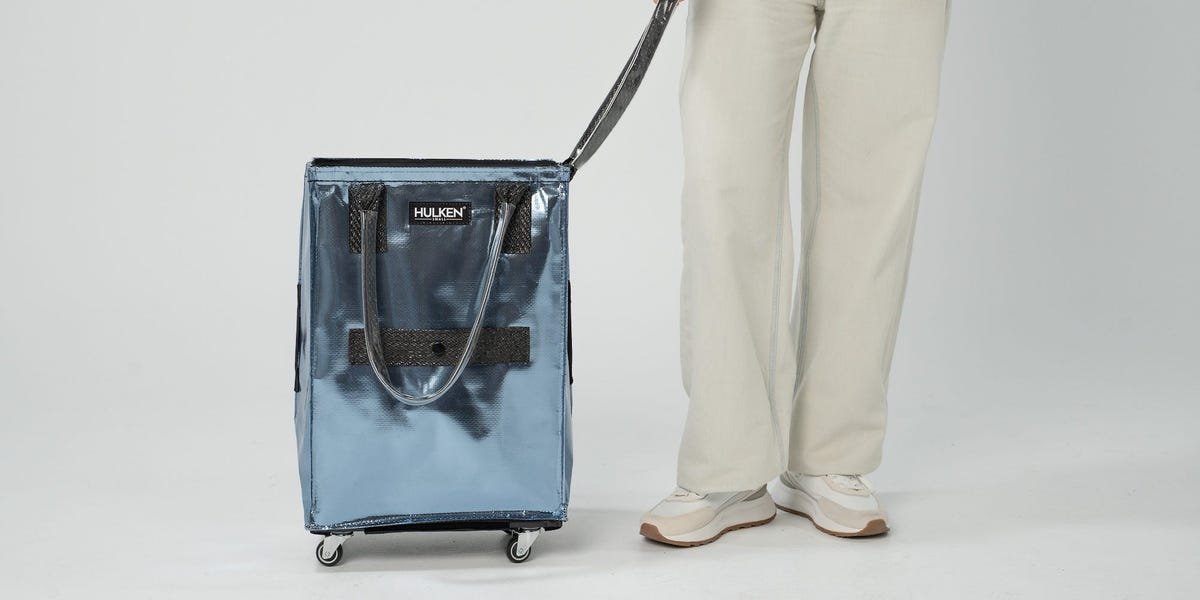
Hulken-was-once-a-sign-of-success-for-entrepreneurs-Now.jpeg

Hulken was once a sign of success for entrepreneurs. Now, it’s coming for travelers — just don’t call it a suitcase.

If you’ve been out and about in New York City, chances are you’ve seen a Hulken.

The boxy, tote-on-wheels bags have quickly become the modern, sexier version of a granny shopping cart. Gen Z has embraced the bags — which range in color from trendy chocolate browns to spunky pinks and are made of a durable, water-resistant plastic — as the new hot way to schlep more chic-ly.

I have to admit that I did not have such a fond first experience with the bags after receiving a large one at a 2024 event. It was the biggest goodie bag I’d ever received, and it completely overwhelmed me. I did not realize then that the massive metallic magenta block taking up what felt like half of my Brooklyn bedroom could fold down.

That foldable design feature is intentional, especially “to really allow for that urban living situation,” cofounder and president Alex Schinasi told Business Insider.

Despite my initial reactions, those who know, know: Hulkens are quasi-status symbols for entrepreneurs and creative industry professionals; a sign of success. It felt like “if you had a full Hulken of packages [to bring to] the post office, you were a successful entrepreneur,” Schinasi remembered. A filled-up medium Hulken of orders? Flex. A large one filled to the brim? An even bigger one.

After capturing the hearts and tired arms of many, Hulken is now trying to prove it’s more than a one-product hit, expanding into travel, experimenting with new materials, and eyeing retail and design partnerships — all while navigating rising costs from tariffs and global supply chain disruptions.

Professionals gravitated toward Hulken

Much of that growth has been fueled by how specific professional communities have adopted the bags for work.

“The first two years of Hulken we were seeing all these professional niches that are very active on social media use it as a work expense, so they would get a Hulken, not for their laundry or groceries, but to transport their gear to and from set,” Schinasi said, listing makeup artists, hair stylists, and prop stylists as a few professionals she’s seen loving their Hulkens online.

A-list celebrities have also made their fandom known, like Kourtney and Kim Kardashian.


A model lugging a chocolate brown Hulken

Hulken’s fan base includes entrepreneurs, creative professionals, and celebrities such as Kim Kardashian. 

Hulken


Schinasi and her drummer husband, Yoni Sheleg, co-founded Hulken as a Shopify site in 2018. When the pandemic set in and Sheleg’s gigs mellowed, they hunkered down and focused on sharpening the product and the brand, and eventually marketing it. But it was Schinasi’s dad, a bag manufacturing executive, who was responsible for the tote’s design.

“He was actually shopping in Paris and not really knowing how to carry all his bags, and thinking, ‘Oh my God, I need a solution for stuffing all this stuff,'” Schinasi said.

He’d eventually go on to create the prototype for the bag that ultimately became the brand’s best-known Rolling Tote.

As outrageous as the Hulken might look at first glance, the functional item is inseparable from a fashion feel. Its sleek look, color variety, and matte options help. So does the expertise from Kathleen Scully, Hulken’s director of product design. She spent more than four years as a senior luggage designer at Louis Vuitton. Her prowess helped Hulken win the Accessories Council 2025 Design Excellence Award for Tech and Innovation, beating luxury brands like Canada Goose and Moncler Lunettes.

After all, Schinasi said, the point of Hulken is that it’s a “product that obviously has a utility component, but very much without compromising on looking stylish and being beautiful and fashionable.”

The intentionally-designed product resulted in Hulken’s sales surging in recent years, growing from about $390,000 in 2020 to $29 million in 2024, with the company projecting as much as $50 million in revenue last year.

Hulken takes on travel

Years later, I gave these schlep-ready bags a second chance, and they’ve proven their worth. I found that my Hulken, a midnight blue medium roller with a 60-liter capacity, works best when it’s weighed down. If it’s not filled by much, it’ll flip and flop around, likely nicking the back of your foot in a way that’s bound to drive you crazy.

While I still don’t think it’s realistic for a Hulken to become my new go-to, I’m inclined to keep these colorful granny carts handy at home the same way I keep a foldable tote in my work bag. For days when I’m embarking on a journey of errands — like doing laundry, dropping off clothes at the thrift store, then getting groceries — a Hulken offers a smooth ride along the way.

Ahead, Schinasi plans to keep innovating materials that the classic Hulken can be made of, though the cofounder wouldn’t hint at what’s on the docket. Its matte version, for example, has already proven successful with customers who want something less flashy.


A woman carrying a Hulken travel tote on an airport escalator.

Hulken is now expanding into travel with a phased rollout that started in August 2025. 

Hulken


Hulken has also been eyeing travelers, too. The brand debuted a carry-on-size bag, which Schinasi deliberately calls a travel tote instead of a suitcase, in August 2025, part of a phased rollout.

“Travel hasn’t really been reinvented, as far as suitcases go. We call ourselves a travel tote because it is that tote that you have at your side at the airport,” she added.

The Travel Rolling Tote retails for $125, almost the same as the brand’s signature tote-on-wheels. It’s often sold out, but for Schinasi, whose background is in tech, that’s OK for the rollout. “I like to be able to start small and kind of grow from there to once I can validate the demand first,” she explained.

Schinasi plans to keep iterating in the travel category, and the cofounder teases designer collaborations may be on the way, in addition to retailer partnerships that’ll be revealed by the end of 2026.

With a solid hero product, Schinasi is currently focused on navigating the turmoil of running a business under Trump’s tariffs. Like many brands, this leaves her to solve a complex pricing calculus that protects the brand’s margins without shocking consumers, ideally raising prices as little as possible.

The war with Iran has been the latest blow to solving that tricky equation. “That’s kind of the flip side of running a flashy DTC brand. [Our] supply chain is being fragmented. Is the supply of material going to suffer from the rising oil prices? All of our shipping has to be rethought, and we have deadlines to meet. We have commitments with retailers and partners,” Schinasi said.

However it pans out, Schinasi isn’t giving up on her mission to make schlepping easier and more chic.



Source link

Bryan Metzger

Trump says his call for a 10% credit card cap sounds like Zohran Mamdani’s idea

President Donald Trump knows he’s aligning himself with the progressive left when it comes to credit cards.

During an interview with CNBC’s Joe Kernen in Davos on Wednesday, Trump acknowledged that his call for a 10% cap on credit card interest rates isn’t a standard conservative policy.

In fact, he joked that it’s something that New York City Mayor Zohran Mamdani, a Democratic socialist, might have come up with.

“I know it’s sort of like… it sounds like the mayor of New York maybe came up with that,” Trump said with a laugh.

Following Mamdani’s election in November, the two met in the Oval Office and appeared to share some common ground in remarks to the press afterwards.

“I’m conservative, but I think I’m common sense, you know?” Trump said on Wednesday. “People say, ‘Are you a conservative?’ I say, ‘Yeah, but I’m a common-sense person.’ I mean, I do things that aren’t necessarily that conservative sometimes.”

Trump said he respected credit card companies but that consumers can’t afford to pay high rates.

“Whatever happened to usury? They can’t pay 28%,” Trump said.

Earlier on Wednesday, Trump called on Congress to pass a bill capping credit card interest rates at 10% for one year.

Key Republicans in Congress have been cool to that idea, with House Speaker Mike Johnson telling reporters last week that Trump “probably had not thought through” the potential downsides of the policy and that credit card companies may “just stop lending money” or “cap what people are able to borrow at a very low amount.”

Many business leaders have also been critical of the idea.

Yet Trump’s call has also been met with agreement from some progressives, including Sen. Elizabeth Warren of Massachusetts, whom Trump called last week.

In Congress, Independent Sen. Bernie Sanders of Vermont and Republican Sen. Josh Hawley of Missouri have introduced a bill that would do just what Trump said, capping credit card rates at 10% for a year.


Source link

Peter Kafka

Donald Trump’s shadow hangs over the call to kill a ’60 Minutes’ story

Ever since Bari Weiss arrived as the head of CBS News, people inside and outside the company have been waiting to see whether her politics — and those of CBS owner David Ellison — would show up in the journalism.

This weekend, they may have gotten their answer. Or they may not have.

And that uncertainty is the problem.

It’s possible Weiss had legitimate editorial concerns about a “60 Minutes” segment on the Trump administration’s use of El Salvador’s notorious CECOT prison. CBS pulled the segment abruptly before it was scheduled to air on Sunday evening. News organizations do periodically delay or spike stories.

But the reported details around this decision make it hard to take the explanation entirely at face value. And Weiss’s position — and the politics surrounding her appointment — mean that editorial calls like this one will always be read for hints of political bias.

The segment, reported by Sharyn Alfonsi, had been promoted by CBS ahead of Sunday’s broadcast and, according to multiple accounts, had cleared the network’s standard internal processes. A few hours before airtime, CBS News announced that the segment needed additional reporting and editorial work.

Alfonsi saw it differently.

“In my view, pulling it now — after every rigorous internal check has been met is not an editorial decision, it is a political one,” she wrote in a note to her co-workers. “We are trading 50 years of ‘Gold Standard’ reputation for a single week of political quiet.”

Weiss, meanwhile, told her staff Monday morning that she held the story because “it did not advance the ball,” and because it didn’t include on-camera comment from the Trump administration, which had sent hundreds of Venezuelans to the prison, where many were reportedly tortured. She had previously sent a memo to “60 Minutes” producers complaining that the report they’d made didn’t provide viewers with “the full context they need to assess the story.”

There are two big problems with those arguments: 1) Making them so late in the process of a long-running investigation, shortly before the air date, is guaranteed to raise eyebrows. And 2) arguing that a story about the Trump administration can’t air without on-camera participation from the Trump administration leads to a chilling endpoint: If the Trump administration doesn’t want a story to run on “60 Minutes,” it can kill it by not showing up on camera.

Now, add in the environment Weiss stepped into. She arrived at CBS News through a deal engineered by Paramount’s owners, the Ellison family, at a moment when the Ellison family is deeply enmeshed with the Trump administration.

David Ellison’s father, Larry, who funded his son’s acquisition of Paramount, controls Oracle — which just got approval to acquire part of the US operations of TikTok, in a deal the Trump administration negotiated with the Chinese government. And the Ellisons are also trying to get Trump to favor their bid to buy Warner Bros. Discovery — a deal that would require approval from the Trump-controlled Department of Justice, as well as other regulators.

Trump, meanwhile, has already been complaining about “60 Minutes” under Ellison’s ownership. “For those people that think I am close with the new owners of CBS, please understand that 60 Minutes has treated me far worse since the so-called ‘takeover,’ than they have ever treated me before,” he posted on his Truth Social platform last week.

None of which proves that politics drove Weiss’ decision. And it’s understandable if the way “60 Minutes” used to work isn’t the way Weiss wants it to work — she’s the new boss, and she has spent much of her career complaining about big media institutions like “60 Minutes.”

But it explains why people are wondering if Weiss’ call was directly, or indirectly, influenced by her owner and his political status. I’ve asked Weiss for comment; a Paramount rep declined to comment.

What we do know is this: The decision was made inside a system where the people who own the newsroom need things from a president who wants leverage over the press.

In that world, suspicion isn’t paranoia. It’s a rational response to how power works. And it’s not something Weiss can fix, explain away, or out-communicate.


Source link