

NTSB-is-investigating-Air-Canada-crash-but-TSA-lines-hindered.jpeg

NTSB is investigating Air Canada crash, but TSA lines hindered an investigator’s arrival at LGA, chair says

The National Transportation Safety Board is investigating the Air Canada crash that killed two pilots at LaGuardia on Sunday, but other air travel issues are causing delays.

Jennifer Homendy, chair of the NTSB, said on Monday that one investigator brought in to investigate the deadly crash was stuck in the TSA line at an airport in Houston for hours.

“Our air traffic control specialist was in line with TSA for three hours until we called in Houston to beg to see if we can get her through so we can get her here,” Homendy said during a press conference.

A combination of TSA delays, Newark’s temporary ground stop, and the collision that caused LaGuardia to temporarily close made it “a really big challenge” to quickly assemble the full team in New York. The team assembled by plane, train, and automobile to reach the investigation site.

“Right up until about, I think the latest I saw was midnight, maybe 1 a.m. tomorrow morning,” she said. “So it is a long travel day for many of those.”

On Sunday, an Air Canada regional jet collided with a ground vehicle

As of Monday evening, one runway remains closed at LGA due to the wreckage and investigation needs.

Homendy said there isn’t yet much information she can provide, since the NTSB is still collecting data and conducting interviews.

Flight data shows the incident that took place late Sunday night involved Flight AC8646, a CRJ-900 operated by Jazz Aviation as Air Canada Express, which departed Montreal at about 10:35 p.m. ET and landed at LaGuardia around 11:37 p.m. ET.

Within a minute, emergency responders were alerted to a collision between the aircraft and a Port Authority rescue vehicle on the runway. Air traffic control audio captured a controller urgently warning the truck to stop moments before impact. The airport was officially closed at 3:16 a.m. ET on Monday, based on federal alerts.

By early Monday, officials confirmed the two pilots had died. The fire truck involved had been responding to a separate aircraft issue, and two officers aboard it were taken to the hospital with non-life-threatening injuries. In total, 41 people were taken to hospitals, most of whom were later released.

Homendy said the aircraft’s “black boxes” — which are actually orange and include cockpit audio and flight data leading up to the collision — have been retrieved and sent to the NTSB lab in Washington, DC, for review.

Operations at LaGuardia resumed gradually on Monday. One runway, Runway 13/31, reopened by midafternoon while the incident runway, Runway 4/22, remained closed due to the wreckage.

Homendy said it could take “days” to clear the plane, adding there was a lot of debris.

The disruption rippled across the air travel system that is already under strain due to the partial government shutdown. About 600 flights were canceled due to the crash, and Delta Air Lines temporarily suspended service from LaGuardia Airport. Officials warned travelers to expect continued delays and cancellations.

The National Transportation Safety Board has launched an investigation, with federal officials on-site.



Source link

Trump-threatens-to-block-the-opening-of-a-bridge-between.jpeg

Trump threatens to block the opening of a bridge between Ontario and Michigan in ongoing spat with Canada

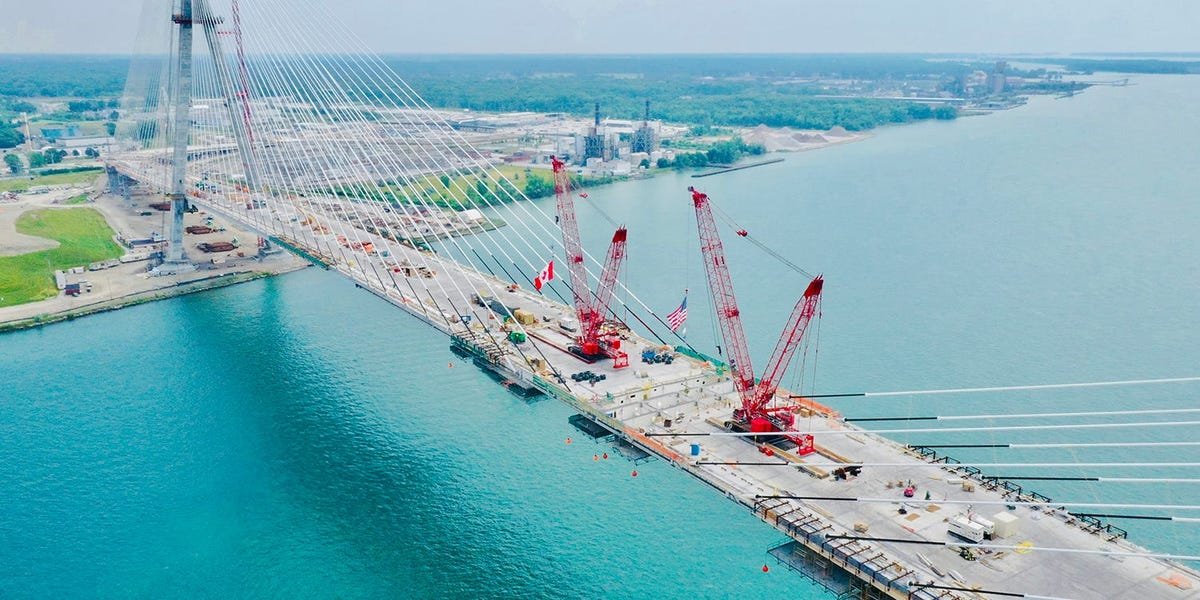
President Donald Trump is threatening to block the opening of the Gordie Howe International Bridge, a long-awaited new border crossing between Windsor, Ontario, and Detroit, Michigan.

In a Truth Social post on Monday, Trump said he would not allow the bridge to open until the US is “fully compensated for everything we have given them,” adding that Canada must treat the United States with what he described as “fairness and respect.”

“We will start negotiations, IMMEDIATELY. With all that we have given them, we should own, perhaps, at least one half of this asset,” Trump added.

The Gordie Howe International Bridge is expected to be completed in early 2026 and has been under construction since 2018. The $6.4 billion project is entirely funded by Canada’s Federal government, and will feature six lanes and a pedestrian and cycling path.

The University of Windsor’s Cross-Border Institute estimated in a 2021 study that the new route will save about 850,000 hours a year for trucks, which would mean billions of dollars in savings over the bridge’s lifetime. The study also found that the Windsor-Detroit corridor is the largest pathway for trade between the US and Canada.

Trump’s remarks mark the latest escalation in tensions with Canada, a key US trading partner, as the president steps up his criticism of the country.

In recent weeks, Trump has threatened to slap a 100% tariff on Canadian goods if Ottawa moves forward with a trade deal with China.

He also bristled at comments made by Canadian Prime Minister Mark Carney at the World Economic Forum in Davos, which were widely seen as an implicit rebuke of Trump’s foreign and economic policies. In January, Trump also warned that he could impose a 50% tariff on aircraft manufactured in Canada and revoke certification for newly produced planes.

The White House and the Ontario Premier’s office did not immediately respond to a request for comment.


Source link

Nathan Rennolds

Trump threatens Canada with 100% tariffs over Beijing trade deal: ‘China will eat Canada alive’

President Donald Trump on Saturday threatened to impose 100% tariffs on all Canadian goods and products exported to the US should Ottawa make a trade deal with China.

In a post on Truth Social, Trump warned Canadian Prime Minister Mark Carney, whom he called “Governor Carney,” against making a “drop off” deal with Beijing or face the levies.

“If Governor Carney thinks he is going to make Canada a ‘Drop Off Port’ for China to send goods and products into the United States, he is sorely mistaken,” Trump wrote.

“China will eat Canada alive, completely devour it, including the destruction of their businesses, social fabric, and general way of life,” he added.

Carney made an official visit to China last week — the first by a Canadian leader since 2017 — meeting with Chinese leader Xi Jinping to discuss economic and trade opportunities between the two countries.

In a joint statement following the meeting, Ottawa and Beijing said they had committed to expanding bilateral trade and investment, as well as building cooperation in areas such as energy and agriculture.

Carney also announced that Canada would now allow up to 49,000 Chinese electric vehicles into the Canadian market on the “most-favoured-nation tariff rate of 6.1%.” In return, he said Canada expected China to lower tariffs on Canadian canola seed to around 15% by March 1.

Trump had initially said that the deal was what Carney “should be doing” and that it was “a good thing for him to sign a trade deal.”

Trump’s changing tone comes days after Carney delivered an impassioned speech at the World Economic Forum in Davos, where he opined on the changing face of global politics since Trump’s election.

“We are in the midst of a rupture, not a transition,” Carney, who did not explicitly name Trump, said, adding that “middle powers must act together because if we’re not at the table, we’re on the menu.”

Trump did not miss the opportunity to snap back at Carney during his own speech at Davos, saying the prime minister “wasn’t so grateful.”

“Canada lives because of the United States. Remember that, Mark, the next time you make your statements,” he added.


Source link

Charissa Cheong

I moved to Canada, but it wasn’t for me. I was cold, isolated, and finding a job was absolutely horrendous.

This as-told-to essay is based on a conversation with Zina Malas, 24, who lives in Beirut. The following has been edited for length and clarity.

When I visited Canada as a 5-year-old, it was the dream.

I was born and raised in Lebanon, and grew up fearing I’d get kidnapped in the streets or a random bomb would fall on me. After war broke out in 2006, our family moved to Canada to escape.

I loved it. There were nice parks, and exotic” activities like ice skating.

After a few months, my family went back to Lebanon, where I did my undergrad.


Zina Malas as a child, wearing a big coat and gloves outside in the snow in Canada.

Malas loved living in Canada as a child.

Courtesy of Zina Malas


In 2022, at 21, I moved to Canada alone.

Three years in, I had struggled to find a job or save money, and began feeling very depressed, so I moved back to Lebanon.

I’d still advise others to try relocating abroad, but living in Canada just didn’t work for me.

I grew desperate to leave Lebanon

Living in Lebanon was a struggle. I felt like I’d lost my youth and was desperate to leave, even if I had to work a minimum wage job.

My time spent studying media and communication at the American University of Beirut was disrupted by a national revolution that started in fall 2019, COVID, and the Beirut explosion in August 2020.

I already had friends in Montreal and Canadian citizenship through one of my parents, so I headed to Canada and gave myself three months to find a job.

I didn’t realize how difficult it would be to find a job in Canada

Even though my Montreal friends warned me that finding a job wouldn’t be easy, I didn’t think it would be that hard.

They were right. It was absolutely horrendous.

In Lebanon, where I had some jobs during my studies, I experienced less competition for work. I was used to sending my application to a potential employer, DM’ing the company on Instagram, and having an interview the next day. But in Canada, I applied for roles across marketing, social media, and business development, which I felt I had the skills for, but didn’t land any.

Some recruiters told me I didn’t have the right experience. I’m not sure if it was because my experience was Lebanese or not Canadian, but it felt like people were treating me like I had no professional history.


Malas taking a mirror selfie

Job hunting was difficult for Malas.

Courtesy of Zina Malas


I also struggled to understand interviewers who spoke Québécois French, a dialect used in Montreal. I went to a French school in Lebanon, so I’m fluent, but I couldn’t for the life of me understand this particular accent, which lost me opportunities.

After applying for what I’d estimate were at least 200 jobs, I connected with a Lebanese HR rep who saw my résumé and gave me the chance to interview for a content manager role. After roughly three months of searching, it became my first job in Canada.

I stayed at the company for 1.5 years, and then moved into tech sales at a different company for a few months.

The cost of living and isolation in Canada drove me to leave

In Lebanon, the work culture was generally less formal. I could show up late to work in a random outfit and no one would say anything. We could have disorganized files and communicate with team members over Whatsapp. It was friendly and laid-back.

In Canada, things were more organized. I knew exactly what my tasks were, and was given proper equipment. I remember being shocked when I was given a MacBook and phone number for work.

My compensation in Canada was good compared with what I could make in Lebanon. I had a nice life, a nice apartment, and ate well. But with the cost of rent, bills, and groceries, I feel like I wasn’t saving much, and was basically living paycheck to paycheck. It’s one of the reasons I left.


Malas walking in throuhg a field on a sunny day, wearing a blue hat.

Malas struggled to make new friends in Canada.

Courtesy of Zina Malas


Another reason was how hard it was to meet new people, and my mental health suffered as a result. Canadian culture is highly individualistic, which is hugely different to the Middle East. In Lebanon, if I go out with one friend to a restaurant, I’ll end up meeting 10 new people. If I tried to talk to people in Canada while I was out, conversations would end abruptly. If my roommate didn’t have friends, with whom I was thankfully able to have a lot of fun, I probably would have been completely alone.

I imagined I’d meet so many new people and have the time of my life, but my expectations weren’t met. Plus, I couldn’t deal with the cold weather.

In September 2025, I went home.

I’m running my own business in Lebanon now, and I’m happier

I’m currently running my own company, Tawlé Consultancy, which helps businesses in the MENA region who are declining or feel stuck. I started it in Canada, but working on it from the West felt weird, as though I was righteously telling people what to do from a distance. Now, I can sit with people, help them come up with new ideas, and feel like I’m making a valuable impact.


Zina Malas

Malas runs her own company in Lebanon

Courtesy of Zina Malas


I’ve noticed many people my age in Lebanon are also trying to build their own thing. Our generation has been through a lot, and we’re trying to figure things out and establish ourselves. When I go to coffee shops, I see so many founders around me. It’s very inspiring.

Being in a stable country like Canada eased my mind, as I wasn’t worried about my physical safety, and it helped me deal with the trauma I experienced in Lebanon.

But I’m happier living in Lebanon. I’ve realized I’m too Lebanese to live anywhere else.

Do you have a story to share about moving abroad and deciding to come home again? Contact this reporter at ccheong@businessinsider.com


Source link