Soaring-gas-prices-convinced-me-to-switch-over-to-Costcos.jpeg

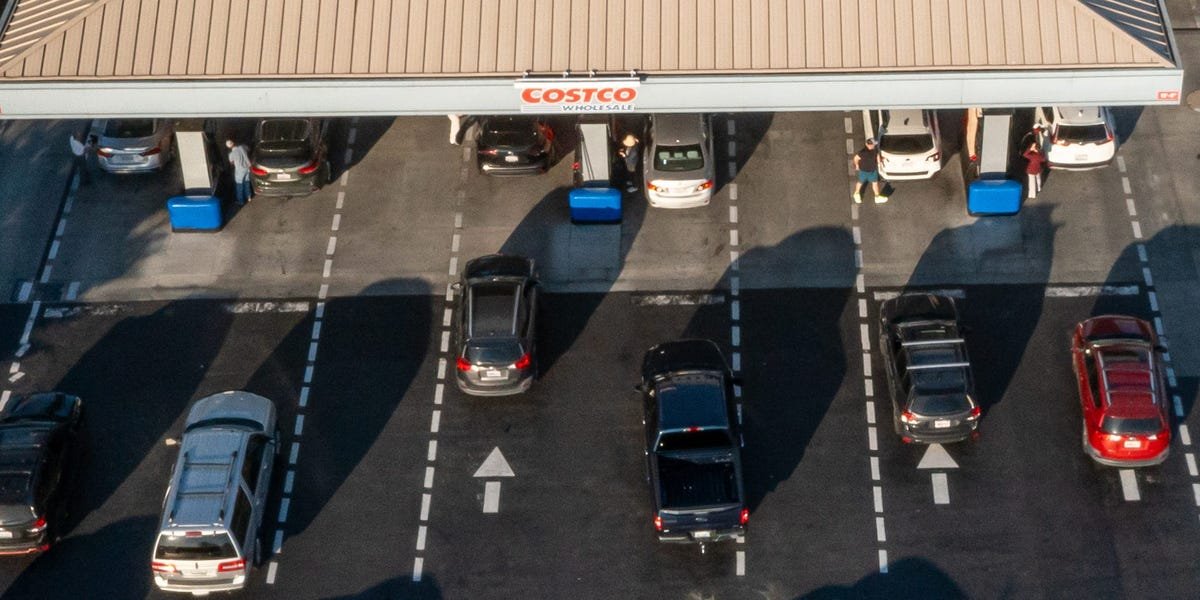
Soaring gas prices convinced me to switch over to Costco’s credit card

When the US and Israel launched the war with Iran and sent the oil market into a frenzy, I figured it would be fair to assume gas prices wouldn’t be coming down anytime soon.

I’ve since become sufficiently convinced of this that I decided to completely shake up the cards in my wallet in recent weeks.

According to AAA, the US average gas price is now around $4.15 per gallon, up more than $0.60 from last month and up nearly $1 from a year ago. That’s no small change.

Gas prices tend to be somewhat lower where I live in Wisconsin compared to the national average, but it has been pretty clear to me that an extended stretch of $4 gas was a strong possibility.

As Business Insider’s retail reporter, I’m well aware of the discounts that wholesale clubs and other loyalty programs offer on gas. I did the math and found that Costco’s gas pricing can more than offset the membership fee.

After that analysis, I got a bit fixated on proactively getting gas from Costco rather than whatever station happened to be closest when my tank was running low.

Prices also began to rise sharply, making the membership advantage clearer. Costco chief financial officer Gary Millerchip seemed to be reading my mind on the company’s earnings call last month.

“When prices are higher, that will tend to cause members to maybe take the extra mile that it might be involved to get to the gas station because of the incremental value they see there,” he said.

Touché, Millerchip.

Still, I knew I was leaving money on the proverbial table.

The thing is, I was already using one of the best fuel and grocery rewards credit cards out there — the Blue Cash Preferred from American Express — but Costco famously (and frustratingly) does not accept AmEx.

That meant I had to pick between Costco’s prices and AmEx’s rewards. I was also using the Chase Sapphire card for rewards in other categories, like dining and travel.

I had considered the Costco Anywhere card before, but dismissed it since it didn’t seem much better than what I already had in my wallet, based on reviews I read from my Business Insider colleagues, NerdWallet, and several finance-focused Reddit communities.

Prolonged high gas prices change the math on rewards

What changed my mind was the prospect that gas could spiral toward $5, making the Costco card’s 5% reward on gas worth more than $0.20 per gallon, which is typically priced $0.20 or more below the traditional retail market. That would work out to a combined savings of about 10% by my math.

I don’t drive a lot of miles, but I also don’t like to pay more than I have to for gas. Plus, the other rewards categories were reasonably similar to those on my other cards, so I decided to consolidate my spending from the two cards onto the Costco card alone.

(I also like the idea of paying fewer annual membership fees, though the rewards from the Blue Cash and the Sapphire more than paid for themselves. We’ll have to see how this year’s fee and rewards math ends up comparing to last year.)

This isn’t intended to be a Costco-only hype session. Walmart-owned Sam’s Club offers low-priced gas and a credit card with a rewards structure very similar to Costco’s, but Sam’s doesn’t have any clubs near me.

In addition, Walmart’s Plus membership offers a $0.10 per gallon discount at thousands of stations across the US, and several major gas brands and grocery chains have their own loyalty programs that could be worth exploring based on your personal needs and habits.

The larger point is that gas rewards didn’t really grab my attention back when prices were relatively low and steady. Now that things are more uncertain, they’re worth a second look.



Source link

Paul Squire Headshot

Logan Paul’s Pokémon card investment pays off; he just sold it for millions in profit

Logan Paul just made millions off a Pokémon card.

The influencer turned wrestler sold his one-of-one Pikachu Illustrator card — one of 41 ever distributed and the only one graded the highest quality by collectibles company PSA — at auction Monday for a jaw-dropping $16.492 million.

The winner? AJ Scaramucci, the founder of venture capital firm Solari Capital and the son of former White House communications director Anthony Scaramucci.

Scaramucci appeared on Logan Paul’s livestream early Monday after auction house Goldin announced him the winning bidder in the auction, which closed at 1:14 am ET.

“My ambition for the card is just a small story,” Scaramucci said at the event. “The real story is that I’m on a planetary treasure hunt. I’m planning to buy a T. rex dinosaur fossil, the Declaration of Independence, and I’m not stopping there. This is only the beginning.”

“You’re just starting?” Paul replied. “Bro. Bro, that is so epic.”

Paul also used the livestream to open packs of Pokémon cards and announce RipIt, a new collectibles business he’s launching.


This Pikachu illustrator Pokémon card set a new record for the most expensive Pokémon card sold privately.

This Pikachu illustrator Pokémon card set a record for the most expensive Pokémon card sold privately.

Goldin


In a statement, Goldin described the Pokémon card, which was originally given to winners of an illustration competition in Japan, as “one of the Holy Grails of the collectibles industry.”

Paul previously set the world record back in July 2021 when he purchased the same card for $5.275 million, meaning he will make millions in profit.

The card also came with a diamond-encrusted chain appraised at $75,000, Goldin said. Paul wore the card during his WWE debut at WrestleMania 38 in 2022.

In an Instagram post on Saturday, Paul bid farewell to the card.

“Goodbye my friend 😢 What a privilege it’s been to be the owner of the greatest collectible in the world,” he wrote.

The markets for Pokémon cards, along with other collectible card sets like Magic: The Gathering and Yu-Gi-Oh!, have become huge in recent years among collectors — especially Gen Z — with the rarest cards selling for tens of thousands of dollars, if not more.

Some people are even forgoing stocks and investing in Pokémon cards instead.


Source link

A woman in glasses wearing a blue dress standing in front of a bush.

I found dozens of recurring charges on my credit card. I had been wasting $1,600 a year on subscriptions I didn’t even use.

My 17-year-old daughter told me that she’d been offered a special deal at the Verizon store: access to Apple Music for up to six people for $10 a month. She was desperate to take advantage of the promotion and said the streaming service had an amazing selection of songs.

I said no, not only because we have Spotify, but also because I’d had a rude awakening after New Year’s.

My husband and I were worried about how much we were charging to our credit cards, especially during the holiday period.

We decided to do a financial tune-up, and I was responsible for reviewing the Mastercard statement. We only used it as a secondary payment method if a merchant didn’t accept American Express.

I thought I’d been subject to fraud

As a result, I rarely looked at the bill. This time, however, I printed the statement covering November 11 to December 12, 2025, when we did most of our Christmas shopping.

There were a few transactions for items like coffee at a little café that doesn’t take Amex and some co-pays for doctors’ visits, but there were others I didn’t recognize.

What on earth was Uexton? I’d paid them $19.99 on November 11. Then there was Sportelx, to whom I’d paid $29.55 on November 21. I’d never heard of it.

I Googled to find that Uxeton was a gaming website and Sportelx was a sports news service.

I’d been a victim of fraud on several occasions, and assumed it had happened again.


Subscription mailers

The author accidentally signed up for services she never used.

Lam Kraker/Business Insider


Then, I looked over the rest of the bill and saw payments of $29.99 to ESPN New York, $14.99 to Canva, and $11.95 to Audiobookstore.com. As far as I was concerned, neither my husband, kids, nor I had used any of them.

There was also a $25 fee to Rockin’ Jump, where my son went once a week before getting too old for a trampoline park. Why were we still paying for his membership?

I reviewed the last two months’ statements and realized the suspicious payments had occurred before, on the same day each month.

It wasn’t fraud. The recurring fees were subscriptions we’d signed up for before switching banks and credit cards. Some went back years. We had failed to cancel Rockin’ Jump. I didn’t know how the rest had come about.

Over the next few hours, I racked my brains trying to figure out where they came from. The only thing I could think of was that my spouse or I must have shared our credit card information at some point to get a trial subscription.

We’d wasted almost $1,600 annually

We must have forgotten to cancel at the end of the free or discounted period. The total of our unnecessary payments was $131.88 a month, the equivalent of a family cellphone plan.

Over the years, I calculated that we’d spent almost $1,600 annually on streaming and other services we didn’t touch. It was hard to blame the companies that use subscription models when I had been the one to drop the ball. I felt dumb and ashamed.

I sprang into action, canceling as many fees as I could. In most cases, I found it much more difficult to unsubscribe than to subscribe because of the hoops you have to jump through.

Still, the experience taught me a lesson. It’s no thank you to tempting — but ultimately useless — offers from now on.


Source link

Bryan Metzger

Trump says his call for a 10% credit card cap sounds like Zohran Mamdani’s idea

President Donald Trump knows he’s aligning himself with the progressive left when it comes to credit cards.

During an interview with CNBC’s Joe Kernen in Davos on Wednesday, Trump acknowledged that his call for a 10% cap on credit card interest rates isn’t a standard conservative policy.

In fact, he joked that it’s something that New York City Mayor Zohran Mamdani, a Democratic socialist, might have come up with.

“I know it’s sort of like… it sounds like the mayor of New York maybe came up with that,” Trump said with a laugh.

Following Mamdani’s election in November, the two met in the Oval Office and appeared to share some common ground in remarks to the press afterwards.

“I’m conservative, but I think I’m common sense, you know?” Trump said on Wednesday. “People say, ‘Are you a conservative?’ I say, ‘Yeah, but I’m a common-sense person.’ I mean, I do things that aren’t necessarily that conservative sometimes.”

Trump said he respected credit card companies but that consumers can’t afford to pay high rates.

“Whatever happened to usury? They can’t pay 28%,” Trump said.

Earlier on Wednesday, Trump called on Congress to pass a bill capping credit card interest rates at 10% for one year.

Key Republicans in Congress have been cool to that idea, with House Speaker Mike Johnson telling reporters last week that Trump “probably had not thought through” the potential downsides of the policy and that credit card companies may “just stop lending money” or “cap what people are able to borrow at a very low amount.”

Many business leaders have also been critical of the idea.

Yet Trump’s call has also been met with agreement from some progressives, including Sen. Elizabeth Warren of Massachusetts, whom Trump called last week.

In Congress, Independent Sen. Bernie Sanders of Vermont and Republican Sen. Josh Hawley of Missouri have introduced a bill that would do just what Trump said, capping credit card rates at 10% for a year.


Source link

Earnings-season-is-here-and-theres-one-big-wild-card.jpeg

Earnings season is here, and there’s one big wild card

Do you enjoy sorting through numbers and executives answering questions with lots of spin? If so, you’re in for a treat.

Earnings season is back, and the big banks kick things off. JPMorgan leads the way on Tuesday, followed by Bank of America and Citi on Wednesday. Goldman Sachs and Morgan Stanley bring us home on Thursday.

BI’s Reed Alexander previews the four biggest things to watch from Wall Street this earnings season. From dealmaking’s rebound to credit risks to AI (of course), there’s a lot to unpack this week.

Banks are a valuable group to open with. Their lending and dealmaking capabilities, coupled with their deep ties to consumers, put them at the epicenter of the business world. Their earnings reports are as much about themselves as the wider economy.

January earnings are also unique since they include a year-end recap. And what a year 2025 was …

A volatile first half was followed by stocks (including banks) hitting record highs by year-end despite ongoing talk of an AI bubble. Bank executives are likely to discuss maintaining that strong momentum in 2026.

There’s also a wild card to consider this earnings season.

President Donald Trump has made it clear he’s on a mission to address affordability, and sometimes that includes targeting specific companies.

Last week, Trump issued warnings against the defense sector and institutional investors in the residential housing market. While the threats lacked specific details, they were strong enough to catch investors’ attention.

Trump also said he’d be talking more about affordability in the coming weeks, including during his speech next week at Davos.

That could be a net positive for banks. A healthy consumer is typically good for them. But with no clarity on how Trump might approach improving affordability, it’s tough to say.

Meanwhile, other industries will need to remain on their toes in case they’re the next target on Trump’s affordability crusade. And even if they feel like the problem Trump is addressing isn’t necessarily applicable to them, the market might not care anyway.


Source link

Trump-calls-for-a-one-year-10-cap-on-credit-card.jpeg

Trump calls for a one-year 10% cap on credit card interest in a Truth Social post

  • President Donald Trump said that he was calling for a 10% cap on credit card interest for one year.
  • The President cannot unilaterally cap credit interest rates; it would require an act of Congress.
  • This week, Trump has also announced proposals to address the affordability of housing.

President Donald Trump has taken another shot at big business, this time targeting banks.

On Friday, Trump said on Truth Social that he would call for a 10% cap on credit card interest for one year.

“Please be informed that we will no longer let the American Public be ‘ripped off’ by Credit Card Companies that are charging Interest Rates of 20 to 30%, and even more, which festered unimpeded during the Sleepy Joe Biden Administration,” Trump wrote in his social media post.

“Effective January 20, 2026, I, as President of the United States, am calling for a one year cap on Credit Card Interest Rates of 10%,” he added. “Coincidentally, the January 20th date will coincide with the one year anniversary of the historic and very successful Trump Administration.”

The White House did not immediately respond to a request for comment from Business Insider. The president cannot unilaterally impose such a cap; it would require an act of Congress to advance. Similar efforts that have been advanced in Congress have yet to become law.

The announcement, made on Truth Social, is the latest in a series of swipes at big business this week.

Earlier this week, he announced that he is instructing “representatives” to buy $200 billion in mortgage bonds, aiming to lower interest rates and monthly payments. He also said he was barring “large institutional investors” from buying up single-family homes and signed an executive order that would limit defense contractors’ corporate spending.

This is a developing story. Please check back for updates.


Source link

The-Trump-administration-pauses-the-green-card-lottery-program.jpeg

The Trump administration pauses the green card lottery program

  • Homeland Security Secretary Kristi Noem said the Trump administration would pause the diversity visa lottery.
  • In an X post, she said the suspect in the Brown and MIT shootings had entered through the program.
  • The green card lottery program issues about 55,000 visas a year.

Kristi Noem, the Secretary of Homeland Security, says the Trump administration would pause the diversity visa lottery program in the wake of the Brown University and MIT shootings.

In an X post on Thursday, Noem said that the man wanted in connection to the Brown University shooting had entered the US in 2017 through the program, commonly known as the green card lottery.

She added that President Donald Trump had long opposed the lottery.

“At President Trump’s direction, I am immediately directing USCIS to pause the DV1 program to ensure no more Americans are harmed by this disastrous program,” she wrote.

The diversity visa entry program offers 55,000 visas a year to people from countries with low rates of immigration to the US. It’s a multi-step process that includes an interview and medical examination.

Valente, a Portuguese national and former Brown University student, was found dead from a self-inflicted gunshot wound in a New Hampshire storage facility, officials said in a press conference on Thursday.

In addition to killing two and wounding several others in the Brown University shooting, officials said they also believed he is connected to the killing of a Massachusetts Institute of Technology professor earlier this week.


Source link