

Alistair Barr, global tech editor of Business Insider, smiles at the camera while wearing a blue and white striped shirt.

Uber gave up on driverless cars. Now it’s paying the price.

It’s relatively easy to follow. Leading is difficult and risky. But if you take a chance and work like hell, the payoff can be huge.

Uber is learning this lesson right now as it scrambles to catch up in autonomous vehicle technology.

The ride-hailing company has recently rattled off six major deals related to autonomous technology. That shows how fast Uber is trying to move right now.

But did you know that Uber had a substantial driverless car project more than a decade ago? That’s right. It launched in early 2015 when Travis Kalanick was CEO. At the time, Uber was a real contender, racing against Waymo and Tesla.

Then, disaster struck. While testing in Arizona in 2018, an Uber driverless car, with a safety driver behind the wheel, hit and killed a pedestrian. It was the tragedy that the nascent industry had nightmares about, and it sadly came true.

By then, Kalanick had been ousted in favor of a steadier hand, CEO Dara Khosrowshahi. Khosrowshahi canceled Uber’s driverless car program and sold off the bits. At the time, this was part of making Uber a more serious company ahead of an IPO that eventually happened in 2019.

Things went pretty well for a while after that. Uber’s market share in the US steadily rose, while Lyft struggled. Healthy profitability followed, and Uber’s stock climbed strongly.

Lately, all that hard work by Waymo and Tesla has begun to pay off. Autonomous vehicles have finally gotten good. I have used Tesla’s full self-driving software regularly, and it’s incredible. Waymo’s AVs now regularly compete with Uber’s human-driven ride-hailing network for riders in San Francisco.

Investors have noticed, punishing Uber stock over the past few months for being a potential AV laggard. Tesla and Waymo are building their own autonomous ride services, which threaten Uber.

On Thursday, I asked Mark Mahaney, a top tech analyst at Evercore ISI, whether, with hindsight, Uber should have stuck with its original autonomous vehicle project all those years ago. It might not be scrambling to catch up now, in theory.

“Not a bad interpretation,” he told me. “Depends on how much conviction they had in their technology stack.”

This goes back to my original point. Eleven years ago, autonomous vehicles were not a sure thing. I rode in early Google driverless cars in 2014. They were solid, but the many edge cases were not ironed out. That led to doubts about whether this technology would ever be good enough to build a business around.

This is the very moment that true technologists with deep knowledge can make visionary bets on the future. Google and Tesla bravely stuck with AVs. They now reap the rewards by being many years ahead of the competition.

Now, Uber is left rushing to get back in the game. Just in the last two months, here’s what it announced:

  • A $1.25 billion partnership with Rivian that gives Uber access to the EV company’s future autonomous-driving technology.
  • A Zoox-Uber partnership: Zoox selected Uber as its first external rideshare partner beyond its own app.
  • A Wayve-Uber-Nissan partnership: Pilot deployment in Tokyo (late 2026) using Nissan Leaf electric vehicles powered by Wayve’s AI Driver technology.
  • A Motional (Hyundai joint venture) partnership: Uber riders in Las Vegas now have access to Motional’s IONIQ 5 robotaxi (with a safety driver), with full autonomy targeted for the end of 2026.
  • An Uber-Nvidia partnership: Uber plans to deploy a global fleet of Nvidia software-driven AVs, with initial rollout in Los Angeles and San Francisco in the first half of 2027 and scaling to 28 cities by 2028.
  • A Waabi investment: Uber participated in Waabi’s Series C with a $250 million commitment, alongside plans to deploy 25,000 Waabi-powered AVs.

In what would be the ultimate irony, there are even reports that Uber may be considering backing Kalanick’s new autonomous vehicle effort.

Actually doing fully autonomous vehicles properly and catching Tesla and Waymo at this point is a whole other thing. But Uber has clearly changed its mind about AVs.

I asked Uber’s press department about all this on Thursday. Any regrets? It did not immediately respond.

Sign up for BI’s Tech Memo newsletter here. Reach out to me via email at abarr@businessinsider.com.



Source link

Ukrainian-drone-pilot-found-hidden-Russian-depot-realized-it-was.jpeg

Ukrainian drone pilot found hidden Russian depot, realized it was filled with horses and cars

Cosmos floated his quadcopter over the ruined warehouse, guiding it through a corner of the roof where shattered metal sheets had collapsed to form a hole.

The drone pilot’s unit, the Wild Division, suspected that the building was a logistics hub for Russian soldiers, roughly 15 km, or about 9 miles, from the line of contact in southern Ukraine. These hidden locations often held ordnance or fuel stockpiles, and Cosmos’ fiber-optic drone was armed with explosives to destroy them.

Yet inside, the drone rotated its camera to reveal what looked more like a farmer’s garage: Four civilian cars, a pair of motorcycles, and two bridled horses.

“We had not expected to see this. It was unusual,” Cosmos told Business Insider, speaking on condition that he be identified only by his call sign.

“We were expecting to find some armored vehicles,” he added.

Video of the discovery went viral last week in Ukraine, as the war has increasingly seen Russian soldiers using unconventional transport tools, such as pack animals and bicycles, to conduct assaults or logistics missions. Cosmos said his drone mission was conducted in early February.

The smaller profile of a horse or civilian car might be harder for a drone to spot, though Russia’s repeated use of them has also raised questions about the viability of its tactics and whether it’s been producing enough military equipment to sustain its invasion.

Cosmos’ squad mates and officers at the Wild Division, a first-person-view drone company in the 82nd Air Assault Brigade, had seen clips of Russian soldiers riding on horses to attack Ukrainian positions before.

One famous example they remember was in Zaporizhzhia, when a Ukrainian drone crew attacked Russian infantry crossing the front lines on horseback last month.

Cosmos, who’s been piloting drones for a year, said it was the first time he’d personally seen the animals on the front lines.

He flew his explosive-laden drone straight into the back of one of the cars, and said his crew later struck several other vehicles inside. When Russian troops moved their transport assets, the Wild Division found the next warehouse and attacked that one, too, Cosmos said.

“The enemy usually lives in hiding close to these places,” Cosmos said of the warehouse. “It’s common for us to check all targets. Sometimes we can see the enemy infantry, or you can see their vehicles.”

Russia calculates war differently

The Wild Division declined to say where exactly the warehouse was located, but its brigade is generally deployed in the Donbas.

The commander of Cosmos’ battalion told Business Insider that the discovery of the horses surprised him, too.

“I thought it had been a location for transport vehicles, sort of a transfer hub,” said the major, whose call sign is Fizruk.

Fizruk said the appearance of horses and cars in his area of the front line could be a sign that Russian forces are running low on standard resources, but also reflects Moscow’s attritional nature of fighting.

The cars discovered by Cosmos appear to be Nivas, inexpensive civilian off-road vehicles from the Russian Lada car brand.

“They treat these like they will be losses anyway, that they will be destroyed anyway,” he said. “Look, a Niva costs, let’s say, $2,000. A Hummer, which the Armed Forces of Ukraine uses in many places, costs $20,000, maybe more.”

“Since they lose their equipment in assaults, from that point of view, why pay $20,000 for one vehicle if you can buy 10 Nivas for $20,000?” Fizruk added.

The Kremlin is known to pressure the front line with repeated ground assaults, sending small groups of infantry to approach Ukrainian positions on foot or in cheap vehicles. The strategy has been costly, with NATO now saying that up to 25,000 Russian troops are dying each month.

Sustaining that style of war has pushed Moscow to informal means of recruitment and weapons procurement, including hiring troops from overseas and receiving ammunition from North Korea.


Source link

Headshot of Ben Shimkus

An ‘ICE OUT Enterprise’ protest is urging Minnesota residents to book and later cancel rental cars

Enterprise is the latest company caught in the crosshairs of anti-ICE protests.

A video showing protesters lined up outside of a Minnesota Enterprise Rent-A-Car location went viral earlier this week on TikTok, part of an “Ice out Enterprise” protest campaign.

Organizers encouraged participants to disrupt Enterprise’s operations by reserving rental cars and then canceling the bookings shortly before pickup — a tactic they say is designed to draw attention and strain vehicle availability that could be utilized by Immigration and Customs Enforcement agents.

“Enterprise is renting cars to ICE agents and profiting from the violence that agents are bringing to our communities,” Minnesota organizers associated with the Sunrise Movement, a progressive climate and social justice advocacy group, posted on social media. The post asked protestors to “please be polite to employees when you contact them.”

An Enterprise employee working the counter at one of the rental car company’s Saint Paul, Minnesota, locations confirmed to Business Insider on Friday that protesters had been calling the store. The employee declined to comment further, citing the company’s media policy.

“I’ve called and told them I was disappointed that they were collaborating with ICE,” a commenter on Instagram said.

“They answered the phone super quickly,” another added. “I was told a complaint would be logged right away.”

The viral video, which was posted on Thursday, had more than 323,000 views on TikTok as of publication. It shows a line of demonstrators holding signs reading “No cars for ICE” and “Cancel ICE contracts now.”

It’s unclear if Enterprise has any contract with ICE. Enterprise did not respond to a request for comment from Business Insider.

The effort is part of a “week of actions” in Minnesota leading up to a “business blackout” on Friday to protest ICE’s presence in the state. The Sunrise and Sunrise Twin Cities groups didn’t respond to requests for comment from Business Insider.

The video has also drawn reactions from conservative commentators on X.

“Anti-ICE leftists are now booking and canceling car reservations at Enterprise to protest them renting cars to ICE,” wrote Chaya Raichik, who operates the popular Libs of TikTik account on X, in a post with more than 208,000 views.

White House spokesperson Abigail Jackson told Business Insider in a statement that “dangerous” protest efforts had led to a rise in violence against ICE officers. “ICE officers act heroically to enforce the law and protect American communities with the utmost professionalism,” she said.

Enterprise is the latest major corporation to face consumer pressure as immigration enforcement activity in Minnesota has drawn widespread protest.

Earlier this month, Hilton removed a franchisee from its portfolio after a video that purported to show a hotel employee refusing to provide immigration enforcement officers rooms.

In a statement, the hotel chain criticized the operator and said its corporate policy was to make all locations “a welcoming place for all” and that it does “not discriminate against any individuals or agencies.”

Minneapolis-based Target has also faced heat from activists who accused the retailer of cooperating with immigration officials. The retailer denied those claims an internal memo obtained by Business Insider.

“Target does not have cooperative agreements with any immigration enforcement agency,” human resources chief Melissa Kremer wrote to employees. “We’re listening and working to de-escalate where possible.”

Enterprise, which runs around two dozen locations in the Twin Cities, is still facing calls from Minnesota-based protestors.


Source link

This-company-gives-away-free-trips-and-luxury-cars-to.jpeg

This company gives away free trips and luxury cars to its top employees every year

Companies are getting creative with rewarding standout workers, but few are giving out $170,000 luxury cars or cruises to the Bahamas.

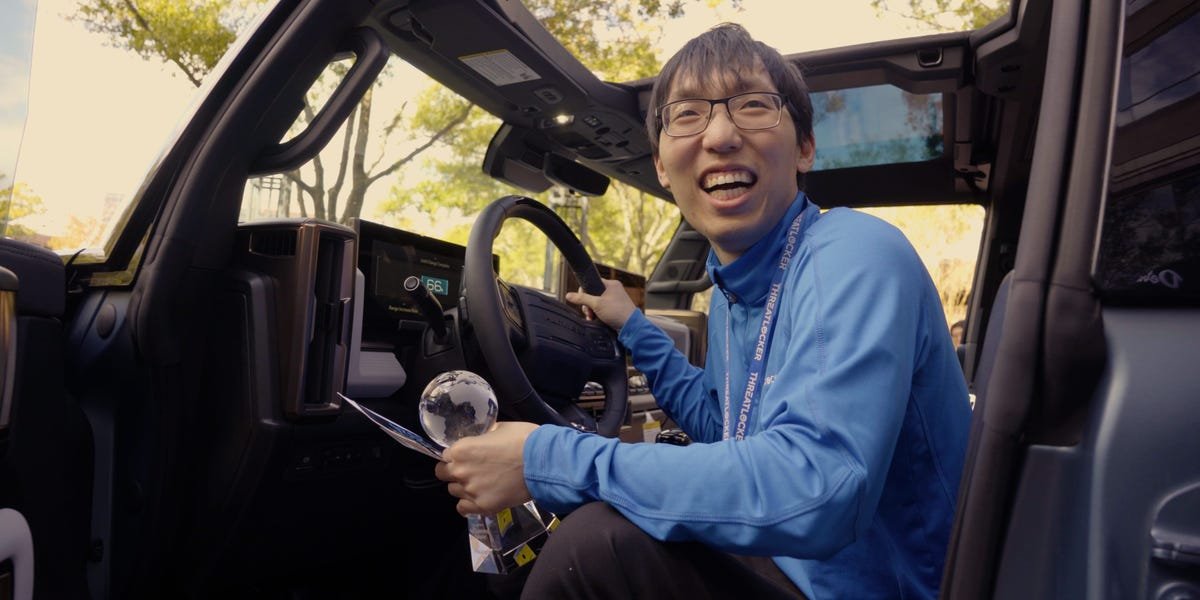
ThreatLocker, an Orlando-based cybersecurity firm with about 700 employees, gives luxury cars to its two most collaborative workers at its annual holiday party, the company told Business Insider.

The firm, which also has offices in Dublin, Dubai, and Australia, receives hundreds of votes each month for the two most helpful employees — one in the US, and one abroad. It flies in its international workers in for the holiday party.

Additionally, every manager votes for the best performer on their team that month. At the end of the year, the total votes for the top performer and the most helpful employee are combined to determine the two car recipients, the company said.

The firm usually awards an electric model, but has also handed out a $125,000 Porsche Panamera. The company hasn’t announced its car for this year yet, but told Business Insider one of the models is worth $173,000.

The tradition began in 2021 as a prize for the top performer, but CEO Danny Jenkins said it created a “dog-eat-dog” work environment. In the cybersecurity industry, teamwork is crucial to the company’s success, he said. Jenkins said the firm operates 24 hours a day with an average pick-up time of 23 seconds for any customer support issue, and colleagues need to work together to achieve that.

“Everything we do is with this matter of urgency,” Jenkins said. “So if you don’t have this teamwork where people are willing to get on a call at 2 a.m. in the morning and help each other and collaborate, then it doesn’t work.”

Jenkins said he works about 100 hours a week, and he keeps his phone on 24/7 in case issues arise.

Retaining the top

AI development has led to a boom in the cybersecurity industry, resulting in heightened demand for qualified talent. Jenkins said the company has never done layoffs and is currently hiring 40 to 50 people a month.

“I’d like to be in a situation where I don’t feel like we’re drowning because we’re constantly struggling to hire and onboard people fast enough,” said Jenkins.

That makes it all the more worthwhile to retain top talent and those who contribute to a strong culture.

He said that before the car winners are announced, between 14 and 16 runner-ups are honored in front of the company, and then offered a spot on a fully paid long-weekend getaway.

Jenkins said the trip has included a Royal Caribbean cruise to the Bahamas, as well as trips to Boston or New York. The group typically includes employees from various departments, and they all receive a spending budget of $2,500 on their trip, he said.

ThreatLocker also offers other perks to standout employees. Jenkins said that most employees work 40-hour workweeks, but sometimes teams may have to put in 18 or 19 hours straight to address an issue. Jenkins said when workers push through tight deadlines or go above and beyond, the company may reward them with court-side seats at games in the Orlando Kia Center, where the company has a permanent box.

Jenkins said the trip and car giveaway have bolstered employee success and that no car recipient has ever left the company.


Source link