From-bits-to-atoms-AI-is-shifting-techs-center-of.jpeg

From bits to atoms: AI is shifting tech’s center of gravity

For the last two decades, investors favored “bits” businesses — software, apps, and online platforms. The logic was simple: software scales cheaply, distributes instantly, and can generate huge margins once built. By contrast, “atoms” businesses, involving physical assets like factories, logistics, or energy, were seen as slower, capital-intensive and less profitable.

That balance is starting to shift.

A growing number of investors and founders now argue the rise of AI is flipping the script, making atoms-based businesses relatively more attractive than their bits-based counterparts.

Travis Kalanick’s comeback underscores the point. The Uber cofounder relaunched his effort under a new umbrella called Atoms, focused on manufacturing, food logistics, mining, and robotics.

“Software has automated tasks of language and math, but the complete automation of the physical world — autonomy — remains largely untouched territory,” he wrote.

Supply dynamics

This change is happening because AI is upending supply dynamics across the tech industry and beyond.

AI is dramatically increasing the supply of digital goods — code, text, images, even video. Digital work that once required skilled workers can now be done faster and cheaper with help from AI machines. That’s great for productivity, but it also means software and other digital products are becoming more abundant, and therefore, according to the law of supply and demand, less valuable.

Joe Fath, a partner at Eclipse who invests in physical industries, describes this as a structural shift. Historically, he said, software businesses had a major advantage because they required far less capital to reach “escape velocity,” where they could sustain themselves. Asset-heavy companies, by contrast, needed more capital, faced uncertain timelines, and so were often higher risk.

“That’s changing quickly,” Fath said.

AI is not only automating digital work, it’s starting to make the physical world more programmable. Advances in robotics and systems that combine vision, language, and action are allowing companies to bring software-like efficiencies to industries such as manufacturing, logistics, and energy.

“For the first time, AI is making physical industries meaningfully programmable,” Fath said. “Opening the door for faster scaling with less capital and labor.”

Software commoditization

At the same time, AI is putting pressure on traditional software business models. If anyone can generate decent code or build an app with the help of AI, it becomes harder to maintain a competitive edge. That dynamic is already showing up in public markets, where software valuations are under pressure.

“If AI commoditizes software, what’s actually safe?” Michael Bloch, a partner at Quiet Capital, asked on X recently. His answers included:

  • Regulated and liability-bearing businesses (someone has to be on the hook).
  • Anything touching the physical world (hardware, manufacturing, energy).
  • Operationally intense businesses (the “bad” businesses become the best ones).

Hard assets = moat

Even the companies building AI models face uncertainty, with open-source alternatives and competition from China, as venture capitalist Marc Andreessen recently noted. If the core technology becomes commoditized, value has to shift elsewhere.

One place it’s shifting is infrastructure — the physical backbone of AI.

Big tech companies such as Microsoft, Google, Amazon, and Meta are pouring hundreds of billions of dollars into data centers, chips, networking gear, and energy. These are deeply physical, asset-heavy investments. In other words, even the biggest “bits” companies are becoming “atoms” businesses.

As a Googler famously wrote in an internal memo in 2023, “We have no moat, and neither does OpenAI.”

This reflects a broader realization: If AI models become roughly comparable, the winners may be those who can deliver them fastest, cheapest, and most reliably. That depends less on software alone and more on physical infrastructure.

Blending real and digital worlds

The same trend is playing out across industries. Companies like Tesla, SpaceX, and Amazon have long blended software with real-world operations. Now newer players — including Wayve, Anduril, and Redwood Materials — are doing the same, using AI to improve everything from defense systems to battery production. Importantly, AI complements these businesses rather than replacing them.

“In physical industries, you still must build and operate real things,” Fath said. “AI can’t fully replace that, in the way it can take over a call center or act as a coding agent.”

His bet is there are many more examples of companies like Redwood and Anduril coming. “Capital that once flowed primarily into software and consumer internet will increasingly shift in this direction over the coming years,” Fath added.

Job market impacts

This shift is also showing up in the job market. Roles tied to digital work — programming, customer service, data entry — are increasingly exposed to AI-powered automation. Meanwhile, demand for skilled, physical trades such as construction, electrical work, and maintenance is rising, partly driven by the buildout of AI infrastructure itself.

“AI is really still digital. Ultimately, AI can improve the productivity of humans who do things with their hands, like welding, electrical work, plumbing — anything that’s physically moving atoms like cooking food or farming or anything that’s physical,” Elon Musk said on a recent podcast. “Those jobs will exist for a much longer time. But anything that is digital, which is like just someone at a computer doing something, AI is going to take over those jobs like lightning.”

Scarcity = value

Still, the shift toward atoms isn’t without risk. Physical businesses remain hard to scale — what Musk has called “production hell.” They require significant capital, operational expertise, and strong execution.

Fath acknowledges that challenge. “You’re not just solving a technical problem — you then must scale it. And when you’re physically building things, scaling well is incredibly hard.”

Even so, the direction seems clear. As AI drives the cost and value of digital work down, scarcity — and therefore value — is moving back into the physical world.

“The future is physical,” said Rohan Pandey, a former researcher at OpenAI, wrote on X recently. “As AI drops the cost of computer work to ~0, the bottleneck (and thus capital) returns to the physical world.”

In that sense, the future of technology may look less like pure software, and more like a fusion of bits and atoms, with the latter increasingly taking center stage.

Sign up for BI’s Tech Memo newsletter here. Reach out to me via email at abarr@businessinsider.com.




Source link

Trump-says-the-US-has-totally-obliterated-military-targets-on.jpeg

Trump says the US has ‘totally obliterated’ military targets on Kharg Island, the center of Iran’s oil empire

  • President Donald Trump said the US has destroyed military targets on Kharg Island.
  • The island, located off the coast of Iran, is central to the country’s oil empire.
  • Trump said the strikes did not damage the island’s oil infrastructure.

President Donald Trump said late Friday that the US had “totally obliterated” military targets on Kharg Island, an island off the coast of Iran that is central to its oil empire.

“Moments ago, at my direction, the United States Central Command executed one of the most powerful bombing raids in the History of the Middle East, and totally obliterated every MILITARY target in Iran’s crown jewel, Kharg Island,” Trump wrote.

“Our Weapons are the most powerful and sophisticated that the World has ever known but, for reasons of decency, I have chosen NOT to wipe out the Oil Infrastructure on the Island,” he added.

“However, should Iran, or anyone else, do anything to interfere with the Free and Safe Passage of Ships through the Strait of Hormuz, I will immediately reconsider this decision,” Trump continued. “Iran has NO ability to defend anything that we want to attack — There is nothing they can do about it!”

Representatives for CENTCOM and the White House did not immediately respond to requests for comment from Business Insider.

What is Kharg Island?

Kharg Island is a small island in the Persian Gulf, located roughly 300 miles from the Strait of Hormuz, which is known for its significance to Iran’s oil production.

Refineries on the island process nearly all of the nation’s oil exports. Disruption to the facilities there could have a significant impact on the global oil shortage, further driving up costs.

This is a developing story. Please check back for updates.


Source link

Oracle-to-investors-Dont-worry-about-data-center-spending-company.jpeg

Oracle to investors: Don’t worry about data center spending, company is ‘very, very good’ at cost-cutting

Oracle has two magic words for investors concerned with the company’s aggressive data center spending: fast and cheap.

Shares of the cloud giant rose as much as 10% on Tuesday after it surpassed investor expectations for the third quarter and raised revenue guidance to $67 billion for fiscal 2026.

Still, Oracle faced some questions about its AI data center buildout and how it plans to justify the billions of dollars it burns along the way. In February, Oracle announced a $50 billion debt raise to help fund its AI ambitions. In the last year, the company has announced major data center projects in Texas, New Mexico, and Michigan.

On Oracle’s third-quarter earnings call Tuesday, Bernstein analyst Mark Moerdler asked, “How comfortable are you with the values you’re creating from the AI data center business itself?”

Oracle co-CEO Clay Magouyrk reassured Moerdler that the company is focused on minimizing the cost of its data center buildout to maximize future profitability.

“We continue to get better and better at running these data centers, delivering them more cheaply, optimizing the amount of cost for networking and hardware spend, as well as power,” said Magouyrk.

He added that Oracle is focused on accelerating the time its buildings spend under construction.

“We’re very good at it,” he said.

“We’re very, very good at reducing those costs during that time period.”

He did not give any other details on how exactly Oracle manages its data center budget.

In 2022, Oracle undertook significant cost-cutting measures, laying off thousands of people in the wake of its $28 billion acquisition of medical records giant Cerner.

In January, Business Insider reported that Oracle was struggling to find financing for Stargate, its $500 billion data center initiative with OpenAI.

Lenders and investors told Business Insider they were growing weary of the project’s lofty ambitions as it races to keep up with the rest of Big Tech amid the AI race.

Amazon, Microsoft, Google, and Meta are on track to spend $600 billion on data centers and AI infrastructure in 2026 alone.


Source link

Police-arrested-a-man-at-a-meeting-to-discuss-a.jpeg

Police arrested a man at a meeting to discuss a proposed Oklahoma data center after exceeding his time limit by 30 seconds

Applause broke out during an Oklahoma man’s speech at a city council meeting on Tuesday to discuss a proposed data center. A minute later, shouts of disbelief rang out across the room.

“Disgusting!” one woman shouted as Claremore Police Department officers handcuffed and escorted Daniel Blanchard out of the room.

Authorities said they arrested Blanchard, whose speech exceeded the three-minute time limit, for trespassing.

Over 100 people, including Blanchard, had gathered in a ballroom at Rogers State University in Claremore to voice their opinions about the large data center project. The developer, Beale Infrastructure, is proposing a campus in the Claremore Industrial Park that includes data centers, supporting infrastructure, and office space.

Blanchard was among the residents who opted to speak during the public comment portion, which limits each person to three minutes. In his speech, Blanchard spoke about what he considered compliance issues related to the potential data centers.

“The Claremore Industrial Economic Development Authority has a fiduciary responsibility to the public, not to build infrastructure. And this act of overreach is putting the health and safety of members of this community at risk,” he said.

AI is driving a data center construction boom across the United States. While companies like OpenAI argue that building new data centers will reindustrialize the US economy and create jobs, residents of towns where developers are proposing new data centers worry about their impact on power grids, water resources, pollution, and overall quality of life.

In an investigation published in September, Business Insider reported that over 1,200 data centers had already been built or were approved for construction across the country.

The proposed data center in Claremore, a suburban hub of Tulsa home to about 20,000 people, has divided the town. During the three-hour meeting on Tuesday evening, dozens of residents spoke both in favor and against the project.

Blanchard exceeded his three minutes by about 30 seconds before police officers approached him. He gathered his notes and calmly followed the officers to the front of the hall, where town officials were sitting.

In a video of the meeting posted by the town on its YouTube channel, Blanchard appears to hand his notes to a council member. At that point, police arrested Blanchard, placing him in handcuffs. The crowd hollered in shock.

In a statement, the Claremore Police Department said officers aren’t responsible for enforcing city council rules and only become involved in city council meetings when an official orders them to remove an individual.

“The man’s position on the issues, what he said, or his unwillingness to follow rules of the meeting played no part in the officer’s decision to arrest him,” the statement said. “He was arrested for trespassing in compliance with the law and with the hope of restoring order to an important meeting.”

A local politician fighting the data center project posted to X on Wednesday that Blanchard has been released from jail. The next council meeting is scheduled for March 2.


Source link

Dan Geiger

Eric Schmidt-backed data center venture is negotiating a major deal with Google

Bolt Data and Energy, a data center development firm that was cofounded late last year by former Google CEO Eric Schmidt, is negotiating a deal that would allow it to begin construction on a large data center project it is planning in West Texas.

Schmidt’s firm is in discussions with Google, his former employer, according to two people with direct knowledge of the talks. The tech giant, one of the leaders in the race to develop and commercialize artificial intelligence, is considering a commitment of 250 megawatts, according to one of the people. The other person said it was too early to characterize the exact size of the potential transaction because it was still under discussion.

The sources spoke on the condition of anonymity because the potential transaction is still being arranged and the talks are confidential.

“We don’t comment on rumors,” a Google spokeswoman told Business Insider, declining to comment further. Google announced last year that it plans to build $40 billion of cloud and AI infrastructure in Texas by 2027.

The potential deal highlights how Big Tech is racing to secure the power, physical infrastructure, and land needed to fuel AI, even as the costs and financial risks of those bets loom.

In December, Bolt completed its first funding round, raising $150 million from investors, including $50 million from Texas Pacific Land Corporation, a public company that owns large tracts of land in West Texas. As part of the investment from TPL, Bolt will develop data centers on land in TPL’s portfolio.

A presentation detailing Bolt’s development plans, shared with Business Insider, said that TPL’s land would give it access to abundant power and water for cooling. These commodities have become increasingly strained as data center development has boomed around the country.

The presentation states that Bolt’s development would begin with an “initial 250 megawatt facility” and expand in 250-500 megawatt increments into a 5 gigawatt campus.

Bolt’s plan is one of several large-scale projects that have been envisioned in Texas to cater to the AI race. Fermi, a public company co-founded by former Texas governor and US Energy Secretary Rick Perry, has plans for an 11-gigawatt campus in Amarillo.

In December, Business Insider revealed that Amazon had pulled back a $150 million cash advance it had pledged as part of a preliminary deal to anchor the project. Fermi’s disclosure of the reimbursement of that advance caused its stock to fall by 50%. Fermi’s CEO, Toby Neugebauer, told Business Insider that although Amazon had reclaimed its advance, the negotiations for it to take space with Fermi were still ongoing.

Major bank lenders who extended $38 billion to finance the construction of data center campuses in Shackleford County, Texas, and Port Washington, Wisconsin, for Oracle and OpenAI, meanwhile, have had difficulty selling off pieces of the huge loan to other banks and investors. Those troubles stem, in part, from worries about whether Oracle’s credit will be strained by its massive AI spending.

To help allay concerns, Oracle announced it would raise as much as $50 billion in debt and equity in 2026 to continue to pursue its AI buildout while also maintaining “a solid investment-grade balance sheet.”

Last week, Alphabet, Google’s parent company, revealed in its fourth-quarter earnings report that it plans to spend between $175 and $185 billion on capital expenditures in 2026, roughly double its outlay in 2025. The spending is being done largely to pay for AI equipment and infrastructure.

A record wave of spending has been announced by big technology companies on AI this year, including Amazon’s disclosure during its earnings last week that it would spend $200 billion alone this year.


Source link

ICE-arrested-2-truck-drivers-heading-to-a-major-Meta.jpeg

ICE arrested 2 truck drivers heading to a major Meta data center project

  • ICE arrested two drivers on Wednesday near a Meta construction project in Louisiana, officials said.
  • The individuals were detained during a traffic stop inspection of vehicles heading to the site.
  • “ICE did not enter the Meta site at any time,” the local sheriff’s office said.

Meta’s new mega data center project had a brush with immigration authorities.

The Sheriff’s Office in Louisiana’s Richland Parish, where the massive Hyperion Data Center is under construction, said Wednesday that US Immigration and Customs Enforcement detained two dump truck drivers traveling to the site during a traffic stop inspection.

“During those stops, two drivers were arrested by ICE due to their immigration status,” the office said. The drivers were from Guatemala and Honduras.

“ICE did not enter the Meta site at any time,” the office said.

In a statement to Business Insider late Thursday, the Department of Homeland Security said that ICE did not target a Meta data center in Louisiana.

The DHS spokesperson said that the ICE agents had carried out a “targeted operation” to arrest the truck driver from Honduras, and had encountered another driver from Guatemala. It said both were arrested and are in ICE custody.

Meta declined to comment to Business Insider.

The Meta project is the largest of several multi-gigawatt data centers that CEO Mark Zuckerberg has said will come online as the company races to catch up on AI computing capacity.

Wednesday’s arrests crystallize an issue that companies have increasingly had to grapple with over the past year: how to prepare workers for an ICE encounter, whether on or off company property.

The action also follows a recent surge of ICE activity in cities and towns across the US, which has met some resistance in Democratic-led states.

Louisiana Gov. Jeff Landry has been a prominent supporter of President Donald Trump’s immigration policies. The state is receiving nearly $1 million a month to house detainees at its Angola prison, Axios reported, citing public records.

January 15, 11.25 p.m. E.T. — This story was updated to include comments from a DHS spokesperson.


Source link

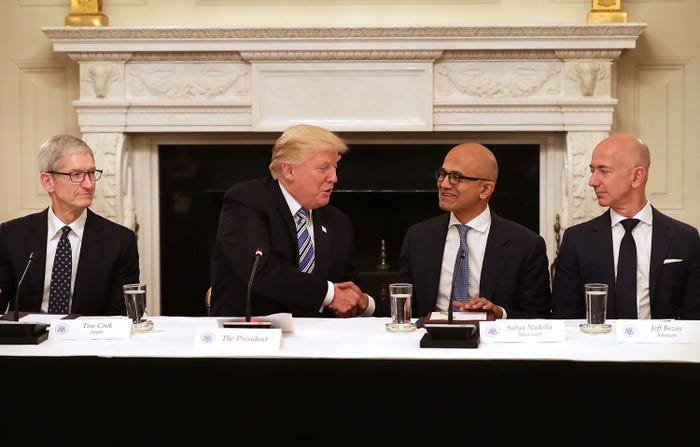
President Donald Trump speaks during an American Technology Council roundtable in the State Dinning Room at the White House in Washington, DC on Monday, June 19, 2017. From left, Tim Cook, Chief Executive Officer of Apple, Trump, Satya Nadella, Chief Executive Officer of Microsoft, and Jeff Bezos, Chief Executive Officer of Amazon. (Photo by Jabin Botsford/The Washington Post via Getty Images)

Trump says that Microsoft will ‘ensure’ Americans don’t ‘pick up the tab’ for its data center power consumption


Chip Somodevilla/Getty Images

  • President Donald Trump asks tech companies to “pay their own way” for their data centers.
  • Data centers drove up utility bills in at least 13 states, Business Insider previously reported.
  • Trump says that Microsoft will be the first to work with the White House to keep utility bills down.

President Donald Trump said on Monday that even though data centers are “key” to the AI boom, tech companies must “‘pay their own way,'” so that Americans don’t have higher utility bills.

“First up is Microsoft, who my team has been working with, and which will make major changes beginning this week to ensure that Americans don’t ‘pick up the tab’ for their POWER consumption, in the form of paying higher Utility bills,” Trump said on Truth Social, hinting at additional announcements “in the coming weeks.”

Data centers drove up utility bills in at least 13 states, Business Insider previously reported.

Over the past year, Microsoft has been planning for data centers in Wisconsin, Atlanta, Texas, and Michigan.

The White House and Microsoft did not immediately respond to a request for comment.

This is a developing story; check back for updates.


Source link

A-peek-inside-the-Feds-renovations-that-are-now-at.jpeg

A peek inside the Fed’s renovations that are now at the center of a DOJ probe

  • The Federal Reserve’s renovation project was expected to cost $1.9 billion. It now has a $2.5 billion price tag.
  • Lead paint and asbestos discoveries contributed to increased renovation expenses and delays.
  • Fed chairman Jerome Powell said a new DOJ probe is part of ongoing pressure from the Trump administration.

The Federal Reserve’s planned five-year renovation project is causing quite the stir in Washington.

Renovations began around 2022 on two Federal Reserve offices, the Marriner S. Eccles Building and the Federal Reserve Bank of East Building, which were first assembled in the 1930s, according to plans reviewed by the National Capital Planning Commission in 2021.

As workers gutted the aging structures, they uncovered lead paint and asbestos, pushing the cost of the renovations rose from $1.9 billion to $2.5 billion, as Federal Reserve chairman Jerome Powell described in a letter defending the renovation’s budget last year.

President Donald Trump has blamed the overruns on mismanagement and allegations of luxury additions. On Sunday, Kevin Hassett, director of the administration’s National Economic Council, told ABC’s This Week that the project became “the most expensive project in D.C. history.”

Later that day, Powell revealed the central bank now faces a potential Department of Justice investigation, and he’s facing a potential criminal indictment over the cost increases.

“No one — certainly not the chair of the Federal Reserve — is above the law,” Powell responded in a two-minute social media video. “But this unprecedented action should be seen in the broader context of the administration’s threats and ongoing pressure.”

As questions swirl around the renovations, Business Insider gathered images of the construction, floor plans for the renovations, and design mock-ups.

The Eccles and FRB-East buildings have been wrapped in scaffolding and cranes since 2022.

The Federal Reserve has been renovating its two buildings since 2022. The project is expected to wrap up by late 2027.

Heather Diehl/Getty Images

Construction workers broke ground on the renovations in 2022 on the 93- and 88-year-old buildings.

The Fed said the building has not had a modernization project in decades. A series of decades-old electrical, heating, plumbing, and air ventilation systems ran through the historic building.

The project was necessary to “address a critical backlog of upgrades, to respond to changes in building codes and regulatory requirements, and to meet requirements for information technology, building security, environmental sustainability, and energy efficiency,” according to plans produced by the Fed and released to the public in 2021.

Documents show the Fed’s proposed floor plans for both buildings.


A floor plan of both Federal Reserve buildings

The Federal Reserve’s modernization plans were mapped out in an exhaustive 87-page document, released in 2021. The document includes floor plans, mock-ups, and explanations of landscaping decisions.


Federal Reserve Board and Fortus


The Federal Reserve published floor plans for the expansion project in 2021. The plans plot out details like where new windows would be erected, why new shrubbery would be planted in specific areas on the lawn, how it would make offices more wheelchair accessible, and where historic marble will be reused.

Since the release of the plans, construction workers have uncovered asbestos and lead paint, resulting in higher-than-expected material requirements. Inflation has also increased the price of those goods.

A mock-up of the exterior, including plans to add some glass structures.


A mock-up of the exterior of the Fed building.

The Fed’s renovation plans include new glasswork that will surround the historic, stone elements of the building.


Federal Reserve Board and Fortus


The modernization project would expand some sections of the Fed buildings, including areas with new glass-covered atriums.

The Eccles building’s courtyard will be converted into an atrium.


A mock-up view from the second floor in the Eccles Atrium

The main building’s atrium is intended to mix “historically significant spaces and work space to balance preservation and modern office needs.”


Federal Reserve Board and Fortus


The courtyard at the center of the central bank’s main building would become a glass-enclosed atrium. The renovation would also include new accessible ramps, and the existing wooden oak doors would be stained a medium brown.

Both historic buildings’ interiors were finished with hand-carved wood in the 1930s. The woodwork will remain intact after the renovation.


Inside the renovated Eccles Building Level 4 Lounge

The renovation is designed to preserve historic architectural elements while updating the decades-old structure underneath. Here is an example of a fourth-floor lounge featuring salvaged woodwork and a marble floor.


Federal Reserve Board and Fortus


Much of the project is dedicated to balancing “preservation and modern office needs,” according to the plans. Several office spaces plan to reuse marble and wood from the original buildings.

The Eccles building’s center wing skylight would be moved to the fourth floor to let the light stream in.


A peaked natural light shaft with bronze beams lets light strem into the fourth floor.

The natural light shaft, which was constructed in 1977, is also getting an update that the Fed said would introduce more natural light to the fourth floor.


Federal Reserve Board and Fortus


A natural light shaft, shown above, has sat on the top of the building since 1977. The renovation would relocate the glass casing to the fourth floor, allowing more light to enter nearby offices.

The core architectural details of each building are important to preserve, the Fed said. It can help project financial power.


A statue of a bald eagle perched on top of the Eccles building.

The project is meant to update the building’s office capacity while maintaining its key architectural details, like the bald eagle perched atop the entrance.

Andrew Harnik/Getty Images

The Eccles building was designed to project stability during the Great Depression, with marble halls and bronze fixtures meant to inspire public confidence in the banking system. Those original details are being carefully restored, the Fed said in the plans.

White House officials have alleged the renovations include new VIP dining rooms and elevators, a vegetated roof, and millions of dollars in new marble. The Fed has denied those allegations in press releases.

The Eccles building has been in disrepair, the Fed says.


Ornate wood that was hand-crafted during the building's construction in the 1930s shows water damage

The Fed’s ornate architecture has endured nearly nine decades of wear, including water damage on the historic wood moldings, shown above.

ANDREW HARNIK/POOL/AFP via Getty Images

Water damage has been an issue for the historic buildings, according to images produced by Getty photographers in a July 2025 walk-through of the construction. Pictures of the historic building’s lobby show extensive damage to ornate wood carvings.

Asbestos and lead paint have been a costly issue. Inflation hasn’t helped either.


Tarp is wrapped over sections of the Fed building where asbestos was found

Workers have been clearing asbestos from the building for much of the past decade. This picture, taken in 2017, shows a construction site inside the Eccles building where workers found the dangerous material.


Federal Reserve


The Fed said it needed to make renovations to make its offices “safe, healthy, and effective places to work,” according to the Federal Reserve’s plans. For years, workers have uncovered asbestos throughout the historic buildings — a material now banned in most construction in the US.

As the project continues, more materials have had to be replaced than expected. Construction-sector inflation has made the overruns steeper.

Trump has seen the renovation project up close.


President Donald Trump and Chair Jerome Powell toured the Fed building in July 2025.

President Donald Trump and Federal Reserve Chair Jerome Powell tour the Eccles Building during its renovation.

Chip Somodevilla/Getty Images/Reuters

In July 2025, Trump toured the renovation project with Powell and Republican Sen. Tim Scott.

During a brief interview with reporters, Trump and Powell sparred over the cost of recent construction projects in the building.

The building is expected to be completed in late 2027.


A mock-up of the exterior lighting on the Eccles Building

Plans include new lighting to highlight the building’s historic features.


Federal Reserve Board and Fortus


This year, Fed press releases suggested construction workers would leave the building in the fall of 2027. Employees who have been working at temporary offices are expected to move in during the first quarter of 2028, if plans proceed accordingly.

Once staffers return to the office, the Fed said its new campus would save money.

“Over time, the Board has needed to lease space in several commercial office buildings to support its operations,” the Fed said in a July 2025 press release. “This project allows the Board to consolidate its operations and reduce expenses on leased space elsewhere.”


Source link

What-is-Delta-Force-The-elite-US-special-ops-unit.jpeg

What is Delta Force? The elite US special ops unit reported to be at the center of the raid to capture Venezuela’s Maduro

At the center of the US operation that captured Venezuelan President Nicolás Maduro and his wife was an elite and secretive special operations group, per multiple reports.

Citing officials, outlets like The New York Times and The Wall Street Journal reported that Delta Force, alongside law enforcement personnel, carried out the extraction of Maduro as part of Operation Absolute Resolve, a surprise nighttime raid of the Venezuelan leader’s compound in Caracas.

Business Insider wasn’t able to independently confirm the participation of the elite unit in the operation. The Pentagon directed BI’s queries to the White House.

In discussions of the complex operation, President Donald Trump said only that it was executed by “the most highly trained soldiers in the world,” adding that “there’s nobody that has their talent.”


Caracas at sunset

Caracas, the capital of Venezuela

Juan BARRETO / AFP via Getty Images


The president may have been speaking about all of the personnel involved. US officials said that the operation to grab Maduro included land, air, sea, space, cyber, and intelligence forces. But Trump’s language could easily apply to Delta Force, a top-tier special operations unit.

Here is what we know about this elite force.

An essential but highly secretive group

Delta Force, officially known as the 1st Special Forces Operational Detachment-Delta (SFOD-D), is tasked with capturing and eliminating high-value targets. Like other tier-one special mission units, such as SEAL Team 6, Delta Force tackles some of the US Army’s most covert and complex tasks.

The special operations unit, founded by Col. Charlie Beckwith in the 1970s for direct combat action, unconventional warfare, and counterterrorism, is headquartered at Fort Bragg in North Carolina, also home to other Army special operations forces.

Operators train for rapid infiltration and exfiltration, intense close-quarters combat, precision marksmanship, demolition, hostage rescue, and more. Unlike some other units, Delta pulls the best warfighters it can from across the US armed forces, though it mainly draws from Army special operations forces. Known as “quiet professionals,” Delta Force operators generally do not speak openly about their activities.

Much of the elite force’s work is highly classified, but some Delta missions are public knowledge.

Delta Force was involved in the US operation, Just Cause, that ultimately led to the capture of Panamanian dictator Manuel Noriega during the 1989 invasion of Panama. And the group distinguished itself during the 1993 Battle of Mogadishu, made famous by the book and film “Black Hawk Down.” Two snipers were posthumously awarded the Medal of Honor for their actions.

This century, this unit was among the US special operations forces that surged into Afghanistan immediately after the 9/11 attacks, played a role in the 2003 capture of former Iraqi President Saddam Hussein, and was involved in the death of the infamous Islamic State leader Abu Bakr al-Baghdadi in 2019.


Aircraft, explosions, and smoke were seen across Caracas, the capital of Venezuela, from about 2 a.m. The US carried out strikes and captured the nation's president, Nicolás Maduro.

Aircraft, explosions, and smoke were seen across Caracas, the capital of Venezuela, during the US operation.

Reuters


And now reporting indicates Delta Force, along with the 160th Special Operations Aviation Regiment, was instrumental in capturing Maduro.

The assault on Venezuela and raid on Maduro’s compound

The US president and other US officials shared details of the raid that captured Maduro on Saturday.

Dan Caine, chairman of the Joint Chiefs of Staff, said the apprehension team broke into a fortified compound to capture Maduro after months of planning. US intelligence agencies watched and studied his patterns of life, while other teams trained for the operation on a replica of Maduro’s home. The US used a similar tactic to ready for the 2011 raid on Osama bin Laden’s compound.

Reports indicate Delta Force was inserted into the target area by the 160th SOAR, the Night Stalkers famous for their ability to get special operators in and out of tough spots.

With fighters, bombers, electronic warfare planes, and more delivering strikes and providing air cover, Caine said the helicopters carrying the extraction team were able to reach their target with “totally the element of surprise.”

During the complex apprehension operation, American operators moved fast through the building to find Maduro and his wife, seizing them before they could get the door closed on a steel safe room.


Venezuelan President Nicolás Maduro arrives in New York.

Venezuelan President Nicolás Maduro arrives in New York.

Reuters


Trump said that Venezuela’s military was overwhelmed by US forces. Several American personnel were injured, the president said, and one of the helicopters was hit but remained flyable. No troops or equipment were lost in the operation.

The Trump administration is holding Maduro responsible for supporting narco-terrorism (drug trafficking) and other criminal activity. The recent operation is also about oil, with the administration accusing Venezuela of using oil revenue to fund malign activities. Maduro has denied the allegations.

Trump said on Saturday that the US would run Venezuela until a “safe, proper” election could occur. He also said that US oil companies would be entering the country, which has the world’s largest proven crude oil reserves.

To secure these operations, he said that he’s not ruling out putting US troops on the ground. He said the US military is ready to conduct more attacks if needed.

US Attorney General Pamela Bondi said Maduro and his wife were charged in New York with drug and weapons offenses. He is due to appear in court.


Source link