Tinder-wants-you-to-meet-people-offline-Its-CEO-tells.jpeg

Tinder wants you to meet people offline. Its CEO tells us it’s responding to ‘changing consumer tastes.’

Tinder wants you to get offline. No, really.

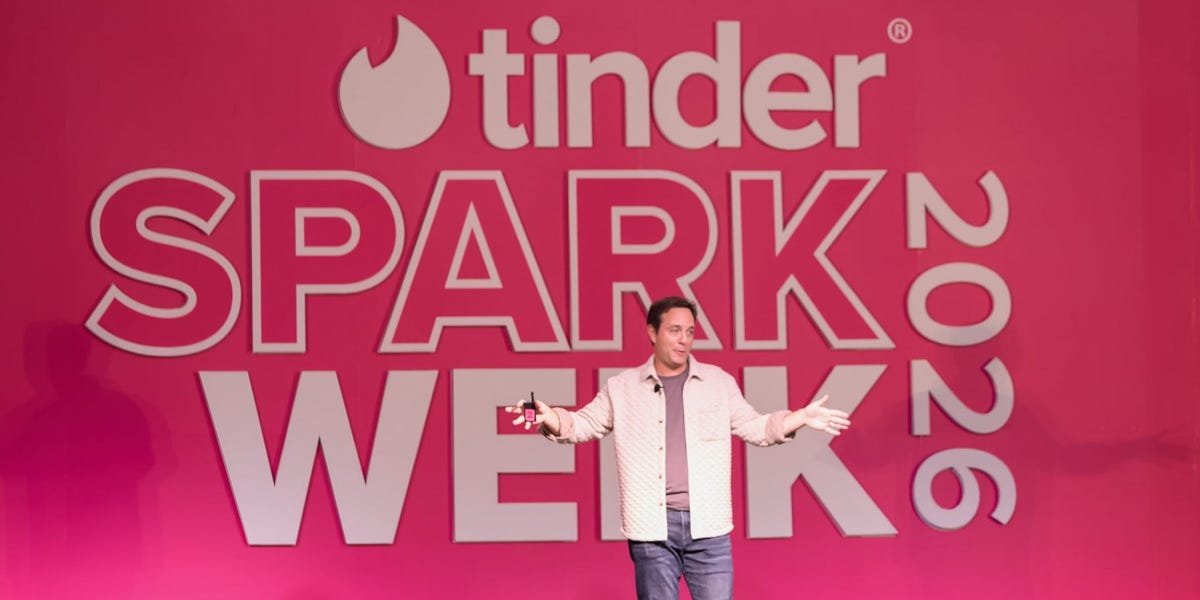
The world’s biggest dating app announced a variety of new features for 2026 at its product conference, Tinder Sparks. There will be ways to match based on music taste and astrology, to enhance photos with AI — and to skip out on the back-and-forth of online dating entirely.

The new “Events” tab, which is testing in Los Angeles this month, will connect users to in-person dating events. In an exclusive interview, CEO Spencer Rascoff said that IRL dating is the “perfect solution” for Gen Z daters.

“Events are fun, they’re low-pressure, they’re social, they’re safe,” Rascoff told Business Insider. “They’re bringing Tinder into the physical world in a way that is consistent with our users’ lifestyles.”

The Events tab is placed squarely next to the swiping tab — a sign, Rascoff said, of how important it is to the company. Users can browse listings with attendee counts and blurred photos. Once the user registers, the photos will unblur, and they can see some of the faces that will be in attendance.

It’s a fairly notable about-face for a company that once centered around the endless possibilities of “Swipe Right.” Indeed, many users have been tiring of the apps entirely; you may have heard of “swipe fatigue.”

“If you run a consumer internet company, you have to stay attentive to changing consumer tastes,” Rascoff said. “We can’t put our heads in the sand and stay wedded to past practice.”


Tinder's Events tab is pictured.

Tinder is testing an in-person dating feature in Los Angeles.

Tinder


Rascoff hopes that events will help bring in those worried by or frustrated with online dating. He compared it to Airbnb’s experiences market. That company uses luxury houses and villas to get people to reconsider “alternative accommodations” and, hopefully, return to their core product.

Since Rascoff’s takeover in 2025, he’s attempted to steer the app clear of its hookup reputation.

“I think IRL events have the potential to drive reconsideration of Tinder from people who have formed an opinion,” Rascoff said. He described an anti-Tinder user who downloads for the events, and eventually uses it as an “alibi” to start swiping.

Other upcoming features include specialty swiping modes for music and astrology.

Rascoff shared stories of two recent job interviews he held with Gen Z candidates. One responded to a question about why they were leaving their current company with, “I’m a Gemini.” Another responded to why they went into this field with, “because I’m a Taurus.”


Tinder's Astrology Mode is pictured.

Tinder lets users match by their astrological sign.

Tinder


Early testing shows that these modes are driving more engagement. One in 10 users under 22 have adopted Music Mode, and there was a 20% increase in Likes sent by women on astrology profiles.

While Rascoff is married, he still has a Tinder profile for product testing. He’s personally a Scorpio, and planned to list the Rolling Stones.

Then there’s AI, the looming question over all the dating app companies. Everyone is embracing it in some form, but the question of how much has proved controversial.

Tinder announced at the conference an expansion of its AI matchmaking program, Chemistry, as well as a camera roll scan for profile creation and photo enhancements, both powered by the tech.


Tinder's Chemistry feature is pictured.

Tinder’s matchmaking feature, Chemistry, is powered by AI.

Tinder


But Rascoff is quick to cut through the flashier features — there’s also video speed-dating and profile stickers — and point out safety. One of the biggest threats to online dating is bots, scammers, and crypto shills.

Tinder is now making its Face Check technology mandatory worldwide (excluding some markets, such as the EU and UK) and further rolling out its safety nudges for potentially inappropriate messages.

“We don’t talk about it enough,” Rascoff said. “We’ve raised the bar on trust and safety.”



Source link

Chong Ming Lee, Junior News Reporter at Business Insider's Singapore bureau.

Emergent’s CEO told us these are the 2 biggest threats to vibe coding

Emergent CEO Mukund Jha told Business Insider the fast-growing vibe coding movement faces two major risks.

The “biggest threat to vibe coding” is the quality of the software it produces, Jha said.

Many AI coding tools can generate apps quickly, but the output can still be buggy, fragile, or difficult to scale. The vibe coding industry depends on those systems getting better.

“There’s a big bet that the quality of software that gets produced is going to improve exponentially,” he said. “If that doesn’t happen, that’s a big threat,” he added.

Another risk could come from AI itself. Jha said it is possible the industry could eventually “skip the whole software building aspect” if autonomous AI systems become powerful enough to replace software.

“We went from like Nokia phones to BlackBerry, and then everybody went to iPhone,” he said. “It could be that the software was the BlackBerry.”

People might eventually rely on AI agents or large language models that perform tasks without needing apps, he added.

Emergent announced in February that it reached $100 million in annual recurring revenue, or ARR, in just eight months after launching. ARR is the revenue a company expects to generate in a year from subscriptions or other recurring payments.

The company said it doubled its ARR from $50 million to $100 million in a single month, underscoring the rapid growth of AI coding startups.

In January, Business Insider reported that the vibe coding startup raised a $70 million Series B round, bringing its total funding to about $100 million. Investors include Khosla Ventures, SoftBank Vision Fund 2, Lightspeed, Prosus, Together, Y Combinator, and Google’s AI Futures Fund.

Just six months earlier, the startup raised $23 million in a Series A round, highlighting how quickly top AI startups are attracting capital during the boom.

Read more about vibe coding

The rise of AI coding startups

It’s not just Emergent. Ryan Meadows, the chief revenue officer at Lovable, a Swedish vibe-coding startup, told Business Insider in an exclusive interview that its annual recurring revenue jumped more than 30% in one month, rising from $300 million to $400 million.

Meadows, said that the recent growth surge came after the launch of Claude Code, Anthropics’ AI coding tool. Rather than hurting Lovable’s business, Meadows said many developers are using both products.

“It’s a rising tide,” he told Business Insider. “We’ve been super happy with what we’re seeing.”

Other players are also seeing explosive growth. In late 2025, Cursor, another breakout company in the vibe coding space, said it had reached $1 billion in annualized revenue and was valued at nearly $30 billion, according to a company announcement in November.

But some industry leaders have warned about the rising costs associated with AI coding tools.

Billionaire investor Chamath Palihapitiya said his software company is reconsidering its use of Cursor amid rising expenses tied to AI development.

“Our costs have more than tripled since November,” Palihapitiya said on an episode of the “All-In Podcast” published Friday. “Between the inference cost that we pay AWS, which is ginormous, between our cost with Cursor, between Anthropic, we are just spending millions.”

AI companies themselves have acknowledged that more advanced features can drive up costs. Earlier this week, Anthropic introduced Code Review, a tool designed to detect complex coding issues and identify bugs. The company said the feature “optimizes for depth,” which makes it “more expensive than lighter-weight solutions like the Claude Code GitHub Action.”


Source link

Watch-what-Atlassians-CEO-said-in-a-4-minute-video-on.jpeg

Watch what Atlassian’s CEO said in a 4-minute video on the company’s AI-induced layoffs

  • Atlassian has cut 1,600 jobs, roughly 10% of its workforce, as it pivots to AI.
  • CEO Mike Cannon-Brookes addressed employees in a four-minute video explaining the layoffs.
  • He said he is “deeply sorry for the disruption” the layoff creates in their lives.

Atlassian CEO Mike Cannon-Brookes addressed employees in a four-minute video explaining why the company is laying off about 1,600 workers — roughly 10% of its workforce — as it pivots more aggressively toward AI.

Cannon-Brookes said in a message on the company’s blog that the decision was difficult but necessary as AI reshapes how software companies operate. The shift isn’t simply about cutting costs, he said, but about changing the mix of skills the company needs as it builds products for the AI era.

About 30% of the affected roles are based in Australia. The Australian-American software firm was founded in 2002 by Cannon-Brookes and Scott Farquhar, both of whom are ranked among Australia’s 50 richest people by Forbes.

The layoffs come amid a wider shift across the tech industry as companies restructure for the AI era. Last month, Block slashed nearly half its workforce, citing productivity gains from AI.

Watch Cannon-Brookes’ video message to employees here:


Source link

Palantirs-tech-head-explains-how-he-manages-stars-—-and.jpeg

Palantir’s tech head explains how he manages stars — and how he owned a big screwup to the CEO

Palantir’s chief technology officer uses a “Superman” analogy to help manage the company’s brightest talent.

On an episode of the “Invest Like The Best” podcast released on Tuesday, Shyam Sankar shared how he helps employees identify which skills to embrace and which to avoid.

“Superpowers are effortless,” he said. “My analogy for this is it Superman could fly. He could see through walls. But that wasn’t some sort of arduous thing for him to do. It’s just something he could do.”

The Palantir CTO, who has been with the defense tech giant for 20 years, added that the other side of this is identifying your “kryptonite” — in the series, a mineral fatal to Superman.

“It’s not like something you can work on. The only strategy for Superman around kryptonite was to avoid it,” Sankar said.

He added that the company supports employees in uncovering these weaknesses.

“The discovery of kryptonite usually involves you being exposed to it,” he said. “You don’t want to create a culture which is like, you fuck this up, I gotta fire you.”

Palantir culture

On the podcast, Sankar shared that he once made a big mistake, which he took to the company’s CEO, Alex Karp.

“I sheepishly went into Alex and was just completely honest,” he said. “He was also in pain as he internalized what this was going to mean. But he valued the fact that I wouldn’t try to hide it.”

Sankar added that the episode taught him that it was important to have an environment that allows mistakes.

Palantir is known across tech for its anti-hierarchical, untraditional company culture.

According to staffers on the company’s YouTube videos, Palantir is split into micro-teams, and employees report to their teammates. One hiring manager said that, for a project to which a Big Tech company would assign 30 engineers, Palantir only assigns three to four.

The company’s leadership has also embraced ditching diplomas in favor of real-world learning.

On an August earnings call, Karp, who holds a law degree from Stanford and a doctorate from Germany’s Goethe University, said “no one cares” about educational backgrounds at the company.


Source link

Patreons-CEO-says-AI-will-be-a-bloodbath-for-the.jpeg

Patreon’s CEO says AI will be a ‘bloodbath for the world’s creative people’ unless tech companies pay up

Jack Conte, the CEO of creator subscriptions platform Patreon, has a bone to pick with the Big Tech AI models.

It’s about compensation.

“The creator economy is being left out, loudly and notably,” Conte told Business Insider in an interview. “And by the creator economy, I don’t mean companies, I don’t mean Patreon. I mean creators.”

While AI companies like OpenAI and Meta are striking deals to license content from traditional media companies, “none of that infrastructure exists for independent creators,” Conte said.

In a roughly 45-minute video posted to Patreon on Tuesday, Conte further explained his personal stance on AI and the creator economy.

Conte said the key problem is that Big Tech companies don’t have much of an incentive to pay individual creators right now.

“I’m heavily in favor of some type of regulation that protects the rights holders and creators who are unable to protect themselves and go to the table with a bunch of leverage in moments like this,” he said.

AI’s standing under existing copyright law is still being assessed in real time. For example, in 2025, a federal court in California ruled that Anthropic’s training of its models on copyrighted books could be considered “fair use” if the material was lawfully obtained. Still, the AI company agreed to pay a $1.5 billion settlement to the author plaintiffs in the case after the judge ruled that copying and storing pirated books without consent did not meet the criteria for fair use. In January, a bipartisan bill was introduced in Congress to address transparency around how AI companies train on copyrighted material.

Conte wants to see AI companies start taking creators — and the rights to their content — seriously.

“I’m not anti-AI,” he said.

Patreon, a creator economy unicorn startup, has been internally using AI tools like Anthropic’s Claude and Cursor.

“I think it’s going to help humans make really beautiful things and be really self-expressive in an amazing way, just like synthesizers, just like sound and picture with movies,” Conte said. “But that doesn’t give people carte blanche to roll it out in a way that just creates a bloodbath for the world’s creative people.”

Conte doesn’t have a solution in mind yet for how creators should be compensated by companies training AI models.

“What we need to solve for is what the spirit of IP is solving for, which is how do you incentivize novelty creation?” he said.

He pointed to YouTube’s rights management system, Content ID, as a potential model. Content ID lets rights holders detect, remove, and monetize YouTube videos that feature their copyrighted work.

“Either I can remove my work from the training data, or I get paid when it’s used as training data and when it’s replicated, and I get credit for that,” Conte said. “I don’t know how to build that, but humans have done harder things.”

AI companies could start — and potentially already are — ripping a page out of social media’s playbook for paying or courting creators. Last year, Bloomberg reported that several AI companies were paying creators to license their unpublished content, including startup Moonvalley. OpenAI also recently hired Meta’s former head of partnerships, who oversaw Instagram’s relationships with celebrities and creators.

“We’re going to see some type of model emerge that compensates artists for their work,” Conte said.


Source link

Yann-LeCuns-startup-has-a-new-CEO-—-and-1.jpeg

Yann LeCun’s startup has a new CEO — and $1 billion

Yann LeCun’s AI startup has raised more than $1 billion in seed funding and appointed a new CEO.

In a post on X on Tuesday, entrepreneur and former Facebook researcher Alex LeBrun said he is joining LeCun and the founding team of Advanced Machine Intelligence (AMI) Labs, also known as AMI Labs, as CEO.

“We have secured a $1.03 billion USD seed round to fuel our mission to build intelligent systems capable of truly understanding the real world—a long-term scientific endeavor,” LeBrun said.

AMI Labs said in an X post on Tuesday the round was co-led by Cathay Innovation, Greycroft, Hiro Capital, HV Capital, and Bezos Expeditions, alongside other investors.

The startup added it is building a team of researchers and engineers across Paris, New York, Montreal, and Singapore.

AI researcher and New York University computer science professor Saining Xie also said in a post on X on Tuesday that he has joined the founding team. Xie, who serves as cofounder and chief science officer, wrote that “AMI isn’t a conventional lab.”

“We don’t intend to become one,” he added.

AMI Labs is recruiting engineers, scientists, and researchers across its four global hubs, according to the company’s job postings.

LeCun revealed plans to launch the startup in November after departing Meta, where he spent 12 years leading its AI research efforts.

AMI Labs will focus on building world models, a type of AI system designed to better understand and reflect how the real world works. LeCun had said that the startup will be among the few frontier AI labs that are “neither Chinese nor American.”

Speaking at an event in Paris in December, LeCun said Meta would partner with the new venture, though it would not invest in the company.

“This new architecture is a project that Mark Zuckerberg really likes. He thinks maybe that’s the future,” LeCun said.

In an interview with MIT Technology Review published in January, the AI pioneer said he disagreed with some of the decisions made by Zuckerberg, including the shutdown of the robotics team inside FAIR.

LeCun also took aim at Alexandr Wang, the former CEO of Scale AI, after Wang briefly became his boss following Meta’s AI reorganization.

“There’s no experience with research or how you practice research, how you do it. Or what would be attractive or repulsive to a researcher,” LeCun said in an interview with the Financial Times in January.

“You don’t tell a researcher what to do,” LeCun said. “You certainly don’t tell a researcher like me what to do.”


Source link

Meet-Jay-Graber-who-is-stepping-down-as-Blueskys-CEO.jpeg

Meet Jay Graber, who is stepping down as Bluesky’s CEO to transition to a role made just for her

Updated

  • Jay Graber is stepping down as the CEO of Bluesky to transition into a position made just for her.
  • Bluesky’s open protocol offers a decentralized alternative to X and Meta platforms.
  • Here is a look at Graber’s career and her unconventional path to Silicon Valley.

Jay Graber is the engineer behind one of the most ambitious experiments in reimagining social media.

The Tulsa-born technologist is best known for steering Bluesky between 2021 and 2026, the decentralized platform she describes as a “billionaire-proof” alternative to X and Meta-owned platforms.

On March 9, Graber announced in a statement that she will be leaving her role as CEO of Bluesky and that someone “focused on scaling and execution” will take over. Meanwhile, she will return to her passion for “building new things” as the chief innovation officer, which is a role made just for her.

She will also remain on Bluesky’s board and have a say in picking her successor.

Graber’s emergence as a Silicon Valley power player was unconventional. In 2021, former Twitter CEO Jack Dorsey tapped her to lead the Bluesky project, which was spun off as an independent public benefit company, just before Elon Musk’s takeover of Twitter.

Since then, Bluesky’s user base has grown to over 40 million as of November 2025, powered by its open protocol, customizable moderation system, and promise of a more democratic digital ecosystem.

Here’s a look at Graber’s career timeline, from her early work in cryptocurrency to her rise as the architect of a new, user-owned social media platform:

Early life

Jay Graber was born Lantian Graber in Tulsa, Oklahoma.

Kimberly White/Getty Images for WIRED

Jay Graber was born Lantian Graber in Tulsa, Oklahoma, to a mother who is an immigrant from China during the Cultural Revolution and a father of Swiss descent. Her mother, who is an acupuncturist, named Graber “Lantian”, which means “blue sky” in Chinese, as a wish that she would have “boundless freedom.” She was aptly named for the job she would eventually be given.

Her father is a mathematics teacher, and in a 2024 profile of Graber in Cosmico, he is cited as a source of intellectual and academic influence for Graber.

Education


JULY 17: A general view of the Penn Shield University of Pennsylvania logo on July 17, 2025, at the University of Pennsylvania, in Philadelphia, PA. (Photo by Erica Denhoff/Icon Sportswire via Getty Images)

Jay Graber studied Science, Technology & Society at the University of Pennsylvania.

Erica Denhoff/Icon Sportswire via Getty Images

At the University of Pennsylvania, Graber studied Science, Technology & Society, which is an interdisciplinary program that examines how technological innovation intersects with culture, politics, and ethics.

Rather than focusing solely on coding or engineering, the program allowed Graber to explore the broader systems that shape how technology is developed and utilized, an approach that later influenced her views on social networks and digital governance.

Some of her key guiding views include a decentralized internet and open source social media protocols. “We believe that the protocol is the fundamental guarantee on freedom of speech,” Graber said once during an interview with Fast Company.

Before Bluesky


A bitcoin illustration

Jay Graber is well known in crypto circles for her work on Zcash.

Peter Dazeley/Getty Images

Graber’s early career unfolded during the first wave of blockchain innovation in the mid-2010s. After graduating from the University of Pennsylvania, she began her career as a software engineer at SkuChain, a startup focused on utilizing blockchain for supply-chain management. Around the same time, she also built and soldered bitcoin-mining rigs, deepening her technical grasp of decentralized systems beyond software.

Between 2016 and 2018, Graber joined the privacy-focused cryptocurrency project Zcash as a junior developer, contributing to one of the most advanced implementations of zero-knowledge proofs. Later, in 2019, she founded Happening, Inc., an events app that aimed to help communities organize and connect through shared experiences.

Happening, Inc. never really took off, but these early roles grounded Graber in both the engineering and ideological foundations of decentralized technology, which later shaped the vision for Bluesky as an open, user-controlled social network.

Joining Bluesky


Bluesky logo

Jay Graber negotiated a formal spin-out of Bluesky from Twitter as a Public Benefit Company.

Illustration by Omar Marques/SOPA Images/LightRocket via Getty Images

When Jack Dorsey, then CEO of Twitter, first announced Bluesky in late 2019, it was a small, Twitter-funded initiative tasked with researching an open and decentralized standard for social media.

By August 2021, Dorsey decided to onboard Graber, who was then known in crypto circles for her work on Zcash and decentralized community tools, to lead and accelerate the effort. However, according to an April 2025 profile of Graber in the New Yorker, she quickly realized that for Bluesky to fulfill its mission, it needs to create a social protocol separate from any single corporation and maintain independence from Twitter.

With Dorsey’s backing, Graber negotiated a formal spin-out by October 2021 and incorporated Bluesky as a public benefit corporation, a legal structure that allowed it to prioritize user benefits and open standards over shareholder profit.

Twitter provided an initial $13 million in funding to give the new entity “freedom and independence to get started,” as Dorsey publicly described at the time.

Bluesky’s rise


Bluesky app

Jay Graber separated Bluesky from Twitter just before Elon Musk’s takeover.

Illustration by Thomas Fuller/SOPA Images/LightRocket via Getty Images

Graber’s early move to separate Bluesky from Twitter may have saved it.

When Elon Musk acquired Twitter in 2022 and renamed the platform X, Bluesky’s independence allowed it to thrive and emerge as a competitor to X as droves of users left the platform.

In September 2023, Bluesky only had around 1 million registered users, but this figure climbed to more than 20 million by the end of November 2024. The meteoric rise came after a user surge in Brazil after X was temporarily restricted there, as well as 1.25 million user gains the week after Donald Trump won the 2024 presidential election.

As of November 2025, Bluesky has around 40 million registered users. That is no match for X’s roughly 560 million users, but it provided an alternative for those dissatisfied with X’s ownership and content moderation.

Calling out Big Tech


Jay Graber at the Keynote

Jay Graber wore a black T-shirt that reads “Mundus sine caesaribus,” meaning “a world without Caesars.”

Samantha Burkardt/SXSW Conference & Festivals via Getty Images

Graber has taken a subtle dig at Mark Zuckerberg, the CEO of Meta, which owns Facebook, Instagram, and Threads.

During SXSW in Austin in March 2025, Graber wore a black T-shirt that reads “Mundus sine caesaribus,” meaning “a world without Caesars.” The design and font are widely interpreted as a response to Zuckerberg’s own Latin slogan shirt, which reads “Aut Zuck aut nihil,” meaning “either Zuck or nothing.”

The shirt drew public curiosity, and Bluesky began selling the same shirt. A spokesperson for the company told Business Insider at the time that the shirts sold out in 30 minutes, representing the company’s “democratic approach, where no single CEO or company controls your experience online.”

A modest net worth


Jay Graber

Compared to most tech CEOs, Jay Graber has a modest net worth.

DON MACKINNON/AFP via Getty Images

Compared to other Silicon Valley CEOs who run major social media platforms, all of whom are billionaires, Graber has a very modest net worth.

Estimates of Graber’s net worth fall between $2.95 million and $5 million, mostly depending on her equity in Bluesky. Since Bluesky is not a publicly traded company, Graber’s stake in the company and her annual compensation are not publicly disclosed.

As of early 2025, Bluesky’s valuation is estimated to be around $700 million.

A ‘billionaire-proof’ platform


Jay graber

Jay Graber positions Bluesky as a “billionaire-proof” platform.

Sam Barnes/Web Summit via Sportsfile via Getty Images

Graber positions Bluesky as a new kind of social network.

Bluesky is built on an open-source Authenticated Transfer Protocol, which decentralizes social networking and hands more control to users rather than a single company or executive.

“The billionaire proof is in the way everything is designed, and so if someone bought or if the Bluesky company went down, everything is open source,” Graber told CNBC in an interview in November 2024.

“What happened to Twitter couldn’t happen to us in the same ways, because you would always have the option to immediately move without having to start over,” Graber added, referring to Musk’s purchase of the platform that is now named X.

Unlike traditional social platforms like X or Facebook, Bluesky is built on an open-source ecosystem called the ATmosphere, powered by the Authenticated Transfer Protocol. The system gives users the ability to design and customize their own ranking algorithms, carry their posts and followers with them across different apps, and avoid being subject to any platform’s arbitrary or politically driven moderation decisions.

Activism on Bluesky


Protesters from the Tesla Takedown movement gather outside a Tesla pop-up store

Protesters from the Tesla Takedown movement gather outside a Tesla pop-up store

Thomas Krych/Anadolu via Getty Images

Bluesky became a platform widely used by progressive activists and community organizers.

The Tesla Takedown movement, a pushback against Tesla CEO Elon Musk’s involvement with Donald Trump and the White House’s DOGE office, famously spread via Bluesky when actor Alex Winter contacted a sociologist in Boston to build a website where people could organize local protests.

But the progressiveness of Bluesky also seems to have spooked some politicians. Semafor’s media reporter Max Tani wrote in May 2025 that some congressional staffers told him that they gave up on using Bluesky as an alternative to X, because “their bosses kept getting yelled at by Democratic users angry at their impotence.”

Changing the ecosystem


Jay graber in conversation with Fast Company

Jay Graber is not worried about Bluesky’s slower growth in terms of registered and active users

Eugene Gologursky/Getty Images for Fast Company

Graber is unfazed by Bluesky’s slower growth in terms of registered and active users.

In an interview in May with Fast Company, Graber said that reports of Bluesky’s death are “greatly exaggerated” and that growth “comes in waves,” with new communities being established at each stage.

“We’re still seeing a lot of community formation, and one of the most exciting things is how structurally different this is,” said Graber. “It’s not just another social site that has to be a singular winner-take-all in an ecosystem with existing incumbents.”

In 2025, Bluesky still added around 10 million newly registered users.

A warning against AI over-reliance


Jay Graber

Jay Graber warns you shouldn’t “fully outsource your thinking” to AI.

Eugene Gologursky/Getty Images for Fast Company

Graber has tips on how to thrive in an era of AI, and reliance is not the answer.

“AI can handle many reasoning tasks, but if we fully outsource our thinking, it’s not good enough,” Graber told Business Insider.

She added that for students, that might mean writing essays by hand to “build the muscle for critical thinking.”

At Bluesky, Graber said AI is used for moderation and curation but never runs on its own, because while AI delivers packaged expertise, human value lies in judgment and adaptability.

For job seekers, Graber encourages workers to adopt a generalist mindset and master core skills such as writing and coding.

“If you don’t know what good code looks like,” she said, “you won’t be able to evaluate AI’s output.”

Stepping down as CEO of Bluesky


Jay Graber

Jay Graber is starting a new era in 2026 as Bluesky’s chief of innovation.

Samantha Burkardt/SXSW Conference & Festivals via Getty Images

Graber is starting a new era in 2026.

On March 9, Graber said in a public statement that she will be stepping down as Bluesky’s CEO and transitioning into a position made just for her: chief innovation officer.

“As Bluesky matures, the company needs a seasoned operator focused on scaling and execution, while I return to what I do best: building new things,” Graber wrote in a blog on Bluesky.

“As we’ve grown, I’ve found that people thrive when they’re in a role where their passions overlap with their strengths. This is as true for me as it is for our team,” Graber added. “Transitioning to a more focused role where I can do what brings me energy is my way of putting that belief into practice.”

Graber’s new role focuses on Bluesky’s technology stack rather than on growth and business operations. She will also play a role in choosing her successor. For now, venture capitalist Toni Schneider will be Bluesky’s interim CEO.


Source link

Lucia Moses

‘The Diary of a CEO’ star Steven Bartlett is going all in on AI — except on LinkedIn

Steven Bartlett isn’t just discussing AI on “The Diary of a CEO” — he’s using it to make entire podcasts, automate sales pitches, and more.

The podcast star recently raised an eight-figure investment round to build out his company, FlightStory, which has about 100 employees and generated around $47 million in revenue last year.

FlightStory’s AI experimentation started in a big way last year, when Bartlett challenged his staff to a two-month competition to use AI agents in their work.

The competition was a scrappy “test for us to very much dive into that space and just see what worked, and see what we could do in a short space of time,” said Isaac Martin, director of innovation at FlightStory.

The pre-production team won Bartlett’s contest — and a $20,000 prize — for building tools or agents that replaced or improved nearly every part of their processes. Bartlett said the contest resulted in savings of $1.18 million for the company.


Isaac Martin, director of innovation at FlightStory

Isaac Martin, innovation director at FlightStory, is promoting AI-made content through an initiative called “Project Gutenberg.”

FlightStory


Since then, FlightStory has used AI throughout its operation, including an AI-content push it calls “Project Gutenberg,” a nod to the founder of the printing press.

Execs at FlightStory spoke with Business Insider about the various ways their operation — a unit of his holding company, Steven.com — is using AI.

They also spoke about why, in the case of LinkedIn, the team is dialing back the use of AI.

The many ways FlightStory is using AI

Shows: In its most ambitious creative application, FlightStory is producing a fully AI-animated video series for kids aged five to eight called “Steven’s World.” The show revolves around a young Bartlett going on adventures with his friends and uses information from podcast guests like Neil deGrasse Tyson. FlightStory said it’s in talks with major streamers for distribution. The series grew out of an earlier AI-made podcast test, “100 CEOs,” that was hosted by an AI clone of Bartlett’s voice.

AI is also being used to translate “DOAC” into 14 languages. The Spanish translation has been the biggest success story so far, bringing in an incremental 20.5 million views or listens and generating $200,000 in indirect gross ad revenues on Spotify, said Christiana Brenton, FlightStory’s CRO and cofounder.


Christiana Brenton, FlightStory's CRO and cofounder.

Christiana Brenton, FlightStory’s CRO and cofounder, sees AI as a way to expand the kind of work the company can perform.

FlightStory


Ad revenue: On the commercial side, staffers are using a custom AI tool to develop pitches based on briefs, FlightStory’s creators, and past brand campaigns and pitches. In this way, FlightStory said it has shrunk the process from about three days to a few hours. This has helped boost the average revenue contribution per person across the company by 60% over the past two years.

Speakers: FlightStory is redesigning its FlightSpeakers division, using a conversational AI tool to reduce the time it takes to recommend speakers and check their availability.

Talya Levine, who leads the project, said the aim is to preserve the relationship element that’s long been a part of the business but also shake it up with tech.

“We hope it ruffles some feathers,” she said.

Social: FlightStory launched a new unit, FlightSocials, in late 2025 to help creators like Colin and Samir, and comedian Ali Siddiq, distribute clips on social media. Brenton said AI has sped up the work of producing clips, evaluating them, and making recommendations for the next ones. In this way, the company can post up to 15 clips per day per creator.

“It just completely removes the guesswork of a human having to decide what part of this long episode to cut up,” she said.

FlightStory also built an API called Creator Radar, which plugs into YouTube and other social platforms to help identify high-potential creators to sign. The API helped validate FlightStory’s decision to bring on “Hot Smart Rich” host Maggie Sellers Reum by showing that she had an unusually strong community — women who self-identify as “HSR angels” — relative to the size of her audience.

AI still has limitations

Surveys have found that independent creators are generally more eager to experiment with AI than legacy Hollywood studios and guilds are.

For creators like Bartlett looking to scale beyond themselves, AI offers a way to reach bigger audiences without being limited by their own time and energy.

Brenton said a lot of companies focus on using AI for efficiency, but FlightStory thinks of it as a way to “do things that we couldn’t necessarily do before.”

Like many companies implementing AI, FlightStory says it’s not using it to get rid of people, but to allow them to focus on higher-value work.

FlightStory’s leaders also recognize AI isn’t right for every use case.

For example, the company cut back on using AI on LinkedIn after noticing a lot of AI-written posts on the platform and deciding that ones written by humans could have more emotional resonance. The conclusion: They take longer to write, but have performed better than AI ones. Bartlett and his team now personally write every piece of social copy, Brenton said.

“Ironically, we believe that’s a unique advantage,” she said. “You’ll even notice now if you do follow Steven, there’s spelling mistakes and errors, and he doesn’t fix them by design.”


A still from

FlightStory used AI to create a junior version of Steven Bartlett for “Steven’s World,” a new kids’ show.

FlightStory


It’s also early days in understanding the types of AI-made content that audiences will embrace.

The AI episodes of “100 CEOs” got at most 35,000 views on YouTube, while Bartlett’s flagship podcast regularly gets hundreds of thousands of views per episode. Some praised it while others criticized the voice as not sounding human enough and said they preferred Bartlett’s interview format. FlightStory execs think kids will be more receptive to an AI-animated show, and that “Steven’s World” will introduce Bartlett’s brand to a new audience.

While the Spanish-language translation of “DOAC” brought in additional audience and revenue, not all of its podcasts will share the same financial opportunity. And podcasts that depend on a strong emotional connection with the audience might feel jarring to some if they’re dubbed by AI.

When it comes to FlightStory’s most valuable property, the “DOAC” podcast, where Bartlett interviews a range of public figures, the execs are adamant that the final edits are done by real people.

“The risk profile and the stakes are higher when you’re producing long-form content that reaches millions and millions of people,” Brenton said.


Source link

Coachs-former-CEO-said-Gen-Z-is-most-similar-to.jpeg

Coach’s former CEO said Gen Z is most similar to the 60s generation

Coach’s former CEO said Gen Z reminds him of his generation.

Speaking to Bloomberg in an interview released on Sunday, ex-CEO Lew Frankfort said he started at the New York City-based luxury company 45 years ago.

“So I’ve seen generations change, and Gen Z is the generation that’s most similar to my generation, the sixties,” he said.

“They’re very value-driven,” Frankfort added. “They’re concerned with climate, they’re concerned with authenticity, truth, being who they are, and relationships.”

Frankfort joined Coach in 1979 and served as the company’s CEO and chairman from 1985 through 2014. He sought to position Coach as an “accessible luxury” brand.

Coach’s current CEO, Todd Kahn, started in the role in 2020 and led the company into its current Gen Z-focused era.

Kahn said in the Bloomberg interview that Gen Z customers are “very, very thoughtful about their purchases” and like to shop in physical stores, making shopping an experience.

Coach has resonated with budget-conscious Gen Z consumers because it sells products priced lower than those of other luxury brands.

Gen Z is big business for Coach. A 2023 consumer spending report by market research firm Earnest Analytics found that consumers under 25 increased their spending at Coach by 10% from January through June that year.

To attract more of this consumer base, Coach has doubled down on its charm range in recent years, catering to Gen Z’s love for bag charms, trinkets, and collectables. The cherry-shaped charm was a Gen Z favorite, said Joanne Crevoiserat, the CEO of parent company Tapestry, during a May earnings call.

The company is also bringing in Gen Z celebrities into campaigns and as brand ambassadors, such as rapper Lil Nas X and K-pop artist Lee Youngji. Celebrities like Bella Hadid have been spotted carrying Coach bags.

Coach reported sales of $2.14 billion in the latest quarter, a 25% increase from the same period the year before. It had 330 stores in North America and 619 stores internationally, as of December.

Tapestry’s stock has risen about 85% in the past year.


Source link

Chong Ming Lee, Junior News Reporter at Business Insider's Singapore bureau.

The CEO of a $15 billion AI company says the biggest AI winners won’t be software — they’ll be mines, farms, and trucks

AI’s biggest impact will likely happen far from laptops, says the CEO of a $15 billion AI company.

Qasar Younis, the cofounder and CEO of Applied Intuition, said on an episode of “Lenny’s Podcast” published Sunday that “the real impact of AI in the next 5 to 10 years” would show up in physical industries, like “in farming, in mining, in construction, in self-driving trucks.”

Applied Intuition develops software to test and power autonomous vehicles and other machines. The company said in June that it raised $600 million in a funding round, valuing it at $15 billion.

Software tools like Moltbook and OpenClaw may excite developers, but Younis said they touch only a small slice of society.

“I love the stuff that’s happening on these platforms, but it’s still segregated to, like, frankly, developers,” he added.

Instead, he said the biggest shift will come from adding intelligence to machines already embedded in the physical economy.

“More pragmatically, it’s actually just putting intelligence into things that already exist all around us.”

Industries like trucking and farming urgently need that kind of autonomy, he said.

“People are not fighting for those trucking jobs,” Younis said. The average farmer is already in their late 50s, meaning many will retire in the coming decade, potentially worsening labor shortages.

AI is more likely to help fill labor shortages in these industries than replace them entirely, he added.

The company has tested autonomous trucks in Japan, where an aging workforce means a driver shortage, and it’s working on AI in mining safety and efficiency.

AI’s impact on blue-collar industries

Earlier this year, Wall Street grew worried that new AI tools and agents could replace some software products entirely.

A research paper by Citrini, an investment firm focused on thematic equity investing, triggered a global stock sell-off last month after researchers outlined a scenario in which the AI boom wipes out white-collar jobs and ultimately slows economic growth.

Against that backdrop, some industry leaders say physical industries could end up benefiting from the technology.

For instance, robots could help address labor shortages in manufacturing. Daniel Diez, the chief business officer of Agility Robotics, told Business Insider in a report published on Sunday that manufacturers globally “simply can’t find the people to do this work.”

Ford CEO Jim Farley said last year that AI-powered augmented-reality tools are helping technicians repair trucks more efficiently, though he warned that automation could still reshape jobs across the broader economy.

Business Insider reported last year that some Gen Z workers are increasingly considering trade and blue-collar careers as automation and AI create uncertainty around traditional white-collar professions.


Source link