How-US-businesses-are-using-AI-to-manage-tariff-chaos.jpeg

How US businesses are using AI to manage tariff chaos

US businesses have been on a tariff roller coaster over the last year. Sweeping tariffs were implemented at varying levels across different countries. Though some were eventually overturned by the Supreme Court, there is now an added layer of bureaucracy as companies seek potential refunds. Some are turning to AI for help.

Companies like EQI and customs advisory firms like KPMG are using generative AI “to process all that chaos,” said Brendan Connallon, the VP of finance at EQI, a company that supplies metal components and provides supply chain advising services to manufacturers. The technology can rapidly scrape and synthesize vast quantities of data, track tariff changes, model potential supply chain scenarios, and accurately classify goods by their government-assigned tariff codes — a highly nuanced system with more than 17,000 codes.

Emil Stefanutti, the CEO of Gaia Dynamics, a software company that provides AI tools to help companies automate trade compliance, said AI is proving particularly useful in this rapidly changing environment, as it can reduce compliance errors and save businesses time. With the Supreme Court ruling specifically, Stefanutti said importers can use AI to analyze data on where and when they paid tariffs, quantify potential overpayments, and flag areas that need correction.

AI “can continuously track and adapt to new rules in a way humans simply can’t at scale,” Stefanutti said.

AI can shave weeks off pinpointing tariff refunds

The consulting firm KPMG has been advising its clients on trade compliance for decades, but last year in particular, “the tariffs were changing fast and furious,” said Andrew Siciliano, the leader of the Global and US Trade and Customs practices at KPMG.

Company leaders needed real-time data quickly to make decisions, so KPMG launched an AI-powered tariff modeler.

The firm’s clients include many large businesses that import goods ranging from auto parts to retail goods and pharmaceuticals, and that use several ports of entry and customs brokers. KPMG takes its clients’ decentralized customs entries and product information from suppliers and freight forwarders — the intermediaries between importers and their transportation providers — and plugs the data into the tariff modeler, Siciliano said.

This approach has helped KPMG’s clients navigate the process of applying for refunds for tariff overpayments resulting from the policy change that took effect after the Supreme Court overturned some tariffs. Many trade rules have nuanced exceptions, leading some businesses to pay multiple tariffs when they should have paid only one. Siciliano said his firm uses AI to interact with a client’s data and better understand which products came from which factories, narrowing down which qualify for refunds.

Though the refund system is in the works, there could still be confusion and uncertainty, said Connallon. He told Business Insider that he anticipates the process will be “an administrative nightmare.”

Before AI, manually sifting through thousands of custom entry data points to spot overpayments could take weeks or months — or not happen at all because of the complexity, Siciliano said. Now, an importer can prompt AI, which delivers the information right away.

AI can speed up complex scenario modeling

AI also saves weeks of time in scenario planning. An importer might wonder how costs could change if it moved sourcing from China to Vietnam, for example. Instead of taking weeks to update multiple spreadsheets, AI models scenarios with the click of a few buttons, Siciliano said.

Connallon said EQI uses AI in a similar way to model potential sourcing scenarios. The company uses the AI platform Altana, which focuses on supply chain management and trade compliance.

In a potential sourcing move from country A to B, EQI uses AI to model total costs, accounting for tariffs, manufacturing costs, and ocean freight rates. For manufacturing, which sources thousands of different products from myriad locations, “the complexity becomes extremely dense very fast,” Connallon said. “So, AI helps us simplify it.” EQI sends the simplified data to its trade attorneys, who can interpret it within hours, said Connallon.

“We’ve turned something that would take weeks into a same-day thing,” he said.

He added that “AI is not good at critical thinking,” and that humans are essential for sourcing decisions. For example, the AI model might say that sourcing all materials from one country results in the greatest cost savings, but business leaders have to consider the bigger picture, said Connallon. Supply chain executives have learned, especially in recent years, that sourcing solely from one country carries risks, such as product shortages or delays if a geopolitical or economic issue halts trade flows.


Source link

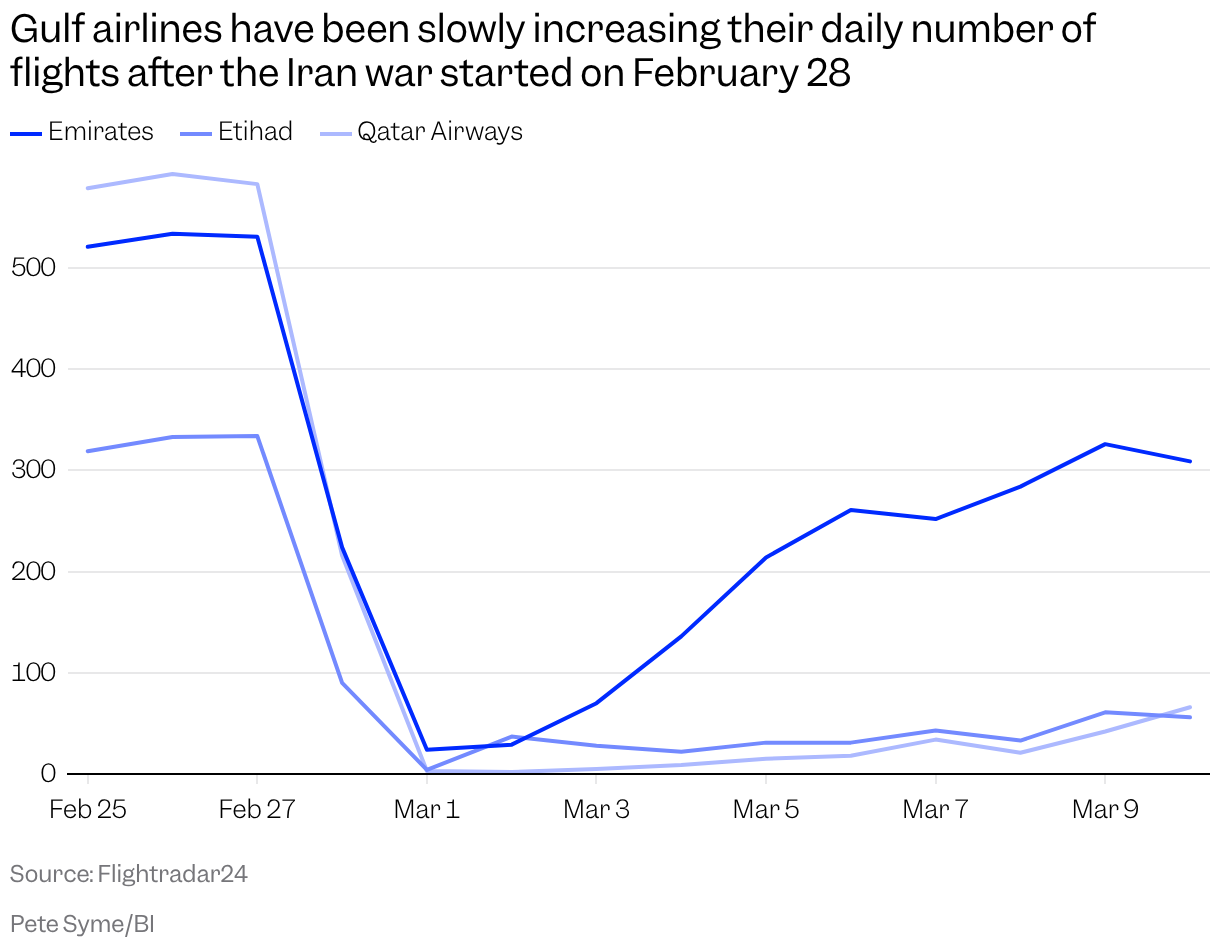
A chart showing the number of flights per day for Emirates, Etihad Airways, and Qatar Airways between February 25 and March 10, 2026.

Flights to the Middle East have resumed, but travel chaos is nowhere near over

Air travel is only getting more complex due to the Iran war.

Eleven days since the first strikes, some flights have restarted after the UAE partially reopened its airspace. However, cancellations and rising ticket prices spell headaches for travelers.

Dubai is leading the restoration of flights in the region.

Its airline, Emirates, operated less than 60% as many flights on Wednesday as on February 27, according to data from Flightradar24. That’s compared to 11% and 17% for Qatar Airways and Abu Dhabi’s Etihad Airways, respectively.

Emirates said last Friday it “anticipates a return to 100% of its network within the coming days.”

However, it still may not be plain sailing for customers. Flights into Dubai are often forced to circle around before landing due to Iranian drones or missiles.

Early on Wednesday, four people were injured when two drones fell near Dubai International Airport, the world’s second busiest airport for international passenger traffic last year.

Hours later, several inbound flights were again forced to enter holding patterns for 55 minutes.

“Safety, as ever, remains paramount as is our duty of care,” Emirates said in its statement.

Meanwhile, British Airways has canceled flights to the Middle East until at least March 28 — and to Abu Dhabi until “later this year.”

KLM, the Dutch flag carrier, canceled all flights to Dubai until March 28.

Rising ticket prices

Passengers flying in and out of the Middle East aren’t the only travelers affected, either.

“In general, it is likely airfares will increase in the short term, depending on the duration of the war,” Hans Jørgen Elnæs, an aviation analyst and advisor, told Business Insider.

Jet fuel is getting more expensive as oil prices have experienced huge volatility. Brent crude was around $90 a barrel on Wednesday morning — up 50% since the start of the year.

The Gulf airlines have become popular for offering stopovers between Europe and Asia, but many travelers are now looking for direct flights instead.

High demand and lower capacity have led to a “significant spike” in airfares on these routes, Elnæs said. “These ticket prices are not sustainable over time, in my view,” he added.

Thai Airways is raising ticket prices by 10% to 15% due to “overwhelming” demand and rising fuel costs, Chief Financial Officer Cherdchom Therdthirasak said Wednesday.

Also, Malaysia Airlines last week deployed additional flights from Kuala Lumpur to London and Paris.

The Middle East is also a vital air corridor for overflights, but airplanes have been forced to reroute north over the Caucasus or further west over Saudi Arabia.

Until at least next Wednesday, the European Union Aviation Safety Agency has banned European operators from flying over the region — including Saudi Arabia and Oman, whose airspace remains open.

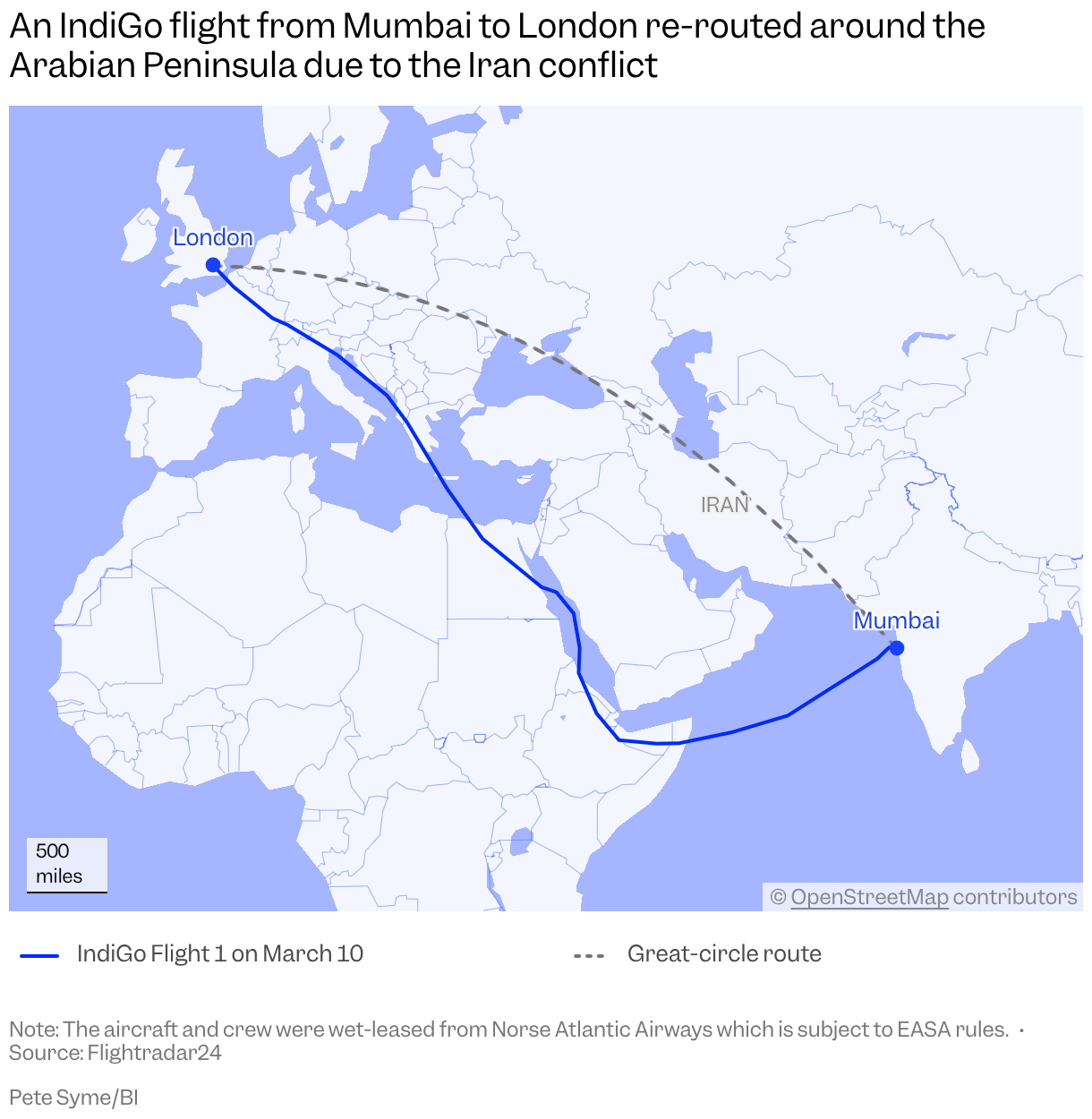
The Indian budget airline IndiGo is taking some particularly long detours; its flight from Mumbai to England is up to two hours longer than before.

That’s partially because it leases airplanes and crew from Norse Atlantic Airways for this journey. As it is a Norwegian airline, the EASA rules require it to fly over East Africa to avoid the Arabian Peninsula.

Some travelers look elsewhere

The World Travel & Tourism Council said Wednesday that it estimates the conflict is already negatively impacting the Middle East to the tune of at least $600 million a day in international visitor spending.

“It is too early to define the long-term impact on the Gulf region’s airlines and tourism. But in the worst case, if the war continues over time, it will hit hard on airlines, tourism, and GDP,” Elnæs told Business Insider.

“If airfares increase too much, it will hit demand, so the airlines need to find a balance here.”


A United Airlines Boeing 787-9 Dreamliner airplane departs from Los Angeles International Airport en route to Tokyo on October 17, 2025 in Los Angeles, California.

United Airlines is seeing more people transit through the US between Oceania and Europe.

Kevin Carter/Getty Images


The conflict has already prompted people to find new ways to travel between Europe and Oceania, such as taking a layover in the US. This is known as the Southern Cross Route and was formerly popular in the mid-20th century.

“Each day this week, we have booked over 1,000 people from Australia and New Zealand to Europe. Last year, we booked less than one a day,” United Airlines CEO Scott Kirby said at a Harvard event last Thursday, according to CNBC.

Some Europeans are also reconsidering where to vacation over the spring vacation period.

“We’ve seen, certainly, there’s a big collapse in bookings to the Middle East, and a big surge in bookings on short-haul airlines within Europe,” ​said Ryanair CEO Michael O’Leary.

Due to their cheaper tickets and strategy of hedging against fuel-price increases, such low-cost airlines often gain market share during geopolitical crises, Elnæs told Business Insider.


Source link

A map of the Middle East, showing the Strait of Hormuz in the Persian Gulf, with Iran highlighted and markers on Dubai and Tehran.

Tons of goods are stuck around the Middle East amid shipping and air chaos

Global supply chains are on edge after the US and Israel launched military strikes on Iran on Saturday, triggering widespread disruption across one of the world’s most critical trade corridors.

The fallout is hitting more than oil tankers moving through the Strait of Hormuz.

Container ships loaded with consumer goods, auto parts, electronics, and food are being rerouted or delayed, while air cargo networks are fracturing under sudden airspace closures.

“Ocean container services in the Persian Gulf have continued unaffected by the recent build-up of military forces in the region, but the escalation in conflict through military strikes means ships will now avoid the area, but for as short a time as possible,” said Peter Sand, the chief analyst at freight-rate analytics platform Xeneta.

On Sunday, MSC — the world’s largest container shipping line by capacity — said it had suspended all bookings for cargo to the Middle East until further notice.

Danish shipping giant Maersk paused Red Sea and Suez Canal sailings amid fears the Iran escalation could spill over into key shipping lanes. The company is rerouting vessels around the Cape of Good Hope in South Africa.

French shipping giant CMA CGM announced Monday it will impose an “Emergency Conflict Surcharge” effective Monday, citing rising security risks. The surcharge will add between $2,000 and $4,000 per container on shipments to and from Gulf and Red Sea countries.

On Saturday, CMA CGM ordered vessels inside or bound for the Gulf to “proceed to shelter.” It also suspended sailings through the Suez Canal and rerouted ships to the Cape of Good Hope.

German shipping giant Hapag-Lloyd introduced a $1,500 per standard container war risk surcharge and suspended vessel transits through the Strait of Hormuz.

Sailing around Africa, rather than through the Suez Canal, absorbs roughly 2.5 million 20-foot container units’ worth of global container capacity, according to Xeneta’s Sand.

Read more about the US-Iran conflict

Air cargo rates may rise

Air freight is also under strain.

Several Middle Eastern airspaces have been closed or restricted, disrupting passenger and cargo flights.

Parcel delivery giant FedEx suspended flights to and from markets including Bahrain, Israel, Qatar, Saudi Arabia, Kuwait, and the UAE, and halted pickup and delivery services in several Gulf countries.

Qatar Airways Cargo temporarily suspended operations due to the closure of Qatari airspace.

DSV, a Danish logistics company, said in an advisory that airspace restrictions are forcing carriers to suspend services or divert flights and lengthen routings.

With less cargo space available on key Asia-Europe and Middle East routes, air freight rates are likely to rise, space will tighten, and airlines may make short-notice schedule and pricing changes, according to DSV.

Ryan Petersen, the CEO of Flexport, wrote on X that conflict in the Middle East has removed 18% of global air freight capacity from the market.

If carriers begin omitting Gulf port calls, containers may be discharged at alternative hubs and trucked onward, wrote Xeneta’s Sand.

The broader concern, however, is what the escalation means for global trade flows through the Red Sea this year. The conflict comes after more than two years of disruption caused by Iran-backed Houthi attacks on commercial shipping.

“The repercussions of the joint military operation by the US and Israel against Iran and subsequent retaliatory action will see the further weaponization of trade and shatter hopes of a large-scale return of container shipping to the Red Sea in 2026,” wrote Sand.


Source link

Air-travel-has-been-thrown-into-chaos-with-cancellations-diversions.jpeg

Air travel has been thrown into chaos with cancellations, diversions, and airspace closures after strikes on Iran

Some of the world’s most congested airspace has been disrupted by the US and Israel’s strikes on Iran.

Iran, Iraq, Kuwait, Bahrain, and Qatar have all closed their airspaces. Dubai International Airport, the world’s busiest airport for international traffic, has suspended all flights until further notice.

A video shared by Flightradar24 showed airplanes deserting the region on Saturday morning.

Data from the aviation analytics firm Cirium shows that about 970 of the roughly 3,400 scheduled flights to the region have been canceled as of 11:00 p.m. Central European time. Factoring in outbound cancellations, that number is closer to 1,900.

The three major Middle Eastern airlines — Qatar Airways, Etihad Airways, and Emirates — operate major hubs that connect passengers to destinations around the world, creating a massive ripple effect of disruptions.

Qatar canceled nearly 60% of its flights on Saturday, Emirates canceled 65%, and Etihad canceled 50%, per Cirium. They’ve pre-emptively canceled hundreds more on Sunday.

Dubai International Airport — the world’s busiest megahub for international traffic — was damaged by an apparent missile strike on Sunday morning, local time. It’s unclear how that could further impact operations even if the airspace opens back up.

A Cirium spokesperson said these carriers collectively carry 90,000 transiting passengers through their hubs daily — not including those destined for the Middle East.

Major airline disruption

Even for flights that don’t land in the region, it’s a key corridor for flying between Europe and Asia. Some flights appeared to re-route over Saudi Arabia. Other airlines were avoiding the region altogether.

Detours are costly for airlines: They have to pay for extra fuel, labor, and any associated passenger compensation. And it’s possible mass diversions could overwhelm certain airports.

In a post on X, Emirates said it was temporarily suspending all flights to and from Dubai, its home base. That’s equal to about 500 flights a day, according to Cirium.

Emirates urged customers to check their flight statuses before visiting the airport. “We are actively monitoring the situation and engaging with relevant authorities,” the airline added.

Qatar Airways said all flights to and from the country were suspended until at least midnight UTC, or 7 p.m. ET. It also expects delays when usual operations resume.

Doha’s Hamad International Airport advised passengers “not to proceed to the airport.” Additional staff were deployed there to help passengers affected by the disruption, the airline said.

Etihad Airways, which is based in Abu Dhabi, said all departures and arrivals to the city were suspended until 2 p.m. local time Sunday.

Kuwait’s civil aviation ministry said a drone attack left some airport employees with minor injuries and damaged a passenger terminal.

Saudia said flights to and from affected airports were canceled until at least Tuesday.

Diversions and flights to nowhere

For those already in the air during the strikes, many flights diverted to other nearby airports or turned back to their origins.

Flightradar24 shows an Emirates flight from Orlando to Dubai diverted to Istanbul in a 14-hour flight to nowhere. A Qatar flight from New York to Doha crossed the Atlantic but then diverted to Rome after about 10 hours in the air.

An American Airlines flight from Philadelphia to Doha had flown for more than six hours when it turned around over Ireland and started heading back across the Atlantic Ocean, flight-tracking data showed. It looks like the total flight-to-nowhere will last about 13 hours.

An Air Canada flight from Toronto to Dubai was over the Mediterranean Sea before U-turning. Passengers appear to face a total journey time of 10 hours.

In a video statement posted to Truth Social on Saturday morning, President Donald Trump vowed to destroy Iran’s missile program and navy, and ensure that the country can “never” have a nuclear weapon.

There is likely more disruption to emerge. When Iran launched strikes on a US air base in Qatar last June, more than 160 flights were diverted.

Similar cancellations and reroutes happened in February 2022 when Russia invaded Ukraine, and again in April 2025 amid rising tensions between India and Pakistan.

Air India, for example, had to reroute flights around Pakistani airspace last year, requiring some long-haul services between India and Europe and North America to add a fuel stop in Vienna.

Some airlines, like Finnair, still fly the long way around Russia on certain long-haul treks rather than canceling the service altogether.


Source link

Photos-show-chaos-at-airports-as-passengers-are-left-stranded.jpeg

Photos show chaos at airports as passengers are left stranded due to canceled flights

  • Airports across the Middle East have suspended all flight operations until further notice, leaving many stranded.
  • The US and Israel launched strikes against Iran on Saturday, with Iran launching retaliatory strikes across the region.
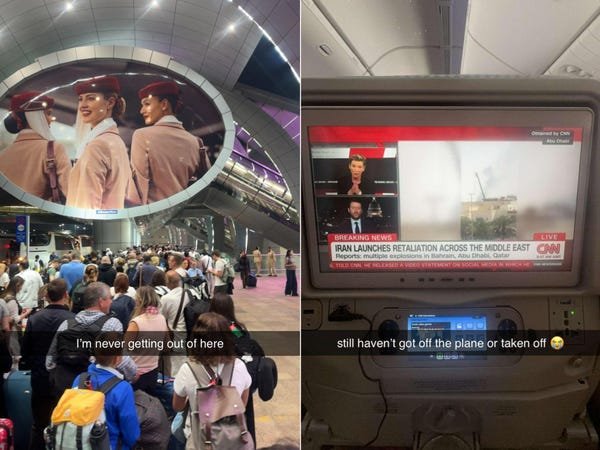
  • One Emirates passenger told Business Insider he was stuck on a plane for five hours without food before everyone was deplaned.

Travelers are in limbo as airport departure boards flip to red after air strikes in Iran resulted in closed airspace and triggered mass flight cancellations.

The heart of the chaos is in the Middle East, where airports in Dubai, Doha, and Abu Dhabi serve as megahubs for global connecting traffic. Data from the aviation analytics firm Cirium shows their home airlines — Emirates, Qatar Airways, and Etihad Airways — carry a combined 90,000 transit passengers a day.

That figure does not include the thousands of travelers whose final destination is the Middle East.

Emirates passenger Jaiveer Cheema, who was set to fly back home to the US on Saturday, told Business Insider that he was stuck on his plane for five hours with no food before everyone was deplaned and shuffled into the crowded terminal at Dubai International.

“The next several hours at the airport were chaos as no one knew what to do,” he said. “We spoke to several security guards and Emirates employees, and they all gave us different answers.”

Cheema said they stood in line after line until they eventually got a hotel voucher and took a bus to the lodging. He was still waiting for a room 90 minutes after arriving — it’s after midnight in Dubai; nearly 20 hours after he initially showed up for his 9 a.m. flight.

While many passengers are stranded within the region’s closed airspace, shuttered until further notice, the disruption has rippled far beyond it.

Flights to the affected region from places like London and the US have been canceled outright or diverted mid-journey — leaving travelers far from home in crowded airport terminals and uncertain when they will be able to depart.

Airlines have told passengers on social media to expect long wait times at airports and on customer-service phone lines as they try to manage the abrupt disruptions.

The sheer number of displaced people and planes on Saturday alone is expected to snowball worldwide if airports are unable to restart operations soon.

Passengers in Dubai were funneled into long snaking lines.

Jaiveer Cheema is one of the thousands of people stranded in limbo.

Courtesy of Jaiveer Cheema

Cheema spent hours in line but managed to secure a hotel voucher — though he had yet to secure a room when talking with Business Insider. He said he did not have answers from Emirates on what’s next.

An Emirates spokesperson did not immediately respond to a request for comment from Business Insider.

Passengers at Beirut Rafic Hariri International Airport in Lebanon are stranded.


Stranded passengers at Rafik Hariri International Airport

Passengers are stranded at Beirut Rafic Hariri International Airport on Saturday.

Anadolu/Anadolu via Getty Images

Airlines are pivoting their operations in response to the strikes. Lufthansa Group said it is suspending flights to Beirut, Tel Aviv, Amman, Erbil, and Tehran until March 7.

Airlines are suspending flights across the region, including Lebanon.


Cancelled flights at the Rafik Hariri International Airport on February 28.

Flight operations at the Beirut Rafic Hariri International Airport in Lebanon on Saturday.

Anadolu/Anadolu via Getty Images

In a statement shared on the Lufthansa Group’s website, the company said it would also suspend flights in additional areas.

“The following airspaces will also not be used until March 7: Israel, Lebanon, Jordan, Iraq, Qatar, and Iran,” the aviation corporation said. “In addition, Lufthansa Group airlines will suspend flights to and from Dubai and Abu Dhabi, Riad, and Dammam until March 1. Furthermore, the airspace of the United Arab Emirates will not be used until March 1.”

International flights at Tribhuvan International Airport in Nepal were disrupted.


Stranded passengers at Tribhuvan International Airport in Nepal.

Passengers waiting at Tribhuvan International Airport in Nepal on Saturday.

Navesh Chitrakar/REUTERS

The Tribhuvan International Airport shared a passenger advisory on Saturday, saying international flights “may be subject to delay, rescheduling, or cancellations” due to airspace restrictions.

Passengers flying with major airlines were told to check their flight status.


Passengers stranded at Tribhuvan International Airport in Nepal on February 28

Passengers at Tribhuvan International Airport in Nepal on Saturday.

Navesh Chitrakar/REUTERS

The Tribhuvan International Airport told passengers flying with major airlines — including Qatar Airways and Turkish Airlines — to coordinate with those companies to navigate travel issues.

Qatar’s airspace closure caused flight disruptions at Hamad International Airport.


Passengers at the Hamad International Airport in Qatar on February 28.

Passengers at the Hamad International Airport in Qatar on Saturday.

Stringer/REUTERS

Qatar’s Hamad International Airport said all aircraft movement has been temporarily suspended due to the country’s closed airspace.

“Our priority is always the safety of our passengers and employees. We are working closely with government stakeholders and airline partners to look after passengers that have been impacted,” the airport wrote in an advisory.

In London, flights to the countries Middle East were canceled.


A check-in counter for Emirates at London Gatwick Airport shows cancelled flights on February 28.

The Emirates check-in counter at London Gatwick Airport shows that flights are cancelled on Saturday.

Ben Stansall / AFP

Flights heading to the Middle East were also canceled at the London Gatwick Airport in England on Saturday.

London Gatwick Airport told some passengers to expect travel interruptions.


Passenger at London Gatwick Airport on February 28.

Passengers at London Gatwick Airport on Saturday.

Ben Stansall / AFP

A London Gatwick Airport spokesperson told Sky News it’s “expecting disruption to our Qatar and Emirates flights.”

Are you a stranded traveler with a story to share? Contact the reporters at ledmonds@insider.com and trains@insider.com along with your preferred contact information.


Source link

A map of the Caribbean with icons on each airport that had flights canceled on January 3, 2026, adjusted for size based on the number

Maps show the scale of the Caribbean air travel chaos — and how airlines are adding extra flights to rescue passengers

Almost 1,000 flights to and from the Caribbean were canceled on Saturday after the US raid on Venezuela.

The Federal Aviation Administration banned commercial aircraft from flying over Venezuelan airspace before expanding restrictions to much of the Caribbean.

Puerto Rico was the most affected, with 400 flights canceled to or from the main airport in San Juan.

There were also over 140 cancellations in the US Virgin Islands, and 91 in Aruba, which is only about 20 miles off the Venezuelan coast.

Using data from FlightAware, Business Insider put together this map to show the scale of the disruption. You can hover over an icon to see the number of cancellations at the airport.

After airspace restrictions ended early Sunday, airlines added dozens of extra flights to help passengers get where they needed to go.

The region is a particularly popular destination for vacationers seeking some winter sun over the New Year holiday.

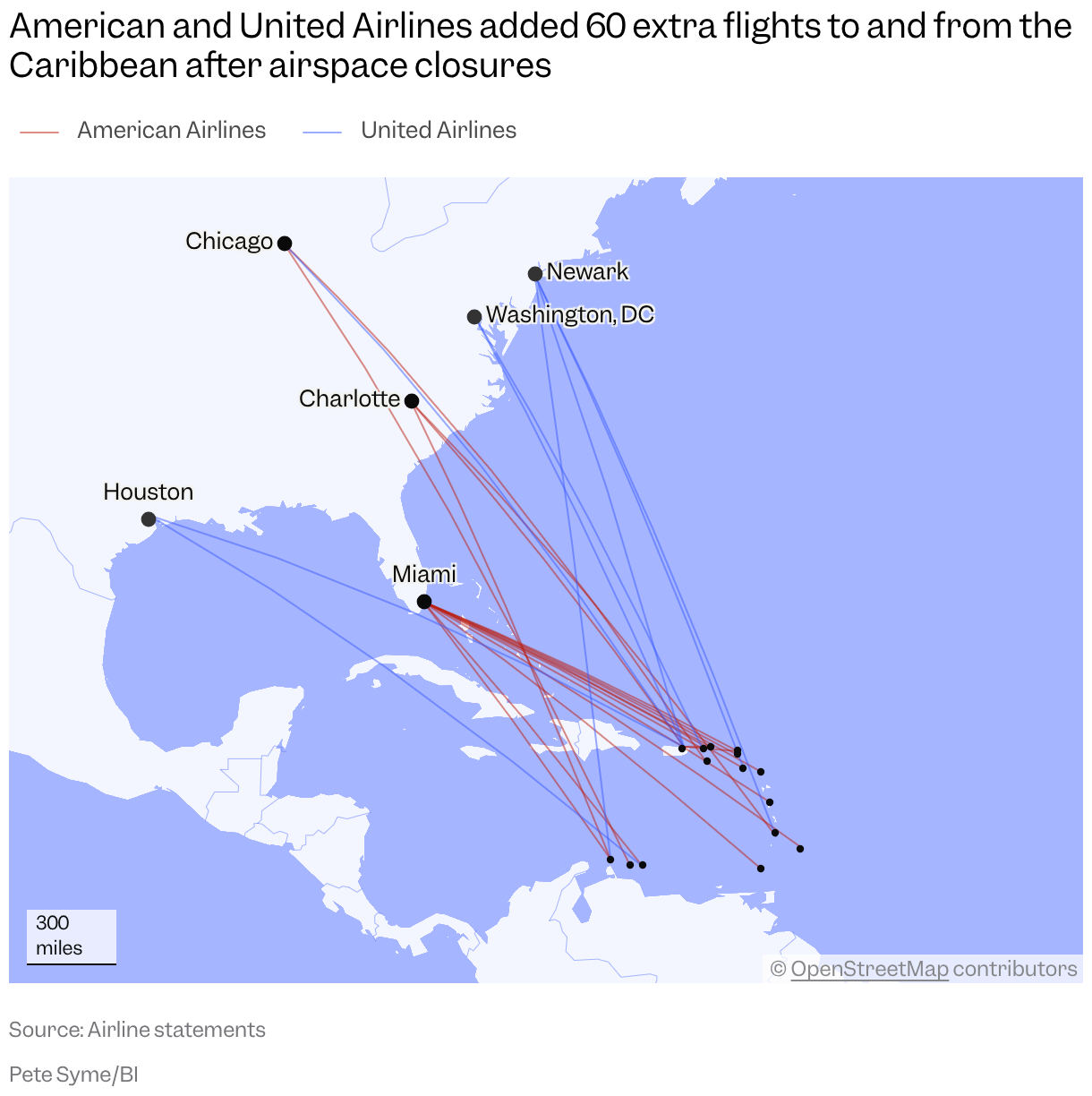
American Airlines added 43 extra flights on Sunday and Monday, with room for 7,000 passengers.

For the first time in over a decade, it operated interisland flights in the eastern Caribbean on Monday. Namely, to Puerto Rico from Anguilla and the British Virgin Islands.

American’s expanded schedule included deploying a Boeing 777-300, the largest model in its fleet, to ferry passengers between Miami and Puerto Rico.

United Airlines listed 17 additional flights scheduled for Sunday and Monday, to and from its hubs in Houston, Newark, and Washington, DC.

Delta Air Lines said that it has added space for 2,600 people on Monday. It didn’t immediately provide details of the extra flights it has scheduled.

Airlines have waived change fees and fare differences for passengers flying to or from the Caribbean, to rebook for flights later in the month.

Have you been affected by the travel disruption in the Caribbean? Reach out to this reporter at psyme@businessinsider.com or via Signal at syme.99


Source link

Misery-Map-shows-holiday-travel-chaos-on-both-coasts-with.jpeg

‘Misery Map’ shows holiday travel chaos on both coasts with canceled and delayed flights

A turbulent year for air travel isn’t over yet.

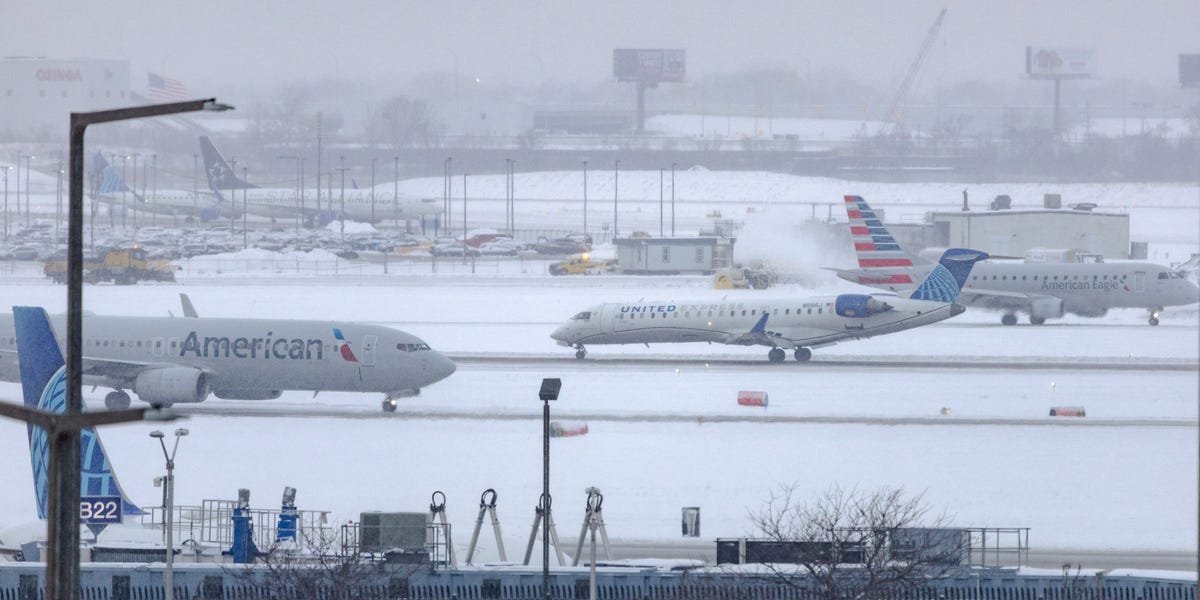
Snow and rainstorms hit multiple states on both coasts on Christmas Eve and Christmas Day, and are now heading for the Northeast, including New York, New Jersey, and Pennsylvania. Travellers are now having a difficult time getting home as major airports see mass delays and cancellations.

According to the “Misery Map,” published by FlightAware, which tracks real-time flight disruptions, there have been over 1,000 delays and more than 350 cancellations across the largest US airports as of 6:45 p.m. ET on Friday.

Here’s a look at the latest flight disruptions, and when you may expect to fly if your flight has been canceled.

The Midwest and the East Coast


Screenshot of Misery map

JFK International Airport is experiencing more than 369 cancellations and 210 delays.

Screenshot


The storm that first hit the Midwest is coming for the East Coast. New York City is set to see the most snow it has seen in years, since the last time it saw at least 4 inches of snow was January 2022. New Jersey and upstate New York will see similar weather conditions.

The NYC Emergency Management said in a press release that “snow is expected to develop Friday afternoon and intensify into steady, accumulating snow Friday night.” The National Weather Service has forecast 3 to 7 inches of snow with locally higher amounts possible.

According to FlightAware, JFK International Airport is experiencing 369 cancellations, with 210 on Friday alone. The situation at Newark Liberty International Airport is also not optimistic, with 244 cancellations and counting.

Based on the Misery Map, flights from airports around NYC to Chicago, Detroit, and Denver are seeing the highest number of delays and cancellations.

The West Coast


Misery map

Los Angeles International Airport is seeing a total of 283 delays and 41 cancellations.

Screenshot


The West Coast is slowly recovering from an exceptionally wet Christmas.

Over the past two days, most residents of California have received at least one weather warning as an atmospheric river accompanied by high winds, floods, and mudslides hit the Golden State. The NWS said that this Christmas season is the wettest one Los Angeles has experienced in 54 years.

The San Francisco International Airport said that 153 flights had been delayed on Friday morning due to windy conditions. To make matters worse, the police briefly shut down Terminal 1 due to a “suspicious package,” but then reopened it without explanation. By midday, FlightAware reports that a total of 381 flights from SFO have been delayed.

According to the Misery Map, flights from the Los Angeles International Airport to Seattle, Salt Lake City, Denver, and the East Coast are all experiencing disruptions. FlightAware counted a total of 283 delays and 41 cancellations.

The disruptions come at the end of a tough year for air travel.

High-profile plane accidents, including when an American Airlines Flight crashed into a Black Hawk helicopter, and the firing of hundreds of FAA employees by the White House DOGE office, triggered a newfound fear of flying among some Americans earlier this year.

The subsequent government shutdown also led to flying snags this year, as air traffic controllers who were left without pay called in sick, and some airports were paralyzed.


Source link