

A headshot of Insider's Pete Syme

Charts show how the Iran war has pushed ticket prices sharply higher on 3 major US airline routes

Your next flight could be twice as expensive because the Iran war is causing volatility in oil prices.

Brent crude is up more than 50% over the past month, to around $101 a barrel. Jet fuel costs are rising faster. The Argus US Jet Fuel Index is up 72% over the same period.

That spells difficulty for airlines because jet fuel is typically their biggest expense after labor. While many airlines around the world hedge against fuel costs, most American ones do not.

Using data from Deutsche Bank, Business Insider charted rising airfares in three major markets.

The data looks at the lowest available published fares 21 days in advance of the flights. The published fare doesn’t necessarily mean a ticket has been purchased for that amount, the Deutsche Bank research analysts said.

Cross-country flights, often known in the industry as transcontinental flights, have seen the biggest week-over-week spike — more than double, on average.

New York to Los Angeles is the country’s busiest domestic route, with a capacity of 3.4 million seats out of JFK Airport last year, according to OAG data.
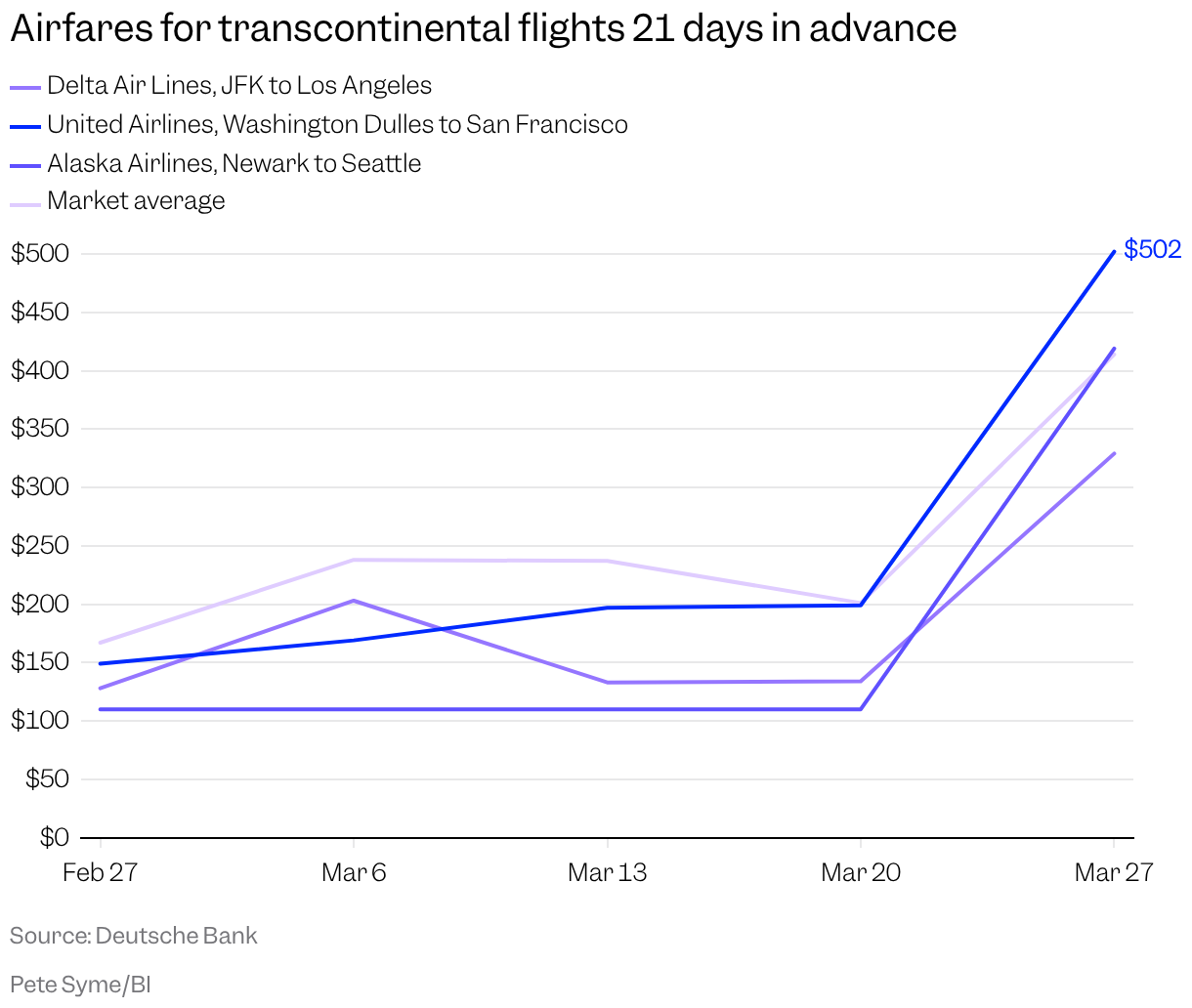
The average price of a transcontinental flight has risen from $167 to $414, Deutsche Bank’s analysis showed. In the past week, the average has spiked 107%.

United Airlines is offering flights from Washington Dulles Airport to San Francisco for $502, up from $149 a month ago.

International business travellers are also seeing flight prices rise.

New York to London is the country’s most popular international route, and the 10th-busiest in the world. Nearly 4 million seats were scheduled on flights between JFK and Heathrow last year, per OAG.
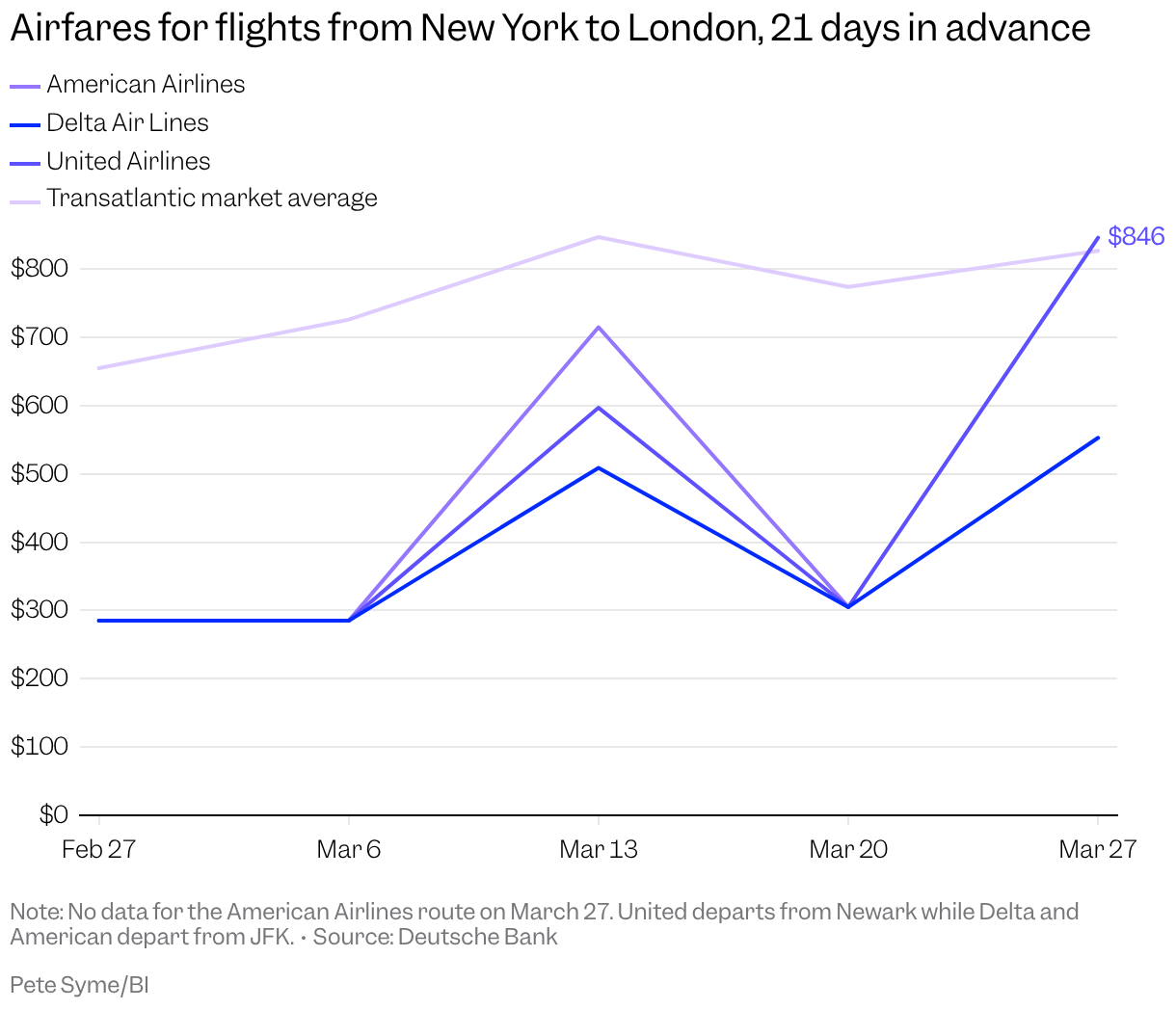
While the average Transatlantic flight is some 40% more expensive than a month ago, there are bigger rises for the New York-London route. However, it also appears more volatile here with a big dip last week.

Delta Air Lines’ service is up from $285 to $553 over the past month, while United’s is up to $846. That’s a 177% rise compared to a week earlier, according to Deutsche Bank’s analysis.

There’s bad news for vacationers, too.

Flights to the Caribbean on March 27 are up 58% on average compared to a week before.
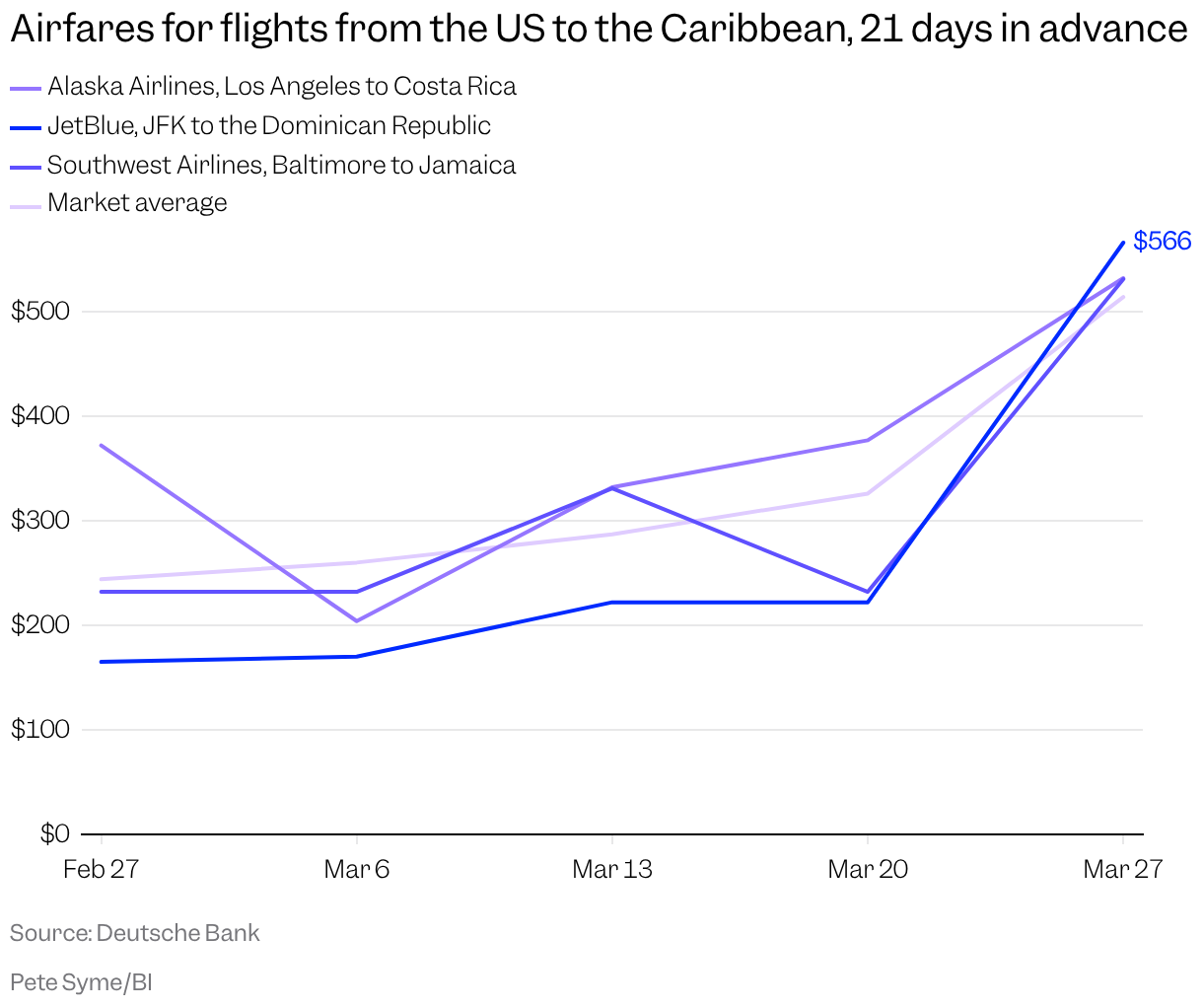
JetBlue’s flight from New York to Santo Domingo, Dominican Republic, has risen from $165 to $566 on March 27.

Compared to a year earlier, that’s a more than fourfold rise, Deutsche Bank found.

Southwest Airlines’ flight from Baltimore to Montego Bay, Jamaica, has more than doubled over the past week. And Alaska Airlines’ service from Los Angeles to San Jose, Costa Rica, is up 40% compared to a week earlier or 120% versus a year ago.



Source link

Taylor-Swifts-latest-business-move-is-another-attempt-to-hack.jpeg

Taylor Swift’s latest business move is another attempt to hack the charts — and it’ll probably work

Taylor Swift is the biggest-selling artist in the world by most reliable measures, so when she makes an unconventional business move — no matter how random or trivial it may appear — it’s worth paying attention.

On Friday, Swift unveiled the self-directed music video for “Opalite,” her latest single from “The Life of a Showgirl.” Upon release, the cameo-laden clip was available exclusively on Spotify and Apple Music, with its YouTube premiere scheduled for a two-day delay.

Streamers like Spotify and Apple Music specialize in hosting songs, albums, podcasts, and playlists — not visual works. Meanwhile, YouTube is famously a destination for music video lovers. So what gives?

As usual, when it comes to Swift, the answer seems to lie with her bottom line. In December, YouTube announced it would withdraw its streaming data from Billboard’s chart formulas because the music company tweaked its methodology so that streams from YouTube subscribers were weighted even more heavily than free streams. YouTube’s stance is that the ratio is unfair to fans.

Swift recently scored her longest reign yet on the Billboard Hot 100 with “The Fate of Ophelia,” the lead single from “Showgirl,” which charted at No. 1 for 10 weeks. With “Opalite” officially serving as its follow-up, Swift appears to be making moves to boost the song’s chart performance.

If fans were flocking to YouTube today to watch her new music video, none of those views would help “Opalite” reach No. 1 — and nobody wants to follow a personal best with a personal flop, least of all an athlete-style competitor like Swift.

Of course, this savvy tweak to the song’s promo schedule was paired with a physical release: a seven-inch vinyl single in “pearlescent blue,” only available in Swift’s online store for 48 hours.

How Taylor Swift moves, other artists tend to follow

Swift’s unyielding commitment to commerce isn’t just something to behold. It’s something to study. Swift’s sales tactics often become instructive for other artists.

Much has been made about Swift’s push to sell physical albums, for example, but many fellow pop stars have followed suit. Charli XCX released about two dozen vinyl variants for her 2024 album “Brat” and its deluxe editions. Sabrina Carpenter, a self-professed disciple of Swift’s work, released 13 vinyl variants last year for “Man’s Best Friend,” in addition to seven-inch singles, cassettes, and CDs. As a result, “Man’s Best Friend” scored the ninth-biggest vinyl sales week of the modern era, according to Billboard. (Seven of the top eight slots on that list belong to albums by Swift.)


Taylor Swift in the music video for

“The Fate of Ophelia” reached No. 1 on the chart dated October 18, 2025.


Taylor Swift/YouTube


So, it could very well mean that Swift’s strategic video rollout will start a trend as well. Although YouTube is the customary platform for music videos, customs can be changed, and she isn’t the only artist who cares about climbing the charts.

It could also be that Swift’s premiere delay will inspire YouTube to rethink its attitude toward Billboard. If one of the most influential celebrities in the world is delaying their content to your product, that could be bad for business — and it wouldn’t be the first time Swift convinced a major company to change its tune. Back in 2015, she criticized Apple Music for refusing to pay artists during a new user’s free trial. Within 24 hours, Apple updated its policy and tagged Swift in the announcement online.

It remains to be seen whether “Opalite” will affect the music industry beyond Swifties, but if the song’s lyrics are any indication, Swift is content to manufacture success on her terms — or, in her words, to make her own sunshine.


Source link