
Sam-Altman-says-concerns-of-ChatGPTs-energy-use-are-overblown.jpeg

Sam Altman says concerns of ChatGPT’s energy use are overblown: ‘It also takes a lot of energy to train a human’

Sam Altman is pushing back on the idea that ChatGPT consumes too much energy.

“One of the things that is always unfair in this comparison is people talk about how much energy it takes to train an AI model relative to how much it costs a human to do one inference query,” Altman told The Indian Express last week on the sidelines of a major AI summit. “But it also takes a lot of energy to train a human.”

Altman suggested it’s not an apples-to-apples comparison, arguing that it’s unfair to discount the years spent nurturing and educating someone to be capable of making their own inquiries.

“It takes a lot of energy to train a human,” he said, prompting some laughter in the crowd. “It takes, like, 20 years of life, and all of the food you eat during that time before you get smart.”

Altman said the clock really began thousands of years ago.

“It took, like, the very widespread evolution of the 100 billion people that have ever lived and learned not to get eaten by predators and learned how to, like, figure out science or whatever,” he said.

Altman also called out what he said were “totally insane” claims on the internet that OpenAI is guzzling down water to power ChatGPT.

“Water is totally fake,” Altman said, when asked about concerns AI companies use too much water. “It used to be true, we used to do evaporative cooling in data centers, but now that we don’t do that, you know, you see these like things on the internet where, ‘Don’t use ChatGPT, it’s 17 gallons of water for each query’ or whatever.”

In June, Altman said that the average ChatGPT query consumes roughly the amount of energy needed to power a lightbulb for a few minutes.

“People are often curious about how much energy a ChatGPT query uses; the average query uses about 0.34 watt-hours, about what an oven would use in a little over one second, or a high-efficiency lightbulb would use in a couple of minutes,” he wrote on X.

Altman said it is fair as a whole to point out the AI industry’s overall energy consumption because of the large growth in usage. He said it’s why he and other AI CEOs have pushed alternative energy sources like solar, wind, and nuclear.

Unlike other CEOs, namely xAI’s Elon Musk, Altman is dismissive of the idea that space-based data centers are realistic in the next decade, a concept that some companies have floated as a way to reduce energy consumption.

Outside of OpenAI, Altman is a major investor in nuclear energy. He previously served as chairman of Oklo, a nuclear energy startup, and has been a major backer of Helion, which plans to build what it calls “the world’s first fusion power plant” in Washington state.

In the US, data center energy consumption is becoming a major topic. Last month, President Donald Trump said he was working with tech companies on “a commitment to the American people” to ensure that citizens don’t pay higher energy bills because of a nearby data center.

Consulting firm McKinsey & Company estimated last year that data centers could account for 14% of total power demand in the US by 2050.


Source link

ChatGPTs-year-end-recap-is-here-—-and-it-tells-you.jpeg

ChatGPT’s year-end recap is here — and it tells you how many em-dashes you exchanged

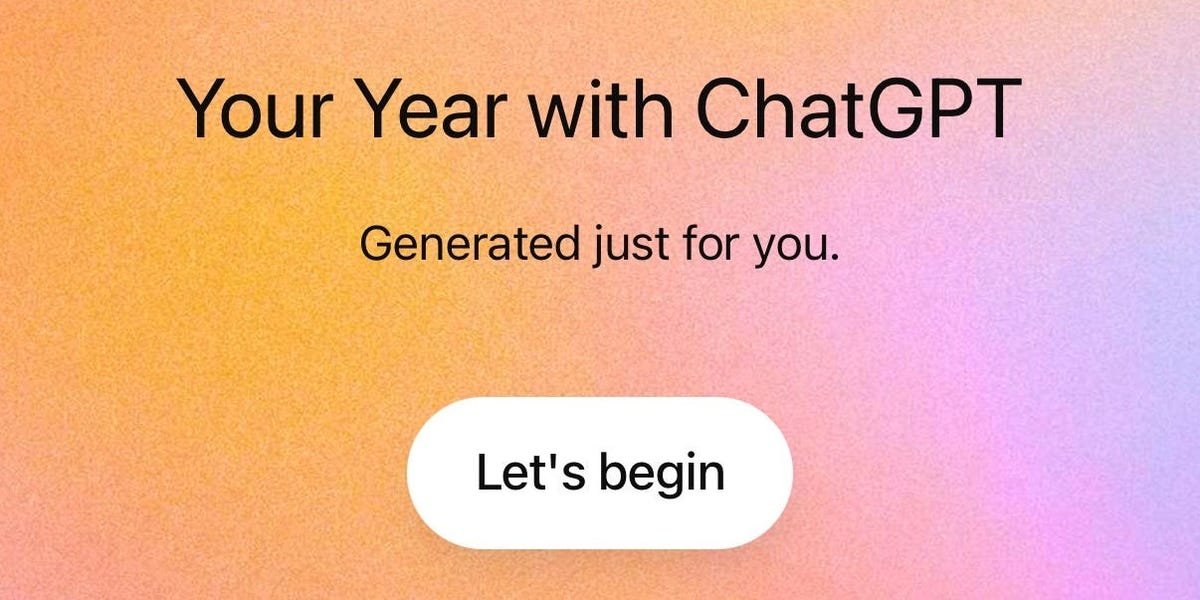
ChatGPT doesn’t want to be left out of the “Wrapped” party that Spotify popularized. So say hello to “Your Year with ChatGPT.”

OpenAI launched the new retrospective on its app on Monday, informing users about the top themes of their chats, the number of messages they have sent, and the awards they have earned.

It’ll even generate some pixel art that depicts some of the your themes.

The recap is available in the US, UK, Canada, New Zealand, and Australia. To see it, click the plus button in the app and ask, “Show me my year with ChatGPT.”

It’s available to Free, Pro, and Plus users, but not those with a business or enterprise account. (So for those with ChatGPT accounts through your work, you likely won’t be able to brag to your boss about your ChatGPT stats.)

OpenAI joins the many companies that are rolling out user rundowns for 2025. Alongside the common streamer packages from Spotify and Apple Music, there are recaps this year from LinkedIn, Uber, Dunkin’, Snapchat, Strava, Partiful, and more.

All these apps promise to show you what you’ve been up to for the past year — perhaps lightly roasting you in the process.

ChatGPT’s rundown begins with a piece of poetry, followed by the three most prominent themes, based on the user’s chat history. Then it gets into the statistics.

Users can learn how many messages they sent, their total number of chats, and their chattiest day. They can also see how many em-dashes have been exchanged throughout the chats, a figure ChatGPT often uses.


Chat stats are pictured in a Year in ChatGPT.

ChatGPT informs users of the exact number of em-dashes they exchanged.

Screenshot via Steven Tweedie


Next, the user can learn about their chat style. This is a measure of tone: ChatGPT told me that I spoke “casually, wryly, and directly.”

Then come the awards and accolades. ChatGPT awarded me the “Most Likely to Google, ‘Is this Flight Worth It?'” It’s a bit ironic — I wouldn’t Google that, I’d ask ChatGPT.

My archetype was determined to be the tinkerer, a title given to 8.5% of users. The title meant I learned by trying, and that I used ChatGPT to experiment.

OpenAI has improved its image and video creation models, recently rolling out Sora 2. The recap features an AI-generated piece of pixel art inspired by the year. I asked mine about moving to Brooklyn; it included a matcha.


A piece of pixel art from my Year in ChatGPT

ChatGPT generates pixel art describing your year.

Screenshot via Henry Chandonnet


Other features are more interactive. Want to learn what your 2026 has in store? You’ll have to wipe away the “mists of mystery” (which looks more like heaps of snow) to learn your fate. Reload the page, and you’ll see another fortune.

With that, ChatGPT’s recap comes to a close, but not before sharing an inspiring message.

“Across all the drafts, questions, and rabbit holes, you found a place to work things out,” it said. “And that’s no small thing.”


Source link