
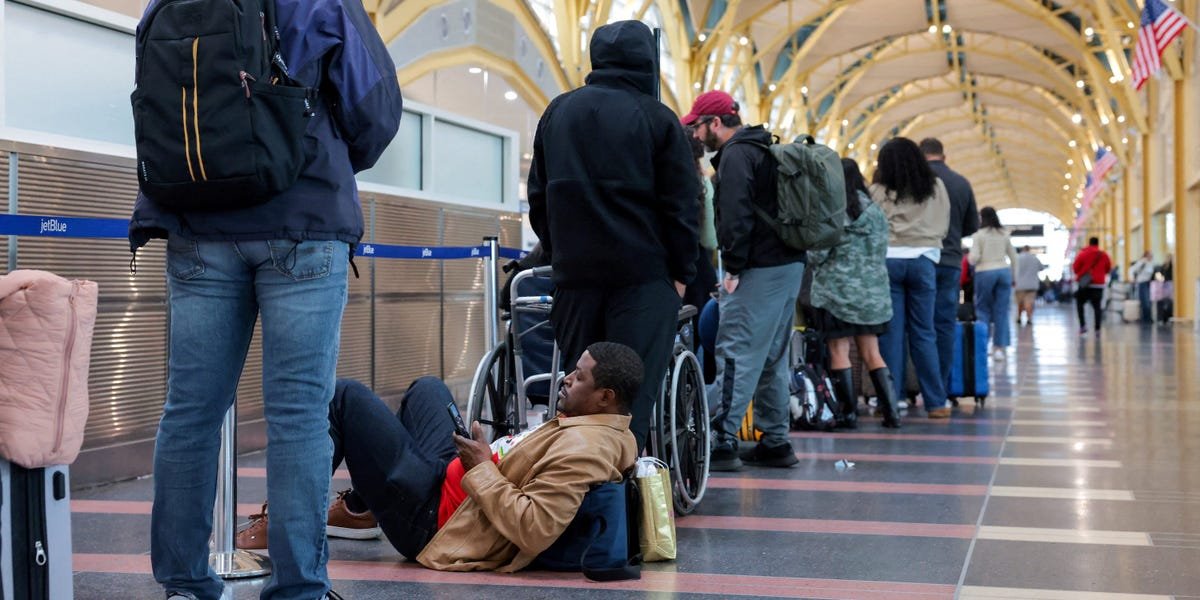
Where-TSA-wait-time-chaos-is-the-worst-and-how.jpeg

Where TSA wait time chaos is the worst, and how to check if you’ll be impacted

If you’re flying in the US, get ready to stand in line.

Airports across the US are continuing to see lengthy waits at security checkpoints as scores of TSA workers call out due to missed paychecks.

A partial government shutdown has left the Department of Homeland Security and its Transportation Security Administration unfunded and their agents unpaid at the height of the spring break travel season.

As many as 10% of all TSA agents called out on several days this week, DHS updates showed, with absence rates averaging as much as 20% in some airports.

Security lines in affected airports are spiking unpredictably from day to day, and sometimes even from hour to hour.

“The current unpredictability is being driven by unpredictable staffing levels, basically, how many TSA officers are showing up for work on any given day,” Sheldon H. Jacobson, the founder professor of engineering at the University of Illinois Urbana-Champaign and an expert on airport security screening, told Business Insider.

“TSA officers have historically been cross-trained to do many different tasks, so the number that show up is the key factor,” Jacobson said.

How long are the TSA delays?

Delays at TSA checkpoints across the US have been unpredictable in recent days, with some airports hit much harder and wait times varying massively from day to day.

On Thursday, among major airports, delays appeared to be worst at Houston George Bush International Airport, where lines at some checkpoints exceeded 2 hours. By late thursday night, the waits were 5 minutes at the maximum.

Hartsfield-Jackson Atlanta International Airport, the world’s busiest by passenger numbers, has been among the worst-affected, with delays of over 90 minutes on most days this week. By late Thursday night, however, there was no wait.

In a Wednesday X post, the airport encouraged travelers to allow extra time for screening and to arrive at least 3 hours before their flight.

In an X post on Tuesday, the airport said there was congestion at the international checkpoint due to domestic travelers trying to bypass long lines in the domestic terminal. The airport said domestic travelers should use the domestic checkpoints.


Passengers in line at Fort Lauderdale airport.

Passengers faced lengthy lines at Fort Lauderdale-Hollywood International Airport on Thursday, March 19. 

Taylor Rains/Business Insider


Lines at checkpoints in three terminals at JFK, the New York area’s biggest airport, were over 35 minutes early Friday morning, while waits at Newark were 7 minutes. At LaGuardia, the wait was around 1 minute.

During the Thursday morning travel rush, waits at Dallas-Fort Worth were over 25 minutes.

At Denver, the US’s 4th-busiest airport, lines were 15 minutes on Thursday. night.

In Philadelphia, lines stretched down escalators in the terminal building, as video shared by one local news reporter showed.

Some airports have so far avoided the hourslong queues. Business Insider’s Taylor Rains flew out of Las Vegas on Monday and saw minimal TSA lines.


The empty TSA line at Las Vegas airport.

The general and TSA PreCheck lines at Las Vegas airport were empty on Monday night. 

Taylor Rains/Business Insider


However, the unpredictable nature of the delays means travelers should plan for long waits even if their airport hasn’t yet experienced problems. Airports like Denver and Seattle have asked the public for food, gift cards, and basic supplies to support TSA staff working without pay.

How to check TSA wait times

The easiest way to avoid the stress of missing your flight is to give yourself extra time in the airport. Many airports are advising travelers this week to arrive up to three hours before their flight, even for domestic flights.

Many airports, including major hubs like Atlanta, Houston, JFK, Newark, Philadelphia, Dallas-Fort Worth, and Denver, have been posting TSA wait times live on their websites.


Long security lines at Houston Hobby Airport.

Travelers at Houston Hobby Airport faced lines up to three hours long earlier in March. 

Brett Coomer/Houston Chronicle via Getty Images


These can also provide more specific insights. For example, DFW’s website shows the wait times at each checkpoint.

You can also use the MyTSA mobile app. It provides estimated wait times in 15-minute intervals based on average checkpoint data. The app, however, will use historical data if the live data cannot be retrieved. The TSA also says it is not “actively” managing its sites during the partial shutdown, and so the app may not always be updated.

How long will the TSA delays persist?

On Thursday, Transportation Secretary Sean Duffy said airport delays could get even worse.

“As we get into next week and they’re about to miss another payment, this is going to look like child’s play, what’s happening right now,” Duffy said on CNBC.

Some airports could even be forced to shut, both Duffy and Adam Stahl, the TSA’s acting deputy administrator, said.



Source link

TSA-delays-Which-airports-have-long-lines-and-how-to.jpeg

TSA delays: Which airports have long lines, and how to check the wait time at your airport

TSA checkpoints at US airports continue to face pressure amid an ongoing partial government shutdown that is now nearly a month old.

Numerous airports are telling passengers to allow longer than usual to clear security, as staff shortages cause more congestion and longer lines.

On Friday, Austin-Bergstrom International Airport told travelers to arrive up to three hours before their flight. Photos and videos shared by travelers online showed lines stretching from the terminal building into the parking lot.

Ava Brendgord, a reporter for local NBC affiliate, KXAN News, shared a video of the line snaking out of the building at around 5 a.m. local time on Friday morning.

By 7 a.m., lines had returned to more normal levels, local news outlets reported.

Similar scenes played out at many other airports this week, and things could worsen over the weekend as Americans travel for Spring Break and TSA agents face their first $0 paycheck, increasing the likelihood they will skip work.

Though waits were nowhere near the three hours some passengers experienced at Houston Hobby Airport last weekend, there was significant congestion at some airports on Friday morning. One Business Insider employee traveling from LaGuardia saw a lengthy line, and at JFK, wait times exceeded 20 minutes at most TSA screening points.

Atlanta Airport, the world’s busiest by passenger numbers, said it expects to serve 250,000 travelers this weekend, and advised people to arrive three hours early.

How to check wait times


Travelers wait in line at New York's LaGuardia airport.

Travelers wait in line at New York’s LaGuardia airport.

Cadie Thompson/Business Insider


The easiest way to avoid the stress of missing your flight is to arrive as early as you can. Many airports are advising travelers this week to arrive up to three hours before their flight.

To check TSA wait times, many airports, including major hubs like Atlanta, Houston, JFK, Newark, Philadelphia, Dallas-Fort Worth, and Denver, post them live on their websites.

These can also provide more specific insights. For example, DFW’s website shows the wait times at each checkpoint.

You can also use the MyTSA mobile app. It provides estimated wait times in 15-minute intervals based on average checkpoint data. The app, however, will use historical data if the live data cannot be retrieved. The TSA also says it is not “actively” managing its sites during the partial shutdown, and so the app may not always be updated.


Source link

A headshot of Insider's Pete Syme

Here’s how to check TSA wait times before your flight

Air travel is facing disruption due to long lines at airport security checkpoints.

Sunday and Monday saw hourslong waits at several airports, as Transportation and Security Administration officers missed their first full paycheck since the partial shutdown began.

At Houston’s Hobby Airport, travelers were warned to expect security lines stretching up to three hours. Delays were also reported at New Orleans, Atlanta’s Hartsfield-Jackson, and Miami International.

A political dispute over federal funding for the Department of Homeland Security has led to TSA officers working without pay.

Airport operations had largely avoided major disruption until Sunday, when some staff did not show up to work.

While disruption seems to have moderated on Tuesday, travelers are being advised to arrive early and allow extra time to clear security, as wait times can shift depending on staffing levels and peak travel periods.

Here’s how you can stay prepared

One simple way to monitor conditions is to check the website of the airport you’re flying from.

Many airports, including major hubs like Atlanta, Houston, JFK, Newark, Philadelphia, Dallas-Fort Worth, and Denver, post live wait times on their websites.

These can also provide more specific insights. For example, DFW’s website shows the wait times at each checkpoint.

On Tuesday morning, all these airports had average wait times of under 30 minutes.

Most US airports also frequently update their own websites with travel advisories for passengers. For instance, on Tuesday morning, Houston Airports, which manages both Houston Hobby and George Bush International, has a notice telling travellers to arrive early.

You can also use the MyTSA mobile app. It provides estimated wait times in 15-minute intervals based on average checkpoint data.

It should be noted that the app says it sometimes uses historical data if the live data cannot be retrieved. The TSA also says it is not “actively” managing its sites during the partial shutdown, and so the app may not always be updated.

Alternatively, flight-tracking websites like Flightradar24 and FlightAware can also give insights into airport conditions.

FlightAware has a “Misery Map” which shows flight delays at airports around the country, which could be affected by the security lines.

Flightradar24 also shows the average delay for departing flights if you select an airport.

TSA PreCheck lanes remain open nationwide, though the agency has warned they could be suspended at individual airports if staffing shortages worsen.


Source link

Im-at-CES-in-Las-Vegas-to-check-out-the.jpeg

I’m at CES in Las Vegas to check out the latest in autonomous driving. Here’s what I’ve learned so far.

  • Robotaxis and autonomous cars once again have a large presence at CES 2026.
  • Several companies, including Amazon’s Zoox, are providing off-site demos.
  • Business Insider is providing an on-the-ground look at the latest in the advanced mobility space.

Business Insider is taking on CES 2026.

I’m on the ground in Las Vegas from Tuesday to Thursday, taking in all there is to know about the latest in the driverless space.

Robotaxis and self-driving cars have already had an outsize presence at the tech conference, especially in the previous hype cycle of the late 2010s and early 2020s.

Things have changed since then. The industry has largely moved on from mere concepts and technology validation to: How are we going to realistically scale autonomy?

It’s day one of the conference, and there’s already a lot to take in.

Nvidia CEO Jensen Huang unveiled the Alpamayo family, which will serve as an autonomous-driving stack for OEMs to deal with those stubborn edge cases — or the “long tail” of self-driving.

Uber and Nuro showed off an early look at the Lucid Gravity SUV that the companies hope public riders will be able to take by late 2026.

I’ll be spending less time at keynotes and speaker events and more on real-life demonstrations and meetings with industry leaders and commentators in autonomy

Think of this as my personal notebook, where I jot down everything I’ve learned and seen at the conference.

Check back in for more updates.

Amazon-backed Zoox is unlike any other robotaxi.

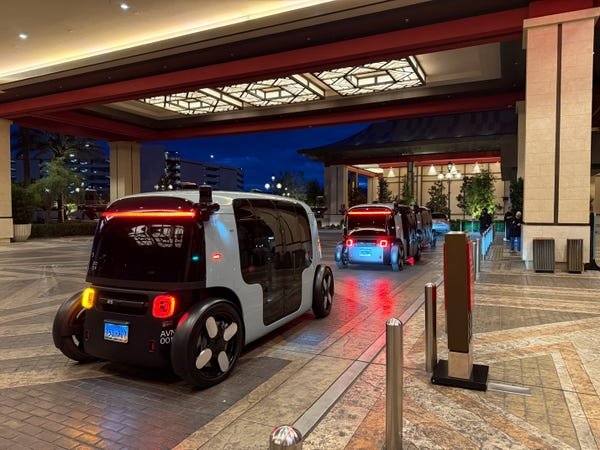
Zoox robotaxis line up in front of Resorts World Las Vegas

Lloyd Lee/BI

This is the first year Zoox, an Amazon-backed robotaxi company, will be giving live demonstrations of its service during CES.

I got to take a ride in one on Monday night in front of Resorts World. (The company tagline that I saw from an ad at the Harry Reid International Airport was: “Don’t just do the Strip. Zoox it.”)

My immediate thoughts were that Zoox feels unlike any other robotaxi or pseudo-robotaxi on the market. It felt more like I was on a theme park ride than in an everyday car we’re familiar with.

Unlike Waymo’s robotaxis, Zoox is not a regular car you could buy that’s been retrofitted with sensors. The Zoox car is bi-directional — meaning there’s no real front or back of the car — and the inside has no steering wheel, just seats.

The robotaxis were clearly a great tourist attraction from what I saw. My Uber driver wasn’t too happy about them.

Uber, Lucid, and Nuro have big plans to scale.


Uber, Lucid, Nuro

Left to right: Uber’s Sarfraz Maredia, Lucid interim CEO Marc Winterhoff, and Nuro cofounder Dave Ferguson.

Lloyd Lee/BI

Uber, Lucid, and Nuro had a swanky cocktail hour at Fontainebleau Las Vegas, where they quite literally wined and dined a room full of reporters, analysts, and investors: endless glasses of wine and an open bar, lobster tails, jumbo shrimp, too many appetizers to count, and a giant charcuterie board — the works.

Maybe understandably so? 2026 will be a big year for the three companies.

Uber’s plan is to roll out a robotaxi service by late 2026. The first market is San Francisco, where Uber will directly compete with Waymo. These two companies are partners in other markets, like Austin.

“We’ve been moving very, very quickly,” Nuro’s co-CEO and cofounder Dave Ferguson said. “We signed this partnership last July. We’re already testing the production-intent vehicles on public roads. And very soon, we’re going to have tens of thousands of them worldwide.”

Here’s a 60,000-pound John Deere combine for scale.


John Deere

John Deere’s X9 combine.

Lloyd Lee/BI

A quick image to get a sense of how big CES’s mobility division is at West Hall of the convention center: There’s a 60,000-pound combine from John Deere that’s sitting in the middle of the showroom.

The combine is one of the world’s largest on the market, according to Julian Sanchez, an engineer at the machinery company.

Even so, John Deere doesn’t even have the largest footprint on the floor. This year, it’s Hyundai.

The combine isn’t autonomous in the way we think about self-driving cars, Sanchez told me, but it is self-steering.

The world got a reality check on self-driving cars since the last hype cycle.


Tensor

Tensor aims to sell a personally-owned vehicle that will have Level 4 driving.

Lloyd Lee/BI

There’s a lot of talk of self-driving cars in the automotive industry, but the scope of what it can realistically achieve has narrowed down in the last decade or so.

Paul Costa, an ex-Apple veteran of 25 years who worked on the company’s abandoned self-driving car project, gave me a bit of interesting color from what he saw at CES in 2015 — when the driverless car hype was reaching its peak — and what’s different now.

“My sense at the time was that people really wanted to focus on Level 5 autonomy,” Costa, who now leads Ford’s electrical engineering team, told me. Level 5 is the highest level of autonomous driving set forth by the Society of Automotive Engineers. That means full autonomy in all weather conditions and no geofences. Waymo is currently Level 4.

The tone has been brought down to reality, according to Costa. The focus is on highly advanced driver assistance systems and eyes-off driving or Level 3 systems, he said.

“Now, I feel like here in 2026, L3 is extremely interesting,” Costa said. “It’s interesting for me to see how the industry — its focus has changed over the years.”

Signup Today: Connectivity and Tech Pro by Business Insider Intelligence


Source link