I-want-another-child-but-my-husband-doesnt-Ive-considered.jpeg

I want another child, but my husband doesn’t. I’ve considered leaving, but instead, I’m looking for other ways to feel fulfilled.

When I was married to my first husband, I learned during a routine gynecology exam that I had an issue that could make pregnancy and childbirth complicated.

Yet, four months into my second marriage, I became pregnant with our first child. As it turned out, that earlier diagnosis did not prevent me from getting pregnant or cause any complications.

My husband initially did not want children, and he took the news hard at first. But then he surprised me. He embraced the idea of fatherhood more fully than I could have imagined.

Raising our daughter has been challenging in all the ways people warn you it will be. It is exhausting, relentless, and humbling. But it has also changed us irrevocably. She made our lives bigger. She turned ordinary days into an adventure, even when we are running on fumes.

That is why one night, when I was weepily looking at her baby photos, I turned to my husband and asked, “When can we have another?”

He shot it down as quickly as he could. “I don’t want any more kids,” he said. “She’s perfect for me.”

Since then, we have had that difficult conversation a hundred more times, and his answer has stayed the same.

I’ve had to create a safe space to talk this through

The question of having a second child isn’t an easy one to answer.

“It is a common challenge for couples,” Amber Trueblood, a licensed marriage therapist, told me recently when I told her about our rift. “Parenthood is hard on a marriage, and for some partners, the idea of doing everything all over again isn’t exciting. It’s terrifying.”

The hardest part for me is that my desire feels so clear. I can picture another child in our family. I can picture our daughter with a sibling. I can picture the kind of home I thought we were building.

But my husband’s no is not coming from nowhere, and neither is my yes. Trueblood reminded me that in most couples, there are real reasons underneath each position.

“Perhaps one partner feels financial pressure or fears passing on a genetic anomaly, rendering them incapable of imagining the benefits of having another child,” she said. “Or one partner fears raising their only child without siblings because of their own very special sibling relationships, rendering them incapable of imagining raising an only child in a happy and complete way.”

I do not know if that applies to us, but I’m now trying to broach the subject from a new angle: explaining to each other why we want what we want. Trueblood explained that when neither person feels pressured and can openly share their beliefs, the conversation can shift.


Claire Volkman and her daughter kissing

The author is now prioritizing her daughter.

Courtesy of Claire Volkman


“Without feeling that pressure, each person is much better able to absorb and explore both their own feelings and their partner’s feelings,” she told me. “You may find a shift happens in one or both partners if neither feels they are being challenged or manipulated.”

I debated leaving, but I’m staying no matter what

Should I leave? This is the question I do not want to ask, but it is there. There really isn’t a compromise that gives both people what they want. You either have another child or you do not.

Trueblood told me that in these situations, partners have to ask themselves a hard thing honestly. “Can I release my frustration and resentment toward my partner so that we may have a strong, healthy, loving relationship moving forward and a happy home for our current child(ren)?” she said.

For some people, the decision is straightforward. They want another kid, their partner does not, and they are not willing to negotiate. Other people find ways to feel fulfilled in the life they have, or hope feelings shift as their child grows.

Instead, I’ve found fulfillment in relishing my one child and spoiling her in ways I couldn’t do with multiple. Pouring into my daughter has helped a lot.

I’m still a little hurt, and my heart aches every time someone I know announces a pregnancy.

The book isn’t over, though, and it’s a conversation we sometimes broach when tensions are very low. Whether we end up with more or live with just our perfect one, I know it will be the right decision for us.

Navigating this struggle together is a testament to the strength of our relationship.


Source link

Im-an-American-raising-my-child-in-Denmark-Kids-here.jpeg

I’m an American raising my child in Denmark. Kids here are trusted to take risks — and parenting feels easier.

Growing up, I knew two things: I wanted to be a mother and to live abroad one day.

Both came true when I met my Danish husband while traveling solo almost a decade ago. Not long after, I moved from New York City to Copenhagen, which was ranked first in the Happy City Index for 2025.

We had our Danish-American son, Aksel, just over three years ago, and today we live in central Copenhagen. I now experience Danish society more fully through the reality of raising him here.

Having Aksel made me understand why Denmark earns its praise. Here, parents are encouraged to trust children’s independence and rely on community support. In the US, parenting is more often shaped by caution and a stronger emphasis on individual responsibility.

My son goes on adventures at day care

This may be my favorite example of that trust: one afternoon, when Aksel was about a year old, I picked him up from vuggestue (day care) and learned his class had gone on a field trip earlier that day. I didn’t sign a permission slip, nor did I receive an email.

Since then, I’ve been surprised by updates to Denmark’s parent-teacher app, Aula. I’ll receive photos of Aksel riding the Metro or exploring Rosenborg Castle during school hours, all without my prior knowledge.

Growing up in the Connecticut suburbs, that would have been unthinkable. I remember even a trip to the town center (just a five-minute walk from my high school) required signed permission slips and repeated reminders to parents.

This is because a stronger suing culture in the US often means safety concerns extend beyond protection to liability. Denmark operates on a different premise, with little fear of lawsuits by parents and a general trust in educators and parents to exercise judgment.

Public life in Denmark is child-centric

That child-first mentality extends into public life. When Aksel was an infant, I used to refer to Copenhagen’s mall as the “milk stop” because there were always proper family rooms for feeding and changing (including in men’s bathrooms!). Restaurants often include play areas, and even formal dining establishments have offered Aksel a highchair.

In contrast, when traveling with Aksel in the US, I always feel as if I’m somehow disrupting adult systems. For example, I remember meticulously planning subway routes in Manhattan because so few stations are stroller-friendly.

In Denmark, public spaces actively accommodate families, reducing stress by meeting children’s needs without explanation. Accessibility features like ramps built into staircases are standard, and the idea of “play” is prioritized. Copenhagen is even designed so that anyone can walk to a beach or park in 15 minutes.

That same thinking shows up in everyday transportation. Like many parents here, I take Aksel to daycare on a cargo bike (the Danish equivalent of the “soccer mom van”) because Denmark invests in supporting it.

Childcare is affordable and accessible

When I signed Aksel up for public day care, I was surprised by how straightforward and accessible the process was, thanks to a centralized system supported by government subsidies that make quality childcare affordable.

There is far less stay-at-home parenting in Denmark because childcare is treated as a public good, something families are expected to need rather than justify. In fact, Denmark leads the European Union in the share of children attending formal childcare each week.

And in this family-first society, even parents in corporate roles usually pick up their kids by 4 p.m. on weekdays, a sharp contrast to the late work hours typical in the US. Here, work simply isn’t given the same priority as family, which, as a “workaholic American,” I’m learning to adjust to.

Children are trusted to take risks

My mom group describes Danish playgrounds as coming “with a side of danger.” This is because risky play is more valued in Denmark than in the US. In day care, kids routinely use tools, work with fire, and learn by doing, because the belief is that resilience is built through experience, not by avoiding discomfort.

At first, this approach was uncomfortable for me because I was used to the American “helicopter mom” mentality. Over time, I realized what seemed like a lack of parental control in Denmark was actually just an expression of trust in educators, institutions, and, of course, children themselves.

Parenting here feels collective

A friend once told me that parenting in the US often feels like defensive driving: constantly anticipating risks and advocating for your child.

That’s a marked contrast to Denmark, where I don’t feel compelled to stay on alert all the time. Whether Aksel’s on an unannounced school field trip or learning to bike at a staffed playground (while I watch from a distance), trusting his safety is the norm, not the exception.

Denmark isn’t perfect, and parenting as an expat has its unique challenges. Still, raising my son in this trust-based, child-centered society has given us what every parent seeks: a genuine sense of community and support.


Source link

Inside-the-relationship-of-Vice-President-JD-Vance-and-second.jpeg

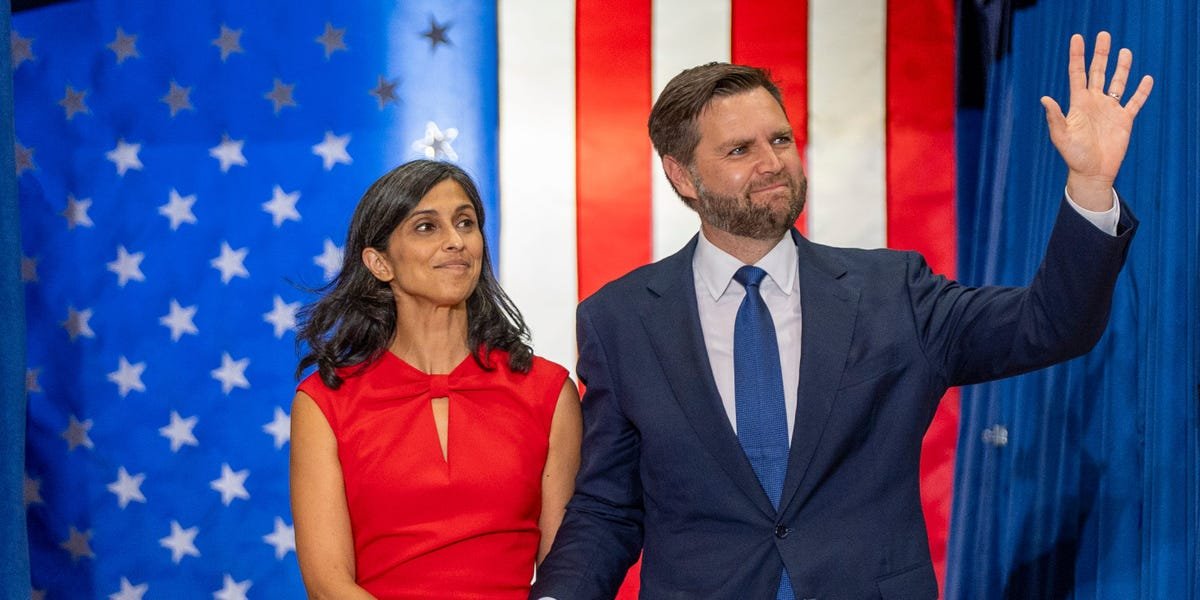
Inside the relationship of Vice President JD Vance and second lady Usha Vance, who are expecting their fourth child

Since winning a second non-consecutive term in the White House, Trump has doubled down on his intention to acquire Greenland, an autonomous Danish territory where the US has a military base. The governments of Greenland and Denmark have maintained that it is not for sale, but Trump has said he would not rule out using force.

In March 2025, the White House announced that Usha Vance would embark on a solo trip to Greenland to “visit historical sites, learn about Greenlandic heritage, and attend the Avannaata Qimussersua, Greenland’s national dogsled race.” The government of Greenland said that they had not invited any delegations to visit, and Greenland’s Prime Minister Múte Bourup Egede called the trip “very aggressive.” Trump said that Greenland had asked the US to visit.

Usha Vance’s trip was subsequently scaled back to visiting Pituffik Space Base, the US military’s northernmost installation in Greenland. In a video, JD Vance announced he would travel with her.

“There was so much excitement around Usha’s visit to Greenland this Friday that I decided I didn’t want her to have all that fun by herself, and so I’m going to join her,” he said.

Taylor Van Kirk, JD Vance’s press secretary, told Business Insider that the Vances were “proud” to visit Greenland.

“The security of Greenland is critical in ensuring the security of the rest of the world, and the Vice President looks forward to learning more about the island,” Van Kirk said.


Source link