I-left-Florida-to-retire-in-New-York-City-at.jpeg

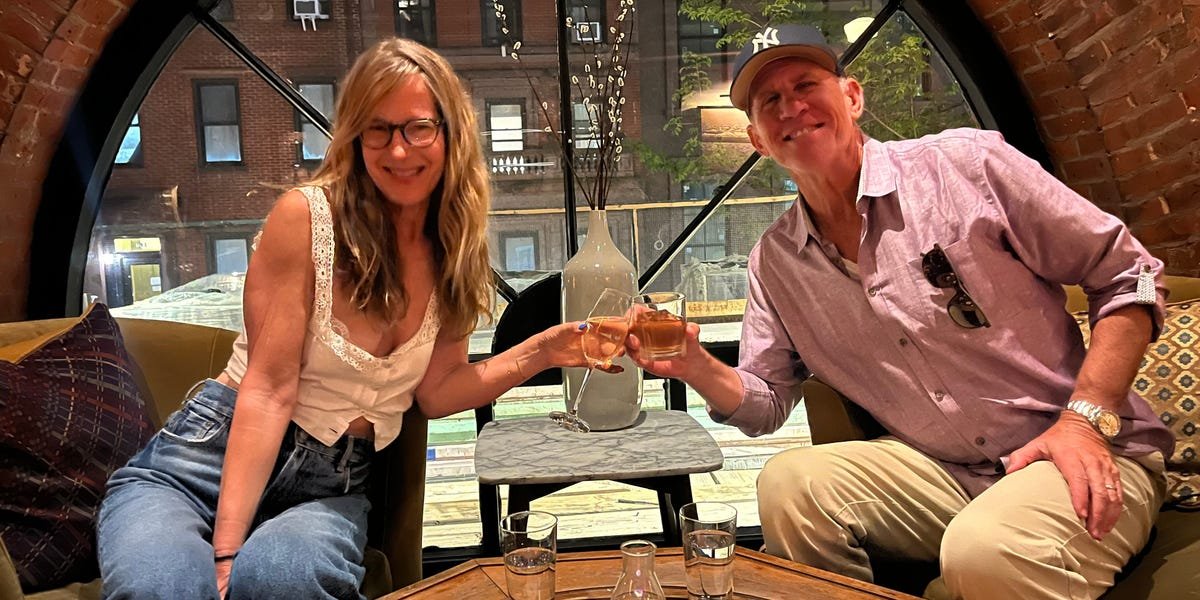
I left Florida to retire in New York City at 62. Living in a bustling city keeps me feeling young.

This as-told-to essay is based on a conversation with Karen Meadows, a 62-year-old Floridian who moved to New York in 2024. The conversation has been edited for length and clarity.

My husband and I have been married for 34 years, and we spent 17 of those years living in Panama City Beach, Florida. It’s where I raised both of my kids and where I started my running coaching business and a 10K charity race.

Panama City Beach was a gorgeous place to live, with beautiful skies every day, clear blue water, and pure white sand. While it was a touristy area, when we first moved there, it was still pretty sleepy during the off-season. That’s actually why I got into the racing business — I was really bored, and there wasn’t that much to do.

However, over the time we lived there, it became more popular.


A family of four - mom, dad, son, and daughter - holds a pumpkin and smiles at the camera.

Meadows, her husband, son, and daughter. 

Courtesy of Karen Meadows


Many people move to Florida to retire because it’s quiet and has a slower pace of life. But for me, I wanted to move somewhere with more energy.

In 2024, my husband and I moved to New York. It’s funny because the first thing everybody says about our move is, “Oh my God, you did the opposite.” And they’re right.

To be honest, at first, I was afraid to live in New York. And I’ll tell you, most days I’m still a little bit afraid. But I’m a huge believer in the idea that your brain is your central governor; it rules everything, and that the second you start restricting yourself because of fear, or thinking you should slow down, you will.

In New York, there are so many people to see and things to do. I’m more active, and living here is keeping me positive about aging.

We moved to be closer to our children

Moving to New York was definitely driven by our children. In 2020, my son was accepted to Columbia University. My daughter also attended Boston University and now lives in New Jersey. My husband and I really wanted to be closer to them.

We did have some issues selling our house in Florida. It was a really pretty home, but it also had a lot of quirky touches. On top of that, there was so much new construction that we were facing a lot of competition.

I took the first decent offer we received. By that point, I didn’t care about trying to squeeze out more money — I felt like my mental health was worth more than that. We made enough from the sale to put some money in the bank and feel like we could downsize comfortably.


An aerial view of Williamsburg, Brooklyn.

East River and Brooklyn Bridge. 

Nisian Hughes/Getty Images


There’s such a big contrast between New York and Florida. It made it pretty stressful trying to figure out where to live. But my son introduced me to Williamsburg in Brooklyn, and I liked that it had plenty to do while feeling a little less hectic than Manhattan.

When we first moved to Williamsburg, we lived in an old converted loft building. When our lease was up there, we moved to Three Williamsburg Wharf in 2025. We live in a two-bedroom, two-bath unit and pay around $8,700 a month. Our corner unit has a view of the Brooklyn skyline and overlooks the Brooklyn Navy Yard, which I love because you can see so much going on.


Two side-by-side images of the interior of a condo in a NYC apartment. First photo is a living room with white furniture overlooking the city. The second photo is a bedroom with a large white bed and an open window with the Brooklyn skyline in the background.

A model home at Three Williamsburg Wharf. 

Courtesy of Naftali Group


Coming from a big house, a two-bedroom apartment is a huge downsize. And while I thought I wouldn’t like renting, I’ve never been happier. There’s a lot less to worry about; there are no property taxes, and everything gets done for you. I also love the sense of community here, from wine tastings and Super Bowl parties to the people I’ve met in the building.

Moving to New York was a risk, but I’ve found a new community

I’ve always been a bit of a risk-taker, and I think it’s important to challenge yourself.

That’s part of why I’m such a dedicated runner — I regularly train for marathons, and I’ve run the New York City Marathon and the Boston Marathon many times.

Still, moving to a new place comes with plenty to worry about.


Karen Meadows has two peace signs in the air as she completes a marathon.

Karen Meadows competing in a marathon. 

Courtesy of Karen Meadows


Some of the fears I’ve had to overcome in New York included learning to use the subway — my son showed me how to use maps, which made it much less intimidating — and getting comfortable driving in a busy city.

The way I got over that fear was by driving more. I also started volunteering with North Brooklyn Angels, a nonprofit food delivery service. Doing that community work has also helped me become more social.

In addition to volunteering with North Brooklyn Angels, I’ve joined the North Brooklyn Runners Club, started a book club, and recently begun volunteering with City Harvest, a food rescue organization. These groups have been especially important to me because I left behind my whole life and many of my friends in Florida. I also love helping people in need.

I know I probably could have moved somewhere more laid-back, warmer, and with lower taxes, but I love New York. I’m almost 63, and I feel better and more alive than ever. Life feels freer, I’m more engaged, and there’s still so much to explore.

Source link

Hot-boys-bright-lights-sweltering-city-Inside-Seventeens-Singapore-stadium.jpeg

Hot boys, bright lights, sweltering city: Inside Seventeen’s Singapore stadium concert

  • Seventeen kicked off the Southeast Asian leg of their tour on Saturday in Singapore.
  • I was in the stadium — again — to see them live.
  • Sweltering heat aside, it’s an experience I’ll never forget.

Heat — that was the word of the day at the boy band Seventeen’s concert in Singapore.

Heat, with legions of fans clutching bags toting pickets bearing their favorite member’s face, comparing merchandise hauls like the spoils of war. Heat, under the blazing equatorial sun. And heat, on stage, when the nine active members of the 13-person group emerged to thunderous cheers.

Stepping into the stadium on Saturday reminded me of the bigger picture. This band is one of the crown jewels of the K-pop business machine. They’ve been working together for 11 years, playing to hundreds of thousands of people who cross continents just to see their favorite boys.

The concert on Saturday marked the start of Seventeen’s Southeast Asia tour leg

Seventeen’s Singapore concert lasted around three and a half hours, with more than a dozen encore songs.

Pledis Entertainment

I’ve been following Seventeen for just over a year now, which makes me a newbie Carat — the name the group has for its fans. The band, which is down four members because of South Korea’s mandatory military service, has been touring the US and East Asia, playing over 26 shows to date, to close to 800,000 people.

Seventeen kicked off the “NEW_” tour in South Korea on September 13 and 14, and did shows in five US cities. They’re back after a short break following their winter dome tour in four Japanese cities.

Performing at Singapore’s National Stadium is no walk in the park


A composite image of the bag check outside the National Stadium in Singapore and two hands holding Seventeen light sticks.

My friend and I came prepped and ready for the show with our concert light sticks.

Cheryl Teh

The 55,000-seat National Stadium in Singapore is a tough venue to play, in part because of the humidity and the heat. It was around 90 degrees Fahrenheit at kickoff.

But it’s the stadium of choice for any big act coming to the island. Taylor Swift performed six nights at the stadium in 2024, and Lady Gaga did four shows there in May 2025.

Seventeen played the venue for two nights in January 2025.

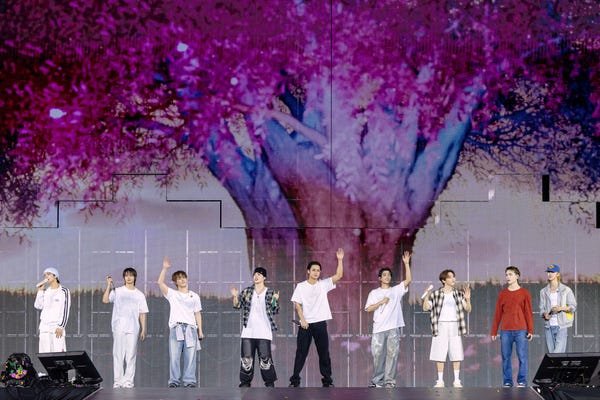
The band is touring with nine out of 13 members, but made up for the missing members with an abundance of energy


A group shot of the band Seventeen in Singapore

Seventeen is touring with nine members — four are serving mandatory military service in South Korea.

Pledis Entertainment

At nine people, the band rallied hard. They kicked off the show with tracks from their 2025 album, “Happy Burstday,” which sold over 2.52 million copies in its first week of release.

The group also dug deep into their archives and pulled out tracks like “Hot,” “Hit” and “Rock” for a segment that the members said was particularly hard to get through because of the strenuous choreography.

The fans were treated to some smooth dance moves and pop-rock


A composite image of Seventeen members Dino, Jun, and Vernon in concert.

Seventeen members Dino, Jun, and Vernon.

Pledis Entertainment

Every member of the team got their fair share of airtime with the nine solo songs, each showcasing their personal style.

The group’s youngest, Dino, and Chinese member Jun showed off their slick moves in “Trigger” and “Gemini.” Korean-American member Vernon went full pop-rock and brought out his electric guitar for “Shining Star.”

The band’s vocalists also served up some sweet, heartrending ballads


A composite image of Seventeen members Seungkwan, Joshua, and DK in concert.

Seventeen members Seungkwan, Joshua, and DK performed a set of three ballads during their segment of the concert.

Pledis Entertainment

Joshua — the group’s other Korean-American, and my favorite band member — kicked off a segment of ballads with his saccharine solo song, “Fortunate Change.” Hong is fresh off an appearance at the Golden Globes and this year’s Super Bowl.

His bandmates Seungkwan and DK — who are in the midst of promoting their unit album, “Serenade” — showed off their vocal chops with their solos, “Raindrops” and “Happy Virus.”

The moment the stadium started to feel like a club


A composite image of Seventeen members The8, Mingyu, and S.Coups.

It was party time with dancer The8 and the rappers Mingyu and S.Coups.

Pledis Entertainment

The crowd went wild when the group’s resident Calvin Klein model, Mingyu, strutted down the stage in head-to-toe denim for “Shake It Off.” That was right after the electro-dance party number, “Skyfall,” from his bandmate The8.

The deafening cheers kept coming for the band’s leader S.Coups’ head-banging hip-hop track, “Jungle.” The rapper — like his teammates Joshua, Mingyu, and Jun — is a fashion week regular in Europe.

Some fans flew across the world to see Seventeen live


A group shot of Seventeen on stage.

Seventeen performed in five US cities. The band will wrap its “NEW_” tour in April in Incheon, South Korea.

Pledis Entertainment

S.Coups was the reason Jackie Ko flew in from California. This was Ko’s 11th time at a Seventeen concert and first abroad.

Ko told me she spent around $2,500 for the trip. It was worth it, she said — she heard songs that weren’t on the US set list.

“S.Coups and Seventeen helped me get through some of the toughest times,” Ko told me. “He makes me feel rejuvenated. He’s my motivation to keep going, no matter what life throws at me.”

Seventeen, like many of their peers, have helped rev up the K-pop business machine


A group shot of Seventeen members performing

One of my personal highlights from the concert: “Network Love,” a unit track.

Pledis Entertainment

Seventeen is part of an industry that generates billions in annual revenue. Tickets to their Singapore show started at $199 Singapore dollars, or around $155, and topped off at $320.

The monetizable hype was evident in the run-up to the concert: Singapore’s Marina Bay Sands resort lit up the landmark in the band’s colors, organized a party featuring their songs at the property’s Marquee club, and had half a dozen restaurants curating custom menus inspired by their tracks.

The group’s parent company Hybe is riding Seventeen and similar groups’ success: Shares are up 55% in the last year.

There’s a reason fans shell out for the band — these concerts feel like once-in-a-lifetime experiences


A crowd shot of the Singapore stadium during the Seventeen concert.

There’s really nothing quite like a Seventeen concert.

Pledis Entertainment

For four hours, there is nothing that shines brighter or makes me happier than watching Seventeen perform. In these troubled times, that’s something worth holding onto.

Seth Aw, an artist from Singapore, agreed.

“The feeling of being in a stadium with other fans enjoying the same moment is so healing,” Aw said. “I don’t think anything can compare to how a good concert makes me feel, and that gives me strength to deal with many things in life.”


Source link

I-didnt-love-Mexico-City-as-much-as-I-thought.jpeg

I didn’t love Mexico City as much as I thought I would. Luckily, I found a smaller, more charming spot nearby.

When planning my two-week trip to Mexico, I looked beyond destinations like Cancún, Puerto Vallarta, and Cozumel. I wanted to visit central Mexico instead, which is further away from the busy cruise ports and all-inclusive resorts.

For years, I’d heard nothing but great things about Mexico City, so I put it at the top of my list. Travelers seem to always rave about the city’s atmosphere, culinary scene, and world-class museums. I couldn’t wait to check it out for myself.

However, once I arrived in the city, which is home to about 22 million people, I was totally overwhelmed. The influx of tourists for Mexico’s Día de Muertos celebrations at the time probably didn’t help, either.

There was a lot to do there, but I missed the quieter atmosphere of Santiago de Querétaro, where I’d been just a few days prior.

The smaller city, often shortened to just Querétaro, is home to around 1.5 million people and is located just three hours by bus from Mexico City. I knew little about the area beforehand, but was soon blown away by its colorful historic center and nearby attractions.

Mexico City gets a lot of hype, but in the end, it was the city I’d previously barely heard of that exceeded my expectations.

Querétaro’s city center is exceptionally charming


View of people walking in Querétaro

Querétaro is much smaller than Mexico City, but it has a lot to offer.

Jenna DeLaurentis


On my first morning in Querétaro, I was immediately struck by the atmosphere of the historic city center.

It’s a designated UNESCO World Heritage Site, and it’s full of tree-lined public squares. Each square acts as a meeting point for commerce, culture, and dining experiences.


Figure with sugar skull head and colorful dress

Querétaro’s pedestrian-only streets are ideal for a relaxing walk.

Jenna DeLaurentis


I loved dining outdoors in these public squares. Often, musicians played soft piano music during mealtimes, and the atmosphere was alluring.

Beyond the squares, every street offered something new. On a visit to Querétaro’s Museum of Arts, I was blown away by the building’s Baroque-style architecture. The intricate design of the space was just as impressive as the artwork inside.


Querétaro's Museum of Arts

Querétaro’s Museum of Arts has stunning architecture.

Jenna DeLaurentis


Likewise, a brief visit to the Calendar Museum left me impressed. The small museum, which houses exhibitions on time and space, contains intricately manicured gardens in a restored mansion. The space was serene, adding another special touch to Querétaro’s endearing city center.

In contrast, I found Mexico City to be more overwhelming than charming. With millions of people, cars, and buses zooming around every corner, it was impossible to feel relaxed.

While walking around Mexico City’s maze of streets, I found myself missing the small-town feel of Querétaro.

The city is a convenient home base for day trips to other destinations, too


San Miguel de Allende

San Miguel de Allende is a short drive from Querétaro.

Jenna DeLaurentis


Something I loved during my time in Querétaro was the city’s proximity to several exciting destinations. I found it easy to take a day (or overnight) trip from the city.

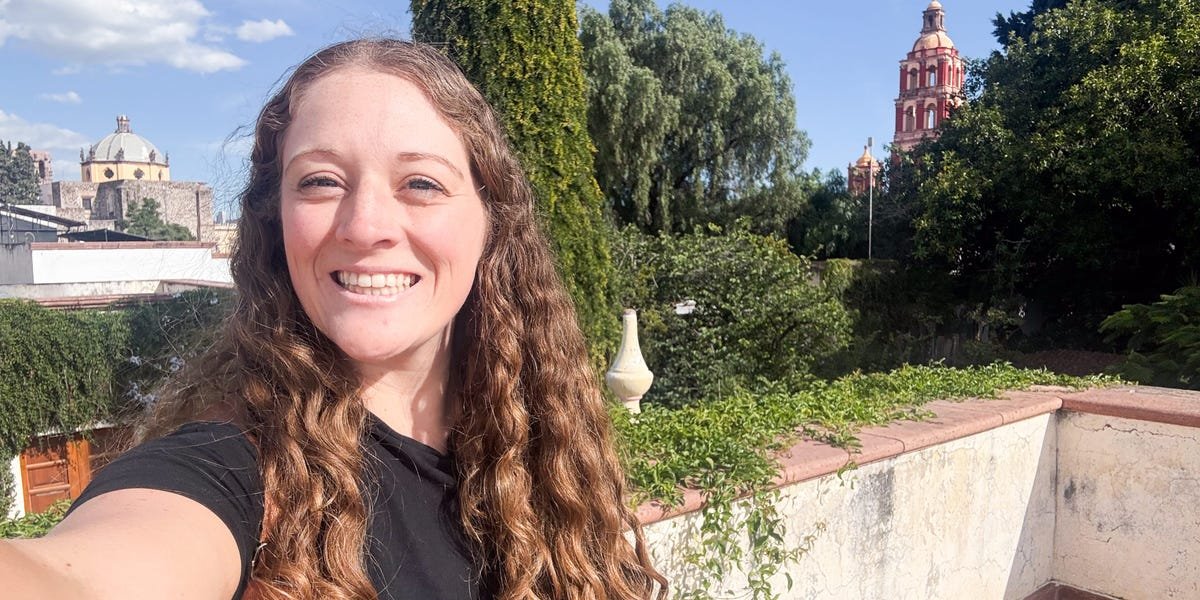
On my visit, I took a one-night trip to San Miguel de Allende, a small city with well-preserved colonial architecture.

It was the perfect destination for a quick visit. I spent my time wandering around cobblestone streets, dining at rooftop cafes, and marveling at San Miguel de Allende’s prominent pink cathedral.

Querétaro is also within an hour’s drive to two of Mexico’s Pueblo Mágicos, or Magic Towns. There are 177 Pueblos Mágicos within Mexico, and each town has been designated to have significant cultural, historical, or architectural significance within the country.

One of these Pueblos Mágicos, Bernal, is famous for its giant monolith that towers over the town. The other, Tequisquiapan, offers a peaceful getaway where visitors can explore traditional cheese markets, vineyards, and natural hot springs.

Taking day trips from Querétaro doesn’t require a car, either. Uber is convenient throughout the area, and comfortable coach buses can take you from town to town at a low cost.

Mexico City has more to offer overall, but Querétaro is definitely worth a visit


Author Jenna DeLaurentis in Mexico City

I was excited to check out Mexico City for the first time, but it wasn’t my favorite place to visit in Mexico.

Jenna DeLaurentis


Even though I preferred Querétaro to Mexico City, there’s no denying that there’s far more to see and do in the latter.

You could spend months in Mexico City and barely scratch the surface. The city has over 150 museums and galleries along with the palatial Chapultepec Castle, massive Zócalo Square, vast green parks, and more restaurants than you could try in a lifetime.

Its National Museum of Anthropology could take an entire day to see in and of itself!

I expected to fall in love with Mexico City, but I didn’t jive with the city as much as I thought I would. For the most part, though, I’d still agree that Mexico City is worth the hype it receives. The metropolis has an addictive, bustling atmosphere, and the street-food scene is definitely out of this world.

Yet my trip was a good reminder to look beyond the most popular destinations in a particular place. I had never even heard of Querétaro before I planned my trip, but I’m so glad I took the chance to discover somewhere new.


Source link

Panama-City-wants-Elon-Musks-Boring-Company-to-build-a.jpeg

Panama City wants Elon Musk’s Boring Company to build a tunnel beneath its famous canal

Mayer Mizrachi, the 38-year-old mayor of Panama City, wants Elon Musk to build him a pedestrian tunnel under the Panama Canal. And Musk’s Boring Company recently announced it just might.

Panama City this week was named one of 16 finalists — the only one outside the United States — in the company’s Tunnel Vision challenge, which offers the winning municipality a free tunnel that can be used for freight, pedestrians, water, utilities or Loop — the electric, underground system that uses Tesla vehicles to transport people.

Mizrachi’s idea is a 0.6 mile pedestrian tunnel under the Panama Canal, which would give city residents a chance to “live” its history and take advantage of the vital maritime trade route that is critical to the global economy. More recently, the canal has been the subject of geopolitical tensions as President Donald Trump threatened to take control of the waterway because, he said, the US was being ripped off by high fees and that it had come under Chinese influence. In February 2025, Panama withdrew from China’s Belt and Road initiative.

The winner will be announced on March 23. Of the 16 finalists, half were in Tennessee or Texas, where the Boring Company is headquartered and where Mizrachi recently went to make his pitch. The project, if chosen, has the potential to tie together Mizrachi, the former DOGE leader, and the Panama Canal that Trump once fixated on seizing.

Mizrachi, the youngest mayor in the city’s history, founded Criptext, a secure email platform, and, like Trump, has styled himself as an outsider. Like Musk, he came to office looking to cut government in the name of efficiency and insists he has succeeded.

In an interview with POLITICO, which is, along with Business Insider, part of the Axel Springer Global Reporters Network, Mizrachi said the tunnel proposal began as a last-minute response to a Boring Company social media post and ballooned from there.

This interview has been edited for length and clarity.

How did the tunnel idea begin, and what exactly was your pitch to The Boring Company?

Mizrachi: I merely just ran into a tweet by the Boring Company in January, and they had this tunnel vision challenge, and they were offering a free tunnel up to a mile long anywhere around the world to the best idea. I did a visit in January to the existing tunnel that’s being built for a subway station in Panama City, and I said, “What if we built a pedestrian tunnel crossing the canal with parks on either side? You can tell the story of how the canal was built and the history of the country, and the biodiversity.”

City planners started working on a proposal, and they kind of really brought the plane in for a landing with a beautiful proposal, and we submitted that on the last minute of the last day.

What did you learn in Texas about how The Boring Company would approach this project?

Mizrachi: We met with Jim Fitzgerald, the VP for global, and we kind of took a 101 on how a Boring Company project works. Tunnels are freaking expensive. But it turns out that the way that they do it makes it actually feasible, and it’s quite a wonder the way that they have put this together.

And as I told Jim, I said, “Listen, I know this is very preliminary, and here are many other projects that they’re considering, but you know, it would be quite a marvel that 100 years ago, you know, the US built the canal, and then 100 years later, that they would build a tunnel that crosses the canal in a modern marvel of engineering in the way that they do it.”

They reuse their tunneling machines. Whereas typically, the tunneling machines are built specifically for a given project, and then they get buried with the project.


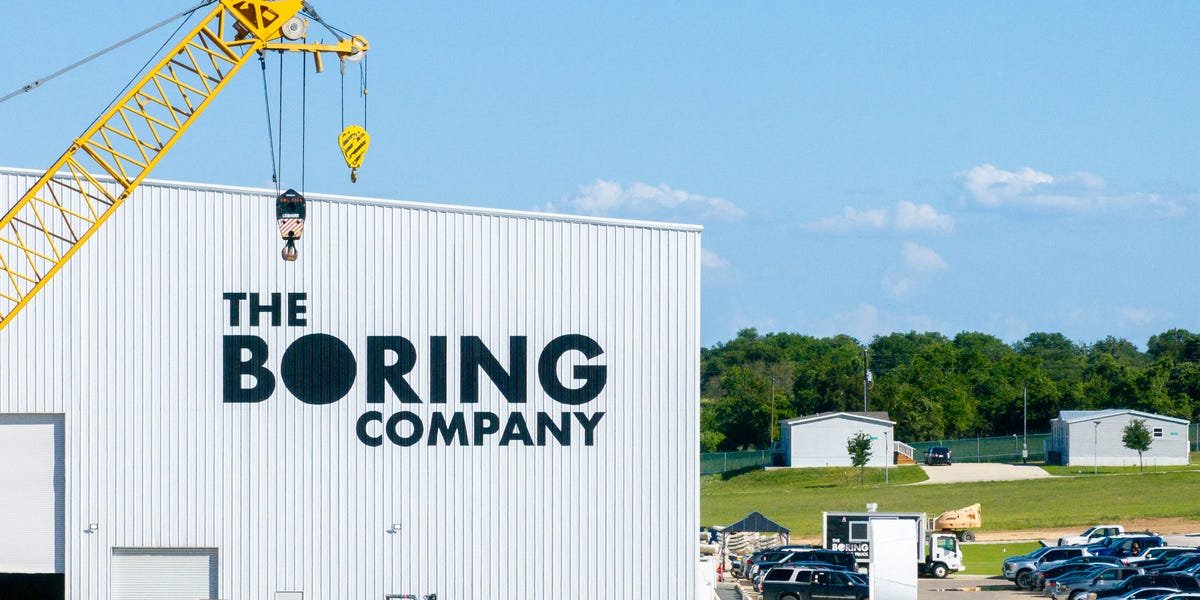
The Boring Company's headquarters in Texas.

The Boring Company’s headquarters in Texas.

Brandon Bell/Getty Images


What would this tunnel mean for Panama, especially at a moment when the canal is caught up in broader geopolitical tensions?

Mizrachi: First of all, Panamanians, we’re really proud of the canal, its management, its history, but we seldom get to live it. So it’s like the rest of the world uses the canal. But you know, Panamanians, we don’t live the canal. You could go to the Miraflores Locks, and you go to the tourist center. You can maybe see a ship, but we don’t really live it.

So the vision here is you create a public space where you integrate families, tourists, and they can cross the canal themselves with an underground tunnel that’s 0.6 miles, the distance. It’s quite short, and I can only imagine it being almost an educational experience, where you can have screens, very thin screens, because the space is not that big, but thin screens that are showing the story, the history of how the canal was built, the biodiversity of Panama, and then stats on the canal, the impact that it has on world trade, etc. It started as an idea, but it’s shaping up. And I think it goes above my pay grade. I spoke to the president [of Panama] about this. This needs to be handled by a task force designated by the president in representation with the entire country.

Why do you think Panama City could beat out American cities for this project?

Mizrachi: Well, there’s one very unique thing about this. They don’t have a canal. The Boring Company has never bored underwater, much less crossing a canal. And I think it’s part of the value proposition to show themselves as engineers, how far they can go with their mindset, with their methodology and their ingenuity.

Also it’s a pedestrian tunnel. So it’s not a loop tunnel that is managed and operated by the Boring Company. So if you think of Vegas, they operate the Loop itself. So, here, it’s a lot more hands off. They build a tunnel, and they don’t have to have an active operation.


The Boring Company's Loop in Las Vegas

The Boring Company-built tunnel at the Las Vegas Convention Center.

AaronP/Bauer-Griffin/GC Images


You’ve drawn comparisons between your work and DOGE-style cost cutting in Washington. How do you describe your governing approach?

Mizrachi: I mean, honestly, I still consider myself an outsider. I am not subscribed to any political party, and I still very much employ the mindset of the tech entrepreneurial efficiency and try things before you scale things, which is uncommon in politics.

As soon as I came into office in July 2024, I realized people’s money was being wasted on a scale that I was just shocked to see. So we were able to reduce the size of City Hall personnel by 50% so it used to have 6,500 people. We reduced it to about 3,500 people. And by all counts, City Hall is operating faster and better with more impact, tangible, visible impact, with less people. And also, we reduced the budget by about 32%, so we did the biggest budget reduction in the history of the city as well.

This story originally ran in POLITICO’s West Wing Playbook and appears on Business Insider through the Axel Springer Global Reporters Network. The network publishes major stories from the Axel Springer network of publications, a worldwide group of news outlets that includes Business Insider.


Source link

My-city-was-filling-up-with-digital-nomads-I-saw.jpeg

My city was filling up with digital nomads. I saw a business opportunity in our family home.

This as-told-to essay is based on an interview with Nguyen Thị Thanh Thơ, aka Hana Nguyen, 36, founder of Hana’s Coworking in Da Nang, Vietnam. It has been edited for length and clarity

I never planned to work with digital nomads. In fact, three years ago, I didn’t even know what “coworking” meant.

I was born in the countryside of central Vietnam and, in my teens, moved to Da Nang with my family for college. I first studied business administration, and later trained to become a pharmacist.

After graduating in 2016, I found a job in a local pharmacy. It was the typical job for many Vietnamese graduates: stable but low-paying; not especially challenging but also very boring.

I couldn’t get excited about it, and I didn’t see a future for myself there.

In 2023, I met a foreigner on an online forum who wanted to go hiking in the Marble Mountains, a group of cave-like temple structures in southern Da Nang. I decided to join.

At that time, I was curious about foreigners, but my English was poor, and I didn’t really know how to connect with people from other countries.

That small encounter changed everything. A few days after visiting the mountains, my new foreign friend took me to a coworking space. I had never seen anything like it before — people from all over the world working on laptops, speaking in English, and sharing ideas.

Something clicked immediately.


Group of people playing pool in Da Nang, Vietnam.

She began organizing events for both locals and digital nomads.

Provided by Hana Nguyen


I felt drawn to the community

I didn’t have money or experience, but I had motivation. In early 2024, I spoke to a friend who owned a hotel with an unused floor.

I offered to manage a coworking space there. I told her that I could try working there for two months for free. If it worked out, we could talk about money. If it didn’t, we could both move on.

After a few months, the project really took off, and I got some good exposure from Vietnamese TV and visiting content creators.

I worked there full-time for more than a year, doing everything myself — managing the space, cleaning, talking to customers, and organizing events. I negotiated a salary of about $250 a month, which wasn’t much, but I loved it.

Eventually, I realized I was building something valuable and with potential — but I didn’t own it. I began feeling exhausted and knew it wasn’t sustainable. Around the same time, my dad fell ill with cancer. I knew I needed to make more money to help my family, so when another friend offered me a space inside his bar — unused during the day — I said yes.

That was the first coworking space where I felt some ownership.

I didn’t have to pay rent, which worked because I had very little money — I couldn’t even afford to hire staff. But still, I managed to build the community. I organized events, beach trips, yoga, dinners — anything that helped people connect.

Since I wasn’t paying rent, I knew this arrangement could only be temporary, so I worked up the courage to ask my parents if we could convert one of the floors in our three-story family home into a coworking space. I explained that I’d need to borrow money from family members and spend a few months renovating the house.


Hana  Nguyễn

Duc Nguyen for BI


Despite the risk, my parents agreed

It wasn’t easy. I was working nonstop and felt stressed, but the top floor, which can seat 18, filled up quickly, so I expanded the coworking space to other parts of the house. I can now fit 30 people and charge $76 a month.

I still manage everything myself. I don’t have employees. My father is a guard at the entrance, and my mother cleans the place, so it’s still very much a family business.

Many people ask me why there are so many digital nomads in Da Nang. I think it’s because the city is friendly, affordable, and super convenient. You have the beach, mountains, urban life, and an international airport close by.


On the beach in Da Nang, Vietnam.

Da Nang has a mix of beaches, mountains, urban life, and an international airport nearby.

Provided by Hana Nguyen


Da Nang is the kind of place where you can go for a walk along the beach in the morning, work during the day, swim in the sea in the afternoon, and eat great food in the evening — and it’s not expensive.

The biggest challenge I’ve seen among digital nomads is loneliness. Many people arrive alone, without friends, and everything feels unfamiliar — the culture, transportation, and daily life. That’s why community is so important. Everyone researches online before they come, but a real connection only happens in person. That’s exactly what I’m trying to foster with my coworking space.

At my events, around 20% of participants are Vietnamese. Many come to practice English, but they also learn about different ways of working and living. Some locals have even found freelance work with nomads in design, tech, and marketing. That makes me proud.

I’m still learning. I don’t have a big master plan. I just know I love connecting people, and I believe community can change lives — including mine.

Do you have a story to share about living abroad? Contact the editor at akarplus@businessinsider.com.


Source link

Pittsburghs-mayor-has-cold-called-dozens-of-tech-CEOs-to-get.jpeg

Pittsburgh’s mayor has cold-called dozens of tech CEOs to get them to relocate their companies to his city.

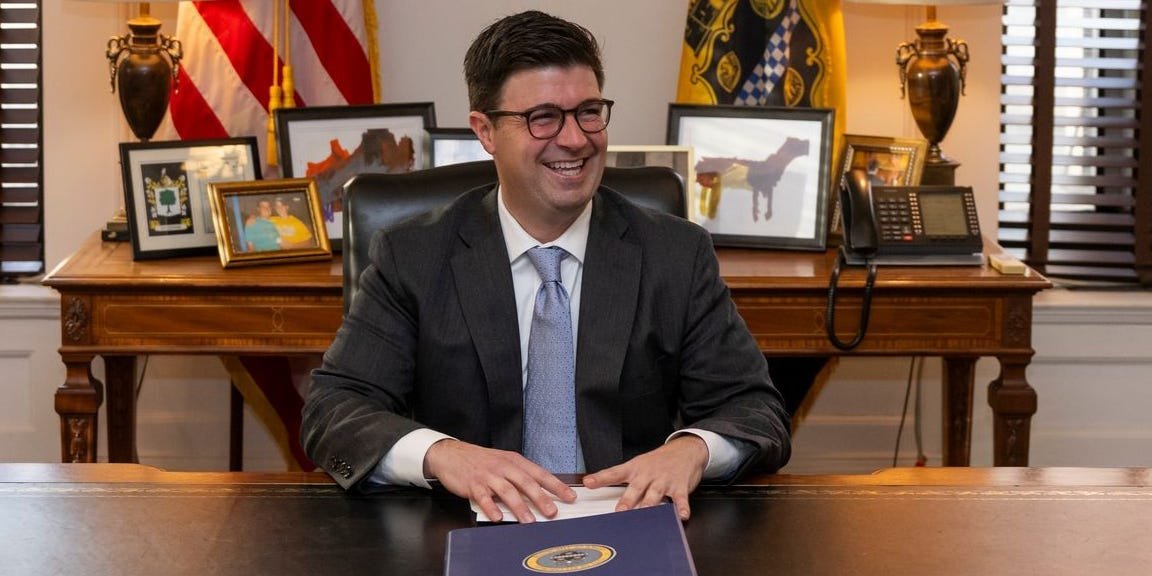
Pittsburgh’s new mayor is personally cold-calling upwards of 20 founders and CEOs across the country every week to check in on them, or to convince them to move to his city.

“Some people think it’s a prank call, but for others, it’s like, ‘wow, the mayor of Pittsburgh just called,'” said Corey O’Connor, who estimates he has called around 150 people since taking office in January. “If you’re already here, I ask, ‘How can we help you expand?’ If you’re not here, I ask ‘How do we get you to come to Pittsburgh?”

Pittsburgh has historically been known as “the Steel City” and is home to the Pittsburgh Steelers. O’Connor’s father worked as a steelworker before a long career in city politics. However, as O’Connor is quick to point out, there are no longer any steel mills within city limits, while the area is home to some of the most important startups in the U.S.

After predictions of its waning influence during the Covid era turned out to be wildly off, the Bay Area’s tech scene is now hotter than ever, largely thanks to AI. That has not stopped smaller cities like Miami and Austin from trying to grab VC dollars, especially as the cost of living in California skyrockets. Now, Pittsburgh would like to be the next Miami.

Its startups raised $1.48 billion in 2025, still a fraction of major tech hubs, but the region’s strongest venture capital year since 2019, according to PitchBook.

Standouts include Gecko Robotics, valued at $1.7 billion, which builds wall-climbing robots that inspect critical infrastructure, including power plants and industrial facilities. Abridge, valued at $5.3 billion, uses artificial intelligence to automatically generate medical documentation from doctor-patient conversations. It has emerged as one of the most closely watched AI companies in healthcare.

The most high-profile is Skild AI, which is developing foundation models for robotics, training AI systems that allow machines to operate more autonomously in real-world environments. The company raised $1.4 billion in a deal led by SoftBank Group and Nvidia in January, pushing its valuation to $15 billion, according to PitchBook.

“Our goal is to change the narrative,” O’Connor said, adding he will use every opportunity he can get to tout the city’s tech potential, especially as the spotlight will be on Pittsburgh as it prepares to host the NFL Draft in April.

Deep-seated roots in AI and robotics

The city’s AI and robotics credentials stretch back decades. In the 1960s, Carnegie Mellon professors began groundbreaking research in AI. In 1979, the first robotics institute at a U.S. university was started at CMU.

The challenge is keeping the most talented graduates from bolting to Silicon Valley.

“I’m constantly going to meet kids on campus,” O’Connor said.

Affordability is a key selling point. The median price for a single-family home in Pittsburgh and surrounding Allegheny County is 42.3 percent below the national average.

O’Connor is also trying to streamline the city’s permitting process to make it easier for tech companies to expand.

“We can get you a permit in four to five weeks, so you don’t have to wait through the government bureaucracy,” he said.

In January, Factify, a Tel Aviv-based digital document startup, said it plans to expand its presence in Pittsburgh and use the city as a major hub for customer engagement and operations.

Asked if he has successfully convinced any companies to move to Pittsburgh, O’Connor said not yet, but he is focused on the long game.

“They’re going to at least tell 10 friends that the mayor of Pittsburgh called,” he said. “That creates a buzz about the city.”


Source link