F-15E-Strike-Eagles-deployed-during-Operation-Epic-Fury-can-fly.jpeg

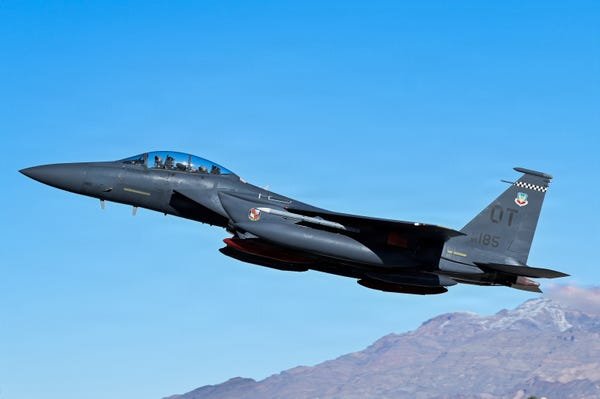
F-15E Strike Eagles, deployed during Operation Epic Fury, can fly 2.5 times the speed of sound. Take a closer look.

  • The US Air Force deployed F-15E Strike Eagles during Operation Epic Fury against Iran.
  • The fighter jets are designed for air-to-air and air-to-ground combat in all weather, day or night.
  • Kuwait mistakenly shot down three F-15E Strike Eagles in a “friendly fire” incident, CENTCOM said.

F-15E Strike Eagles, fighter jets designed for air-to-air and air-to-ground combat, are usually a dominating force in the skies.

When three F-15E Strike Eagles were mistakenly shot down by Kuwait during Operation Epic Fury, it brought renewed attention to one of the Air Force’s fastest, most versatile aircraft.

Here’s a closer look at the F-15E Strike Eagle, an advanced aircraft the US is using to destroy Iran’s missile arsenal and drone bases from the skies above Iran.

The F-15E Strike Eagle has been in service in the US Air Force for nearly 40 years.

An F-15E Strike Eagle at Nellis Air Force Base in Nevada. 

U.S. Air Force photo by Airman 1st Class Jasmine Thomas

The first F-15A model flew in 1972, and the first F-15Es were produced in 1988, according to the US Air Force.

It’s the fastest crewed aircraft in the US Air Force.


An F-15E Strike Eagle flies through the sky.

An F-15E Strike Eagle during an exercise at Gando Air Base in Gran Canaria, Spain. 

U.S. Air Force photo by Staff Sgt. Elizabeth Davis

The air-to-air and air-to-ground attack aircraft can fly at 1,875 miles per hour, or 2.5 times the speed of sound.

The F-15E Strike Eagle’s high thrust-to-weight ratio enables it to accelerate during vertical climb.


An F-15E Strike Eagle.

An F-15E Strike Eagle in flight. 

U.S. Air Force photo by Staff Sgt. Tylin Rust

The high thrust-to-weight ratio also allows the F-15E Strike Eagle to execute tight turns without sacrificing speed. It has two Pratt & Whitney F100 engines, each producing over 23,000 pounds of thrust.

Another distinguishing capability is the plane’s head-up display, which projects flight and tactical information directly on the windscreen.


The head-up display on a C-17 Globemaster III.

The head-up display on a C-17 aircraft. 

U.S. Air National Guard photo by Tech. Sgt. John Linzmeier

Pilots can track and attack targets, check the status of weapons, and see other tactical and flight information without taking their eyes off the windscreen.

The fighter jet also includes a low-altitude navigation and targeting infrared for night (LANTIRN) system.


The underside of an F-15E Strike Eagle.

The underside of an F-15E Strike Eagle. 

U.S. Air Force Photo by Airman 1st Class Olivia Gibson

The LANTIRN system allows the planes to fly in any weather and attack ground targets at low altitudes. The system consists of two pods, a navigation pod and a targeting pod, mounted under the plane.

F-15E Strike Eagles can carry both nuclear and conventional weapons.


Loading an AIM-120 missile onto an F-15E Strike Eagle

US Air Force crew members load an AIM-120 missile onto an F-15E Strike Eagle aircraft at Mountain Home Air Force Base in Idaho. 

Airman 1st Class Donovin Watson/366th Fighter Wing

Its armament includes an internally mounted 20-millimeter gun with 500 rounds of ammunition, AIM-9 Sidewinder missiles, and AIM-120 AMRAAMs, an acronym for the radar-guided Advanced Medium-Range Air-to-Air Missiles.

The F-15 also regularly carries ground attack weapons like the Joint Direct Attack Munition, or JDAM, a kit that adapts an unguided munition into a “smart” bomb with fins and GPS guidance.

F-15E Strike Eagles are flown by a pilot and a weapons systems officer.


The cockpit of an F-15E Strike Eagle.

The cockpit of an F-15E Strike Eagle. 

U.S. Air Force photo by Airman 1st Class Aidan Martínez Rosiere

The weapon system officer sits directly behind the pilot, and closely manages the plane’s sensors and weapons.

Two variants of the F-15 are single-seaters: the F-15A and F-15C.

The planes can fly 2,400 miles without refueling, and can be refueled in flight.


An F-15E Strike Eagle receives in-flight refueling from a KC-135 Stratotanker.

An F-15E Strike Eagle receives in-flight refueling from a KC-135 Stratotanker during an exercise over the Atlantic Ocean. 

U.S. Air Force photo by Senior Airman Cody J. A. Mott

F-15E Strike Eagles have a fuel capacity of 35,550 pounds.

The fighter jets can be refueled in flight by KC-135 Stratotanker aircraft, which Boeing developed from its “Dash 80” prototype in the 1950s.

KC-135s were also deployed to Israel as part of Operation Epic Fury. One crashed in western Iraq on Thursday, killing six US service members. United States Central Command said the circumstances of the crash were under investigation, but it “was not due to hostile fire or friendly fire.”

Each F-15E cost $31.1 million to produce in 1998, according to US Air Force figures. That would be around $62.3 million when adjusted for inflation.


F-15E Strike Eagles at Travis Air Force Base in California.

F-15E Strike Eagles parked at Travis Air Force Base in California. 

U.S. Air Force photo by Kenneth Abbate

Newer F-15 models cost around $100 million, The Wall Street Journal reported.

The newest version of the aircraft is the F-15EX Eagle II, which features more advanced controls and upgraded engines.

On March 1, Kuwait’s air defenses mistakenly shot down three American F-15Es during Operation Epic Fury in what US Central Command described as a “friendly fire incident.”


F-15E Strike Eagles in the Middle East.

F-15E Strike Eagles at an undisclosed base in the Middle East. 

U.S. Air Force photo by Senior Airman Jared Brewer

All six crew members ejected safely. The incident is under investigation.

“Kuwait has acknowledged this incident, and we are grateful for the efforts of the Kuwaiti defense forces and their support in this ongoing operation,” CENTCOM said.


Source link

My-wife-and-I-let-go-of-our-dreams-and.jpeg

My wife and I let go of our dreams and left New York City. We moved to a small town so we could be closer to my in-laws.

Two years before our son was born, my partner, Liv, and I moved to New York City to immerse ourselves in the city that never sleeps. She was working full-time and pursuing a master’s degree at Columbia, while I was figuring out what it meant to be human after I quit my tech job.

We dreamed of the community and opportunity that awaited us in that glorious place of concrete and glass. After the loneliness COVID brought, I fantasized that we’d meet other adults who shared enough of our values to create a tight community in New York City, one that was more than just friends.

But everything changed after our son was born.

We moved to New York City to live our dream life

My sister-in-law, her boyfriend, and a handful of friends already lived in New York City. The region’s high population density came with the promise of new close relationships.

Within six weeks, we sold our house in suburban Maryland and moved into a New York City apartment, sight unseen.

Living in NYC is like gripping life’s volume knob with both hands and cranking it up past the breaking point. The city offers an unmatched variety of sights, sounds, smells, tastes, and feelings to the privileged people who can afford it.

Some nights over the next year, I sat on our windowsill, admiring the twinkling cityscape teeming with life. I was making new friends, but I wasn’t seeing a path to the fantastical relationships with other adults that I thought would come easily.

The question of whether or not to expand our biological family also hung heavily in my mind.

After an errand to the Financial District, I shared a transformative conversation with a tourist couple from rural Germany. We talked about their children, and I revealed my ambivalence about having my own.

The man’s response was warm and adamant: Having children is the best. There’s never going to be a right time. Just do it.


a view of the new york skyline

The author’s frequent meditation spot, overlooking Brooklyn and Manhattan.

Courtesy of Zachary Fox Photography


We hugged, took a selfie, and parted ways. Six months later, having learned countless lessons from the city and its people, Liv was pregnant with our first child.

Our priorities shifted after the birth of our son

Shortly after our son was born and I became a stay-at-home dad, our family reached a decision point. We could not afford to live in New York City and enjoy our preferred lifestyle. We needed more space and more help.

A house in my in-laws’ neighborhood was put up for sale at an attractive price. Liv’s desire burned for this home and the comfort of neighbor-parents, but I was unconvinced. Leaving my community and moving to Slower Lower Delaware felt like a massive downgrade.

As our son’s eyes opened and he began to crawl, my priorities shifted toward my growing family. Whenever my mother-in-law trekked up to the city to help with childcare, I felt rested and loved. If we moved, her love and nurturing spirit would be just down the road.

I chose to be excited about the move, focusing on the reasons it felt good, like the familial help, lower financial pressure, and quieter calm.

We bought the house and moved after our son’s first birthday.

An unexpected step toward a dream come true

I am fortunate enough to both love and like my family, including the family I inherited from Liv. With this type of love comes a web of commitment to the well-being of all members of our system. Societal norms make the depth of this commitment far more accessible to family than it is to friends.

In an alternate universe, there’s a version of myself whose hyperlocal community consists of friends and family, where our children have sprawling chosen families and roam freely between homes. In this imaginary village, shops and services are walkable, and what we make transcends money. I thought we might make this happen in New York City. Maybe it can for others, but it didn’t for me.

Perhaps that idealized universe is actually this one, only set a few years in the future. The open-door policy we happily share with my in-laws is a part of the dream made real.


Source link

I-took-my-teen-out-of-school-for-a-trip.jpeg

I took my teen out of school for a trip to Antarctica. It brought us closer together.

My high school son, Jack, was overwhelmed with college anxiety — SAT prep, AP classes, acceptance rates, and all the pressure that comes with being a New York student.

It was hard to quiet the noise, so I decided to make a radical — and unconventional decision: I pulled him out of school and took him to Antarctica for three weeks over winter break.

Everyone told me it was a terrible idea, but I thought it was exactly what he needed.

We’ve been traveling since he was a baby

Jack and I have been traveling together since he was 3 months old. I’m a huge traveler, and when I had my first son, I decided to take him along for the ride.

In elementary school, I didn’t think twice about pulling him out in order to explore the world (Costa Rica, Mexico, Nevis, Finland). Against the judgment of some parents (and some school officials), I thought it was important to expose him to travel — different cultures, different ways of doing things, different ways of thinking. He quickly became my favorite travel companion, and I often thought travel Jack was the best version of himself.


Mom and son posing with penguis

The author and her son have been traveling together since he was a baby.

Courtesy of the author


It became more difficult to pull him out in middle school (but I still did — he missed eighth-grade graduation — to go on a trip to Sri Lanka). Once he entered high school (where, according to him, grades matter), it became really difficult to make up the work if I pulled him out.

Then came junior year and all the stress that comes with college prep settled upon us. Not only was he balancing a bunch of AP classes, but he was also studying for the SAT and doing all the college prep work. Basically, he (and therefore I) became slightly unhinged.

I booked a 3-week cruise to Antarctica

So when I floated the idea of going on a trip — just the two of us — Jack was instantly in, but I got tons of pushback from everyone else. Junior year is the most important year for college prep; he’s in AP classes, and it’s super hard to make up the work. Did I have my priorities straight? Now is the time to lock in, not travel.

But I ignored the noise and booked us on a three-week cruise to Antarctica — he had two weeks off for the holiday break and would miss one week of school. I had him talk to all his teachers about missed work and make-up, and, surprisingly, while a lot of parents thought I was nuts, the teachers were supportive of this once-in-a-lifetime trip.


Mother and son kayaking

The author says people told her not to take her son out of school as he was preparing to apply for college.

Courtesy of the author


And off we went on a three-week trip to Antarctica, South Georgia, and the Falkland Islands. I purposefully chose this cruise itinerary because it included South Georgia, which everyone says is a must if going to the white continent. It definitely made the trip long (by a week), but it turned out South Georgia was both Jack and my favorite part of the cruise (we saw thousands of king penguins in their beautiful orange plumage, alongside their baby chicks, which looked like they were wearing lush fur coats).

His perspective started to shift during the trip

Every day was a different adventure: hiking up snow-capped peaks; kayaking among icebergs looking for whales and seals; getting face-to-face with several types of penguins (we quickly learned the difference between rockhopper, macaroni, gentoo, Adelie, and chinstrap varieties).

Far from GPAs and college chatter, surrounded instead by penguins, elephant seals, and endless ice, Jack’s perspective started to shift. College stopped feeling like the entire world — and started looking like just one chapter.

One night we had dinner with Rich Pagen a naturalist and Kristen Wornson the Young Explorers guide. When Jack asked them how they knew what they wanted to do with their lives, they shared their experience of trying to find the right college and then moving into different career circles. It was great for Jack to hear that their path wasn’t always straightforward, but they ultimately found jobs they loved.

For Jack to see people loving their jobs — and to realize that no one thought they’d end up where they did, leading expeditions in Antarctica — was a great wake-up call.

Also, because this was the family holiday cruise, several other families with teens were on board. It was great for Jack to get out of his comfort zone and talk to teens from all over the world. One was taking a gap year before college, and it really got him realizing that there are so many paths out there.

The trip brought us closer together

The trip also brought Jack and me closer together; away from the distractions of everyday life, we connected in a way that’s rare during the teenage years.

On this trip, Jack and I always did the excursions together, and we ate dinner together every night. But on sea days, I attended every lecture, and he opted to go to the gym or sleep. By giving each other space, we really enjoyed the time we did spend together. I didn’t nag him, and he, in turn, didn’t give me an attitude.

It was one of our favorite trips together.


Source link

We-give-our-teenagers-more-experiences-than-gifts-for-Christmas.jpeg

We give our teenagers more experiences than gifts for Christmas. It brings us closer as a family.

When my kids were little, we embraced the magic of Santa Claus. Christmas morning meant lots of presents to unwrap, some from mom and dad, and plenty from Santa. Still, we valued giving our kids experiences, as well. When grandparents and other relatives asked for holiday gift ideas for our kids, we’d always suggest things like a membership to our local zoo or movie theater gift certificates — gifts that would provide us with time together as a family instead of sending more stuff into our house.

Our gifting style changed when my kids stopped believing in Santa. Sure, we’d give our kids a few actual presents to open on Christmas morning, but we also upped the emphasis on choosing experiences over gifts. From cruises to road trips, we started turning our focus to what we could do together to create memories over the holiday season, away from material things.

We give our kids experiences, but they still get a few things from their wish lists


The author's kids opening gifts on Christmas when they were younger.

The author’s kids have always gotten gifts, but over the years, they’ve gotten fewer presents and more experiences.

Courtesy of Terri Peters


My teenagers are now 15 and 17, and while they look forward to the items from their Christmas list that do end up under our tree, they also like finding things to experience together as a family. And it’s not always the gift of travel we bestow upon them; there’s also magic and memories to be found in the things we do together at home.

As my kids have gotten older, they’ve begun to appreciate our holiday traditions, such as assembling gingerbread houses, hopping in the car to see Christmas lights, and going to a holiday-themed theater production together just as much as they appreciate a new pair of sneakers or a video game on Christmas morning.

Travel is one of the experiences we most love giving our teens


The author with her family on a beach.

The author enjoys traveling with her family as part of their holiday gift.

Courtesy of Terri Peters


Still, travel remains a gift we love giving to our kids over the holidays. This year’s holiday trip was a trek from our home in Florida to New York City, where we stayed in a hotel within walking distance of Central Park and Times Square, saw a Broadway show every night, and ate some seriously good NYC treats all over the city.

In past years, we’ve gone on a 10-day cruise around the Caribbean and taken a 3-hour road trip to spend a few days exploring Miami. Wherever we go and however we get there, traveling helps us tuck away cherished memories of time together, and hopefully, it will teach my kids how important it is to experience the world with people you love.

We also consider holiday-season day trips part of our kids’ Christmas gifts


The author with her son and the Grinch at Univeral.

They also do day trips, including the holiday show at Universal Orlando.

Courtesy of Terri Peters


Living in Central Florida, we have lots of great day trip options, too. Often, we go on the same adventures every single year, like heading to Universal Orlando to see their Grinch-themed holiday stage show or taking a drive to do an airboat ride (a very Florida way to see nature, waterways, and yes, alligators). On these trips, we often let them bring a friend or partner along for the day, teaching them to choose time together with the people they love over spending a lot of money on gifts.

In fact, I was touched this year when my son was telling me the things he’s planning to get his girlfriend for their first Christmas together. Sure, there were some very sweet presents in the mix, but he also asked for my help in presenting her with the gift of an experience they can do together after the holidays. Seeing them pay our family traditions forward in their own ways is pretty heart-warming.

I’m so happy my family simply enjoys being together over the holidays


The author's two kids standing on a balcony.

The author’s kids enjoy spending time with each other and their parents over the holidays.

Courtesy of Terri Peters


My teens truly seem to love our family tradition of focusing on experiences more than presents during the holidays. Not only has it built us a treasure trove of memories (and family photos) throughout the years, but it’s given them a solid foundation of understanding that life isn’t about getting the next big material possession on your wish list; it’s about experiencing everything life has to offer with the people you care about most.

As a mom, I love seeing my kids open the gifts I’ve picked out for them on Christmas morning just as much as the next parent. Still, I’m OK with there being fewer presents under the tree as long as I know we truly enjoyed one another’s presence during the holiday season.


Source link