The world of fashion has witnessed a consistent pattern for some time now: Big Tech billionaires gradually entering its orbit from the edges until they’ve found themselves at its center.
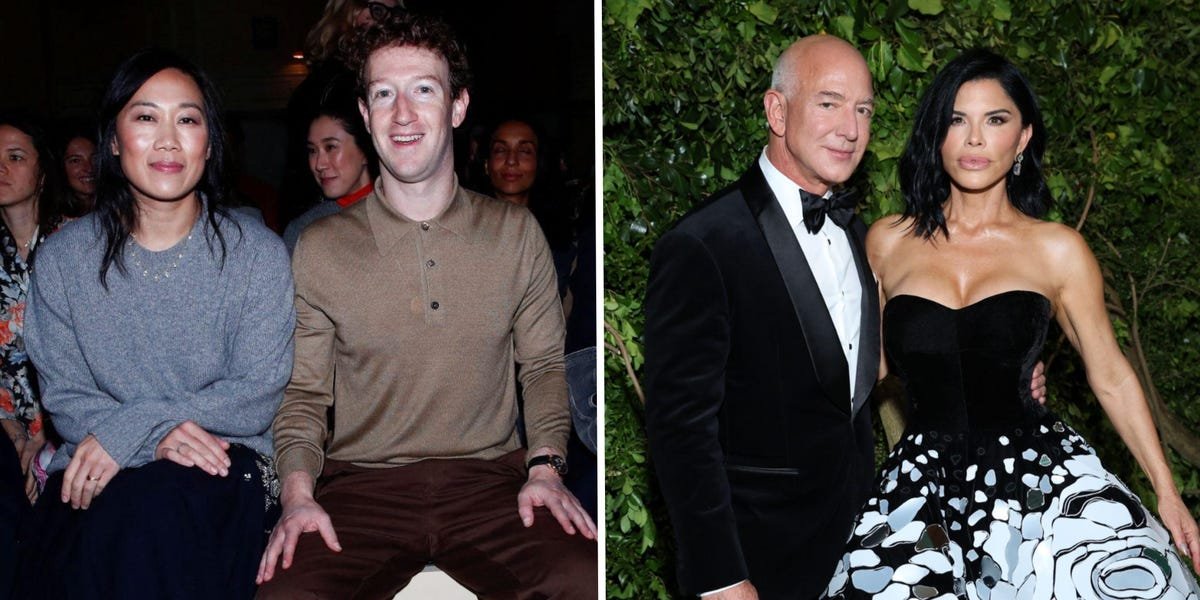
Just last month, Mark Zuckerberg and Priscilla Chan’s presence in the front row at the Prada Fall/Winter 2026 collection stirred the fashion world, amid Meta’s ambition to up the luxury factor in its AI glasses.
A few glances over prove that this was not an isolated case. Amazon magnate Jeff Bezos and Laura Sánchez-Bezos have long been fashion enthusiasts, with the fashion world courting them and vice versa.
There was the Vogue cover. Their roles as lead donors to the 2026 Met Gala — a decision Anna Wintour defended amid backlash. Persistent, if unfounded, rumors that Bezos could acquire Condé Nast. Add strategic appearances with Wintour, front-row seats at Schiaparelli and Dior couture, and Law Roach-styled vintage Versace moments, and the idea becomes clear.
With tech billionaires attending the right places and hanging with the right people, their place in fashion feels less like a cameo and more set in stone. It’s no longer up for debate. What is, though, is why. Why fashion? One expert told Business Insider it’s about power.
From indifference to front row
Since its early days, fashion has gone hand in hand with the elite class. It’s what they consumed, financed, and promoted. The situation hasn’t changed much. Look around, and conglomerates like LVMH and Kering, as well as celebrities, still largely influence the industry.
What has evolved, however, is technology.
Alessandro Garofalo/Reuters
“Social media has changed everything,” fashion journalist Louis Pisano told Business Insider. “People have become really image-conscious in a way that we previously only saw in celebrities. Now, everyone needs to brand themselves because everyone knows that every moment is an opportunity to make an impression.”
If before, tech bros were famously indifferent toward fashion — think of Steve Jobs, who proudly wore a black turtleneck and jeans — today, even they seem susceptible to the constant presence of social media.
Pisano points to an Instagram reel posted by Chan that felt distinctly TikToky, as if she and her husband were lifestyle influencers casually strolling through Milan and Prada.
Being mindful about social media is one thing. Venturing into fashion’s gatekept inner circle is another. In an appearance-driven culture, coolness — and the validation that comes with it — still matters above all else.
“You can be a tech bro, and if you’re badly dressed, everybody’s still gonna be like, ‘You look like shit,'” Pisano said. “You have all of this money, so why not look great as well?”
But looking great here isn’t about self-expression. It’s about access — and the kind of cultural legitimacy money alone can’t automatically buy.
Anthony Ghnassia/Getty Images for Christian Dior
Joshua Graham, fashion editor at Rolling Stone UK, compared the entrance of tech bros into the high fashion world with Mark Mylod’s film “The Menu,” in which a group of rich people go to an exclusive restaurant but “don’t really care about the food, just that they’re able to be seen within the context of what the best looks like.”
Pisano voiced a similar point: Over the years, fashion has become one of the easiest pathways to cultural relevance simply because it’s an exclusive framework. You have to be let in.
It is, after all, a business where brands and money tend to speak louder than individual style, and wearing the right label and knowing the right names becomes fashion shorthand, a sort of entry pass to culture’s apex.
Billionaires want staying power
For billionaires used to building platforms, cultural legacy is the next frontier. “Wearing an independent label isn’t going to bring you as much cultural cachet as wearing Prada or a custom Louis Vuitton piece,” Pisano noted. Indeed, symbolic power is still the goal.
”It’ll immortalize them,” Pisano said of tech billionaires’ aligning with luxury houses. Prada has been around since 1913. Schiaparelli since 1927. Dior since 1946. You get the picture. ”They want to attach themselves onto something that they’re betting is going to live forever because social media platforms die out. New ones will come, but you’re always going to need clothes to wear.”
These moguls have already had a hand in shaping society’s tastes and lifestyles thanks to the technology they’ve created. “They control the algorithms and build the infrastructure,” Pisano continued.
Still, he makes the point that it’s not a one-sided relationship. Perhaps, billionaires are already fashion people after all. “Designers need these people in order to push their content out to shopping recommendations,” Pisano noted.
Graham echoes this view, adding that fashion houses need to court relationships with tech titans because, ultimately, labels are always seeking exponential growth. ”I understand why anyone would want to work with Zuckerberg,” the editor said. ”The economy everywhere is in the toilet.”
ANGELA WEISS / AFP via Getty Images
So while many were scrunching their faces, wondering why Zuckerberg was pushing himself to the front row at Prada, the reality is that the relationship between tech and fashion is more symbiotic. Brands are increasingly turning to AI instead of creatives, for example.
The danger, Graham warned, is that when billionaires invest in fashion, they should at least pay attention to emerging designers who do it for the love of the art form. He added that so many creatives, such as the late Lee Alexander McQueen, did not enter the fashion world to ”make a quick buck,” but because it was their passion.
”I don’t know if it would be smarter for billionaires to go to a Central Saint Martin show and pick out a few students that they loved,” Graham argued, referencing the graduate show held by the prestigious London art and design school. ”But there needs to be a way for us to find ourselves back in a place where the patronage of fashion isn’t so commercial.”
Graham, like many who questioned why Zuckerberg was sitting front row, said he can understand the critique. “They are very hypercritical of something like this,” but it’s because they care “about what a designer, a garment, a shoe says about you as a person and then says about society as a whole.”
For now, though, the relationship between tech and fashion will continue to evolve. Tech may control the feed, but fashion still controls the culture.