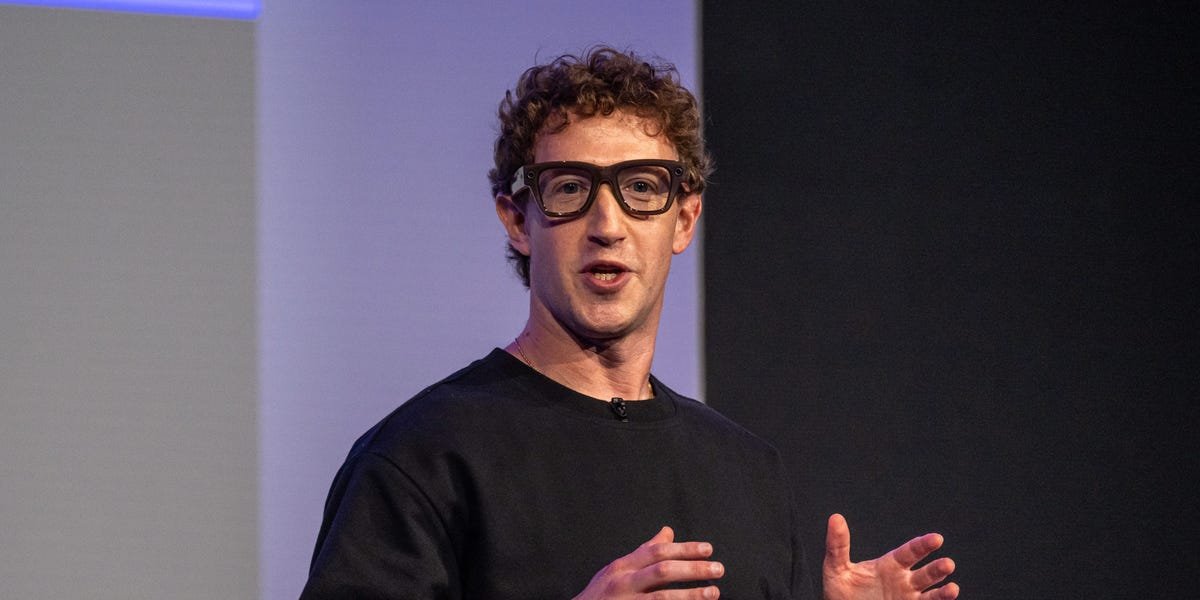
Meta-is-running-intensive-AI-training-weeks-to-get-employees.jpeg

Meta is running intensive AI training weeks to get employees testing agents and coding with Claude

At Meta, there’s no escaping AI.

The company has begun running intensive AI training weeks to encourage staff to experiment more with AI tools, according to Meta employees who spoke with Business Insider and public LinkedIn posts.

The weeks have involved a series of hackathons, demos, and other projects where Meta staff show off what they can build with AI, regardless of their job title or seniority. Some of the projects are built with Anthropic’s Claude Code, which the company has adopted widely internally.

This is part of Meta’s latest initiative to embrace AI across its workforce, which has included setting org targets for AI adoption and reorganizing some teams around AI-native “pods.” Similar pushes are taking place across corporate America as companies aim to become more efficient with AI. Google has told some employees their AI use will be considered in performance reviews, and JPMorgan has told software engineers it expects them to be harnessing AI to save time.

“It’s well-known that this is a priority and we’re focused on using AI to help employees with their day-to-day work,” a Meta spokesperson told Business Insider.

Internally, these sessions have been given names such as “AI Transformation Week.” During the sessions, some employees were given demos on how agents and other tools could work across their laptops and phones, an employee who attended some sessions told Business Insider.

Some of these AI weeks took place in March. One Meta employee told Business Insider that some teams held their own AI weeks at the end of last year, during which staff used vibe coding to create something valuable with no strict output requirements.

At one hackathon during Meta’s AI Transformation Week, attendees sat through demos of its own internal AI tools, Claude Code, and others, according to a LinkedIn post from an employee. AI agents are a big focus, with the aim of having employees guide autonomous systems that can handle everything from coding to compiling reports.

Design is also part of the effort. One Meta product manager touted building an interactive vibe-coding guide for designing products at Meta using Claude Code, according to her website.

Pods and goals

While some employees were brushing up on AI this week, Meta laid off several hundred employees across Reality Labs, the division overseeing its virtual reality projects, and other orgs. The company has spent billions on hiring top AI talent and building out infrastructure. However, it has yet to launch its long-awaited frontier model, internally codenamed Avocado.

While that has given Meta the perception of being behind in the AI race, a top Wall Street analyst said earlier this month that the company’s aggressive internal AI transformation could, in fact, give it “insurmountable” cost and performance advantages.

Meta has been making other changes in an effort to be what CEO Mark Zuckerberg has described as “AI native.” In a division of Reality Labs, the organization overseeing Meta’s virtual reality projects, employees were rebranded with titles like “AI builder” and were organized into AI-native “pods,” Business Insider previously reported.

The company has also set specific goals for adopting AI tools that vary across teams, according to an internal document reviewed by Business Insider.

On Tuesday, Meta’s CTO Andrew Bosworth said he would take leadership over the company’s efforts to adopt AI for internal use, an initiative known internally as “AI for Work,” according to a copy of the post seen by Business Insider and first reported by The Wall Street Journal.

“These tools hold the promise of giving each employee so much more power to accomplish their work,” Bosworth said in a post on X.




Source link

Tim Paradis

Vibe coding is becoming a real job now

Lazar Jovanovic trained as a forestry engineer and has never written code.

So, when he sits down to build software, he doesn’t open an editor and start churning out syntax. He begins by describing what he wants to build to an AI tool.

Before joining the vibe-coding company Lovable, Jovanovic oversaw operations at an online marketplace. His latest job title: vibe-coding engineer.

As Jovanovic sees it, his work isn’t all that different from traditional software development because he’s still building. At Lovable, part of his job is to show customers how easy the tools are for nontechnical users.

“The skill is no longer writing code,” Jovanovic, 36, told Business Insider. “The skill is ownership, clarity, judgment, taste, subject-matter expertise.”

Vibe coding is getting more attention because just about anyone can do it to build useful software. Now, people like Jovanovic are turning it into a full-time job, while others are vibe-coding their own apps and becoming entrepreneurs.


Lazar Jovanovic

Lazar Jovanovic sees vibe coding as the thing he was born to do.

Courtesty of Lazar Jovanovic


Sam Schneidman is head of community at Base44, which lets users build software with natural-language prompts. He said he expects vibe coding to produce a new professional class of creators who want to develop apps yet aren’t fluent in languages like Python or Java.

The era of vibe coding is “great for the ideas person,” he told Business Insider.

A dozen apps in five months

Antoni Tzavelas, who lives in Toronto, began his career as a fashion designer. When the industry faltered, someone told him how much money he could make in tech. So he went back to school to study systems administration.

Tzavelas eventually became a cloud computing engineer, later a DevOps engineer, and, down the line, moved into coaching software development teams.

Even while he progressed through seven career transitions, Tzavelas, 51, said he never learned to code. Then a friend introduced him to vibe coding.

“That took everything that I’ve ever learned from every single role and brought it all together,” Tzavelas told Business Insider.

He said he has since built a dozen apps in five months. One of them is a tool he developed in two days that analyzes conversations to help users improve their connections with others. Now, Tzavelas is the cofounder of a startup called MiruPulse, which aims to commercialize the app.

Vibe coding, he said, brought him the “ultimate joy of doing a job that I just love every single morning.”

A buildup of ‘judgment debt’

Tzavelas said that while it’s easy enough to build a basic app with vibe coding, turning it into a reliable, “battle-tested” system that a large company could rely on would likely require a deeper understanding of how IT systems work. That could be a problem if you are trying to turn your idea into a business that has legs.

Another challenge that entrepreneur Alibek Dostiyarov sees in vibe coding is the buildup of “judgment debt” — a pernicious accumulation of decisions that occur when AI alone constructs the technical scaffolding of software.

Dostiyarov, who has a background in software engineering and consulting, told Business Insider that the process can let flaws slip through, and over time, those can become like cracks in a foundation.

He is the cofounder of Perceptis, which develops AI-powered software for professional services firms.

Dostiyarov said that, more than ever, companies need to prioritize sound human judgment when developing software. Vibe coding has its place for testing ideas and prototypes. That’s about as far as he is willing to go.

“There is no world that I can imagine in the near future where we’ll be just saying, ‘OK, now that we’ve tested it, let’s just integrate it directly into our system,'” Dostiyarov said. Instead, he said, a vibe-coded prototype would need to be rebuilt by trained engineers.

The tools are changing fast

Vibe coding sometimes gets a bad rap among industry veterans, Adam Janes, a fractional CTO, told Business Insider.

“It’s a very touchy subject for devs, because they like to think that they have this real expertise,” he said.

Yet Janes thinks an opportunity exists for people who are experts in an area to become professional vibe coders because they can pair their knowledge with AI’s technical wizardry.

Because AI tends to either over-engineer or under-engineer a problem, Janes said, technical expertise is still a big help. Even so, as AI continues to improve, vibe coders could find it easier to develop robust software, he said.

“Three months ago, we were talking about a completely different world,” Janes said.

Will Wilson, CEO and cofounder of Antithesis, an autonomous software-testing platform, told Business Insider that he’s witnessed a similar shift since the arrival of models such as Claude Opus 4.5 last year.

Their emergence marked a tipping point, he said, though bottlenecks remain. Wilson said AI coding tools can spit out so much that it becomes “astonishingly hard” to review and ensure it won’t “blow up your business.”

With vibe coding, he said, “the burden all shifts to testing and reviewing the code and making sure it works right.”

There aren’t good estimates of how many professional-level vibe coders are out there, though AI is taking on larger chunks of coding, even in traditional engineering.

Articulating what AI needs

For Jovanovic, there’s no going back. Before Lovable hired him, he said he built dozens of apps — including one for journaling and one to track his jogs near his home in Sarasota, Florida.

It took Jovanovic about a year of vibe coding to go from enthusiast to employee. The toughest part of the job, he said, is articulating what he needs so AI can build it.

Jovanovic still gets goosebumps when he thinks about the first time he built an app.

“This feels like the thing that I was born to do,” he said.


Source link

Lovable-exec-says-big-boys-and-girls-like-OpenAI-and.jpeg

Lovable exec says ‘big boys and girls’ like OpenAI and Anthropic worry her more than other vibe coding startups

Other vibe coding players are not the biggest competition, says one Lovable exec.

“I always worry about the big boys and girls in the world,” Lovable’s head of growth Elena Verna said on a Sunday episode of the “20VC” podcast. “So, OpenAIs, Anthropics, Googles, Apples, more so than our competitors that spring up from the bottom or from sideways.”

This is because the distribution power of these tech giants and frontier labs in the market is unparalleled, she said.

Stockholm-based Lovable was valued at $6.6 billion in a December funding round led by CapitalG and Menlo Ventures. It competes with other vibe coding startups like Cursor, Replit, and Emergent, as well as far bigger and better-funded players, including OpenAI, Anthropic, and Microsoft, that make their own AI coding tools.

Verna, who joined the startup last May after a series of advisory and head of growth stints at various startups, said that in a world where products are becoming increasingly similar, distribution and growth are winning strategies.

“Whoever has the best distribution that is earned, that is competitively defensible, that is sustainable, that is predictable, is going to be the winner in the market,” she said. “I worry about the companies that have that figured out.”

Verna’s comments about competition follow a period of brutal comparisons between products made by vibe coding startups and Anthropic’s Claude Code.

After Anthropic released its latest model, Opus 4.6, founders and developers said on X that they are ditching their expensive Cursor and Lovable subscriptions for Claude Code.

Still, Lovable is going strong.

The Swedish startup’s annual recurring revenue has surged by more than 30%, from $300 million to $400 million in a single month, Business Insider reported. ARR, a key metric to gauge startup performance, refers to the predictable revenue a company expects to generate over a year.

Lovable’s chief revenue officer, Ryan Meadows, told Business Insider that the company plans to more than double its head count by the end of 2026, from 146 to 350 employees.

He added that Lovable, which specializes in making coding user-friendly, sees at least 200,000 new vibe coding projects created each day.


Source link

Im-an-Amazon-tech-lead-who-got-promoted-by-building.jpeg

I’m an Amazon tech lead who got promoted by building AI products. Here are my top vibe coding tips.

This as-told-to essay is based on a conversation with Anni Chen, who has worked in Amazon software engineering for about three-and-a-half years. It has been edited for length and clarity. Business Insider has verified her employment history.

AI helped me code, but more importantly, it helped with turning it into products. It’s the combination of grasping AI and translating it into scalable products that helped me get promoted faster.

I started off as a Software Engineer I, an entry-level role, in 2022. I was in the recommendations team working on serving recommendation widgets.

About two years ago, I started working on AI products on the side. That became huge and eventually spun off into its own team, which I’m a founding engineer of.

I was promoted in the recommendations team to Software Engineer II, and then I got promoted in the current team to senior engineer.

I focus on what we call memory, which powers personalization in generative AI experiences across Amazon.

AI writes 95% of my code

I started using AI as a side project to generate engaging titles for recommendation widgets when ChatGPT and Claude emerged. I saw how powerful it is in generating something really creative.

I started thinking: whenever I have a question or I want to code something up, I’ll just ask AI for help first before I attempt it.

I saw that the solution it came up with was leveling up my own code, and it helped me code more, too. Now I would say almost 95% of the code authored by me is written by AI.

I’m not just using AI to code; I also integrate AI’s output into products. I need to have a deep understanding of how AI works, what works well, and what doesn’t.

I have to be open and receptive to new models and tools coming out that can help with product iterations and make products better.

I work as a tech lead on large-scale LLM-driven systems in production environments, so I have a front-row seat to how AI-assisted workflows behave, not just in prototypes but under real-world scale and cross-team collaboration.

Top tips for vibe coding

The first tip is understanding the inner workings of LLMs and where they might fail.

LLMs are pre-trained — they’re trained on a large corpus, and it’s a probabilistic game. It’s followed by supervised fine-tuning, so the model will answer based on the structuring of a question and the answering format. Lastly, it’s followed by RLHF — reinforcement learning from human feedback.

By understanding these three steps, you can know, for example, when the LLM will not understand what you’re talking about, and when it needs domain knowledge from you. You will know when to use a new window or why hallucinations happen.

By understanding the limitations of the context window, you know when to break problems down. You will learn how to follow the structure to break things down into lower levels, and then you slowly focus on each component and generate.

By understanding the inner workings, you also know that you have to explain things to a peer. If you don’t explain in detail, it will default all those assumptions to the most common pattern, but that might not fit your use case.

My second tip: Think before vibe coding.

If you check the answer first, then your thoughts will be swayed by the answers. Compare your thoughts versus the LLM’s and see what the gaps are — what you didn’t know, and why the answer differs. From there, you know what implicit assumptions you haven’t told the LLM.

Thirdly, prompt for hard questions. Ask questions like what is the fallback when there is an error, or how this is going to scale? This is like a teacher asking a student, or a senior engineer asking a junior engineer to make sure the hard cases are covered. If you want the product to scale, think about it from day one and be conscious about asking those scaling questions.

Lastly, review and understand. Always review at each step, not just review after the whole code is generated. This ensures errors stop early rather than cascading all the way to the end, where you need to redo everything.

Creating wrong code is very dangerous. The presence of code makes people think, “Okay, this is good, it’s working.” But wrong code that enters production can cause more damage than the absence of functionality.

Understanding code is still important

You have to understand your own code. AI lowers the barrier to writing code, but not the responsibility for understanding it.

If something goes wrong and the code was committed by you, you’re the one responsible.

Imagine your code breaks in production, and you need to fix it, and you say, “I also don’t know, AI told me.” That’s not the correct way.

I don’t think we can entrust AI with such high-stakes tasks yet.

Understanding becomes easier with AI because it’s also a perfect learning opportunity. You can simply open another window and ask it to explain the concept.

If you ask in the same window about what it produced, it will explain only in that context. But you want to understand the concept more generally and see whether it makes sense to apply in this case.

Do you have a story to share about coding with AI? Contact this reporter at cmlee@businessinsider.com.


Source link

Chong Ming Lee, Junior News Reporter at Business Insider's Singapore bureau.

Emergent’s CEO told us these are the 2 biggest threats to vibe coding

Emergent CEO Mukund Jha told Business Insider the fast-growing vibe coding movement faces two major risks.

The “biggest threat to vibe coding” is the quality of the software it produces, Jha said.

Many AI coding tools can generate apps quickly, but the output can still be buggy, fragile, or difficult to scale. The vibe coding industry depends on those systems getting better.

“There’s a big bet that the quality of software that gets produced is going to improve exponentially,” he said. “If that doesn’t happen, that’s a big threat,” he added.

Another risk could come from AI itself. Jha said it is possible the industry could eventually “skip the whole software building aspect” if autonomous AI systems become powerful enough to replace software.

“We went from like Nokia phones to BlackBerry, and then everybody went to iPhone,” he said. “It could be that the software was the BlackBerry.”

People might eventually rely on AI agents or large language models that perform tasks without needing apps, he added.

Emergent announced in February that it reached $100 million in annual recurring revenue, or ARR, in just eight months after launching. ARR is the revenue a company expects to generate in a year from subscriptions or other recurring payments.

The company said it doubled its ARR from $50 million to $100 million in a single month, underscoring the rapid growth of AI coding startups.

In January, Business Insider reported that the vibe coding startup raised a $70 million Series B round, bringing its total funding to about $100 million. Investors include Khosla Ventures, SoftBank Vision Fund 2, Lightspeed, Prosus, Together, Y Combinator, and Google’s AI Futures Fund.

Just six months earlier, the startup raised $23 million in a Series A round, highlighting how quickly top AI startups are attracting capital during the boom.

Read more about vibe coding

The rise of AI coding startups

It’s not just Emergent. Ryan Meadows, the chief revenue officer at Lovable, a Swedish vibe-coding startup, told Business Insider in an exclusive interview that its annual recurring revenue jumped more than 30% in one month, rising from $300 million to $400 million.

Meadows, said that the recent growth surge came after the launch of Claude Code, Anthropics’ AI coding tool. Rather than hurting Lovable’s business, Meadows said many developers are using both products.

“It’s a rising tide,” he told Business Insider. “We’ve been super happy with what we’re seeing.”

Other players are also seeing explosive growth. In late 2025, Cursor, another breakout company in the vibe coding space, said it had reached $1 billion in annualized revenue and was valued at nearly $30 billion, according to a company announcement in November.

But some industry leaders have warned about the rising costs associated with AI coding tools.

Billionaire investor Chamath Palihapitiya said his software company is reconsidering its use of Cursor amid rising expenses tied to AI development.

“Our costs have more than tripled since November,” Palihapitiya said on an episode of the “All-In Podcast” published Friday. “Between the inference cost that we pay AWS, which is ginormous, between our cost with Cursor, between Anthropic, we are just spending millions.”

AI companies themselves have acknowledged that more advanced features can drive up costs. Earlier this week, Anthropic introduced Code Review, a tool designed to detect complex coding issues and identify bugs. The company said the feature “optimizes for depth,” which makes it “more expensive than lighter-weight solutions like the Claude Code GitHub Action.”


Source link

Ben Bergman

AI vibe coding darling Lovable is racing toward $1 billion in revenue

Lovable, a Swedish vibe coding startup valued at $6.6 billion, saw its torrid growth accelerate even as Anthropic’s Claude Code went viral over the past few months.

The Swedish startup says its annual recurring revenue has surged by more than 30%, from $300 million to $400 million in a single month, and could top $1 billion by year’s end, Lovable’s chief revenue officer, Ryan Meadows, told Business Insider in an exclusive interview. ARR refers to the predictable revenue a company expects to generate over a year from subscriptions or recurring contracts.

Lovable’s breakout growth comes amid a broader boom in AI-powered coding tools, which include Claude Code and startup Cursor, which was last valued at nearly $30 billion. In late 2025, Cursor said it had $1 billion in annualized revenue.

Lovable launched at the end of 2024 and reached $100 million in ARR just eight months later, doubling to $200 million by the end of 2025.

Vibe coding allows novices with limited programming expertise to create code using AI. Lovable, founded by Anton Osika and Fabian Hedin, aims to make coding even more user-friendly, enabling non-engineers to make software and applications. It was valued at $6.6 billion in a December funding round led by CapitalG and Menlo Ventures’ Anthology fund.

“It’s accelerating quite a bit,” Meadows said. “We’ve doubled the number of active users daily just in the last couple of months.” Lovable now boasts over 15 million daily active users and sees 200,000 new vibe coding projects created each day, according to Meadows.

The vast majority of Lovable users are still non-technical founders and entrepreneurs, but Meadows says the company is seeing its fastest growth from the enterprise business it launched in August.

Anthropic is a partner rather than a competitor

Lovable’s most recent growth spurt occurred after the release of Claude Code. But rather than eating into Lovable’s market share, Meadows says most customers use both tools. Professional software developers and engineering teams use Claude, while non-technical staffers prefer Lovable.

“It’s a rising tide,” he said. “We’ve been super happy with what we’re seeing.”

Lovable is powered by Claude, and when Anthropic launched its marketplace this week, it prominently featured Lovable.

“They’re pretty committed to working with us to pass business through,” said Meadows. “We’re going to keep investing in that partnership.”

A hiring spree

Lovable has rocketed to $400 million in ARR with a lean staff of just 146 employees, said Meadows. This year, the company will embark on a hiring spree, mostly in product and engineering roles, and will end the year with around 350 employees, he added.

Though its engineering team will continue to be based in Stockholm, the company will be opening its first US office this year in Boston to house go-to-market roles.

“We can’t hire fast enough,” Meadows said.

Have a tip? Contact Ben Bergman via email at bbergman@businessinsider.com or Signal at BenBergman.11


Source link

Shuby headshot

An Accel VC says the vibe coding market is big enough for Cursor and Claude Code

The great vibe coding war of 2026 isn’t the bloodbath it appears, says a venture capitalist whose firm backed Cursor.

On an episode of the “20VC” podcast released on Monday, Miles Clements, a partner at VC firm Accel, said that the AI-assisted coding industry is big enough for Anthropic’s Claude Code and Cursor.

After Anthropic released its latest model, Opus 4.6, last month, founders and developers said on X that they are ditching Cursor for Anthropic’s Claude Code.

“This market is growing enormously, and I don’t think a lot of these companies are actually experiencing success at the expense of the others,” Clements said.

Cursor, founded in 2022, was valued at $29.3 billion late last year. Accel first invested in the AI coding startup in June and co-led its $2.3 billion Series D round in November.

On the podcast, Clements called Claude Code an “amazing product.” Still, he said, there are two reasons Claude’s latest improvements don’t hurt Cursor.

“First of all, they’re bringing so many new cohorts of users online, so people who would not have been software developers a year ago today can be software developers with these tools,” he said.

Second, the market is expanding because consumption per customer is increasing, Clements added.

Last week, Chamath Palihapitiya, a VC and the founder of software incubator 8090, said that Cursor was one of his company’s biggest AI costs.

“We need to migrate off of Cursor,” he wrote on X. “It’s just too expensive vs Claude Code. The latter is equivalent, and if you use the Pro plan, you eliminate huge Cursor bills for token consumption.”

Cursor did not respond to a request for comment from Business Insider.

On a podcast released in late February, Insight Partners cofounder Jerry Murdock said that Cursor is behind its peers.

“Most of the companies I mentioned, their view is that Cursor is obsolete today,” he said. “I think those guys are going to have to quickly embrace autonomous agents.”

On Monday’s podcast, Clements countered Murdock’s remarks.

“Like, all due respect, I thought about playing in the NFL, but instead I walked onto a college football team and was the fifth-string inside linebacker,” he said. “You’re not looking at any real metrics. Like, who are these people to make these judgments?”

A representative for Murdock did not immediately respond to a request for comment.


Source link

Chong Ming Lee, Junior News Reporter at Business Insider's Singapore bureau.

I’m a 78-year-old retiree who’s vibe coding. Being out of the workforce doesn’t mean we can’t use AI like tech pros.

This as-told-to essay is based on a conversation with Lewis Dickson, a 78-year-old retiree and technology consultant. It’s been edited for length and clarity.

I’ve been in technology for a long time. I worked for IBM in the late 1970s. I did technology consulting for a Fortune 500 company in Atlanta from 2015 to 2024. I’ve taught many engineers and customers over the years.

I’m in semi-retirement mode now. Technology isn’t work to me — it’s fun.

When ChatGPT came out, I jumped on it. About six or eight months ago, when vibe coding became hot, I said, “Well, I need to try this out.”

I researched and found Emergent. What I liked is that they had the full stack. I didn’t have to connect anything or get my developers on the line to handle the back-end. I could just get on there and start.

I began with a couple of simple things. Now I’ve probably done a dozen or more vibe-coded apps.

The last two were for this AED company. They wanted the ability to access their existing camera provider’s website and extract their data. So I vibe-coded an app that would do that — pull that data in.

I also vibe-coded an AI voice app for them. It’s a web app, so you go to it on your phone, hit a button, and ask, “What’s our AED status?” It checks the database, then returns the information.

When I first showed the CEO a demo, he lit up. He thought it was the coolest thing he’d ever seen.

Older people can move fast

Most people think an old guy like me would have a flip phone.

When I started as a ham radio operator at 13, I was using Morse code on tubes, transmitters, and receivers. To go from that to what we’ve gone through with phones and cellphones, and then to watch that transition over the years into AI and be closely involved, I just love the technology — both the hardware and the software.

A lot of young kids today are into software but don’t know much about the hardware piece. Having a wide background comes in handy.

There’s often an assumption that gray hair means outdated technology skills. I understand where that perception comes from, but it’s not always accurate.

Many of us have moved just as quickly with the rise of AI as younger professionals. The advantage we bring is perspective: decades of experience that allow us to apply AI strategically, not just technically.

Some people would say older people retire and lose purpose. I’ve never had that problem because I’ve always had a passion for doing technical things.

I’m constantly on my laptop and phone, doing something related to AI and learning. You’ve got to watch a lot of YouTube and social media, learn what’s coming and what’s new.

How seniors can use AI for everyday life

I’m teaching AI to seniors now. In my class back in November, we were talking about data centers, what’s behind AI.

There’s a lady named Sue who’s 100 years old. Near the end of the class, Sue came up and asked, “What’s a semiconductor?”

I have a hardware background, so I answered her question at a very high level. She listened intently and wrote down a few notes.

After that class, I thought, “I need to do more for her.” So I used AI to create a video that went through the evolution of tubes in the 20s and 30s — things they could relate to — and old radios and TVs. Then we went to transistors in the late 40s and 50s, and what that meant.

The seniors I taught have now learned enough to take over their internal resident newsletter and use AI to help write it. They also created images for the newsletter with AI.

They are using AI to shop, check for bargains, and research their items.

I’ve shown them how to recognize different plants and birds with AI. They’ll walk through their garden area, take a picture, and ask ChatGPT or Gemini.

Do you have a story to share about vibe coding? Contact this reporter at cmlee@businessinsider.com.


Source link

Katherine Li, West Coast breaking news reporter at the Business Insider.

An identity verification AI startup is having all employees try vibe coding

If you work for a San Francisco startup and don’t know how to code, you could soon be asked to get creative with vibe coding.

Checkr, an AI-powered background check company, gave Business Insider a glimpse of how employees are actually using AI.

Checkr CEO Daniel Yanisse said that the company is going “all in” and trying everything to encourage its employees to fully embrace AI — including staff that don’t work in engineering roles.

“We really pride ourselves on using AI to the maximum possible amount,” said Yanisse. “We gave every employee a monthly stipend to try AI tools, and we did AI days and demos. After one year, 95% of the employees use prompting daily.”

“This year, we’re going to level up and move to building with AI, as in vibe coding,” Yanisse added. “I’m working with all of our teams now, and we’re going to do our AI days soon in March, where we’re going to make every non-technical person vibe code their own business apps.”

Yanisse said that many employees who have no idea how to code, who work in finance, legal, and HR, are already vibecoding apps to automate their workflows and problem-solve, such as building tools that help clean up large spreadsheets.

While Checkr is evaluating a variety of builder tools like Lovable, Replit, and Claude Code, Yanisse said Cursor is a clear standout and “has amazing adoption” among both engineers and non-technical staff, but Lovable is the best place to start for people with no coding experience.

“Probably, we’re going to buy all of them and just use the right tool for the right person,” Yanisse said of different AI coding tools.

“We have AI solution engineers who are available to actually partner and help, so they would come and help you and unstuck you if you have a problem, and take you all the way to success,” Yanisse added. “And then you’re on your way because then we share success stories with everyone in the company.”

AI adoption in some companies can be complicated

In practice, data shows that AI adoption can be complicated in a large enterprise. Competence with AI tools can be very uneven across the board, and security risks can mount without clear guidelines on AI usage.

According to a survey published in November by Moveworks, an AI-powered platform that automates IT and HR support, most executives said that non-technical employees are playing a bigger role in driving AI use, and that 78% have seen successful AI projects originate directly from support staff looking to solve daily challenges.

The National Cybersecurity Alliance also wrote in its Annual Cybersecurity Attitudes and Behaviors Report that AI adoption has surged to 65% globally as of the end of 2025, but more than half of these AI users never received any training in privacy and security risks. The report surveyed over 6,500 workers worldwide.

“A few years ago, most businesses were still debating whether AI was something they really needed,” Louis Riat-Bonello of Optisearch, an AI-powered marketing platform that specializes in SEO, told Business Insider.

“The businesses getting the best results aren’t blindly chasing automation. They’re using AI to support smarter decisions, move faster, and free up teams to focus on strategy and creativity,” Riat-Bonello added. “That balance is what will matter long after the hype fades.”

Yanisse said that in the age of AI, the company is looking for creative and adaptable people, because while AI will eliminate some roles, it will create others.

“We are constantly training and helping people update their skills and careers,” said Yanisse. “The job of the product designer and the job of the marketer are all completely shifting right now.”

“We’re over 900 people, so we’re not a small startup, but I’m a startup guy, and I’m a builder,” Yanisse added. “The people who come here need to be OK with uncertainty, be self-driven, adaptable, flexible, willing to do new things, and solve new problems without too much guidance or structure.”


Source link