An-entrepreneur-is-transforming-a-Cold-War-era-nuclear-silo-into.jpeg

An entrepreneur is transforming a Cold War-era nuclear silo into an underground data center. Look inside.

A decommissioned nuclear silo near Denver, Colorado, that could once launch three 4.5-megaton nuclear missiles at a moment’s notice is now an entrepreneur’s pet project.

Nik Halik, an Australian venture capitalist, purchased the decommissioned Cold War-era nuclear missile silo from the US government in 2021 for more than $10 million. For the past five years, Halik has been overseeing its transformation into a modern, renovated facility, where he plans to house an AI data center.

The project is on brand for Halik, a self-described “thrillionaire” whose past endeavors have included skydiving over Mount Everest, training in Russia as a civilian cosmonaut, and diving 5 miles deep to the deck of the Titanic.

He said his interest in these types of structures pairs with his vision for what they could become.

“I’m immersed in the world of castles and underground bunkers,” Halik told Business Insider. “I’m a value-facturer. I like things that I can add value to.”

Halik took Business Insider on a tour of the facility. See what it looks like inside the roughly 75-year-old nuclear silo.

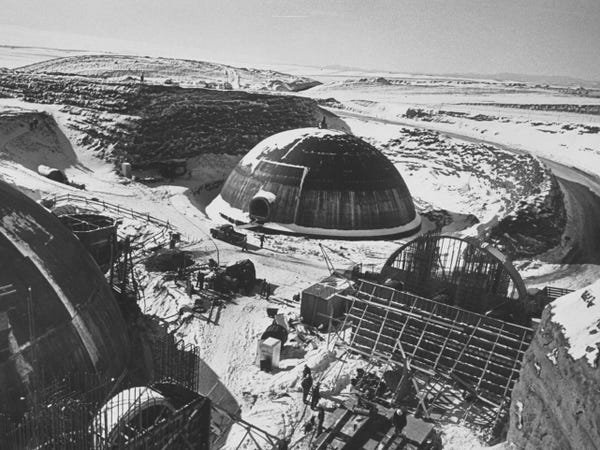
The facility was built in Colorado in 1959 for $47 million, or $350 million in today’s dollars.

Other Titan I silos like Halik’s were built in Colorado.

Carl Iwasaki/Getty Images

At the beginning of the Cold War, the US began developing intercontinental ballistic missiles (ICBMs) at a rapid pace. Following the US’ first operational ICBM, the SM-65 Atlas, the Titan I went under development in the mid-1950s.

According to the National Park Service, the Titan I missiles were 98 feet tall and could deliver a nuclear warhead over 6,000 miles.

Eighteen silos, like Halik’s and the one pictured, were built across the US to house these missiles during the Cold War.

Four large diesel engines powered the facility.


A person walking into a Titan I facility.

Another Titan I silo near Denver. Thanks to diesel power, the facilities could be powered without the grid.

Carl Iwasaki/Getty Images

Thanks to the silo’s use of diesel fuel, it had the ability to stay running without being connected to the electrical grid. The amount of fuel in the silo was enough to fuel around 2,000 houses for roughly 2 weeks.

Just one of the silo’s three diesel tanks has the capacity to hold about 50,000 gallons of fuel, Halik told Business Insider.

The missiles were removed from the silo less than a decade later.


A construction worker attached to a crane touching the tip of a missile.

All Titan I missiles were decommissioned in 1965.

Carl Iwasaki/Getty Images

In all, 54 Titan I missiles were operational between April 1962 and January 1965, according to the National Park Service.

Despite the impressive stature of the Titan I silos, they proved to be short-lived. All were removed by early 1965, becoming obsolete due to rapid technological developments that led to the Titan II and Minuteman I ICBMs.

In the years that followed, the US government removed valuable materials from the silos and sold off most of the facilities to public and private owners. Halik said after his bunker was decommissioned, it was used by government defense contractors and The Defense Advanced Research Projects Agency.

Today, Halik is renovating the silo at an estimated cost of $30 million.


Outdoor view of Halik's facility,

Halik’s facility is in an isolated area near Denver, Colorado.

Business Insider

Halik, with help from others, has been renovating the facility, located in a top-secret location in Colorado, for over four years.

Aside from the facility’s rusty metal scraps and loose wires, other hidden dangers lurk throughout the complex. The basement level, Halik said, is riddled with cyanide, lead paint, mercury, and asbestos.

The entrepreneur has taken a hands-on role in exploring and renovating the facility.


Halik holds a flashlight and points.

Halik has taken a large role in the renovation process despite safety risks.

Tyler Merkel

He’s documented every step of his journey in the facility on the YouTube channel Nuclear Bunker Living. The first episode, uploaded in September 2021, shows him exploring the bunker by himself for the first time.

As Halik’s videos show, he often jumps into the exploration and renovation headfirst, despite the safety risk. On one occasion, he crawled through a rusty pipe, only to realize later that it had a live wire running through it that he said could’ve electrocuted him instantly.

“There are so many variables of danger here,” Halik said in a video. “This place is unforgiving, and it always reciprocates with interest.”

The bunker totals 200,000 square feet.


View from the bottom of the bunker's stairs.

The bunker needed to be deep enough to house the 98-feet-tall Titan I missiles.

Tyler Merkel

The silo descends 165 feet below the surface, deep enough to house the missiles and the equipment necessary to launch them.

Seventeen distinct chambers make up the facility, connected by a network of tunnels spanning 4,500 feet.


A tunnel in Halik's complex.

A network of tunnels connects the complex’s rooms.

Tyler Merkel

Different launcher rooms, control domes, a power dome, and other areas make the facility a sprawling complex.

The most secure part of the complex can withstand a nuclear blast.


A sign reading

One part of the facility has strong concrete walls reinforced with steel.

Tyler Merkel

One portion of the facility was built by what Halik called “Hoover Dam-type engineering.” Featuring multiple layers of steel-reinforced concrete, each square inch of the wall could withstand roughly 15,000 pounds of pressure.

In this room, operators would stand ready to launch the missiles at a moment’s notice.


A desk from the control room of the facility.

Operators for the missiles would stand ready for a call from the Pentagon.

Nuclear Bunker Living/YouTube

The control room was where the missile operators would have pressed the fateful buttons to launch missiles that were 300 times more powerful than the bomb dropped on Hiroshima.

“The fate of the Western world was in the hands of these 21- to 22-year-olds who had the keys to the missiles, ready to employ them on the instructions of the Pentagon from the president,” Halik said.

Halik wants to turn one part of the facility into a museum.


An up-close shot of the launch deck.

Halik and his team found papers pertaining to the missile’s launch in the bunker.

Nuclear Bunker Living/YouTube

Many relics still remain in the control room and other areas, including pieces of the desk where a launch would’ve been programmed.

Recently, Halik and his team discovered papers containing launch codes, times, and other protocols.

For other rooms, he has more creative plans.


A large room that Halik said could be turned into a night club.

Halik wants to turn one room into a nightclub.

Nuclear Bunker Living/YouTube

In another room, Halik envisions a nightclub, complete with a DJ, bar, consumption lounges, and Cirque du Soleil dancers.

At a different decommissioned missile site in New Mexico, this vision may already be a reality. The Twistflower Nuclear Missile Silo in Roswell will host the ATOMIKA festival in November.

The festival, promoted by Halik, describes itself as an “experimental, annual gathering that fuses immersive art, deep inquiry, and powerful music.”

Chief among Halik’s plans is to turn part of the facility into a data center.


The facility's power dome

The facility’s power dome could once again be used to power a data center.

Tyler Merkel

Since AI requires large amounts of power, as well as a safe and reliable space for data, underground locations like Halik’s facility could prove to be prime locations.

A critical factor is the bunker’s cool temperature of 52 degrees Fahrenheit, even during the summer, which is optimal for the interior of a data center to prevent servers from overheating.

At some data centers, it can take more than 30% of a facility’s electricity to keep servers cool, the Pew Research Center reported.

“AI needs power,” Halik said. “AI needs safe environments to basically have all their computational processing power.”

The data center could be powered entirely in-house, without the grid.


Halik said he would install small nuclear reactors for power.

Halik said he would install small nuclear reactors for power.

Tyler Merkel

Halik said that to power the data center, he would swap the facility’s diesel infrastructure with small nuclear reactors in an attempt to avoid the hassles of refueling.

Halik said he has already gotten the attention of tech and AI companies.


View of one room with light bulbs and wires.

Companies are increasingly looking to house data centers underground.

Tyler Merkel

Although Halik didn’t disclose the specific companies interested, it aligns with a growing trend of underground data centers becoming more commonplace.

One company, called Iron Mountain, utilizes a former limestone mine in Pennsylvania for data processing and storage. The 220-foot-deep facility stretches 40 acres, about nine times the size of Halik’s bunker.


Source link

We-wanted-to-get-away-from-the-cold-so-we.jpeg

We wanted to get away from the cold, so we left Michigan and retired in Panama. We’re not planning to move back.

This as-told-to essay is based on a conversation with Greg Kitzmiller, a 64-year-old American retiree living in Panama. It has been edited for length and clarity.

I was born and raised in Michigan, where I met my wife, Jen, and where we built our life together.

In 2016, I retired from my job as a manufacturing supervisor. My wife retired from her law career over a year later.

The year before she retired, my main goal was to find a place where we could live the best life during our retirement. I did a lot of research on various countries, and Panama kept coming to the top of the list.


A man and woman standing on the beach in Panama.

For their retirement, the couple wanted to live in a warm place where their money could go further.


Greg Kitzmiller.


We were eager to escape the snow, so my first priority was eternal summer. We also wanted to stay close to the US to make traveling back easy. The fact that Panama uses the US dollar only added to its appeal.

We hadn’t spent our whole lives planning to retire abroad, but after watching HGTV shows, we both thought that this was something we could do.

Panama also offers a special Pensionado visa for retirees, which comes with incentives such as discounts on utility bills, medication, and even transportation.

Before making the move, we took a few exploratory trips to Panama. Our first trip was a weeklong in October 2017. After my wife retired, we came back in February 2018 for a nine-week trip, touring different areas to see if it felt like the right fit.


Snow-covered driveway of a house in Michigan.

Coming from Michigan, they were eager to get away from the snow.


Greg Kitzmiller.


During that trip, the weather was beautiful. When we went home to Michigan and saw the snow on our driveway, my wife turned and said to me, “We’re moving, right?” And I said, “Yeah, we are.”

We sold our house quickly. We held a few garage sales, donated what we didn’t need, and fit our lives into five suitcases. In June 2018, we officially moved to Panama.

Our kids were OK with the decision.

We have two daughters in Texas and one in Alabama. We’re no further from them now than we were in Michigan. Moreover, the world has gotten so small. We can get on a video call with the kids and the grandkids anytime.

With the help of a real-estate agent, we bought our two-bedroom condo for $210,000 in Coronado, which is about an hour and a half from Panama City by car.

Our condo is in a country club community, where the golf course wraps around our building, and we have 180-degree views of the ocean and the mountains.


View from a condo bedroom in Panama.

The couple bought a two-bedroom condo in Coronado.


Greg Kitzmiller.


Even though I’ve joined several Facebook groups, it’s the people we met at church that make up the core of our social circle.

Moving to Panama sparked an unexpected passion for writing.

When we started talking about moving here, one of Jen’s friends at work said, “Well, you should write a blog.”

It wasn’t that easy, since I’m not very tech-savvy, but I did it. I still maintain the blog and publish a newsletter. And, right after we got here, I connected with a writer’s group.

Being a part of that group led me to do a lot of things in my retirement that I never thought I would do.


Bookshelves in a bookstore in Panama.

Kitzmiller published his first book about his experience retiring in Panama in 2020.


Greg Kitzmiller.


I published my first book in 2020 about our experience of retiring in Panama. Since then, I’ve started writing in different ways, including a detective fiction series — I’m working on the fourth installment.

Writing wasn’t something I expected to do in my retirement, but there’s a strong community of artists, authors, and musicians here. When you surround yourself with other people who are talented in those ways, it fosters your own talent.

My retirement has been very fulfilling.

Our health is better, too. It helps that there is always an abundance of fresh fruit and vegetables around.


A couple smiling over a meal at a restaurant.

Kitzmiller says being surrounded by a thriving community of artists has encouraged his own passion for writing.


Greg Kitzmiller.


If I had it to do over, I would’ve learned Spanish when I was young. When you’re in your 60s, it’s hard to learn a new language. I almost always understand what’s being said, but don’t verbalize very well, unlike my wife, who is fluent.

Every day’s a little different. We have a few social groups, including one where we play dominoes every week. We rotate between houses, someone makes lunch, and we spend the afternoon playing.

Initially, we figured we’d come for 10 years and then evaluate if we wanted to stay. It’s only been eight years, but we’ve already decided that this is where we want to be.

We’re not planning to move back to the US. There’s honestly not much we miss.

Do you have a story to share about relocating to a new city? Contact this reporter at agoh@businessinsider.com.


Source link

I-made-Ina-Gartens-minestrone-soup-and-its-the-best.jpeg

I made Ina Garten’s minestrone soup, and it’s the best cure for a cold or the winter blues

  • I made Ina Garten’s winter minestrone soup. 
  • Her recipe is packed with veggies, including carrots, celery, butternut squash, and spinach. 
  • The colorful soup was hearty and comforting, exactly what you need during the winter. 

The dropping temperatures, canceled plans, and empty shelves can only mean one thing — winter is definitely here.

And nothing helps the winter blues, or the flu, more than a piping hot bowl of soup.

There are few celebrity chefs I find more comforting than Ina Garten, so I whipped up her winter minestrone soup to brighten my day.

Here’s how to make it.

Ina Garten’s winter minestrone soup is packed with colorful veggies.

Garten’s winter minestrone soup features butternut squash, carrots, celery, and pancetta.

Anneta Konstantinides/Business Insider

To make 6-8 servings of Garten’s soup, you’ll need:

  • 2 cups of cooked small pasta, such as Tubetti
  • 1 26-ounce can or box of chopped tomatoes, such as Pomi
  • 1 15-ounce can of cannellini beans
  • 6 to 8 cups of chicken stock, preferably homemade
  • 8-10 ounces of fresh baby spinach leaves
  • 2 ½ cups of peeled butternut squash, ½-inch diced
  • 2 cups of celery, ½-inch diced
  • 2 cups of carrots, ½-inch diced
  • 1 ½ cups of chopped yellow onions
  • ½ cup of good dry white wine
  • 4 ounces of diced pancetta
  • ½ tablespoon of minced garlic (about 4 cloves)
  • 2 tablespoons of store-bought pesto
  • 2 teaspoons of fresh chopped thyme leaves
  • 1 bay leaf
  • Freshly grated Parmesan cheese, for serving

My prep began with plenty of chopping.


Chopped veggies for Ina Garten's winter minestrone soup

First, I chopped all of my veggies.

Anneta Konstantinides/Business Insider

Garten’s recipe requires a lot of prep, but it makes a lot of soup. And all those veggies make the broth so hearty and comforting.

If you can, recruit a loved one or friend to help you chop everything — just bribe them with leftovers.

I also cooked the pasta ahead of time.


Cooked pasta for Ina Garten's winter minestrone soup

I cooked my pasta so it would be ready for the soup.

Anneta Konstantinides/Business Insider

Garten recommends using Tubetti pasta for this recipe, but I couldn’t find any at my local supermarket. I went with a similar shape and cooked my noodles until they were al dente.

To begin my soup, I first threw some olive oil and pancetta into a large pot.


Cooking pancetta for Ina Garten's winter minestrone soup

Garten says to cook the pancetta for 6 to 8 minutes.

Anneta Konstantinides/Business Insider

I added 2 tablespoons of olive oil to the pot, which was placed over medium heat.

Then I added the pancetta, cooking it over medium-low heat for about six minutes until it had lightly browned.

Then I added the veggies and herbs.


Adding butternut squash for Ina Garten's winter minestrone soup

I added my peeled and diced butternut squash.

Anneta Konstantinides/Business Insider

I threw my chopped onions, carrots, celery, squash, garlic, and thyme into the pot.

Garten says it’s best to use fresh thyme if you can because it “really makes a difference.”

I cooked everything over medium heat, making sure to stir occasionally.


Veggies in pot for Ina Garten's winter minestrone soup

I cooked my veggies for 10 minutes, until they began to soften.

Anneta Konstantinides/Business Insider

Garten says you should cook the mixture for eight to 10 minutes, until the vegetables begin to soften.

Then I added the chopped tomatoes and six cups of chicken stock.


Adding chicken broth for Ina Garten's winter minestrone soup

Then I added the chicken stock.

Anneta Konstantinides/Business Insider

Garten recommends using her homemade chicken stock, which I didn’t have time to whip up for this dish.

I will confess that the soup’s broth wasn’t very exciting or rich with store-bought stock. You could add some chicken bouillon to amp up its flavor, but nothing will taste as good as the homemade stock. It’s worth the extra effort!

I added the bay leaf and seasoned my mixture.


Adding bay leaf to broth for Ina Garten's winter minestrone soup

I seasoned the broth with salt and pepper.

Anneta Konstantinides/Business Insider

I added 1 tablespoon of salt and 1 ½ teaspoons of freshly ground black pepper to the pot.

I brought the broth to a boil, then lowered the heat and simmered it uncovered for 30 minutes.


Simmering Ina Garten's winter minestrone soup

My boiling broth.

Anneta Konstantinides/Business Insider

Garten says you should allow the mixture to simmer until the vegetables are tender, so I let my soup simmer for an additional 15 minutes.

Once my broth was done simmering, I took out the bay leaf.


Taking out bay leaf for Ina Garten's winter minestrone soup

No one wants to eat the bay leaf.

Anneta Konstantinides/Business Insider

Garten says you can use a fresh or dry bay leaf for this recipe.

Then I added the beans and pasta and allowed them to heat through.


Adding beans to Ina Garten's winter minestrone soup

My broth with the pasta and beans.

Anneta Konstantinides/Business Insider

Make sure you drain and rinse the cannellini beans before adding them to the broth.

The pasta will likely absorb a lot of the broth. If your soup looks too thick at this stage, add more chicken stock.


Simmering Ina Garten's winter minestrone soup

My soup was almost ready.

Anneta Konstantinides/Business Insider

Garten recommends adding two more cups of chicken stock if you’re unhappy with the consistency.

Once I was ready to serve, I added the spinach to my soup.


Adding spinach to Ina Garten's winter minestrone soup

Adding the spinach to my soup.

Anneta Konstantinides/Business Insider

Garten recommends tossing the spinach with two big spoons to help cook the leaves until they’ve wilted in the broth.

Then I added the white wine.


Adding wine to Ina Garten's winter minestrone soup

I chose a pinot grigio wine for this recipe.

Anneta Konstantinides/Business Insider

Garten says you should select a nice white wine that you’d want to drink for this recipe.

This is also where you should add the pesto if you’re using it. (I skipped it because my sister is allergic to pine nuts.)

I mixed everything together and gave my soup a quick salt check.


Ina Garten's winter minestrone soup

Check the saltiness of your soup before serving.

Anneta Konstantinides/Business Insider

I was happy with the saltiness of my soup, but Garten recommends adding another teaspoon or two if you feel the broth needs more.

After a drizzle of olive oil and a sprinkle of Parmesan cheese, my soup was ready.


Ina Garten's winter minestrone soup

Garten’s winter minestrone soup is packed with bright bursts of color.

Anneta Konstantinides/Business Insider

Garten’s winter minestrone soup is a much-needed burst of color on a cold and dreary day. I loved seeing the rainbow of hues from all the vegetables — the soup couldn’t have looked more inviting.

It was time for my first sip.

Garten’s winter minestrone soup is really hearty and comforting.


Ina Garten's winter minestrone soup

Garten’s winter minestrone soup is packed with so much flavor.

Anneta Konstantinides/Business Insider

I’m a huge soup fan. I love soup so much that I’m even in a group chat dedicated to sharing photos, recipes, and daily appreciation for soup and its various forms (shout-out to my soup girlz). But minestrone has never been my favorite.

Garten finds a way to infuse this often lackluster soup with flavor. The taste of the tomato shines through, adding a richness to the broth that’s amplified by the final touch of Parmesan and olive oil on top. All the veggies tasted delicious and maintained their texture, even when I ate leftovers a few days later. I also enjoyed the burst of freshness from the spinach and thyme, and how the soup still tasted healthy and light.

Winter is a tough season for everyone. So, if you’re under the weather or just feeling blue, I recommend a bowl of Garten’s colorful winter minestrone soup.


Source link

Charissa Cheong

I moved to Canada, but it wasn’t for me. I was cold, isolated, and finding a job was absolutely horrendous.

This as-told-to essay is based on a conversation with Zina Malas, 24, who lives in Beirut. The following has been edited for length and clarity.

When I visited Canada as a 5-year-old, it was the dream.

I was born and raised in Lebanon, and grew up fearing I’d get kidnapped in the streets or a random bomb would fall on me. After war broke out in 2006, our family moved to Canada to escape.

I loved it. There were nice parks, and exotic” activities like ice skating.

After a few months, my family went back to Lebanon, where I did my undergrad.


Zina Malas as a child, wearing a big coat and gloves outside in the snow in Canada.

Malas loved living in Canada as a child.

Courtesy of Zina Malas


In 2022, at 21, I moved to Canada alone.

Three years in, I had struggled to find a job or save money, and began feeling very depressed, so I moved back to Lebanon.

I’d still advise others to try relocating abroad, but living in Canada just didn’t work for me.

I grew desperate to leave Lebanon

Living in Lebanon was a struggle. I felt like I’d lost my youth and was desperate to leave, even if I had to work a minimum wage job.

My time spent studying media and communication at the American University of Beirut was disrupted by a national revolution that started in fall 2019, COVID, and the Beirut explosion in August 2020.

I already had friends in Montreal and Canadian citizenship through one of my parents, so I headed to Canada and gave myself three months to find a job.

I didn’t realize how difficult it would be to find a job in Canada

Even though my Montreal friends warned me that finding a job wouldn’t be easy, I didn’t think it would be that hard.

They were right. It was absolutely horrendous.

In Lebanon, where I had some jobs during my studies, I experienced less competition for work. I was used to sending my application to a potential employer, DM’ing the company on Instagram, and having an interview the next day. But in Canada, I applied for roles across marketing, social media, and business development, which I felt I had the skills for, but didn’t land any.

Some recruiters told me I didn’t have the right experience. I’m not sure if it was because my experience was Lebanese or not Canadian, but it felt like people were treating me like I had no professional history.


Malas taking a mirror selfie

Job hunting was difficult for Malas.

Courtesy of Zina Malas


I also struggled to understand interviewers who spoke Québécois French, a dialect used in Montreal. I went to a French school in Lebanon, so I’m fluent, but I couldn’t for the life of me understand this particular accent, which lost me opportunities.

After applying for what I’d estimate were at least 200 jobs, I connected with a Lebanese HR rep who saw my résumé and gave me the chance to interview for a content manager role. After roughly three months of searching, it became my first job in Canada.

I stayed at the company for 1.5 years, and then moved into tech sales at a different company for a few months.

The cost of living and isolation in Canada drove me to leave

In Lebanon, the work culture was generally less formal. I could show up late to work in a random outfit and no one would say anything. We could have disorganized files and communicate with team members over Whatsapp. It was friendly and laid-back.

In Canada, things were more organized. I knew exactly what my tasks were, and was given proper equipment. I remember being shocked when I was given a MacBook and phone number for work.

My compensation in Canada was good compared with what I could make in Lebanon. I had a nice life, a nice apartment, and ate well. But with the cost of rent, bills, and groceries, I feel like I wasn’t saving much, and was basically living paycheck to paycheck. It’s one of the reasons I left.


Malas walking in throuhg a field on a sunny day, wearing a blue hat.

Malas struggled to make new friends in Canada.

Courtesy of Zina Malas


Another reason was how hard it was to meet new people, and my mental health suffered as a result. Canadian culture is highly individualistic, which is hugely different to the Middle East. In Lebanon, if I go out with one friend to a restaurant, I’ll end up meeting 10 new people. If I tried to talk to people in Canada while I was out, conversations would end abruptly. If my roommate didn’t have friends, with whom I was thankfully able to have a lot of fun, I probably would have been completely alone.

I imagined I’d meet so many new people and have the time of my life, but my expectations weren’t met. Plus, I couldn’t deal with the cold weather.

In September 2025, I went home.

I’m running my own business in Lebanon now, and I’m happier

I’m currently running my own company, Tawlé Consultancy, which helps businesses in the MENA region who are declining or feel stuck. I started it in Canada, but working on it from the West felt weird, as though I was righteously telling people what to do from a distance. Now, I can sit with people, help them come up with new ideas, and feel like I’m making a valuable impact.


Zina Malas

Malas runs her own company in Lebanon

Courtesy of Zina Malas


I’ve noticed many people my age in Lebanon are also trying to build their own thing. Our generation has been through a lot, and we’re trying to figure things out and establish ourselves. When I go to coffee shops, I see so many founders around me. It’s very inspiring.

Being in a stable country like Canada eased my mind, as I wasn’t worried about my physical safety, and it helped me deal with the trauma I experienced in Lebanon.

But I’m happier living in Lebanon. I’ve realized I’m too Lebanese to live anywhere else.

Do you have a story to share about moving abroad and deciding to come home again? Contact this reporter at ccheong@businessinsider.com


Source link