

Headshot of Chris Panella.

The Army’s new drone competition is really a talent hunt. It’s scouting out what makes a top drone pilot.

The US Army used its first Best Drone Warfighter competition not just to test skills, officials say, but to identify what makes a top drone operator — and who in the force is best suited for the job.

Rather than training every soldier to fly drones, the Army is using competition to identify the skill sets of top drone operators and whether there are specific roles within units that would make the most sense for working with uncrewed aerial systems.

The effort reflects a broader shift from treating drone flying as something for all soldiers to approaching it as a specialized skill set that requires the right aptitude, training, and sustained practice.

The inaugural drone competition took place this week at the University of Alabama in Huntsville, gathering teams from across active, Reserve, and National Guard units. There were no requirements on what types of soldiers could participate or where they came from.

Rather, “it was just send your best UAS operators,” Col. Nicholas Ryan, director of Army UAS Transformation at the Aviation Center of Excellence, told reporters, prompting a mix of operators with different backgrounds and expertise.

Over three days, soldiers competed in multiple events, testing their piloting skills. The first was an obstacle course that operators navigated using first-person-view drones.


A soldier holds a drone controller.

Recent US Department of Defense directives have prioritized the development and integration of drones across the Army.

US Army photo by Spc. Michelle Lessard-Terry


The second was a hunter-killer scenario in which teams used a reconnaissance drone to survey an array of targets and decide which were highest priority for simulated strikes with one-way attack drones. The competition didn’t involve any kinetic strikes; instead, soldiers flew the drones into nets on the targets.

The third event was focused on innovation. Soldiers could build, modify, and test their own drones.

Ryan said that the Army was taking notes throughout the competition on who the top operators were, calling it talent management.

“At the end of the day,” he said, “it’s not about receiving trophies or awards,” it is about identifying what sets the top drone operators apart and figuring out how they developed those skills. The goal, he said, is to understand “what lessons can we take from this to find out who the best operator is and how they became the best operator. What skills and resources and training allowed them to become the best operator?”

Soldiers in the US and Ukraine have noticed that gamers make excellent drone pilots, as do soldiers who have experience piloting hobby drones.

“That’s something we’re absolutely looking at right now,” Ryan said.

Army leaders have previously noted a correlation between soldiers who grew up playing video games — or who are active gamers — and drone proficiency.

Troops who game have shown quick reflexes, precise hand-eye coordination, and strong spatial awareness that make them competent with drones.

At an exercise in Germany last fall, a US Army captain told Business Insider that the top pilots were soldiers who “when they got off on Fridays, then go and play video games.”

The Army has been restructuring its approach to drone warfare, rewriting its training and focusing on integrating soldiers with small drone training into front-line units. Lessons and approaches are being shared across the service, building a broader doctrine on how the Army is adopting drones.


A quadcopter drone flies on a field with trees in the background.

The competition allowed Army leadership to learn more about the skillsets and backgrounds that make drone operators successful.

US Army photo by Sgt. Aaron Troutman


Ryan said that the service is realizing that flying drones needs to be a dedicated assignment. “You can’t be a squad rifleman and a drone operator,” he said, explaining that “it’s one or the other because you have to have the level of skill and expertise in operating and employing the drones. That’s what you have to be good at and train at and focus on for most of your time.”

Other Army officials said efforts like the competition were demonstrating where drones best fit in a formation and what aspects of training are most important to maintain these highly perishable skills.

For the most part, soldiers flew their drones successfully, but the Army did take note of communication breakdowns as soldiers went through the hunter-killer lane, specifically getting drones into position and identifying and simulating strikes on targets.

“That’s an example of something we didn’t anticipate, but it’s absolutely standing out as that is something we as an Army need to do better on,” Ryan said. “If we’re going to proliferate these drones and want them to be more effective and lethal, we just need to improve on how our soldiers talk to each other to communicate when they’re using them.”

In future iterations of the Best Drone Warfighter competition, the Army hopes to include kinetic elements as well as electronic warfare and jamming to better replicate real-world scenarios.



Source link

Melia Russell smiles

Harvey makes a big chief product officer hire as legal tech competition heats up

Harvey, the $8 billion legal software startup, is becoming a default vendor in Big Law. Now, with rival startups nipping at its heels and AI model providers moving closer to legal workflows, Harvey is bringing in a new executive to help defend its lead.

The company tells Business Insider it has hired Anique Drumright as its first chief product officer. In this role, she’ll shape what Harvey builds next and how quickly it can ship. Drumright has held roles at Uber, TripActions, Loom, and, most recently, HR software startup Rippling, where she led the company’s push into IT management software.

“Her slope of learning is very high,” said Winston Weinberg, Harvey’s chief executive. He described sending Drumright a lengthy Google Doc on the state of law firm technology and the day-to-day mechanics of legal work. She came back quickly with “really good product ideas,” he said.

The C-suite hire comes at a critical moment for Harvey — and for legal tech more broadly. Law firms are pouring money into new software meant to help lawyers work faster and save costs. Clients are driving much of that spend. After seeing chatbots and virtual assistants transform their own operations, they now expect the same efficiency from outside counsel.

Those tools don’t come cheap, and recent moves by the model providers themselves have complicated the picture. Anthropic’s release last week of a contract-review tool sent ripples through the industry and led to a major sell-off of legal-research stocks. It raised a pointed question: If a foundation model can review contracts, on top of handling tasks across the rest of the organization, how much specialized legal software will firms still pay for?

Harvey sits at the top of the heap for now. The startup has emerged as one of the best-known and best-funded players in legal tech, with licenses at over half of the 100 largest US law firms. The company said it ended last year with more than $190 million in annual recurring revenue. And job postings reviewed by Business Insider suggest it is pushing into mid-market and smaller firms, a long tail of potential growth beyond Big Law.

Earlier this week, Forbes reported that Harvey is raising a new round of funding that would value the company at $11 billion, citing unnamed people familiar with the deal. A Harvey spokesperson declined to comment on the report.

Harvey’s dominance comes with pressure. The company still needs to show lawyers its product can boost revenue, not just save hours. At the same time, competition is intensifying, from legal software startups like Legora and from OpenAI and Anthropic, the same companies whose technology powers Harvey’s platform.

Weinberg said Anthropic’s latest release doesn’t change Harvey’s product direction, but it does emphasize the need to move faster on shipping what makes the company distinctive. “Part of hiring Anique is to accelerate that,” he said.

If the next fight is adoption, Drumright has put in the reps. She’s spent years building products that ask people to change their habits.

At Uber, she worked in product and marketing as the ride-hailing giant scaled to billions of trips a year. Later, at Loom, she helped grow a product that nudged office workers away from meetings and long email chains, replacing them with screen-recorded video messages.

Drumright faces a similar challenge at Harvey, where the company has to convince reluctant lawyers, a famously luddite profession, to trade the familiar way of doing things for new tools. Those take time to use effectively.

“When something is new, even if it’s powerful, it’s still harder to do than the way you’ve always done it,” she said. Her job, she said, is to make those new capabilities feel intuitive.

Drumright is the daughter of two lawyers, and she has seen firsthand how low-tech legal work can be. She remembers her mother siting on the couch, preparing for a deposition by speaking into a tape recorder.

Drumright starts on Tuesday. Her first weeks at Harvey will be spent on a listening tour, meeting lawyers using the product and legal teams deciding whether to buy it. “Legal is a very specific domain,” she said, but the work starts with understanding how lawyers actually work today, and designing products that don’t slow them down.

Have a tip? Contact this reporter via email at mrussell@businessinsider.com or Signal at @MeliaRussell.01. Use a personal email address and a non-work device; here’s our guide to sharing information securely.


Source link

Why-Satya-Nadella-said-hes-psyched-about-more-competition.jpeg

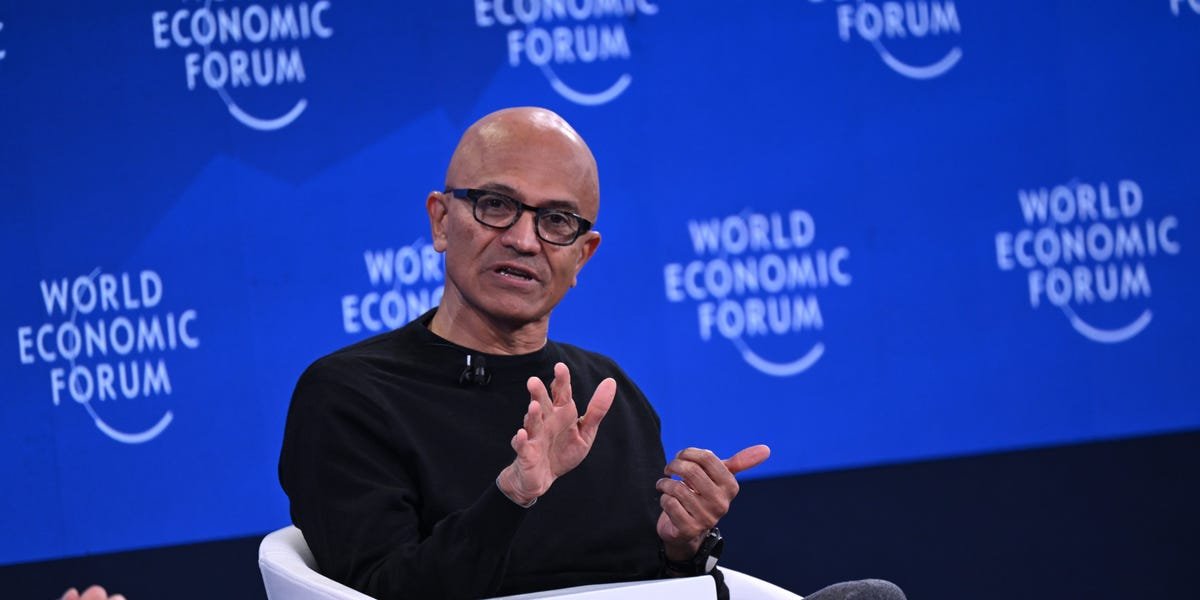
Why Satya Nadella said he’s psyched about more competition

The AI race doesn’t need to be a zero-sum game, says Satya Nadella.

On an appearance of the “All-In” podcast recorded in Davos on Wednesday, the Microsoft CEO said current competition is intense — but that’s not a bad thing.

“The way I always think is it’s always helpful when you have a complete new set of competitors every decade because that keeps you fit,” he said. He added, “It’s a pretty intense time. I’m glad there’s the competition.”

Nadella said that when he joined the computer giant in 1992, Novell, a Utah-based software and services company, was the “big, existential competitor” Microsoft had.

Novell’s dominance declined in the late 1990s, and it was acquired in 2011.

Nadella said that the tech industry as a whole will continue to dominate economically.

“At the end of the day, when I look at it as a percentage of GDP, five years from now, where will tech be? It will be higher,” he said, referring to gross domestic product. “So we’re blessed to be in this industry. It’s a lot of intense competition, but it’s not so zero-sum as some people make it out.”

Nadella said that his approach is a different take on Peter Thiel’s advice. He said Microsoft avoids competition by understanding what customers really want from the company rather than treating everybody like a competitor.

The Microsoft CEO’s embrace of competition matches the approach one of his predecessors, Bill Gates, and top rival, former Apple CEO Steve Jobs, took toward competition.

“Competition is always a fantastic thing, and the computer industry is intensely competitive,” Gates said in a 2005 interview. “Whether it’s Google or Apple or free software, we’ve got some fantastic competitors, and it keeps us on our toes.”

Jobs famously shifted his perspective on competition after returning to Apple in 1997. He went from dismissing Microsoft’s taste and originality to saying that Apple needed to focus on its own success rather than Microsoft’s failure.

“If we want to move forward and see Apple healthy and prospering again, we have to let go of this notion that for Apple to win, Microsoft has to lose,” he said at the 1997 Macworld Expo.


Source link