
Line chart

Dell continues to quietly shrink its workforce

Mass layoffs are all the rage in the tech industry.

This year alone, Amazon has cut 16,000 jobs, Jack Dorsey’s fintech firm Block has slashed half its workforce, and the software company Atlassian has laid off 4,000 employees — about 10% of staff. Next up, Meta is reportedly preparing cuts of 20% or more.

The PC giant Dell is taking a different approach, quietly but systematically shrinking its head count.

In its latest 10-K filing, published on Monday, Dell said that it had roughly 97,000 employees as of January 31, 2026. The number marks an 11,000 reduction in the company’s workforce in the last year.

The number includes both attrition and layoffs, but a clear pattern is emerging — it’s the third year in a row that Dell’s workforce has shrunk by 10%.

The company now has 36,000 fewer employees than in February 2023 — a 27% decline over three years.

The company said that throughout its 2026 fiscal year, it had reduced costs through measures including “employee reorganizations, limitation of external hiring, and other actions to align our investments with our announced strategic and customer priorities.”

Dell did not immediately respond to a request for comment.

Job cuts across tech are being linked to AI

This year’s headline-grabbing tech layoff announcements share a common thread: companies are tying job cuts to AI transformations.

Memos from both Block’s and Atlassian’s CEOs highlighted profound shifts in how they see technology reshaping work and, therefore, how many workers they’ll need in the years to come.

Dell may be less overt about announcing employee cuts, but, like others in the industry, it is undergoing a major modernization push as it prepares for an AI-driven future.

In its 10k filing, Dell said it had been committed to “cost management in coordination with our ongoing business modernization initiatives.”

In its latest annual results, revenue in Dell’s Infrastructure Solutions Group (ISG), which sells servers and storage infrastructure, rose 40% in its 2026 fiscal year, and the company said it expected AI-optimized server revenue to double in 2027.

Internally, Dell is preparing to roll out standardized processes across its operations and launch a single enterprise platform, an initiative it has called One Dell Way. In a January memo, Dell told staff the systems overhaul would be the “biggest transformation in company history,” Business Insider exclusively reported.

In line with other tech industry trends, Dell has also been tightening workplace policies for its remaining 97,000 employees, first with a 5-day RTO mandate for workers living near offices and, most recently, in February, introducing a tougher compensation system for sales staff.

Have a tip? Contact this reporter via email at pthompson@businessinsider.com or Signal at Polly_Thompson.89. Use a personal email address, a nonwork WiFi network, and a nonwork device; here’s our guide to sharing information securely.



Source link

Honda-takes-a-157-billion-hit-as-EV-retreat-continues.jpeg

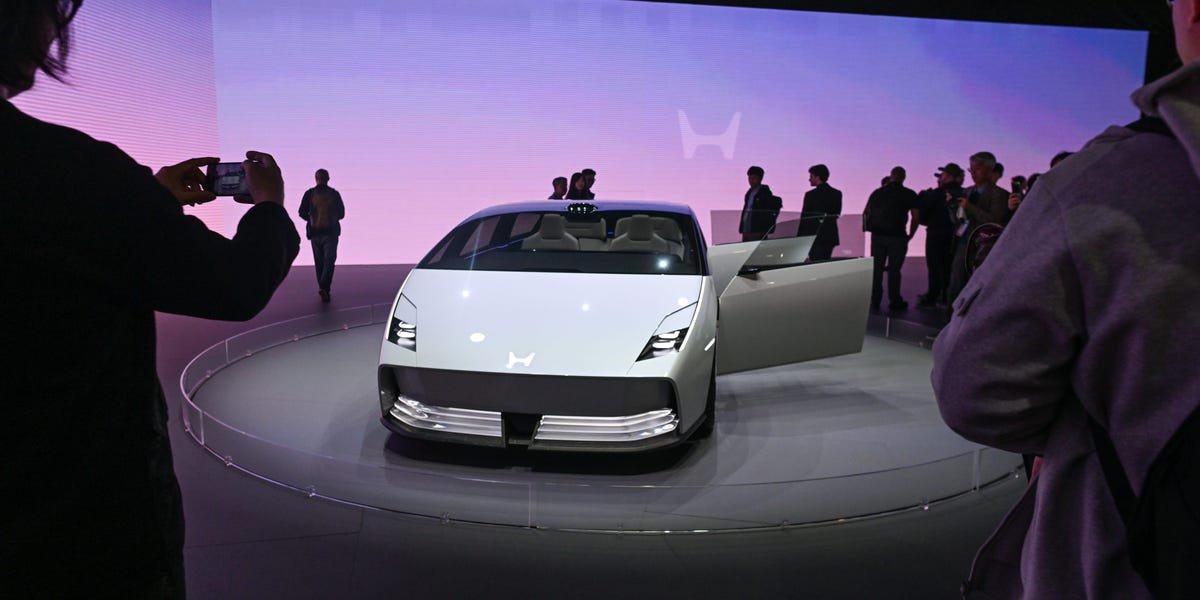
Honda takes a $15.7 billion hit as EV retreat continues to batter legacy automakers

Honda is taking a massive financial hit as it pulls back on its electric-vehicle ambitions.

On Thursday, the Japanese automaker said it expects to write off up to 2.5 trillion yen — roughly $15.7 billion — as it reshapes its North American EV strategy. Honda expects the charge will push profits into the red in 2026, marking its first annual loss in nearly 7 decades.

It’s the latest in a growing list of legacy automakers to announce multibillion-dollar hits as the industry recalibrates its electric plans.

The EV pullback has gained momentum after the federal government ended the $7,500 tax credit for US-built EVs under the Inflation Reduction Act in September. The rebate was intended to spur both EV adoption and US auto manufacturing.

“Many automakers were investing in their EV platforms to align with the subsidies,” Seth Goldstein, an EV analyst at Morningstar, told Business Insider. “When these expired early last September, this led automakers to adjust their investments and EV strategies.”

Jeep maker Stellantis booked a $26 billion charge after discontinuing several EVs and plug-in hybrids. Ford reported a $19.5 billion hit in December and canceled its F-150 Lightning. General Motors took a $6 billion charge as it slowed production across its 11 EV models. Volkswagen also had a $5.7 billion charge.

In total, the five automaking behemoths have announced $72.9 billion in write-downs tied to EV portfolio adjustments.


A yellow Acura RSX EV with a black roof and black wheels sits on a well-manicured lawn.

Honda also said it would cancel US production of three cars, including the Acura RSX EV, shown above.

Acura


Honda said its EV reset stems from two main pressures: What it described as an “unfavorable impact” from changes in US tariff policies affecting its gasoline and hybrid business, and a decline in competitiveness in Asia.

As part of the shift, Honda is canceling three planned EVs for the US market: the Honda 0 Saloon, the Honda 0 SUV, and the Acura RSX crossover.

All three models were supposed to roll off the assembly line at the Marysville Auto Plant in Ohio.

The move leaves Honda with just one fully electric vehicle in its US lineup — the Prologue, which it developed in partnership with General Motors.

Acura, Honda’s luxury brand, also discontinued its ZDX electric SUV at the end of 2025, shortly after the federal tax credit was scrapped.

Still, analysts say the industry’s recent pullback doesn’t amount to a full retreat.

“No automaker is abandoning plans to sell EVs as a part of their product lineup,” Goldstein added. “While I see EV sales declining in 2026 from the tax credit expiration, I forecast a return to growth in 2027.”

Electric-only automakers are continuing to push forward with new models, including Rivian’s coming R2 and Tesla’s Cybercab, which could help lift overall EV sales.


A white Rivian R2 rolls onto a stage next to the automaker's CEO, RJ Scaringe.

An industry analyst said he expects EV sales to return to growth in 2027 as automakers’ focus shifts to mass appeal. He pointed to the launch of smaller, more affordable vehicles, such as the coming Rivian R2.

Phillip Faraone/Getty Images for Rivian


Legacy brands are also betting that smaller, more affordable EVs could reignite demand.

Toyota, Nissan, Ford, Chevrolet, and Subaru have all outlined plans to introduce cheaper electric models to US dealerships.

Honda, for its part, still has one EV in the US pipeline: the Afeela, a screen-heavy sedan developed in partnership with Sony, expected to start around $89,900.

Work at Honda? We want to hear from you. Contact Ben Shimkus at bshimkus@insider.com or Signal at bshimkus.41. Use a personal email address and a nonwork device; here’s our guide to sharing information securely.


Source link

Jordan Hart's face on a gray background.

Apple bumps up the prices of its new MacBook Air and MacBook Pro as global memory shortage continues

Amid the global memory shortage, Apple didn’t raise prices for its latest iPhone and iPad. That’s not the case for its new MacBooks.

After Monday’s reveal of the iPhone 17e and iPad Air, it’s the Mac lineup’s turn for a revamp. The tech giant announced on Tuesday a new MacBook Air, MacBook Pro, and Studio Display.

Apple introduced the M5 Pro and M5 Max chips that will power two versions of the MacBook Pro, and the MacBook Air will run on an M5 chip.

The MacBooks got a price bump along with the new chips, which offer faster performance, as well as higher storage capacity.

The MacBook Air starts at $1,099 for the 13-inch and $1,299 for the 15-inch version — a $100 price increase for each model.

The M5 Pro MacBook Pro starts at $2,199 for the 14-inch option, up from $1,999. The 16-inch will go from $2,499 to $2,699. For the M5 Max MacBook Pro, the starting price is $3,599, up from $3,199.

While Apple didn’t specify a reason for the price hikes, they arrive as the consumer electronics industry grapples with a global memory shortage as the artificial intelligence race shakes up the supply chain and market for memory chips, which are used in computers and other devices.

In its January earnings call, Apple said it expected the price of memory to continue to increase. However, CEO Tim Cook declined to speculate on whether or not it would lead to increased prices for Apple’s products.

Best Buy CEO Corie Barry addressed the memory shortage earlier on Tuesday during the retailer’s earnings call.

“As you are aware, the significantly increased demand for memory components is driving cost inflation and supply uncertainty, particularly in computing. We are partnering with our vendors to mitigate impacts on the business,” she said. “We are focused on five major themes. One, we are bringing in as much inventory as we can. We are also providing our vendors with a longer forecast horizon to better plan allocations across commercial and consumer segments and collaborate more effectively with memory partners.”

The key features that Apple highlighted in the new MacBook Air are the Liquid Retina display, up to 18 hours of battery life, and a 12 megapixel camera. It comes in four colors: sky blue, midnight, starlight, and silver. For the higher entry price, customers will also get double the amount of starting storage at 512 gigabytes.

Apple said the new MacBook Pro with the M5 Pro chip delivers faster AI image generation, LLM prompt processing, and gaming performance, with the M5 Max building on that speed even more. Apple touts the new chips as game-changers for the MacBook Pro’s AI capabilities. The M5 Pro MacBook Pro starts at one terabyte of storage, up from the previous 512 gigabytes, while the M5 Max model doubled its starting storage to two terabytes.

The Studio Display, which starts at $1,599, and the $3,299 Studio Display XDR boast 5K Retina displays designed for video editing, 3D rendering, and more workflows.

The new computers are available for pre-order starting Wednesday.


Source link

Vanity-Fair-and-Olivia-Nuzzi-cut-ties-as-RFK-Jr.jpeg

Vanity Fair and Olivia Nuzzi cut ties as RFK Jr. relationship drama continues to unfold

Journalist Olivia Nuzzi and Vanity Fair are severing ties.

Nuzzi joined Vanity Fair in September 2025, after departing New York magazine in 2024 in the wake of revelations that she’d had a relationship with her source, Robert F. Kennedy, Jr, then a presidential candidate.

The fallout from the affair has continued after Nuzzi’s ex-fiancé, former Politico correspondent Ryan Lizza, recently accused Nuzzi of additional ethical breaches.

“Vanity Fair and Olivia Nuzzi have mutually agreed, in the best interest of the magazine, to let her contract expire at the end of the year,” according to a joint statement from spokespeople for Vanity Fair and Nuzzi provided to Business Insider.

A third-party investigation into her reporting at New York magazine revealed no bias, but the magazine said at the time that her relationship with the ex-presidential candidate violated their conflict-of-interest standards.

Following her split with Lizza and New York magazine, Nuzzi, a former star political reporter, moved to Los Angeles. She published a memoir, “American Canto” on Tuesday, in which she detailed the past 10 years of political reporting and her relationship with “the politician,” understood to be RFK Jr.

Since their split, Lizza and Nuzzi have been engaged in an ongoing reputational battle, with each publicly accusing the other of engaging in behaviors that, while not illegal, undermine each other’s journalistic credibility.

Nuzzi, in a petition for a temporary protective order against him in late 2024, accused Lizza of blackmailing her and threatening to destroy her career, which Lizza has denied. She later withdrew the petition.

After a lull, the public acrimony continued with the revelation of Nuzzi’s book, followed by a series of Substack posts from Lizza.

He has suggested in online postings that Nuzzi used her position as a reporter to “catch and kill” unflattering stories about RFK Jr. He also accused her of having another unusual relationship with a different subject.

A spokesperson for Nuzzi did not respond to questions about Lizza’s allegations. In a post for Emily Sundberg’s Substack, Feed Me, she wrote it was “another attempt to harass, humiliate, and harm me until I am as destroyed as he seems to be,” and called Lizza’s posts “fan fiction-slash-revenge porn.”


Source link