
When-my-kids-got-their-first-phones-at-10-I.jpeg

When my kids got their first phones at 10, I made them sign a physical contract. They’re teenagers now, and it’s still binding.

When my oldest daughter turned 10, many of her friends were already getting phones. At the time, I was working as a middle school teacher, and I had a front-row seat to what constant screen time was doing to my students. I saw rising anxiety, shortened attention spans, and social dynamics that played out more online than in real life. It made me pause.

My husband and I weren’t against technology, but we knew we didn’t want to rush into it. Instead, we decided to introduce it carefully and on our terms.

Before our daughter got a phone, we created a simple contract for her to sign, and when our son reached the same age two years later, we followed the same approach. They’re now teenagers, and that contract still works.

The contract introduced phone expectations early on

On their 10th birthday, each of our children received their first phone. From the outset, they knew it came with expectations, and everything was laid out in a simple contract that they had to read, agree to, and sign.

The contract was simple and included rules that many families struggle to enforce consistently: phones don’t go into bedrooms (unless it’s FaceTime and the door stays open), devices are taken away between 8 and 9 p.m., and social media is limited until they’re older. There are occasional exceptions for travel, sleepovers, or special events, but the structure has stayed the same for years.

What surprised me most was that the contract didn’t just control screen time; it removed the daily arguments. The expectations were clear from the beginning, and because the kids signed it themselves, it felt less like punishment and more like an agreement. Now that they’re teens, we still follow the same framework.

How framing the phone as a ‘rental’ changed our kids’ mindset

Although we gave our children phones as gifts, we were clear about one thing: the phones were rentals. It belonged to my husband and me, not to them.

My husband and I agreed we would always have full access to the phones. We didn’t want any confusion about ownership, and more importantly, we wanted to protect our kids as they began navigating the online world. Setting that expectation early helped us avoid arguments later.


Naomi Tsvirko and her family sitting on a bench

The author (second from left) allowed her 10-year-old kids have cellphones. 

Courtesy of Naomi Tsvirko


When my daughter or son challenges me about access to their phone, I simply pause and remind them of the contract terms.

“Who does the phone belong to?” I ask, and they often fall silent, knowing I will follow through on taking away the privilege of a phone at any point.

Our children are surprisingly grateful not to have phones in their bedrooms

It’s not often that our kids admit we’re doing something right in real time, but this is one thing they both appreciate.

When my daughter came back from a sports camp, she told me she hadn’t slept well because her phone was in her room. Even though she wasn’t using it, she said its presence made it harder to relax.

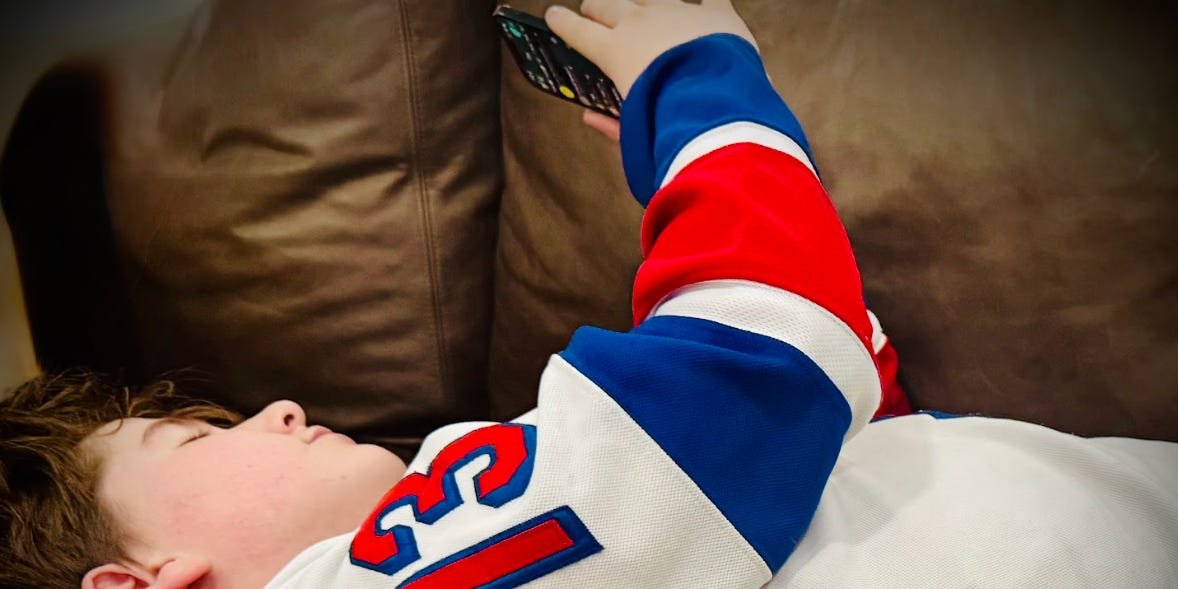
My son has never asked to keep his phone overnight and values the structure around protecting sleep, especially since he plays travel ice hockey and is often exhausted after practice.

How the system evolved as our kids became teenagers

Like most parenting moments, curveballs are expected, so as my kids got older and we got busier, we became more relaxed about how long they could FaceTime their friends (especially during the pandemic and occasional later nights).

One change that made a big difference was introducing a lockbox. Instead of taking phones away each night, we lock them up. It removes the need for negotiation and helps everyone switch off.

In the morning, the phones stay locked away until basic routines are done, their beds made, breakfast eaten, and chores are complete. Then I unlock the box.

Becoming a low-screen family takes a lot of effort, but it’s worth it

We know no system is perfect, but parenting in the modern world of phones means we are doing our best, knowing that there are so many variables in how our children grow up.

We’re not a no-screen family, but we are intentional about being a low-screen one. We understand the benefits of technology, but we’re also realistic about the downsides.

The contract gives our kids freedom within clear boundaries, like a river that stays on course. And years later, that balance still holds.



Source link

Katherine Tangalakis-Lippert's face on a white background

OpenAI shares its contract language and ‘red lines’ in agreement with the Department of War

OpenAI says its agreement with the Department of War is “better” and has more safety guardrails than the one Anthropic was blacklisted for refusing to comply with.

In a blog post published Saturday, OpenAI shared some contract language from its agreement with the Department of War, including clauses that indicate its tech cannot be used for mass domestic surveillance or to power autonomous weapons or high-stakes decision systems like “social credit” scores.

“We think our agreement has more guardrails than any previous agreement for classified AI deployments, including Anthropic’s,” OpenAI’s post read. “In our agreement, we protect our red lines through a more expansive, multi-layered approach. We retain full discretion over our safety stack, we deploy via cloud, cleared OpenAI personnel are in the loop, and we have strong contractual protections. This is all in addition to the strong existing protections in U.S. law.”

OpenAI CEO Sam Altman took to social media shortly after the company’s blog post was published, answering questions from users concerned about the nature of OpenAI’s agreement with the government.

In Ask-Me-Anything-style responses, he doubled down on OpenAI’s agreement being better than Anthropic’s, not just for the broader AI landscape but also for the American people.

“Anthropic seemed more focused on specific prohibitions in the contract, rather than citing applicable laws, which we felt comfortable with,” Altman wrote in response to a question about why OpenAI agreed to partner with the government when its rival would not. “I think Anthropic may have wanted more operational control than we did.”

OpenAI’s agreement with the federal government comes on the heels of Anthropic being blacklisted and declared a supply chain risk after refusing to comply with the military’s terms of use for the company’s frontier model, Claude.

Anthropic, in a Friday statement, said that “no amount of intimidation or punishment from the Department of War will change our position on mass domestic surveillance or fully autonomous weapons” and vowed to “challenge any supply chain risk designation in court.”

OpenAI, in its Saturday post, argued that Anthropic should not be designated as a supply chain risk and said it had made its position “clear to the government.” Its agreement with the Department of War stemmed, in part, from a desire to “de-escalate things between DoW and the US AI labs.”

“A good future is going to require real and deep collaboration between the government and the AI labs,” OpenAI’s post reads. “As part of our deal here, we asked that the same terms be made available to all AI labs, and specifically that the government would try to resolve things with Anthropic; the current state is a very bad way to kick off this next phase of collaboration between the government and AI labs.”

Representatives for OpenAI and Anthropic did not immediately respond to requests for comment from Business Insider. It was not immediately clear whether Anthropic, or any other leading AI company, had been offered similar contractual terms to those that OpenAI said it had agreed to.

OpenAI said that, as part of its deal with the Department of War, it will maintain “full control” over the safety stack it deploys, and robust “safety guardrails” to prevent misuse. Should the government violate the terms of the agreement, OpenAI said it “could” terminate the contract.

“We don’t expect that to happen,” OpenAI said in its post.

Altman, in his Ask Me Anything posts, wrote that OpenAI would not agree to allow the government to use its technology for mass domestic surveillance “because it violates the constitution.”

He added that he is prepared for a potential dispute over the legality of specific governmental requests in the future, but added that if the Constitution were amended to make such surveillance legal, “Maybe I would quit my job.”

“I very deeply believe in the democratic process, and that our elected leaders have the power, and that we all have to uphold the constitution,” Altman wrote. “I am terrified of a world where AI companies act like they have more power than the government. I would also be terrified of a world where our government decided mass domestic surveillance was ok. I don’t know how I’d come to work every day if that were the state of the country/Constitution.”

The dispute between the government and the AI giants has sparked widespread criticism, with critics concerned about the ethical implications of the Department of War’s use of AI and OpenAI’s agreement to provide the government access to its technology.

OpenAI on Saturday said it believes AI will “introduce new risks in the world” and, by allowing the government use of its models, will give people defending national security “the best tools” to do so.

Business Insider previously reported that Anthropic’s model, Claude, shot to the top of the app store on Saturday, and many people on social media, including celebrities like Katy Perry, have publicly posted about canceling their ChatGPT subscriptions in the wake of OpenAI’s agreement with the government.


Source link

NBCUniversal-is-suing-Group-Black-alleging-breach-of-contract-and.jpeg

NBCUniversal is suing Group Black, alleging breach of contract and seeking nearly $36 million

Comcast’s NBCUniversal has sued Group Black, a firm created to direct ad dollars to Black-owned and Black-led media, alleging it owes the media giant $35.8 million in unpaid invoices and guaranteed payments.

The suit, filed February 11 in New York Supreme Court, stems from a partnership that gave Group Black exclusive rights to sell ads in Black-led shows on NBCU’s streamer, Peacock, with Group Black and NBCU sharing the revenue.

“We dispute the claims made by NBCUniversal and intend to respond through the appropriate legal process,” Group Black said in a statement. “Group Black remains focused on its mission and serving its partners.”

NBCU has said that more than 30 brands signed on to the partnership in its first year, which began in September 2023. Group Black had predicted that NBCU would be its largest source of revenue in 2024, according to a board document dated November of that year, which was submitted in a separate court case.

NBCU’s lawsuit alleged that Group Black failed to fulfill the terms of the contract in the months after it began in September 2023, despite selling more than $30 million worth of advertising.

The suit alleged that in 2024, Group Black agreed ​​to shift its revenue share to zero to pay down the shortfall. NBCU says in the lawsuit that it repeatedly demanded payment, and that Group Black cofounder Bonin Bough had acknowledged the company’s liability multiple times, emailing at one point that he took it “very seriously.”

The partnership ended in September 2025.

Group Black has faced internal and market challenges

Group Black was launched in 2021 after the George Floyd protests that led to a national reckoning and prompted big advertisers like Coca-Cola and Walmart to increase their spending on Black-owned media. In the years that followed, the company faced a mix of internal struggles, executive departures, and broader market challenges. It pivoted last summer to focus on a wider audience with the launch of a new venture, Portrait Media Group.

Group Black has faced other legal action alleging nonpayment. Two companies owned by Essence Ventures, part of a venture led by a second Group Black cofounder, Richelieu Dennis, sued Group Black in 2024, alleging it owed them about $20 million. Group Black said in a court filing that Essence loaned it money but otherwise denied the allegations in the suit. The suit is ongoing.

In another case, Audiomob, an ad agency that provided mobile app advertising inventory for Group Black to sell to its clients, demanded about $181,000 from Group Black for invoices it alleged the company had failed to pay. The suit was terminated in August after Audiomob sought dismissal, saying Group Black had made a “partial payment” of the money owed, per court filings.


Source link