
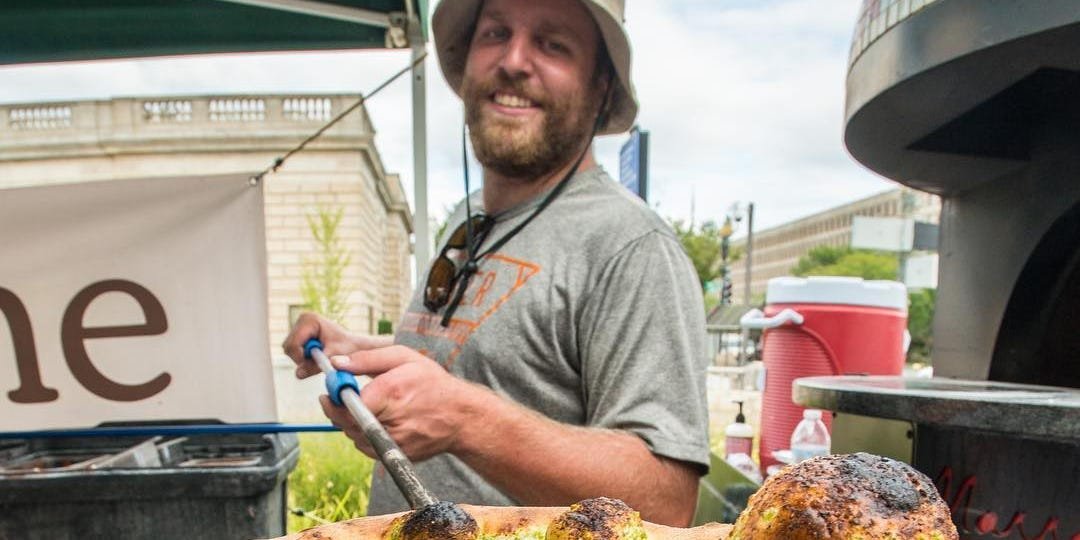
I-quit-my-corporate-job-at-25-to-sell-pizza.jpeg

I quit my corporate job at 25 to sell pizza with a friend. Now we have 9 locations.

This as-told-to essay is based on a conversation with Chris Brady, founder and president of Timber Pizza Co. It has been edited for length and clarity.

By the time I started my second job in tech sales in my early 20s, I knew I had no desire to keep working in the corporate world and wanted to do something on my own. My coworker Andrew Dana also felt the same way, so we’d brainstorm different business ideas over lunch.

I had a lightbulb moment while talking to a potential client. I was selling catering and wedding venue advertising and called on a pizza company. The owner started telling me more about his mobile wood-fired pizza business. I called Andrew immediately, and he agreed it was a great idea worth pursuing. Now, Timber Pizza Co. has nine locations and five mobile pizza units.

We started our business with $20,000 and a lot of optimism

I was 25 when I left my corporate sales job to start Timber Pizza, so I didn’t have a lot of capital to work with. My dad lent me $15,000 to get started, and I remember walking a $5,000 check of my own money to the bank. But the beauty of a mobile business is that you don’t need much to get off the ground and can rely on scrappiness.

Without the stress of running a brick-and-mortar business, I knew we could experiment without taking a big swing. The worst thing that would have happened is that I would have had to move back with my parents and get another sales job if it didn’t work out.

Andrew and I both loved pizza, but didn’t have much background in the restaurant world. We went to a pizza camp in Colorado for a weekend to buy our first oven and learn the basics of making pizza, and then came up with our recipe after a lot of trial and error.


Blue truck

Courtesy of Chris Brady


We started driving our 1967 baby-blue Chevy pickup truck, with our oven hitched behind, all around Washington, DC. Our goal was to make pizza people loved, not to take ourselves too seriously. We would ride around in basketball shorts blasting hip-hop music, just trying to have a good time. That definitely made us stand out.

After a year, we opened our first brick-and-mortar

Our first retail location opened in 2016 in DC’s Petworth neighborhood. Baby Blue still exists, but it’s definitely the show pony now, not the workhorse. The business was doing really well, and then in 2017, Bon Appétit recognized us as their “Pizzeria of the Year.” We also got our first Bib Gourmand from the Michelin Guide in 2019.

It felt like we were really hitting our stride and had the business where we wanted to be, but then COVID happened. So in 2021, we decided to bring on some new partners to the business and some capital to help stabilize things. It’s also when we started our franchising journey.

It felt like I was in startup mode again

We had been doing business one way for seven years, but now our goal was to bring Timber with great people to great communities. I really had to rewire my brain to go from how we had done business for the first seven years to how we were going to expand.


Men standing next to blue truck

Courtesy of Chris Brady


Since 2021, we’ve grown to nine locations across the South. The goal is to find our groove, opening between five and eight locations a year over the next three to five years and then continuing to scale after that. We’re looking at markets like Atlanta, Savannah, Greenville, South Carolina, and Wilmington, North Carolina.

There were a lot of days in the first few years with some soul-crushing moments and tough times, especially when we looked at our bank account, but I’m really glad we stuck with it.


Source link

Burned-out-in-her-50s-she-left-corporate-life-Starting.jpeg

Burned out in her 50s, she left corporate life. Starting over in Korea helped her heal.

Jane Newman spent her evenings watching K-dramas on her recliner during the pandemic lockdowns. She didn’t expect they’d spark a curiosity about South Korea that would eventually lead her to move there and start over.

In 2023, Newman was working for a consulting firm in Brisbane, Australia. As a manager, her heavy workload didn’t let up even as the world began to return to normal.

After months of long hours spent in front of a screen, she was burned out and beginning to feel the strain.

“I started out with a whole lot of shoulder and back pain, and then it developed into arm pain, and I couldn’t use my mouse,” Newman, now 60, told Business Insider.


A woman posing in a red suit in South Korea,

Jane Newman said she burned out from her corporate job in Australia.


Greg Samborski.


Standing desks and different chairs fixed little, so she took a sabbatical.

Newman had first visited South Korea the previous year, curious about the country she’d only seen on TV. Remembering how much she had enjoyed that trip, she decided to return for a two-month break.

When she went back to work, the symptoms didn’t take long to resurface. This time, Newman found herself struggling mentally and emotionally, too.

“I found it more and more difficult to do my work,” she said. By July 2024, she and her employer agreed it was best for her to step away from the company.

“I knew that South Korea was a place that I loved, and it made me feel good,” Newman said. “So I made the decision to go back and stay for a few months to see how it felt.”

New career, new home

For three months, she lived in an Airbnb in Gwacheon, a city just outside Seoul. Newman lived with her host, a local woman who had invited her to participate in the community events.

There, she joined a group supporting former US military “comfort women,” as well as two English clubs where members met to discuss news, read English fiction together, and give weekly presentations on various topics.

“I met the most wonderful people, and they really invited me into their conversations. And I got to know a lot more about Korea itself, and its history,” she said.


A woman leaning against a tree in South Korea.

Newman says she found healing in a small community outside Seoul, where she learned more about South Korean history and culture.


Greg Samborski.


“All of those things made me feel really welcomed, and at home, and part of a community, which is what I was really lacking back in Australia,” Newman added.

In Brisbane, her social life largely revolved around people she knew at work, or old friends she’d kept in touch with from her years living in the UK when her daughters were young. She was part of a bushwalking community and a social dining community, but most of those groups faded after the pandemic.

As Newman considered her next career steps, she found herself drawn toward public speaking and coaching to help people navigate the pressures of modern society and technology.

That focus also eventually led her to begin developing a tech startup in South Korea aimed at helping young people struggling with social isolation.

By February 2025, Newman moved to Seoul to begin her next phase of life.

She said her Gen Z daughters weren’t surprised by her decision since they already knew how much she loved South Korea. Both had already taken trips to visit her there.

When it was time for Newman to look for an apartment, she wanted a place that was close to public transport, with separate spaces for living and sleeping, and a good view.

It took her about two weeks to find a place. She now lives in Dongdaemun, a popular neighborhood, where her two-bedroom apartment costs 1.43 million Korean won, or about $1,000, a month.


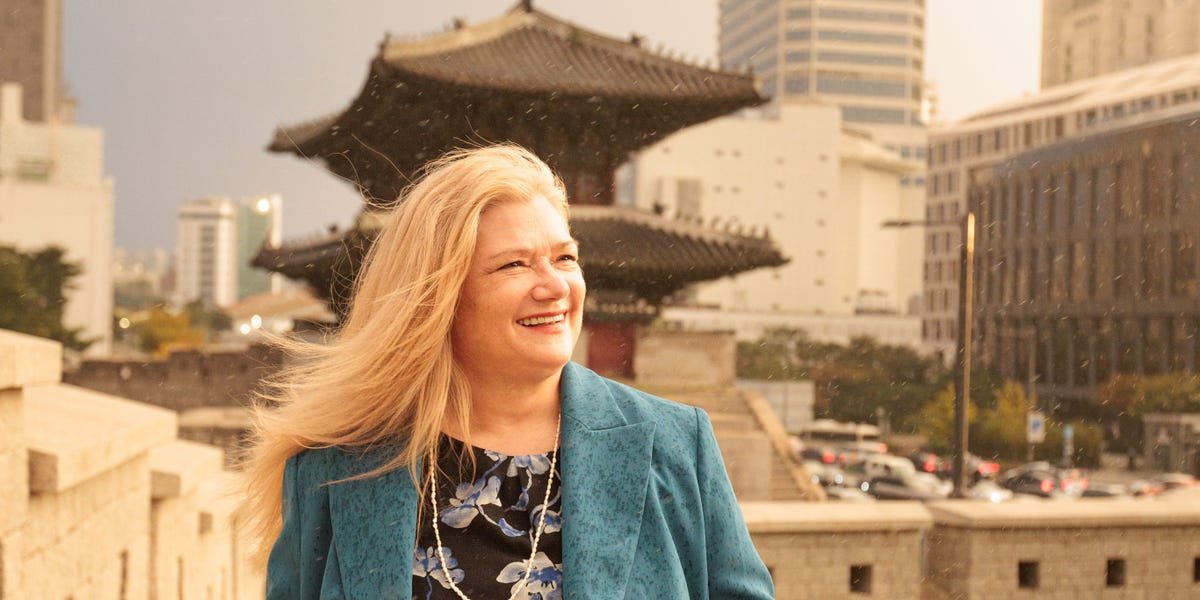
Skyline from Seoul City Wall at Dongdaemun.

Newman lives in Dongdaemun, a popular neighborhood in Seoul.


Jane Newman.


Building a new life from scratch

South Korea has become an increasingly popular choice for foreigners in recent years.

Data from the Ministry of Justice showed that the number of foreigners living in South Korea at the end of 2024 stood at 2.65 million, a 5.7% increase from the year before.

For Newman, building friendships in Seoul came more naturally than she expected.

“I’ve found that every time I’ve come to Korea, I’ve made new friends,” Newman said, adding that this included people she met through a fan group for a Korean actor she admired.


A photo of Cheonggyecheon stream in Seoul.

Newman says she makes it a point to get out of the house once a day to enjoy her surroundings.


Jane Newman.


These days, Newman’s routine is a mix of work and settling into life in Seoul.

She starts her mornings with a coffee from the Starbucks across the street before diving into her coaching sessions and working on getting her startup off the ground.

Compared to her previous job, where working 60 hours a week was common, Newman says she now works around 20 to 30 hours a week.

With the more flexible schedule, she has time to exercise, meet people, and sometimes work from libraries or cafés.

“But I do make sure I get out once a day to go out and enjoy this beautiful place I’m living in,” she said.

Do you have a story to share about relocating to a new city? Contact this reporter at agoh@businessinsider.com.


Source link

Ex-Google-CEO-Eric-Schmidt-says-AI-isnt-overhyped-—-the.jpeg

Ex-Google CEO Eric Schmidt says AI isn’t overhyped — the biggest gains from automating corporate work are still ahead

If AI feels overhyped now, Eric Schmidt suggests that businesses should brace themselves — the real disruption hasn’t even begun yet.

In an interview with Professor Graham Allison at the John F. Kennedy Jr. Forum at Harvard University on Monday, the former Google CEO pushed back on the idea that AI’s rapid growth is a speculative bubble, saying that the technology is actually under-hyped.

“If anything, it’s under-hyped because you are fundamentally automating businesses,” he said.

The real transformation, he said, is happening deep inside companies, where AI systems are beginning to take over the “boring” tasks that quietly consume billions in corporate spending.

The biggest gains, he suggested, will come from automating the backbone of corporate work: the repeatable, time-consuming processes buried deep inside every organization.

The former Google chief listed billing, accounting, product design, delivery, and inventory management as examples of this.

“There’s an awful lot there — it’s extraordinary,” he said, pointing to areas like medicine, climate solutions, and engineering as sectors where automation could accelerate breakthroughs.

Schmidt, who helped steer Google’s early investments in AI and later co-authored a book on AI with Henry Kissinger, implied the technology’s economic impact will be far larger than markets or executives appreciate.

Still, not everyone agrees with that perspective. Some economists are sounding alarm bells that the AI boom is overheated.

In an interview this week, renowned economist Ruchir Sharma said the AI surge displays all four traits of a classic bubble and could unravel if interest rates rise, while tech leaders such as Sam Altman and Bill Gates have cautioned that parts of the market resemble the dot-com era.

Far beyond coding

To illustrate how quickly AI capabilities are advancing, Schmidt described watching an AI system generate an entire software program.

“Holy crap. The end of me,” he said.

“I’ve been doing programming for 55 years. To see something start and end in front of your own life is really profound,” he added.

However, he said that AI’s long-term upside extends far beyond coding.

From back-office workflows to logistics and scientific discovery, Schmidt believes the automation curve is still in its early stages of scaling and that Wall Street is underestimating the magnitude of the shift.

“The reason people are spending this amount of money,” he said, “is to automate the boring parts of their business.”


Source link