Messy breakup? Instagram might make it a lot harder to move on.
Instagram is testing a new subscription that gives paying users access to several features, including the ability to view another user’s Story in stealth mode.
Other perks include creating audience lists beyond “Close Friends” and extending a Story by an additional 24 hours. Instagram Stories are photos and videos that expire after 24 hours. Currently, the creator can see who views them.
“Our hope from these tests is to understand what’s most valuable to people in a premium feature set,” an Instagram spokesperson said in a statement to Bloomberg. The company did not respond to a request for comment from Business Insider.
TechCrunch first reported the test and said that Instagram is offering the subscriptions in Mexico, Japan, and the Philippines for about $1 to $2 a month.
In the last few years, Meta has been experimenting with various paid products as it seeks to diversify its revenue beyond its main advertising business.
In 2023, it launched Meta Verified, a subscription service for creators and business accounts that helps protect brands from impersonation and build credibility. Verified has four tiers, the most expensive of which costs $500 a month.
Other subscription products include an ad-free subscription for European Union users and a monthly subscription that lets fans get exclusive content from their favourite creators.
Snapchat, X, YouTube, and LinkedIn have introduced premium tiers that unlock some features for paid users, in an effort to supplement ad dollars and make revenue more predictable.
Kristi Noem might not be a Hollywood star, but her department spent like the big studios.
The former secretary of the Department of Homeland Security was ousted from her post on Thursday, following months of controversy over her handling of immigration enforcement in Trump’s mass deportation campaign.
During Noem’s appearance before Congress on Tuesday, SenatorJohn Kennedy, among other lawmakers from both sides of the political aisle, pressed Noem about the department’s spending of taxpayer dollars, including a $220 million ad contract.
The ads, which Noem said were intended to encourage undocumented immigrants to leave the US, included footage of the now-former secretary riding a horse in front of Mount Rushmore while delivering stern messages about border enforcement.
Lawmakers scrutinized the bidding process for the contracts behind the ad campaign, as well as the firms selected, raising questions about how taxpayer dollars were awarded and spent.
In her testimony, Noem defended the ads as “effective” and said President Donald Trump had approved the $220 million in spending. “We went through the legal processes, went through it correctly,” she said.
Trump later disputed that account, telling Reuters on Thursday, “I never knew anything about it.”
On social media, “The View” host Meghan McCain compared the DHS ad costs to the production budget for “Sinners.” The Ryan Coogler-directed movie, which recently set an Oscars record with 16 Academy Award nominations, had an estimated budget of $90 million, as reported by The Hollywood Reporter.
“Kristi Noem’s DHS vanity videos cost $130 million more than Sinners,” McCain wrote in an X post.
“Sinners” isn’t the only movie with a smaller budget than the department’s ad spending.
The $220 million price tag — which also accounted for media buying and placement, consulting fees, and related administrative expenses — surpasses the budgets for a list of blockbuster movies.
Here are 15 of them, as well as their reported budgets, which have been adjusted for inflation to reflect what those costs would be today.
And spoiler: some of your favorite movies might be included.
America’s national parks are as magnificent as they are diverse, and in a single road trip, it’s easy to marvel at arid desert mountains one day and sky-high conifer forests the next.
I’ve visited all 63 national parks within the US, all on a shoestring budget, and I can attest that exploring “America’s best idea” is well worth the effort and drive time.
For those hoping to take an extended (and wallet-friendly) vacation, the national parks are a great place to look.
With my van and some careful budgeting, I was able to travel to Joshua Tree, Grand Canyon, Petrified Forest, Carlsbad Caverns, Guadalupe Mountains, Big Bend, Zion, Bryce Canyon, Capitol Reef, Arches, and Canyonlands over the course of 30 days and only spend about $1,500.
Here are a few strategies and resources that helped me pull this 11-park trip off without a hitch, plus the one thing I’d do differently next time.
The key to this trip was planning far in advance
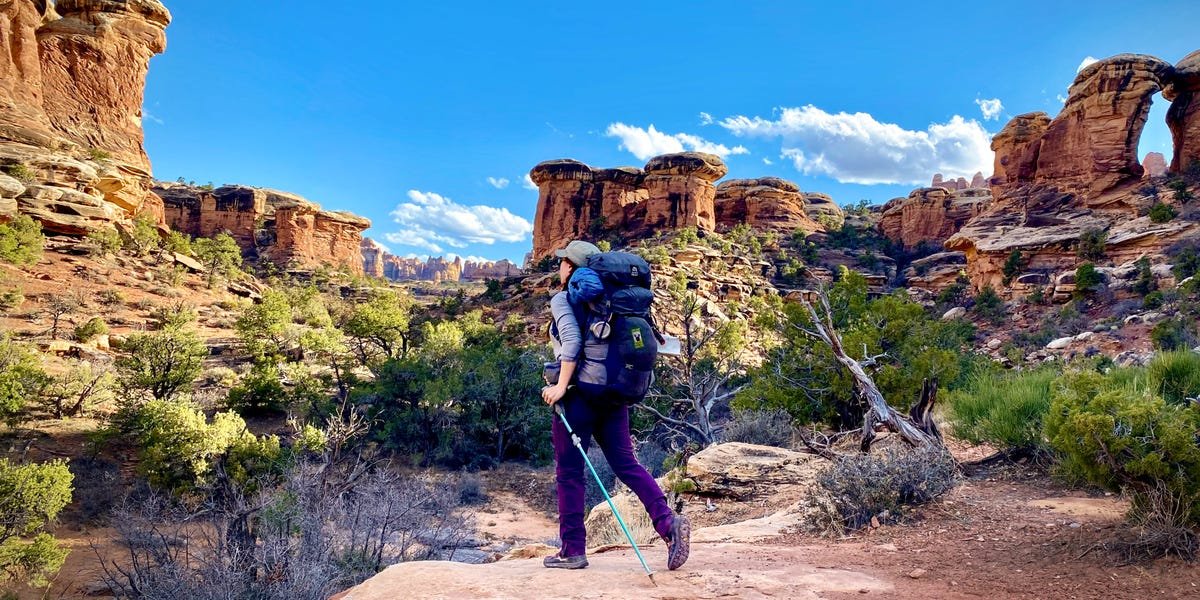
Teepees Petrified Forest was one of many stops on my trip.
Emily Pennington
Going on a trip of this magnitude took loads of research and preparation, and I started planning several months before I headed out.
First of all, many reservations and permits within the US national parks open up six months in advance and are available on a first-come, first-served basis.
This means you’ll want to have a clear picture of where you’ll be hiking, camping, or backpacking on every day of your journey at least six months before your trip, so you can take advantage of subsidized park campgrounds.
Sure, websites like Hipcamp make it easy to book a last-minute campsite near natural wonders, but you’ll often pay double or triple the price on bookings. For example, I’ve seen campsites listed for $50 or $60 a night that national parks and forests initially charged $20 for.
Oh, and don’t forget to nab an annual America the Beautiful Pass before starting your grand adventure.
For just $80, the pass gives access to all national parks, forests, and federal recreational lands for a calendar year — it’s an easy way to avoid entrance and standard amenities fees.
Groceries and homemade meals helped me stick to my budget
I spent some time enjoying Joshua Tree on my trip.
Emily Pennington
One of the strictest cost-cutting measures I implemented was a $100 a week grocery budget. I slept inside my kitchenless minivan each night, meaning that I’d have to get up and go outside to boil water or cook evening meals.
Since I didn’t have a fridge or much in the way of electricity, I ate a lot of simple meals, like peanut butter and jelly sandwiches, mac and cheese, and carrot sticks with hummus.
As a treat, I gave myself a $50 a week restaurant budget so I could enjoy quirky roadside cafés and food trucks along the way.
Some of my favorite memories from the trip were discovering DB’s Rustic Iron BBQ, a tiny hole-in-the-wall near Big Bend, and Sweet Cravings Bakery, just outside of Arches, in Moab.
A few apps helped me save money on gas, overnight stays, and entertainment
I stayed at a campground in the Grand Canyon.
Emily Pennington
Gas and lodging are likely to be your biggest expenses, and I definitely used the GasBuddy app every day to plan where I could fill up for the best price.
I also made sure to drive a fuel-efficient vehicle for the entire road trip, which saved me hundreds of dollars in gas alone.
As much as I could, I tried to camp in free campsites and sleep in Walmart parking lots for the duration of my monthlong road trip.
I used apps like AllStays and Campendium to find free, legal places to bed down in my minivan. Sometimes this meant I was sleeping an hour’s drive away from any given national park, but that seemed worth it to me at the time to skip the $20 to $30 park campgrounds typically charge.
The National Park Service app is also worth downloading before any trip. It’s filled with things like free guided audio tours, maps, ranger program schedules, and top attractions. In addition, popular parks, such as Zion and the Grand Canyon, offer free in-person ranger talks and activities that are open to all visitors.
These proved to be invaluable assets to my trip when I couldn’t afford guided hikes and bus trips.
Looking back, though, I wish I’d stayed at a few more campgrounds
I learned a lot about myself on this epic trip through US national parks.
Emily Pennington
Even though I had the time of my life exploring America’s national parks for a month straight, there’s one thing I’d do differently next time.
In the interest of saving money, I slept in the parking lots of many truck stops and Cracker Barrels, rather than driving a bit farther to sleep on federal lands or spending $20 to camp closer to a park.
As a solo female traveler, I tended to feel safer when I was camping outside cities. I slept better, too, because the woodsy environments always proved to be quieter and more soothing.
If I had a tiny bit more in my budget, I would’ve happily booked more national park and national forest campgrounds during the planning phase of my trip.
Still, I learned so much about my own ability to do more with less on this epic journey across the US national parks, and I can’t wait for my next long road trip into the wilderness.
This story is available exclusively to Business Insider
subscribers. Become an Insider
and start reading now. Have an account? .
Israeli Air Force F-35I planes struck Iranian missile systems and military leaders on Saturday.
The Israeli F-35 variant is known as “Adir,” meaning “Mighty One” in Hebrew.
The planes also struck Iran in June and aided defenses against Iranian missiles in 2023 and 2024.
Israel launched what it called “the most extensive aerial operation ever conducted by the Israeli Air Force” on Saturday, targeting Iranian missile systems and military leaders in tandem with US forces. Israel’s F-35I stealth fighter jets were on the front lines.
The Israeli variant of the US-made Lockheed Martin Lightning II Joint Strike Fighter plane is known as “Adir,” meaning “Mighty One” in Hebrew. With advanced stealth capabilities and a customized electronic warfare system, the F-35I is one of the most powerful tools in Israel’s air defense arsenal.
In addition to Israel’s newest assault on Iran, the Israeli planes also conducted preemptive strikes against Iran’s nuclear program in June, intercepted hundreds of drones, missiles, and rockets fired by Iran in a retaliatory attack in 2024, and took down a missile fired by an Iran-backed group in Yemen in 2023, according to the Israel Defense Forces.
Here’s a closer look at the “Mighty One” military aircraft.
F-35 Lightning II stealth fighter jets, produced by Lockheed Martin, are some of the most advanced military aircraft in the world.
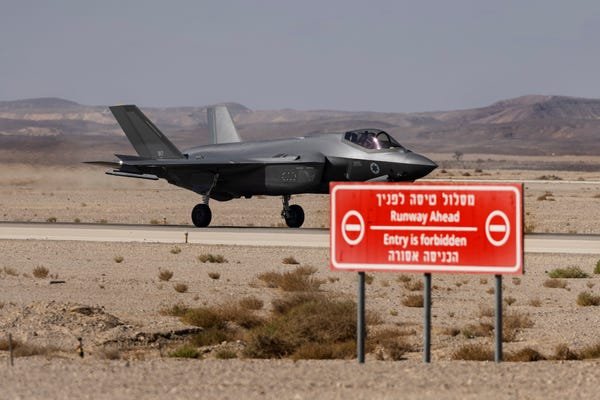
An Israeli F-35I lands at Ovda airbase near Eilat, southern Israel. Tsafrir Abayov/AP
The F-35 stores its weapons and fuel internally, and its aligned edges and radar-absorbent coating also help the aircraft evade detection. The planes cost $44,000 per hour to fly, The National Interest reported.
They feature advanced stealth and information-processing capabilities and can reach supersonic speeds of Mach 1.6, or 548.8 meters per second.
An Israeli Air Force F-35I Adir fighter aircraft flies over the Negev Desert. YURI CORTEZ/AFP via Getty Images
Lockheed Martin CEO Marillyn A. Hewson said in 2018 that the planes “can fly in what we call ‘beast mode,‘ carrying up to 18,000 pounds of internal and external ordnance, in a mix that can include 5,000-pound-class weapons.”
In 2016, Israel became the first country other than the US to acquire F-35 fighter jets.
Israeli Prime Minister Benjamin Netanyahu stands next to an F-35 fighter jet just after it landed in Israel at Nevatim air base. Amir Cohen/Reuters
Israel was the first country to select the model through the US Foreign Military Sales process and bought 50 planes, according to Lockheed Martin.
Israel has made significant modifications to the jets.
A production line for F-35 wings in Israel Aerospace Industries’ (IAI) campus near Tel Aviv. Amir Cohen/Reuters
Israel manufactures its own wings and electronic warfare system for the F-35I. It also developed its own version of the high-tech helmet that displays the plane’s airspeed, altitude, targeting information, and other crucial stats directly on the pilot’s visor.
The Israeli Air Force named its F-35I variant “Adir,” meaning “Mighty One” in Hebrew.
Israeli Air Force technicians customize an F-35I plane with a Star of David symbol. Israeli Air Force
The Israeli Air Force also added a six-pointed Star of David to the design, a Jewish symbol that also appears on the Israeli flag.
In 2018, Israel became the first country to use the F-35I in combat, its air force chief said.
Israeli Air Force F-35 flies during an aerial demonstration. Amir Cohen/Reuters
“We are flying the F-35 all over the Middle East and have already attacked twice on two different fronts,” then-Israeli Air Force chief Major-General Amikam Norkin said in a speech at a gathering of foreign air force leaders, Reuters reported.
In July 2023, Israel acquired an additional 25 Adir planes in a $3 billion deal.
Israeli F-35I planes. Israeli Air Force
The deal was financed through the military aid Israel receives from the US, Reuters reported.
In November 2023, Israel’s F-35I Adir fighter jets took down a missile fired by an Iran-backed group in Yemen, according to the IDF.
A F-35I fighter jet flies during a graduation ceremony for Israeli Air Force pilots in southern Israel. Amir Cohen/Reuters
It was the first known intercept of a cruise missile by an F-35 plane.
The Israeli Air Force released footage of the encounter on X, writing in Hebrew that its personnel are “preoccupied at every moment with planning and managing the defense response and are prepared for any threat in any area.”
Iran appeared to target the Nevatim air base, which houses Israel’s fleet of F-35I jets, during an attack in April 2024.
An Israeli F-35 combat aircraft in the skies over Israel’s border with Lebanon. Ammar Awad/Reuters
Out of the over 350 ballistic missiles, cruise missiles, and UAVs, or unmanned aerial vehicles, launched at Israel by Iran and its proxies in Iraq, Yemen, and Lebanon, around 99% were intercepted by Israel and its allies. The IDF released photos showing minor damage near a runway at the Nevatim Airbase and to a road in Hermon caused by the few projectiles that landed.
The missiles appeared to target Israel’s Nevatim Airbase in the Negev desert, which houses its fleet of F-35I stealth fighter jets. The base remained operational throughout the attack, according to the IDF, with the Adir fighter jets aiding the defensive mission.
“Iran thought it would be able to paralyze the base and thus damage our air capabilities, but it failed,” IDF spokesperson Rear Adm. Daniel Hagari said in a statement.
In June 2025, the Israeli Air Force launched around 200 fighter jets, including F-35Is, in a preemptive strike targeting Iran’s nuclear program.
An F-35I Israeli fighter jet used in strikes against Iran. Israel Defense Forces
An IDF spokesperson said that Israeli fighter jets struck over 100 sites across Iran to prevent it from developing a nuclear weapon, including military targets and its largest uranium enrichment site in Natanz.
The IDF said that Iran’s nuclear program had “accelerated significantly” in recent months and called it “clear evidence that the Iranian regime is operating to obtain a nuclear weapon.” Iran maintains that its nuclear program is solely for civilian purposes.
“This is a critical operation to prevent an existential threat by an enemy who is intent on destroying us,” Lt. Gen. Eyal Zamir, the IDF’s Chief of the General Staff, said in a statement.
The IDF released photos showing planes used in the large-scale operation, including F-35I jets.
F-35Is struck Iran over the weekend in what the IDF called “the largest military flyover in Israeli Air Force history.”
US and Israeli F-35s flew together during a training exercise. The two countries launched new strikes against Iran using land, air, and sea assets. U.S. Air Force photo by Senior Airman Duncan C. Bevan
As part of Operation Roaring Lion, Israel’s moniker for Operation Epic Fury, around 200 Israeli fighter jets, including F-35Is, struck 500 Iranian missile launchers and aerial defense systems on Saturday. IDF spokesperson Lt. Col. Nadav Shoshani characterized the operation as “the most extensive aerial operation ever conducted by the Israeli Air Force.”
The strikes “significantly degraded” Iran’s offensive capabilities, the IDF said. The strikes also killed Iranian military leaders, including Iranian Defense Minister Aziz Nasirzadeh and Mohammad Pakpour, commander of the IRGC.
The war in Gaza prompted new scrutiny of US military aid to Israel.
An Israeli soldier sits inside an F-35I fighter jet after it landed in Israel at Nevatim Airbase. Amir Cohen/Reuters
The October 7 terrorist attacks carried out by Hamas killed around 1,200 Israelis and captured over 240.
Israel’s counteroffensive airstrikes and military actions in Gaza resulted in over 72,000 Palestinian fatalities, according to figures provided to the United Nations Office for the Coordination of Humanitarian Affairs by the Hamas-run Ministry of Health in Gaza. The IDF reports that at least 17,000 of these fatalities were Hamas militants. A ceasefire agreement was reached in October.
The devastating human toll of the war in Gaza with US-funded planes like the F-35I has prompted new scrutiny of US aid to Israel, with some lawmakers in Congress raising the possibility of conditioning military and economic aid.
This as-told-to essay is based on a conversation with Ivan Ureña-Valdes, who has worked at Block for nearly four years as a data analyst. It has been edited for length and clarity.
When I got an email from Jack Dorsey, I was in the middle of interviewing someone for a role at Block.
It was pretty strange because, in the past, with layoffs, I knew people had their access cut almost immediately.
A coworker messaged me: “Hey, are you okay?” My heart started racing. I knew from that message it meant that I was probably getting laid off.
I felt really bad because I was in the middle of interviewing someone. I had to tell them, “I was actually just let go from the company. I probably won’t be able to submit your feedback in time. Please reach out to your recruiter.”
Every time Lee Chong Ming publishes a story, you’ll get an alert straight to your inbox!
Stay connected to Lee Chong Ming and get more of their work as it publishes.
I’m the sole provider for my family. It was tough.
I had a hunch that AI would lead to cuts at some point
We knew there were many performance cuts happening around right now, and those have largely finished. I had no idea this cut was coming.
For 4,000-plus people to be cut without anybody knowing, that tells me decisions were made very high up.
I’ve survived three rounds of layoffs, some companywide, some engineering organization-wide. I knew I wasn’t being let go for performance-related reasons. I was in the middle of working on two large projects, probably the largest projects I’d worked on since joining the company.
I had a hunch that, at some point, the company would cut people because of AI. I just didn’t think it would be right now.
Working at Block, I saw how AI was automating tasks away
I appreciate Jack for his honesty. It’s much fairer of him to come straight out and say why it happened — that it’s because of AI and the vision he sees.
I’m honestly grateful for the generous severance and benefits. It definitely helps make the rough situation a bit easier.
I’ve felt the rumblings of AI disruption for a while now, especially since Anthropic launched Opus 4.5 late last year.
Jack loves AI and was constantly pushing us to use it. I got to use these tools as much as possible every single day.
I could see in my own work very quickly how much of it was already being automated. So much of the data analyst world is finding the right dataset, writing something that will allow you to pull the data set that you want, and then generating output. Every single one of those steps is significantly faster and easier because of AI.
It was definitely a “whoa” moment when I realized just how powerful things had gotten.
AI will continue to replace jobs
I 100% think that more disruption and more of these types of cuts will probably come at other companies, which is unfortunate.
I’m much more pessimistic about all of it than many other people probably are.
Given that we live in the US, where growth is everything, it’s inevitable that AI will continue to replace people wherever it’s financially beneficial to do so.
I’m optimistic that I can find a job in the general data field, whether it’s something I’m extremely passionate about or pays as much as I did before. It will be difficult to find something that matches the environment I was working in because I had developed really strong ties with my coworkers. The pay was fair within the data analytics or business intelligence world, and the role was remote.
There are incredible companies out there doing great work, though I am nervous about the industry as a whole and the competitiveness as I search for that perfect next role. Some people are getting really, really high salaries at AI companies, while tons of people at Block are getting laid off.
Do you have a story to share about tech layoffs? Contact this reporter at cmlee@businessinsider.com or on Signal at cmlee.81.
A GoFundMe for James Van Der Beek’s family highlights a harsh reality of young cancer diagnoses: they can be financially devastating.
“The costs of James’s medical care and the extended fight against cancer have left the family out of funds,” reads the fundraising page.
The effort raised over $1 million in 24 hours following the actor’s death from colorectal cancer on February 11.
Van Der Beek, who was 48, was diagnosed with stage 3 colon cancer in 2023 and publicly announced his diagnosis in late 2024. He is survived by his wife, Kimberly, and their six children. The fundraiser says the money will help pay off Van Der Beek’s care, cover household expenses, and support the kids’ education.
The family’s story underscores the financial struggles for millions of Americans navigating a cancer diagnosis under 50. While it’s hard to face steep healthcare costs at any time, it can be especially challenging during prime earning years. Van Der Beek worked in TV and movies from the 1990s to the early 2020s.
Every time Allie publishes a story, you’ll get an alert straight to your inbox!
Stay connected to Allie and get more of their work as it publishes.
Young cancer patients lose $5,000 in yearly wages
Business Insider heard from dozens of patients as part of a yearlong investigation into young cancer cases. They told us about the credit card debt they incurred from treatment, the skyrocketing cost of health insurance, and the impact of cancer on their working lives long past recovery.
Our newsroom collaboration with health economists at GoodRx found that the average 30-something with a stage 3 colon cancer diagnosis spends $45,000 out of pocket in their first year of treatment. Chemotherapy, prescriptions, insurance premiums, fertility treatments, and unexpected costs like transportation and mobility aids are included in that figure.
Lost wages are too — young patients in their prime earning years typically miss out on thousands of dollars in income.
The GoodRx analysis of data in the national Medical Expenditure Panel Survey found that the average cancer patient ages 18 to 44 loses $5,104 in annual wages and 26 days of work due to illness. This is markedly more than older patients outside their prime working window: Patients ages 45 to 64 lose $2,903 in wages and 18 days of work.
These numbers are averages, and a particular patient’s wage losses and costs may vary depending on their age, job, treatment plan,and location. But it highlights a truth for young adults like Van Der Beek: Bills for cancer care can hit at a time when people are financially vulnerable or facing income instability.
Financial challenges can also be compounded by career setbacks. Young cancer patients told Business Insider they struggled to balance their workload with constant medical appointments and worried about losing out on promotions. Some had to quit their jobs, while others couldn’t afford to give up their employer-sponsored health insurance. Medical debt is among the top causes of bankruptcy in the US, and is more frequently reported by millennials than any other generation.
What’s harder to capture in data is the emotional toll young cancer has on patients, especially those who consider their careers to be part of their identities.
As Van Der Beek told Business Insider last year:“All these beautiful things that I love, and I used to define myself as — a father, a provider, a husband — all that got taken away, or at least paused. I had to sit there and say, ‘Well, what am I?’ And it was, ‘I’m still worthy of love.'”
This as-told-to essay is based on a conversation with Kiva Lucero, 21, who is from El Paso and studies in New York City. He is the cofounder of a Paris-based creative collective. It has been edited for length and clarity.
I was scrolling on Instagram on Tuesday when I saw the El Paso airspace was closing for 10 days. Immediately, I was stressed and anxious.
I had a flight booked from El Paso to Dallas for Thursday, and then Dallas to Paris, and had to get to Paris by the weekend for work.
When I found out that what was supposed to be a 10-day closure lasted seven hours, I didn’t feel much relief — I had canceled my flight to Dallas and spent nearly $100 on a bus that I haven’t been able to get refunded.
I booked a bus ticket at three o’clock in the morning
When I first found out about the airspace closure at around midnight on Tuesday, I called my airline immediately and explained the situation. I kind of freaked out.
I asked them if it was possible for me to cancel the El Paso to Dallas leg of my flight, and I would just figure out a way to get to Dallas.
They canceled my flight after a lot of hard negotiation. At three o’clock in the morning, I booked a ticket for a 12-hour bus ride from El Paso to Dallas, leaving at 7 p.m. on Wednesday and getting to Dallas 6:30 a.m. Thursday.
I didn’t even know if I was going to make it to the bus. I was thinking El Paso could get completely locked down. I was up all night.
I just didn’t expect anything good to come of the situation. I thought it could be a serious evacuation. I called my mom to make sure everything was good, because I didn’t want her staying in town if there was a major issue.
I felt stressed and helpless
When I saw on the New York Times in the morning that the closure was lifted, I still couldn’t sleep.
I called the airline again to reinstate my original booking, because I didn’t want to take a 12 hour bus. Luckily, they did.
But it was hours of just stress and anxiety and feeling so helpless.
I had already canceled plans with friends and work meetings because I thought I would be on the bus the next day.
Thankfully, I should make it to Paris now, but it cost me $100 and a full night of sleep.
A Trump administration official told Business Insider of the disruption: “Mexican cartel drones breached US airspace” and the Defense Department “took action to disable the drones,” and there was no threat to commercial travel.