
Alice Tecotzky

Wells Fargo’s head of AI shares his playbook for staying in demand as banks weigh what the tech means for head count

Saul Van Beurden is the man helping Wells Fargo confront a question hanging over banks of every size: What happens to jobs in the age of AI?

He and his central team can’t, and shouldn’t, figure out what an AI-ready Wells Fargo looks like alone. The bank must teach employees skills to stay competitive in a changing industry, and they must choose to learn them, Van Beurden said.

“You cannot deny things,” Van Beurden, who is the head of AI and the co-CEO of consumer banking and lending, told Business Insider. “But how do you make it a thing where everybody has a role to play and takes their own accountability and responsibility?”

The bank is leaning on AI literacy programs and demos, among other things, to hopefully inspire “grassroots enthusiasm.” The goal is to make employees comfortable enough with the technology that they can be redeployed if their jobs change, or competitive in the job market if they leave Wells Fargo, he said. Wells Fargo doesn’t mandate AI usage, even as it bets the technology will help supercharge its growth following the Federal Reserve’s decision to lift a $1.95 trillion asset cap.

Van Beurden thinks that fluency starts outside the office. He’s trying to build an agent to help pull documents for his 2026 tax returns, and believes it’s crucial for employees to use AI in their personal lives, too.

“It’s really important to have that personal usage, to understand the power of what it can do. And then we are enabling that and allowing that to happen at the workplace,” he said.

Still, Van Beurden emphasized that everyone needs to “stay cognitive,” since AI could generate all of our ideas if we let it. He suspects that most college students are comfortable with technology but should invest time in activities like reading or playing chess. Staying sharp, he thinks, will help them in what’s broadly a brutal job market.

Wells’ workforce, like many of its competitors, is already changing because of AI. The bank’s CEO, Charlie Scharf, said in November that it will probably “have less head count as we look forward,” and added in December that generative AI has already made engineers up to 35% more productive.

Van Beurden didn’t say whether the bank would need 30% fewer engineers as a result or whether it would necessarily alter hiring, leaving it at, “it’s a great question.” Instead, he said that growth and head count aren’t always one-to-one.

“How great is it to grow without the need to hire people, because you have created the capacity to take on more clients, to take on more customers with the same amount of people?” he said, calling AI the “ideal tool” for that growth. Wells Fargo recorded $21.3 billion in revenue in the fourth quarter, up 4% year over year; revenue in its consumer bank, which Van Beurden oversees, rose 7% year over year.

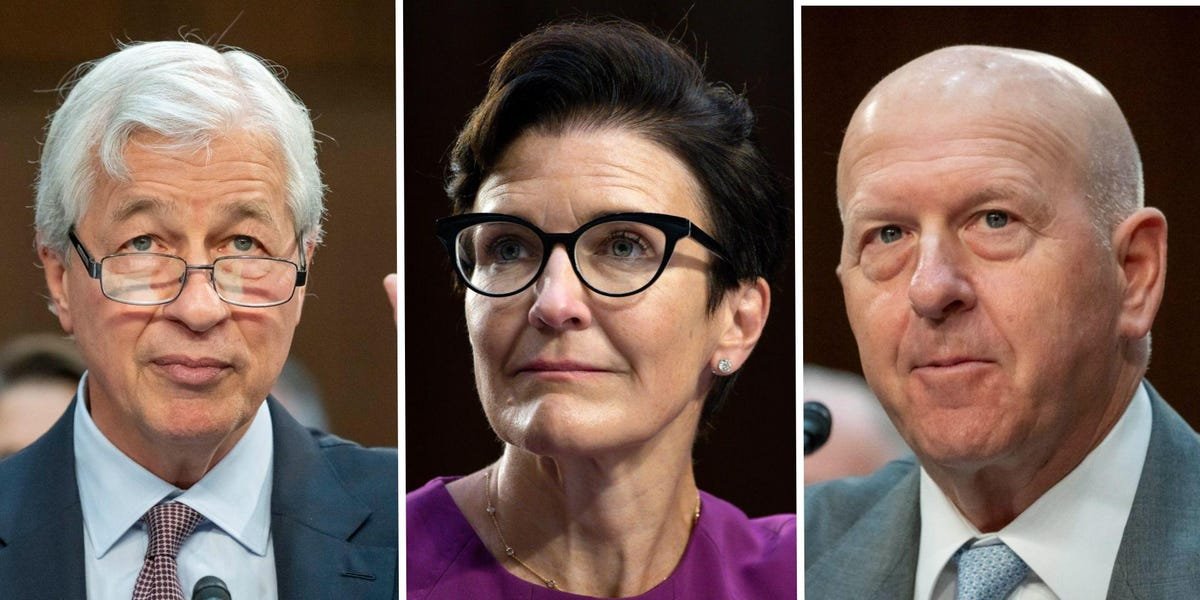
The leaders of other big banks have also said that AI will likely eliminate some jobs and slow hiring, both publicly and in internal memos. JPMorgan CEO Jamie Dimon has said his bank has “huge redeployment plans.”

Efficiency promises and big technology budgets aside, the head count cuts haven’t yet materialized at most banks. Around 60% of 240 financial services CEOs surveyed by EY said they expect AI investments to maintain or boost their head count this year.



Source link

I-asked-Taco-Bells-CMO-what-his-go-to-order-is.jpeg

I asked Taco Bell’s CMO what his go-to order is. I wasn’t ready for the hot-sauce count.

A person’s go-to Taco Bell order is a sacred thing.

Selena Gomez was eating a Mexican Pizza when Benny Blanco proposed. Jason Sudeikis grabbed two chicken tacos on the night his son was born. When Dolly Parton would go through the drive-thru on dates with her husband Carl Dean, she always ordered a Taco Supreme.

I’m partial to the Cantina Chicken burrito, and just last week, I convinced three different friends to try it during our 1 a.m. Taco Bell run (which somehow racked up to $117, but that’s another story).

So, when I recently sat down with Taco Bell CMO Taylor Montgomery, I knew I had to find out what his usual order is. Montgomery eats at the fast-food chain every other day, but his go-to hasn’t changed — nor has his wild hot-sauce count.


Taylor Montgomery and Benson Boone at Live Más LIVE,

Taylor Montgomery and Benson Boone at Live Más Live on March 3.

Courtesy of Taco Bell


“My order is still the same,” Montgomery, who has worked at Taco Bell for a decade, told me. “Crunchy tacos, one Fire sauce packet per bite. I have like 10 sauce packets per taco.”

“If I’m really hungry, it’s three tacos,” Montgomery added. “If it’s a normal day, it’s two.”

“Per bite!?” I asked. I’ve been known to rip through a few of Taco Bell’s hot and avocado verde salsa packets myself, but 10 was a whole new level.

“Oh yeah,” Montgomery replied. “You gotta go big. Fire sauce, only Fire.”

‘We truly are one of one’

While some fast-food brands have spent the past week trying to outdo each other with burger taste-test videos, Taco Bell has been focusing on the premiere of Live Más Live, an annual event where the chain unveils every new menu item it plans to release during the year.

Montgomery was originally inspired by Apple’s Worldwide Developers Conference when he helped launch the first Live Más Live in 2024. This year, the CMO knew he wanted to shake up the format.


Taco Bell Live Más LIVE 2026

Taco Bell Live Más Live 2026 took place at the Hollywood Palladium in Los Angeles.

Courtesy of Taco Bell


“We truly are one of one, just like Apple, just like Amazon, just like Tesla,” Montgomery said. “So I started to look at how some of those companies are behaving, and they are behaving like entertainment companies. That’s what consumers want. That’s what consumers’ expectations are.”

“That’s how Live Más Live, an unhinged night in Hollywood, was born,” he added.

Taco Bell hired the production team behind the Academy Awards, made a streaming deal with Peacock, and rented out the Hollywood Palladium in Los Angeles for a one-hour awards show on March 3. Celebrities like Sudeikis, Doja Cat, Benson Boone, and Demi Lovato were on hand to help announce the 20-plus new items coming to Taco Bell’s menu in 2026.


Taco Bell's Fire Queso Sauce Packet

Taco Bell’s Fire Queso Sauce Packet is an edible version of the famous hot-sauce packet.

Courtesy of Taco Bell


Montgomery said he hopes the event makes Taco Bell’s fans feel “seen and heard,” noting that the chain also listened to their pleas for more sweet treats.

“One of the most requested things we hear from our fans is, ‘I want more desserts at Taco Bell,'” he said.

Crème Brûlée Crunchwrap Sliders, Strawberry and Cream Mexican Pizza Bites, and chocolate fudge empanadas will all be coming soon, but Montgomery said the core of Taco Bell’s brand is still “crunchy, cheesy, saucy, spicy.” This year’s menu slate even includes an edible version of Taco Bell’s Fire hot-sauce packet.

The real question is, will Montgomery be using 10 of them per taco?


Source link

Person at computer with robots in the background

Bank employees, rejoice: 60% of finance CEOs don’t see head count shrinking because of AI


AndreyPopov/Getty Images

  • Of the 240 financial CEOs EY surveyed, only 28% see AI reducing head count in 2026.
  • Nearly half of the CEOs said AI is the most critical factor in their company’s ability to adapt.
  • Some Wall Street leaders have said AI will eliminate some roles, but ultimately increase head count.

Banks’ analyst classes probably won’t swap fresh-faced college grads for bots — at least not this year.

Some 60% of the 240 financial services CEOs that EY surveyed for its Quarterly CEO Outlook Survey said they think investing in AI will maintain or even increase their current head count in 2026. Only 28% of those surveyed predicted head count would drop this year.

Leaders at some of the biggest banks, including JPMorgan and Goldman Sachs, have said that they’re resisting hiring growth where it makes sense to prioritize efficiency. They, along with some other bulge-bracket leads, have predicted that AI could grow head count in the long run, though. Still, some roles are becoming obsolete: Citi CEO Jane Fraser said in a recent internal memo that some jobs “will no longer be required” as AI advances.

For their part, the financial services CEOs that EY surveyed are similarly bullish about AI’s capacity to transform the workplace, and nearly half see AI and digital investment as the most important factor in their companies’ ability to thrive and adapt this year.

Around a quarter said their AI initiatives have significantly beaten expectations, and 57% said they’ve shown results faster than expected. Just more than half said they expect the biggest transformations to come from generative AI.

When it comes to hiring for AI talent — itself a highly competitive market — 87% of CEOs in EY’s survey are optimistic about their ability to attract and keep talent in 2026. The question of returns on the AI investment, for talent and in general, also seems top of mind for the financial services leaders. Seventy-six percent of boards in the survey said they’ll review transformation ROI metrics as often as financial results.

Firms of all sizes are being asked to justify their AI spends, as analysts and investors begin to wonder whether the sometimes billion-dollar bets will show up on balance sheets.


Source link

Heres-what-Wall-Street-bank-CEOs-are-saying-about-head.jpeg

Here’s what Wall Street bank CEOs are saying about head count in the age of AI

Jamie Dimon has stuck to his trademark bluntness when talking about AI and jobs.

“It will eliminate jobs,” Dimon said at a Fortune conference in December. “People should stop sticking their heads in the sand.”

In the near term, Dimon said in an interview with CNN that JPMorgan’s head count remains steady, or even rises, as AI continues to roll out — if the bank does a “good job.”

The bigger promise is efficiency. “It will affect every job,” Dimon said at a 2024 Alliance Bernstein conference, describing a future where AI handles tasks like note-taking and summarization at the push of a button.

That efficiency could still mean more hiring in areas like cybersecurity, where Dimon says banks will need AI to counter increasingly sophisticated fraud.

CFO Jeremy Barnum said during the company’s fourth-quarter earnings call on Tuesday that the bank is allowing for some additional hiring in technology “at the margin.”

On that same call, however, Barnum said that, generally speaking, they “want to make sure that when someone needs to get something done, whether it’s in technology or elsewhere, their first reaction is not, ‘Hire more people.'”

He has previously said JPMorgan is asking people to “resist head count growth where possible” and focus instead on efficiency.

The head of JPMorgan’s consumer business, Marianne Lake, has said operations staff could be 40% to 50% more productive over the next five years — a shift she said would lead to slower net head count growth, as each employee can handle far more work through automation, digital assistants, and self-service tools.


Source link

A woman in glasses wearing a blue dress standing in front of a bush.

When I was diagnosed with low sperm count, I felt guilty and embarrassed. I want to break the taboo.

This story is based on an interview with Brian Mazza, 41, who has appeared on the cover of “Men’s Health.” Mazza was recently named “Champion for Male Fertility Advocacy” by the World Fertility Awards. The conversation has been edited for length and clarity.

Before we got married in 2014, my wife, Chloe Melas, a journalist, and I were very much aligned on wanting children in the future. It’s a huge step for anybody in a relationship, but we agreed that it would be great to start a family together.

Then, around a year after the wedding, we tried to get pregnant — without success.

The sense of disappointment each month was challenging and disheartening. Like anything else in life you want to accomplish, it becomes frustrating when it’s not working out.

It wasn’t ideal for both of us and caused a lot of issues, which weren’t fun. It was a strain and kind of brutal.

The test to determine my sperm count felt awkward

Fortunately, we were able to find a good, straight-talking doctor who ran a series of tests. Chloe was found to have a diminished ovarian reserve, but they wanted to check me out, too.

It was awkward and strange. Everybody in the waiting room knew why you were there, which was fine, but then you were ushered into a room next to the secretary’s desk. It felt a bit strange.

My test was back in 2016. Thankfully, there are now a lot of companies that allow you to sort everything out in your own home.


A man wearing a tuxedo

Mazza attends the Michael Rubin Reform Alliance Casino Night Event in September 2025 in Atlantic City, New Jersey.


Photo by Dimitrios Kambouris/Getty Images for Reform Alliance


The results showed I had a low sperm count, which proved to be the primary cause of the issues. If someone asked if I felt guilty, embarrassed, or was worried that Chloe was resentful toward me, I’d answer yes.

I was extremely fit, eating well, and doing everything to meet the expectations of an elite performer in life. I thought, “What is getting in the way of this goal?”

I began to wonder if I’d done something in the past that was responsible. It wasn’t the case, but I wanted to look at the full road map.

I went to every appointment with the fertility doctor

Then, since I’ve always been a problem solver and a reverse engineer, I thought, “How can we approach the situation?”

We had no luck with intrauterine insemination (IUI) and moved on to IVF. The process was pretty easy from a male perspective because you are physically removed.

Still, I went to every doctor’s appointment to listen to the advice. It was hard to see Chloe go through what she did, but we tried to focus on the end result.

We didn’t share our journey with family or friends at the time. It was to protect the situation and not feel like we were letting people down.


A family of four on a dinghy

Mazza and Melas with their sons.


Courtesy of Brian Mazza.


Thankfully, we got pregnant on our first round of IVF. We were thrilled, and it turned into elation when our son, Leo, was born in July 2017.

We went through the same process, and Luke arrived exactly two years later.

I advocate for increased awareness of male factor infertility

Holding Leo and Luke in my arms was every dream that I’d ever dreamed. I’d wanted to become a father so much.

I’m speaking up about male factor infertility because it’s a topic that should be openly discussed. I hope that I’m helping to remove the stigma. It’s useful when someone who has been through an experience like ours can share their story.

As the years pass, I find myself gazing at my boys — now 8 and 6 — with joy and wonder. They’re bright, athletic, and kind. Chloe and I call them our miracles.


Source link