I-went-to-an-AI-conference-and-got-a-crash.jpeg

I went to an AI conference and got a crash course in middle management

I have seen the future of AI, and we are all managing agents.

We are telling them where to go. What to look at. We are answering their follow-up questions. We are correcting them when they make a mistake.

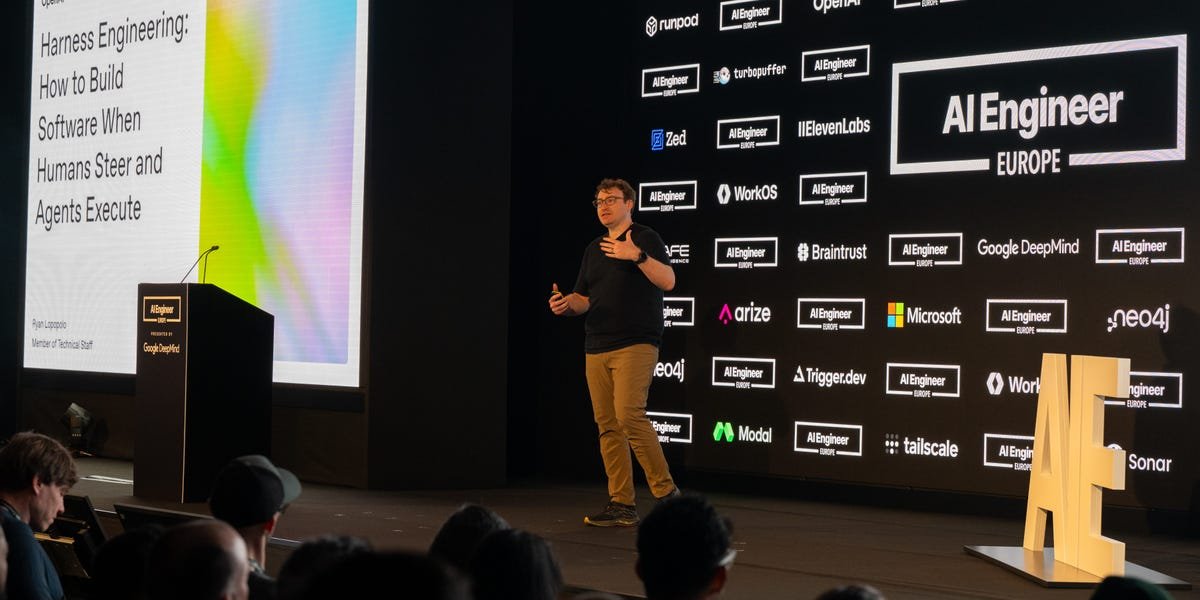
These were some of the talking points at last week’s AI Engineer conference in London, which brought together people from across the industry, including Google, Anthropic, and OpenAI.

The talks were varied, highly technical, and curated for the people steeped deepest in AI right now.

What was striking was how many of the presentations and discussions weren’t so much about the quality and abilities of AI models and agents — software that can perform tasks semi-autonomously — but the humans managing them.

Ryan Lopopolo, a member of OpenAI’s technical staff, called the moment early in the show. He said coding had changed dramatically in late 2025 because of advances in AI tools. The role of today’s software engineers, he said, is to steer and unblock agents.

That prompted several recurring questions: How much control should we cede to agents? What should agents look like? Should they delegate to other sub-agents? Is human language too limiting for telling an agent what you want it to do?


AI Engineer Europe 2026

Anthropic’s David Soria Parra said agents are about to jump from coding to other jobs. 

Hugh Langley


The event quickly started to feel like an MBA for the AGI-pilled. Everyone had a perspective on how agents should be managed. Words like “guardrails” and “context engineering” (a plan to have the agent perform optimally while burning fewer tokens) were everywhere.

These details matter because there’s an emerging consensus that 2026 will be an inflection point, when agents move from the experimental phase into one where they’re more reliable and leap from coding into other domains.

“I think 2025 was all about exploring, and 2026 is all about putting these agents into production,” said Anthropic’s David Soria Parra onstage. It’s not just coders who are going to have to think about these things: Parra said he expects we’ll soon see more “general agents that will do real knowledge worker stuff” such as financial analysis and marketing.

In this utopian work future, the agents are doing the grunt work for us — but they still need oversight. That means they need the right documentation, context, and guidelines to keep them from careening off course and doing things they shouldn’t.

It’s an irony of this moment that companies including Meta, Google, and Amazon are cutting management layers but may also end up turning everyone into AI supervisors. Individual contributors at tech companies, who once coded away without worrying about their direct reports, are now delegating and reviewing work done by AI.

Another big topic of debate was the amount of control we should give to agents — especially given how prone they are to breaking things. There was more than one dig at a recent disruption at Amazon caused by an AI coding assistant.

Mario Zechner, the creator of coding agent Pi, struck a more cautious message than most speakers. Agents learned on the internet, which is filled with a lot of garbage code, he said. He proposed a model for software engineers working with agents: use them sparingly, and don’t let them make decisions for you. “All of the decisions it makes are learned from the internet,” he said.

Agentcraft

Keeping tabs on agents means being able to see them, which prompted another interesting question: what should an agent look like?

One answer came via a showstopping moment from Monday.com’s Ido Salomon, who built a program called Agentcraft that, yes, displays functioning agents in a “Warcraft”-inspired environment.

The user can spawn new agents, prompt them as they would in any other AI interface, and there’s a handy way to cycle through agents with follow-up questions or that need your approval to execute a task. A heat map shows you if your agents are at risk of colliding — a problem that can occur when running multiple agents in parallel. This can happen if two agents are editing the same file at the same time, or both are tweaking different code functions that rely on each other.


AI Engineer Europe

How do you make controlling agents fun? Make it a video game. 

Hugh Langley


Several attendees who spoke to Business Insider weren’t from major AI labs but companies big and small that are embracing agents in the workplace.

Yann Mainier, a senior engineer at Sky UK who attended the event, told Business Insider he wanted to learn more about how he and his team can build better agents.

“It’s more about: once you get agents, how do you make sure they are doing a good job? You can’t check them the same way you are doing with traditional software,” he said. For example, ask an agent to write the same function twice, and it might do it differently. “You need to have other ways,” Mainier said.

Managing agents may also require rearchitecting parts of the web to make it more legible.

Vercel CTO, Malte Ubl, said that in the week leading up to the AI Engineer conference, more than 60% of page views on Vercel.com were from agents.

“We have to consider another shift that the software itself is going to be used by agents now,” he said. When an employee proposes a new feature or interface, Ubl said he now asks a new question: “How does an agent use this?”

Have something to share? Contact this reporter via email at
hlangley@businessinsider.com or Signal at 628-228-1836.


Source link

John F. Kennedy Jr. and Carolyn Bessette Kennedy in black tie attire

JFK Jr. and Carolyn Bessette died in a plane crash 27 years ago. It fueled rumors of a ‘Kennedy curse.’

John F. Kennedy Jr. and his wife, Carolyn Bessette Kennedy, attended the Municipal Art Society Gala in 1998.

  • John F. Kennedy Jr., his wife, and her sister died in a 1999 plane crash near Martha’s Vineyard.
  • Rumors of a “Kennedy curse” were fueled by multiple family tragedies over the decades.
  • JFK Jr. and Carolyn Bessette’s relationship is now the topic of an FX series, “Love Story.”

The Kennedy family has been subjected to many tragedies over the years, including two assassinations and a plane crash that took the lives of John F. Kennedy Jr. and two other passengers.

Nearly 27 years ago, on July 16, 1999, John F. Kennedy Jr., his wife Carolyn Bessette-Kennedy, and her older sister Lauren Bessette were killed in a plane crash off the coast of Martha’s Vineyard in Massachusetts. There were no survivors from the accident.

The relationship between John F. Kennedy Jr. and Carolyn Bessette-Kennedy is now the topic of an FX series executive-produced by Ryan Murphy, “Love Story.”

Their deaths became a major news story and perpetuated rumors of a “Kennedy curse.”

JFK Jr.’s father, former President John F. Kennedy, was assassinated in 1963. His uncle, Robert “Bobby” Kennedy, was assassinated five years later in 1968. And two years before JFK Jr.’s death, his cousin Michael Kennedy also died after hitting a tree while skiing in Aspen, Colorado.

Here’s what we know about the plane crash that killed John F. Kennedy Jr. and two others.

John F. Kennedy Jr. frequently made headlines throughout the 1990s.
John F. Kennedy, Jr. addresses the Democratic National Convention in 1988
John F. Kennedy, Jr. at the Democratic National Convention in 1988.

As the son of a president and a member of one of America’s most prominent political dynasties, John F. Kennedy Jr. was destined for the spotlight.

JFK Jr. was born on November 25, 1960, just two weeks after his father was elected president. His father was assassinated on November 22, 1963, just three days shy of JFK Jr.’s third birthday.

JFK Jr., affectionately nicknamed “John-John” by the public, attended the funeral on his birthday and was famously photographed saluting his father’s casket.

Throughout much of his adolescence and adulthood, he mostly remained out of the public eye.

However, his public image began to change after he introduced his uncle, Ted Kennedy, at the Democratic National Convention in 1988.

In September 1988, People named Kennedy, who was then a 27-year-old third-year law student at NYU, the “Sexiest Man Alive.”

JFK Jr. also dated a few celebrities throughout the 1990s, including “Sex and the City” star Sarah Jessica Parker, Cindy Crawford, and Daryl Hannah.

John F. Kennedy Jr. began dating Carolyn Bessette, a publicist for Calvin Klein, in 1994.
John F. Kennedy Jr. and Carolyn Bessette-Kennedy in 1995
John F. Kennedy Jr. and Carolyn Bessette-Kennedy in 1995.

They met in the fitting room at Calvin Klein, where Bessette helped JFK Jr. pick out wardrobe items, Elizabeth Beller wrote in “Once Upon a Time: The Captivating Life of Carolyn Bessette-Kennedy,” cited by People.

Tall, sophisticated, and beautiful, JFK Jr.’s new girlfriend captivated the public.

After two years of dating, the pair married in an intimate ceremony on Cumberland Island, Georgia, People reported.

While their wedding ceremony was private, their relationship was anything but, thanks to the prying eyes of the paparazzi.
John F. Kennedy Jr. and Carolyn Bessette in New York City and the front cover of the October 7, 1996, Daily News picturing the couple and the headline

The media attention may have even inspired Kennedy to get his pilot’s license in 1998.

“That was some of the happiest times he ever had. Floating around with the buzzards in his Buckeye [plane]. It was the freedom,” his close friend Robbie Littell told “JFK Jr: An Intimate Oral Biography” author RoseMarie Terenzio, according to People.

“He said, ‘It’s the only place I can go where no one is bothering me. I have complete silence, and no one can get to me except the air traffic controllers.’ Maybe that gives you insight into what he was really dealing with on the ground,” his college friend Gary Ginsberg said, People reported.

John F. Kennedy Jr. was traveling to Martha’s Vineyard with his wife and her older sister when their plane was reported missing.
The hangar where John Kennedy Jr. kept his Piper Saratoga airplane and a similar model plane.
The hangar where John Kennedy Jr. kept his Piper Saratoga airplane.

The Washington Post reported that Kennedy departed Essex County Airport near Fairfield, New Jersey, at around 8:38 p.m. on Friday, July 16, 1999. The sun was already beginning to set and “hazy conditions,” which had been reported earlier in the evening, were getting worse, People reported.

Kennedy planned to drop his sister-in-law Lauren Bessette on Martha’s Vineyard before traveling to his family’s compound in Hyannis Port with Carolyn. The couple was due to attend his cousin Rory Kennedy’s wedding the following day, according to People.

However, the plane never landed in Martha’s Vineyard.

An unidentified driver reported the plane had failed to arrive at Martha’s Vineyard Airport as expected, according to the Post, citing an NBC report. It kicked off a search for the missing aircraft in the early hours of July 17.

The Kennedy family notified the Cape Cod Coast Guard that the couple had not made it back to Hyannis.
A Coast Guard helicopter lifts a rescue swimmer after the swimmer jumped into the water on July 17, 1999, to look for debris from John Kennedy Jr.'s plane
A Coast Guard helicopter searching for debris from John Kennedy Jr.’s plane.

The Washington Post reported that the Coast Guard then began investigating whether the plane had landed at another airport.

By 4 a.m., the Coast Guard began searching for the missing plane, and by 7:30 a.m., the Air Force and Coast Guard had launched 20 aircraft vehicles and two boats to search the area between Long Island and Martha’s Vineyard, according to the Post’s timeline.

On Sunday afternoon, what was presumed to be debris from the plane was found on Philbin Beach on Martha’s Vineyard. Among the debris was a headrest that was later concluded to be from the missing aircraft and a black suitcase that contained Lauren Bessette’s business card.

Rory Kennedy’s wedding, scheduled for 6 p.m. that night, was put on hold as the family awaited more news.

The Washington Post reported that after more debris was found in the days to follow, the search-and-rescue mission became a search-and-recovery mission.

All three of the plane’s passengers were now presumed dead. John F. Kennedy Jr. was 38 years old. Carolyn Bessette-Kennedy was 33, and her sister Lauren Bessette was 34.

Five days after the crash, the bodies of John F. Kennedy Jr., Carolyn Bessette-Kennedy, and Lauren Bessette were recovered.
Massachusetts State Police divers left Menemsha on Martha's Vineyard on July 19, 1999.
Massachusetts State Police divers left Menemsha on Martha’s Vineyard on July 19, 1999.

The debris field was identified off the coast of Martha’s Vineyard, relatively near the estate once owned by Jacqueline Kennedy Onassis, Kennedy’s mother, The New York Times reported. (Kennedy Onassis died in 1994.)

The bodies of John F. Kennedy Jr., Carolyn Bessette-Kennedy, and Lauren Bessette were discovered by Navy divers on July 22, 1999, after an extensive search approved by President Bill Clinton.

The bodies of the crash victims, which were ”near and under” the main body of the aircraft, were still strapped in, according to the Times.

Details began to emerge about what led to the crash.
A television technician holds up the official handout map of the search and rescue area off Martha's Vineyard
A television technician holds up the official handout map of the search and rescue area off Martha’s Vineyard.

Kennedy had only flown about 72 hours without a flight instructor, and had only about 300 total hours of flying experience, The New York Times reported in July 2000. He had reportedly rejected an offer to have a flight instructor accompany the group on their journey.

As a newly trained pilot, Kennedy was not licensed to fly and navigate the air using flying instruments. Instead, he had only trained to fly using sight alone, which would have been extremely difficult in dark or hazy conditions such as those on the night of July 16.

Warren Morningstar, a spokesman for the Aircraft Owners and Pilots Association, told the Times that “flying at night over featureless terrain or water, and particularly in haze or in overcast, is a prime setup for spatial disorientation.”

About an hour into the trip, the plane’s flight path became irregular as it began its descent into Martha’s Vineyard, indicating that the pilot may have become disoriented by the darkness of the sky and the water, the National Transportation Safety Board concluded.

“His flight path into the water is consistent with what is known as a graveyard spiral,” Jeff Guzzetti, an NTSB investigator in the accident, told Terenzio, according to People. “The airplane makes a spiral nose down … kind of like going down a drain. The plane went into one final turn and it stayed in that turn pretty much all the way down to the ocean.”

The aircraft went down in the water about 7 miles from its intended destination of Martha’s Vineyard.
A mourners cries as people pay respects at the floral shrine outside of the building where John F. Kennedy Jr. and Carolyn lived in 1999.
Mourners pay respects at the floral shrine outside of the building where John F. Kennedy Jr. and Carolyn lived in 1999.

The Washington Post reported that the plane did not send out a distress call. Instead, it made its final descent and crashed into the Atlantic Ocean in under 30 seconds.

Kennedy, Kennedy-Bessette, and Bessette’s bodies were cremated and buried at sea off the coast of Martha’s Vineyard on July 22, 1999.

“We are filled with unspeakable grief and sadness by the loss of John and Carolyn and Lauren Bessette,” Ted Kennedy said in a statement on behalf of the Kennedy family. “John was a shining light in all our lives and in the lives of the nation and the world that first came to know him as a little boy.”

As the country mourned the loss, rumors of a “Kennedy curse” were reignited.
John F. Kennedy, Jr. gives his wife Carolyn a kiss on the cheek during the annual White House Correspondents dinner
John F. Kennedy, Jr. and Carolyn Bessette-Kennedy attended the White House Correspondents dinner in 1999.

The extensive search captured the nation’s attention, as did the tragedy of the three young passengers’ deaths. Yet another tragic accident for the Kennedy family, the plane crash only added to rumors of a Kennedy family curse.

“I’ve looked high and low and cannot find another family since the ancient Greek House of Atreus that has suffered more calamities and misfortunes than the Kennedys,” Edward Klein, the author of “The Kennedy Curse: Why Tragedy Has Haunted America’s First Family for 150 Years,” said, according to The Washington Post.

While there are many logical reasons for the fateful plane crash, it’s nevertheless poignant that the Kennedy family, one of the wealthiest and most influential political families in the world, has suffered so much tragedy throughout the last 100 years.

“The humanity of their story is what keeps us engaged,” Kennedy family biographer J. Randy Taraborrelli told NBC News in 2019.

“We peer behind the scenes of their wealthy lifestyle, and we see, for all the advantages they have, tragedy can still happen.”

Read the original article on Business Insider

Source link

Jeremy-Grantham-called-pandemic-crash-but-screwed-up-his-trade.jpeg

Jeremy Grantham called pandemic crash but screwed up his trade: memoir

Legendary investor Jeremy Grantham raised the alarm on an AI bubble, revealed a pandemic bet that didn’t pay off, and recommended young people steer clear of Wall Street in a memoir published last month.

The GMO cofounder wrote in “The Making of a Permabear: The Perils of Long-term Investing in a Short-term World,” which he coauthored, that ChatGPT’s release in late 2022 shored up a crumbling stock market and created a “bubble within a bubble.”

There’s “no clear historical analogy to this strange new beast,” Grantham wrote, but the AI bubble is likely to “at least temporarily deflate,” allowing the original market bubble to pop.

He issued a grim outlook, warning that the massive run-up in stocks has frontloaded returns so the market’s long-term prospects “look as poor as almost any other time in history.” Investors face either a “dismal return forever or a hefty bear market followed by a normal return,” he added.

Grantham also predicted that past interest-rate hikes and “ridiculous speculation” during and after the pandemic would “eventually end in a recession.”

“The US market since at least 2020 has been in a bubble,” he wrote, adding that even though bubbles can be unpredictable, all of them have popped so far.

Right bet, wrong size

Grantham disclosed in his book that he anticipated the COVID-19 pandemic would tank the stock market, but he didn’t win big from the prescient call.

The investor wrote that he dug into every rumor about the mystery virus in January 2020, and determined it posed a serious medical and economic threat, especially if countries bungled their responses.

He took steps to protect the portfolio of his family foundation — the Grantham Foundation for the Protection of the Environment — from a slump in stocks, and later convinced his GMO colleagues to prepare for trouble too.

“I get to brag here at how early this was compared to most,” Grantham wrote. “The bad news was that when the smoke had cleared, our trade was so unlevered and so lacking in cleverness that we really might as well have done nothing.”

Grantham contrasted that with Bill Ackman, whose Pershing Square hedge fund spent $27 million on credit-default swaps (CDS) on investment-grade and high-yield CDS swap indexes in February 2020.

Those derivatives soared in value within weeks, and Ackman sold them for $2.6 billion by late March, scoring a nearly 100-fold profit. The windfall offset losses in Pershing’s equity portfolio, and Ackman plowed more than $2 billion into stocks before they rebounded.

Grantham said his comparatively lackluster pandemic trade was a reminder that he’s “good at research and judgment, but left to my own devices sometimes mediocre at implementation.”

He gave another example of that shortcoming. He recalled publishing a bullish outlook the day the stock market hit its low in March 2009, but “neither I nor our Foundation nor GMO came close to maximizing the potential rewards of such a highly confident call.”

Skip the finance job

Grantham wrote in his book that he enjoyed the “intellectual challenge” of investment management, but came to view it as a “trivial activity.”

“If I started out all over again I’d prefer to do something that has some socially redeeming features,” he wrote.

Grantham said the world needs more people with practical and scientific skills to weather hard times and tackle existential risks such as climate change.

“We are going to have desperately difficult years ahead,” he wrote. “And I would urge young people with talent to do really seriously useful stuff: engineering, farming, metal bashing and serious science and research because we are going to need those kinds of skills.”

Grantham added that his foundation invests in new ventures that could “save the day” by harnessing geothermal energy or replacing toxic food packaging with greaseproof paper.

He wrote that making strides in “something so important is more satisfying and exciting than the equivalent breakthrough in making money in the stock market.”


Source link