The side-hustle bug bit Priscilla Tina in college.
She snapped photos of other graduates during their senior year. Now, the 28-year-old tech product manager spends 20 hours a week on content creation in San Francisco.
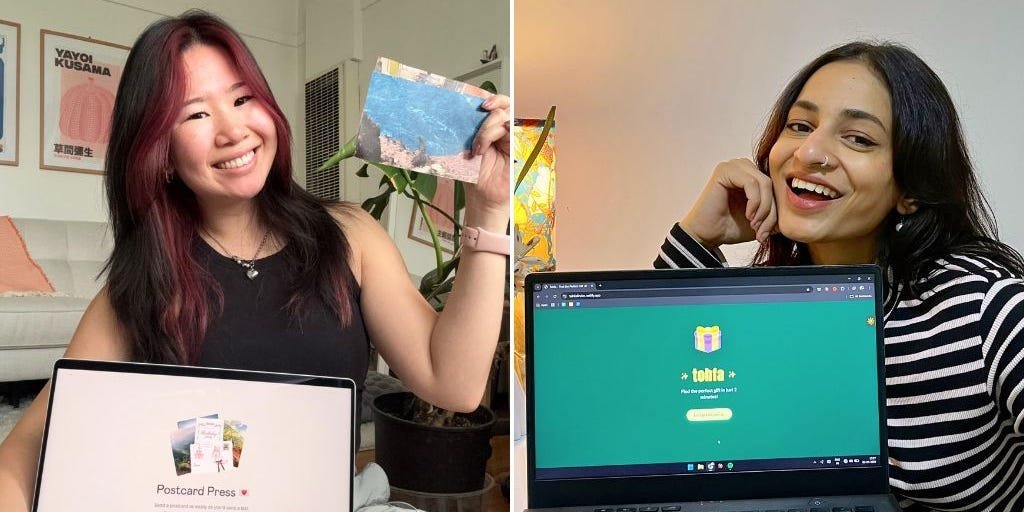
Her newest side gig — a vibe-coded app called “Postcard Press” that allows people to send their photos as postcards — took her significantly less time and energy.
Tina said she needed an idea to present at a networking event in November. She whipped up a prototype of the app on Anthropic’s Claude in four hours.
She launched the app online at the end of 2025, charging $2 per postcard sent, and said that in the last three months, about 100 people have used it. Her most viral Instagram reel about the app has received more than 80,000 views.
Priscilla Tina
“There is this insane inflection point right now where non-coders can just bring products to life in such a short amount of time with really little learning curve, which is super exciting,” she said.
Vibe coding refers to using plain English to instruct AI tools to write code. The phenomenon has swept through the tech world since Andrej Kaparhy coined the term last year, urging developers to “fully give in to the vibes.”
Building apps before AI required basic coding and software development knowledge, but now it’s as easy as typing a prompt into platforms like Lovable, Claude, or Base44, which spit out usable products in minutes.
The catch is that creativity and originality are now the great levelers, and having a smart, original idea has never been more important. In an arena where things move fast, and the pie is only so big — and where everyone can get their hands on tools with ease — you want the sharpest knife.
Side hustles are getting a lot easier, thanks to vibe coding
A non-technical user can go from prompt to live app in just a few hours for a simple product, Lovable’s head of product, Alexandre Pesant, told Business Insider.
“A more polished, market-ready product with auth, a database, and payments — which may typically take weeks to build — can be completed over a weekend,” he added.
Before the rise of vibe-coding tools, minimum viable products “would cost thousands of dollars and weeks of developer time,” Pesant said.
Emergent’s CEO, Mukund Jha, told Business Insider that the cost of building has fallen significantly. Traditional development can run from $15,000 to over $50,000, while Emergent subscriptions range from $20 to $200 a month.
Lovable’s Pro plan starts at $25 a month, giving builders enough credits and tools to ship and iterate on side projects.
Some users are already turning vibe-coded apps into serious revenue. Vibe-coding agency founder Jacob Klug made over $170,000 in a single month by building and selling Lovable apps, while Swedish builder Henrik Fasth scaled a virtual try-on tool into an AI fashion platform that now generates over $800,000 in annual recurring revenue within nine months.
Speed and simplicity are the keys to these apps. Users can move from concept to a production-ready product without setup or switching tools, Pesant said.
Emergent’s Jha said he’s seeing a wide range of side hustles, from a musician building a gig-booking marketplace to a gardening business owner creating a “Google for Gardeners” app.
“We also see internal teams building tools when engineering bandwidth is unavailable. Sales teams, HR teams, and influencer teams are building custom systems,” he added.
Tina, the product manager behind “Postcard Press,” studied mechanical engineering in college and had no real coding experience. “I didn’t know how to set up a Stripe payment system, and I didn’t want to complicate it that much,” she said. “But my friend challenged me, saying: ‘I think you can integrate Stripe to do credit card payments in 30 minutes.'”
She took the bet and got what she needed up and running in 30 minutes.
“That’s pretty insane because normally I would have had a developer help me do that, but I just asked Claude to read through all of Stripe’s API documentation,” Tina added.
Everyone can build. Not everyone has a good idea.
Everyone can build apps and start side hustles in their 5 to 9s with less than $200. That doesn’t mean they’ll all make bank.
Priyanshi Bansal, a product manager in India, vibe coded an app on Claude that helps people pick gifts for their loved ones. She tinkered with the design, curated a list of gifts, added Amazon affiliate links for monetization, and built a usable app in under three weeks. She made it available online for free at the start of December.
Priyanshi Bansal
But several users reported that the recommendation logic in her app was flawed — one user said they were recommended dog accessories for a friend who’s a cat parent. She brought on a software developer to help fix that issue.
“I realized that if it’s going to be a full-fledged business product, it has to have a good code stack. It would be better if I got an engineer to help me out in creating an architecture suited for scaling this app,” Bansal, 27, said.
Siddarth Natarajan, who teaches entrepreneurship at Singapore’s Nanyang Technological University, said vibe coding makes a strong business model key.
People can now come up with products easily, but they won’t be the most original, he said.
“That’s where creativity comes in, that’s where entrepreneurial insight comes in, and that’s where your appreciation of what people around you want and need matters,” he said.
Ramanathan Vythilingam, a professor of marketing from NTU, said identifying a worthwhile problem and solving it is a “fundamentally human instinct.”
“Vibe coding can be a means to get to market faster, but will not shine a spotlight on a problem worth solving for,” Vythilingam added.
Not all barriers fall so easily
Vibe coding solves some tech hurdles, but not the other barriers to starting a business.
For Haris Rana, a 34-year-old general physician in California, the bottleneck is regulation.
Rana vibe-coded a dashboard to help doctors organize medical records and see patients faster, reducing the time from “door to discharge.”
Rana’s prototype dashboard, built with Claude, contains patients’ identifiers and ailments, and helps him see a list of specialists he can direct them to.
But he said he can’t deploy the product because of the US’s Health Insurance Portability and Accountability Act, which protects patient privacy and data.
“To get it approved would require a lot of strings that you need to pull from very important people,” Rana said. “That’s not possible for a random doctor to do. You need an entire operation.”
So, for now, building the dashboard and posting about it online is his way of getting eyeballs on the problem of long patient wait times.
And while vibe coding is more affordable than hiring a software engineer, it’s still not cheap.
Justine Chang, who left software engineering to start a tutoring business with his wife in Singapore in late 2024, built a simple internal tool to avoid paying for external subscriptions. It now handles invoices, student and parent communication, and student feedback. And it’s evolved from a personal tool into something he believes can be used by other centers.
He estimates that he spends about $300 Singapore dollars, or $232, a month on tokens for Amp, an AI coding tool. Tokens are the small chunks of text that AI models process and charge for.
“Nobody wants to be burning SG$1,000 every month on tokens. But I think it’s very important to get a feel for how the AI works and how the AI thinks,” Chang said.
Justine Chang
And with everyone launching vibe-coded businesses, the need for marketing has become more important than ever.
Jong Yeob Kim, an assistant professor of marketing at NTU, said, “When product development is commoditized, attention becomes the scarce resource.”
Kim added, “Startups that can effectively capture attention, through social media, communities, or influencers, have a disproportionate advantage.”
Vibe coding provides a safe testing ground for ideas
Natarajan said vibe coding helps with experimentation, letting people test out ideas and table projects that are not viable — with limits.
“You can experiment and iterate very often, but through every failure, what is the learning that you take away?” he said. “If you keep vibe coding, throwing out trash, and not learning from every product or every failure, that’s not very useful.”
For Tina, building the postcard app has been a learning experience, even if she’s learned it won’t make her rich.
“I think about how startups fail 90% of the time, and really what you take away from each experiment is all the learnings that you have,” she said.
Do you have a story to share about vibe coding or side hustles? Contact Lee Chong Ming at cmlee@businessinsider.com or Aditi Bharade at abharade@businessinsider.com.