

Dominick Reuter

The AI tech my dad helped pioneer is now the foundation for the tools I build at AT&T

This as-told-to essay is based on a conversation with Natalie Gilbert, a 30-year-old data scientist at AT&T whose father, Mazin Gilbert, was a researcher at the company’s Bell Labs division. The interview has been edited for length and clarity.

Growing up, I was super naive about what AT&T was.

What I knew about the company came through the lens of my dad, who was working on speech recognition. He worked with people like Yann LeCun, who was developing the capability to detect handwriting and convert it to text, and Dennis Ritchie, who created the C programming language.

My dad’s work with speech recognition and synthesis was the foundation for what I do today with generative AI. Everything I’ve built here has the same foundation he was working on: convolutional neural networks, which enable computers to process inputs like images and sound. It’s really cool to see how that foundation has evolved.


Natalie and Mazin Gilbert

Natalie Gilbert and her father, Mazin Gilbert. 

AT&T


Their early discoveries have enabled us to work with AI agents and make them more autonomous.

As a child, I was pretty much in my dad’s office almost every day after school, and I remember watching him and his colleagues have heated discussions and draw crazy diagrams on the whiteboard.

That inspired me to start drawing my own decision trees and whatnot that were super nonsensical, but the experience taught me how to be creative and analytical.

One side project my dad and I worked on together was called Dr Bot, which was an early iteration of a large language model that could assess your symptoms and tell you where to seek care.

From whiteboarding to coding and back

What I do with AI agents really boils down to a bunch of decision trees that reason through how to get from point A to point B. It was something that I learned very early on with my dad.

There’s a lot of human interaction that’s increasingly important in the building of AI technologies.

In AT&T’s Chief Data Office, we’re working on a project that’s transforming how people think about using HR technology within the company. We’re basically eliminating the question of where to go to solve an HR problem by having an AI agent identify the relevant policy or procedure for a person’s situation. That’s no small matter in an organization as large and complicated as AT&T.


Natalie Gilbert (L) with a colleague.

Natalie Gilbert with a colleague at AT&T. 

AT&T


In my own work, I do use a coding copilot, or digital assistant, that helps me work a lot faster, but people who are developing AI tools still need to understand the technologies that underlie LLMs and machine learning models.

New AI tools are amazingly powerful, but they can’t do everything

As these copilots get more popular, people can run into trouble if they don’t understand how those technologies fundamentally work.

For example, if you don’t know how the code is actually handling an edge-case scenario, then your AI tools aren’t going to be any good.

At the same time, it feels like people need to learn something new every two months.

What I see changing with large language models is that they are much more natural-language-focused rather than coded. That means I actually spend most of my time doing prompt engineering, which isn’t coding at all; it’s using natural language to get machines to understand us.

It’s sort of ironic, because this is another form of what my dad did 30 years ago.

AI has changed so drastically in my lifetime, and now I feel like I’m representing him and representing his legacy. Continuing the work that he did feels surreal.



Source link

My-dad-died-at-56-and-never-made-it-to.jpeg

My dad died at 56 and never made it to retirement. The 3 lessons he taught me changed my own plans and perspective.

In 2023, my dad called to tell me he’d dropped down to four days a week at work.

He’d had a long career as an insurance underwriter, though it didn’t define him. At one point, he even left the profession to become a plasterer for a decade to better balance out his schedule. Still, it served him well enough.

“You really are getting old, then,” I joked. Dad laughed — he was only in his 50s.

We talked about his retirement and how he planned to wind down gradually over the next few years, before pulling the trigger and paying a full-time job’s worth of attention to the golf course.

That step was the first, and last dad took toward retiring. A year later, he told me he had cancer.

His diagnosis marked the beginning of a period in which I spent every day with him. He had been exceptionally fit, competing in triathlons, marathons, and Ironman races, but went from Hyrox to hospice care in just eight weeks.

Then on June 19, 2024, at the age of 56, Dad’s oesophageal cancer snatched away his future, and any prospect of a retirement.

I later realized our conversations during his illness were a textbook of the values by which he had lived his life. I’d heard him talk along similar lines in the past, but it wasn’t until I was lucky enough to spend each day for two months with him as his peer that I was able to distill them into three lessons.

Now, at the age of 32, these guide me in my career and life, and frame the way I think about retirement.

Live as if you might never make it


Man jumping in the air in front of a mountain

Dad while doing the Tour De Mont Blanc.

Callum Macauley-Murdoch


It may sound a morbid start, but I see this principle as both pragmatic and a call to action.

I see it as pragmatic because, of course, it is true: You might very well not make it to your retirement. And thinking about death in this way can help you take important practical steps, like ensuring you have an updated will and, at the very least, start thinking about granting powers of attorney.

And I see it as a call to action because, when loss helps you understand that life is precarious, it shines a light on how we often live without confronting the inevitability of death.

With that understanding, a more fulfilling life can emerge years earlier than it might otherwise have; one that, perhaps, you dreamed might come in retirement.

This principle led my dad to travel widely, a habit he passed to me. I’m due to visit New Zealand soon, the place he unknowingly took his final big trip. It also led him to take up the sports that piqued his interest over the years, and achieve a genuine sense of contentment.

It took me a lesson in the brutality of life, and the illuminating chaos of grief, to truly understand the importance of living it.

Build a life that gives you choices


Man on a bicycle

Dad finishing an Ironman in Wales.

Callum Macauley-Murdoch


One of the pitfalls of the first lesson is that, if taken literally, it could lead to financial ruin.

If it were a certainty I’d never make it to retirement, I’d spend everything I had now. However, in a classic catch-22, living life like I’d never make it there would delay my retirement in perpetuity.

So instead, I keep an eye on the future and try to resist the urge to part with all my money in exchange for experiences now, so that I can have some freedom of choice when I retire.

For Dad, working hard and getting an education meant having choices, and that influenced many of my decisions in life, including the one to pursue a career in corporate law.

In the end, that didn’t align with the life I wanted, but the experience gave me the skills and financial backing to choose a different legal career for myself.

Because of my job and savings I’ve built up from it, I had choices when Dad died. I was able to pause, reassess my life, and temporarily step away from my busy career.

During that time, I thought about how he used to ask me about work and I’d sometimes tell him how I wished I could just retire now to travel the world and write. He’d remind me I had a long way to go.

But now, those passions I always thought I’d save for later, like planning a trip to New Zealand or getting my master’s in creative writing, have become present pursuits.

Soon enough, though, I’ll pick up some legal work again. Why? Because unless I write a bestselling novel by the end of the year, I still want choices in retirement, should I make it there.

Find the adventure in everything


Man with hat on a mountain leaning on a stone

My dad on a hike at Arthur’s Pass in New Zealand.

Callum Macauley-Murdoch


Dad took a keen interest in all aspects of life, and didn’t take much of it seriously — because of that, not in spite of it, he was still successful in much of what he did.

This lesson applies to every aspect of life, including retirement, which I’m viewing as simply another opportunity to experience a new pocket of life.

It even applies to terminal illness. When my dad was nearing the end of his life, he said something in an attempt to comfort me, which has ended up being the most transformative lesson of the three.

“Life is one series of adventures. This is just another one.”

That impacted me profoundly, and taught me to seek joy even in life’s darkest corners.

These days, I view my retirement, career, and life much differently


Author Callum Macauley-Murdoch and his dad

Dad and I at my wedding.

Callum Macauley-Murdoch


Losing Dad changed how I think about my life, career, and the very concept of retirement.

Most of all, it prompted me to stop deferring what I truly wanted to my final years while still setting myself up to have choices in the future.

Now that I’m taking incremental steps towards something I’d be happy to do well into my old age, the dream of retirement crosses my mind less often.


Source link

Lauren Crosby

I moved away from my family in my 30s. When I called crying, my dad dropped everything and came to see me.

This as-told-to essay is based on a conversation with Ruth Davis, a Creative Director in LA. It has been edited for length and clarity.

In 2019, I relocated with my 12-year-old daughter and fiancé to Los Angeles, which is two hours away from the “family village” where I had grown up.

All my family — siblings, cousins, aunts, uncles, and grandparents — all lived within 15 minutes of each other. I knew it was going to be a hard move for our nuclear family unit, but I was convinced LA was the right place for us to be.

I didn’t fully understand the impact it would have on me.

My dad is my everything

It was my dad whom I immediately felt I had lost.

Before we moved, my dad was everything to me. He and my mom had split when I was young, so my dad had full custody. It was just the two of us all the time.

When I had my daughter, my dad moved in with us and was there to help with all the practical aspects of raising a child. But he was also just there as emotional support for me. He made me complete.

After we moved, we only saw him once a month, when he’d take the train to visit us. I missed him and felt overwhelmed without him.

In August 2025, I was grieving the loss of two family members, feeling overwhelmed with sadness, but also with life in general. I remember sitting on my bed, losing it, crying.

I called him, crying

My daughter was knocking on the door, asking me when we were leaving the house — we were going out for the day. I snapped at her. I couldn’t leave the bed. I wanted to show up for her in that moment, but couldn’t.

In that moment, I felt like a failure compared to my dad. He had lived through so much grief and so many hard times, and yet I never knew because he managed to hold everything together.

All I could think to do was to call my dad, crying as he answered. He listened to me and then told me he would call me right back.

“Everything is going to be OK,” he said before hanging up. Dad has never been a “words” person.

Not too long after, he called back and told me he had been to the train station to buy a train ticket to come visit the next day.

Knowing he was coming felt like a double-edged sword. I felt incredibly lucky to have a dad who would come and see me at the drop of a hat, but I also felt self-doubt because my elderly dad could get it together, but I couldn’t.

The next morning, when I knew my dad was on the train, bound for my house, I was certain everything would be OK. My dad was coming. With him, life feels normal and complete.

I won’t advise my daughter to move away

I don’t regret the wonderful changes the move afforded me and the position in life it put my nuclear family and me in. But had I known not seeing my dad every day would wreck me as it has, I don’t know if I would have done it the same way.

I had bought into the modern idea that decisions should always be made with the nuclear family in mind, but the distance from him made me realize how much I emotionally value my dad in ways I didn’t think imaginable.

Knowing what I know now, I would never advise my daughter to move away from her village, even if it means she’ll move closer to a partner’s village, as I did. I think as a mother, I did her a disservice by moving her away from my family, her tight-knit community.


Source link

I-quit-my-job-at-JPMorgan-to-run-a-restaurant.jpeg

I quit my job at JPMorgan to run a restaurant group with my dad. It’s the best decision I’ve ever made.

This as-told-to essay is based on a conversation with Kassidy Angelo, a 25-year-old managing director at Gioia Hospitality Group in Fort Lauderdale, Florida. It has been edited for length and clarity.

I never imagined myself entering the restaurant business at the age of 24. I majored in American Studies at Georgetown University with the hope of attending law school.

Instead of pursuing a law career, I decided to apply for finance jobs and eventually landed an internship at JPMorgan in New York. Ultimately, I became an analyst in Miami, but I quit after two years.

My dad, an attorney by trade and restaurateur for many years, asked me if I’d ever consider partnering with him on a new venture. He already owned successful restaurants, and I thought this was a unique opportunity to learn from him and pursue my own entrepreneurial path. It’s the best decision I have ever made.

My biggest concern was how working together would change our father-daughter dynamic

Together, my dad and I are attempting to create a new world-class dining experience from the ground up, Daniel’s Steakhouse, in Fort Lauderdale. My dad is 62 years old and already owns several other successful restaurants, so he doesn’t really need to build this brand for himself.

Working with him, I can gain hands-on experience alongside someone who has already mastered the art of entrepreneurship. We’ve always had a close relationship, and I’ve long admired his work ethic; however, I wasn’t sure how it would feel to work side by side, day in and day out.

Before I left my job at JPMorgan, we had a long conversation about expectations and how we wouldn’t only build a strong professional relationship but also maintain the personal closeness we had created throughout my life. He’s an amazing dad and has become an incredible business partner.

If the opportunity to work with my dad had not happened, I probably would have stayed in finance

Working in finance is always a great opportunity to seize. It helped me become more financially literate and gave me a lot of experience working with all types of people.

Ultimately, you’re in a client service role. Private finance, especially, is a people business. Every single day, I communicated with clients, assistants, coworkers, and others, and ultimately, I learned to work as part of a team and how to correspond effectively with high-net-worth individuals. But working in finance has a lot of pressures too.

The analyst role at JPMorgan is intended to be a two-year program. When the opportunity to work with my father came up, I had to make a decision: stay for the full two years and then make the leap, or leave to go through the process of a true restaurant opening.

Ultimately, I realized that if I were going to pursue a career in the restaurant industry, learning the ins and outs of an opening would be the best way to truly understand the business. I viewed it as a once-in-a-lifetime opportunity not only to work with my dad, but to build something from the ground up.

There are lots of positives, but it’s sometimes difficult to separate work and family

Working with family has been one of the most rewarding experiences of my life. One of the biggest pros is the amount of quality time I get to spend with my father. He understands my day-to-day, where my head is at, and where I may be struggling, and he’s always in my corner — not just as a resource, but as a true partner.

In terms of cons, I wouldn’t say there’s anything inherently negative, but it can sometimes be hard to find the “off button.” Family dinners, vacations, and time away often circle back to conversations about how we can improve and grow the business.

Being a financial analyst helped prepare me for building a new restaurant

I entered the restaurant industry with less experience, but more authority than I had as an analyst, which is the bottom of the totem pole in finance. Having worked with senior management at JPMorgan, I had the confidence to run the restaurant.

I also believe it was important that I worked for someone else before working with my dad. It taught me how to take constructive criticism, recognize my shortcomings, and develop confidence outside of my family’s influence. On my first day at the restaurant, I learned how to run the door, be a hostess, serve, and run private events. Now, I’m mentoring a woman who works for us, and I work six days a week on the floor, overseeing everything that goes into running a restaurant.

While there may not be the same financial benefits in the short term, and I must work holidays like Thanksgiving and Christmas, being an entrepreneur allows me to work and live in my home city.

Taking the unknown route can sometimes be the most rewarding

Working at JPMorgan immediately after graduating gave me an instant sense of accomplishment. On the other hand, joining a family business at its foundation was a bigger risk — but one that has been incredibly fulfilling.

I never like to say never to going back to finance, but I truly believe I’ve found my calling in the hospitality world, and doing it alongside my dad makes it even more meaningful.

Do you work with a family member and want to share your story? Please email this editor, Manseen Logan, at mlogan@businessinsider.com.


Source link

My-dad-died-3-years-ago-Im-learning-how-to.jpeg

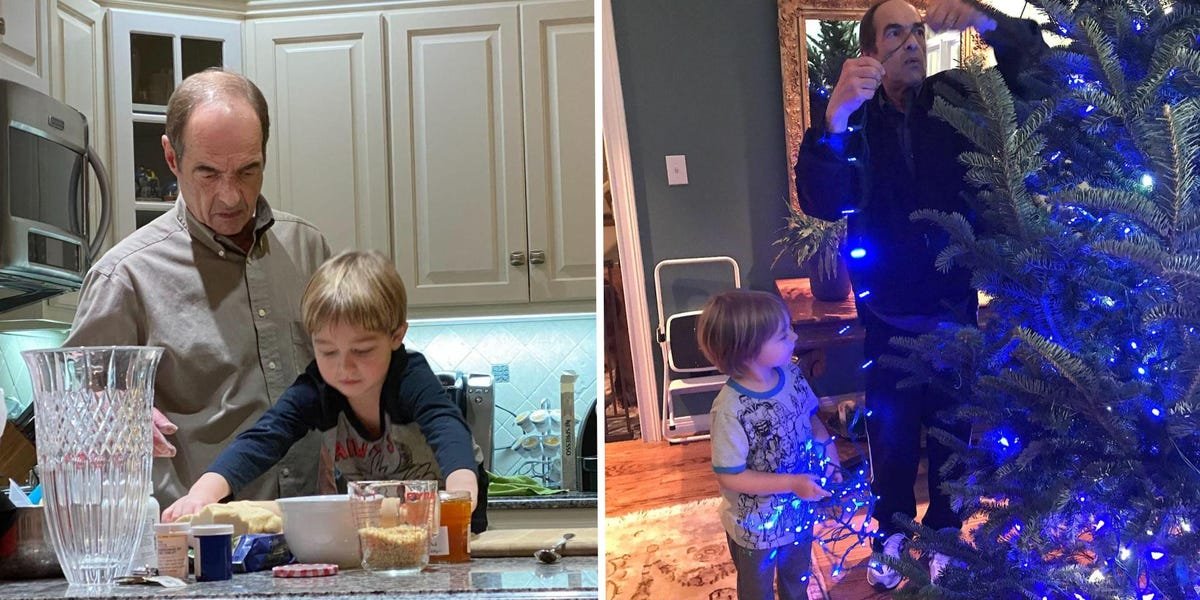
My dad died 3 years ago. I’m learning how to celebrate the holidays without him.

Walking by the holiday decorations, I see the lights. It’s hard to miss them since they’re everywhere — blinking from plastic trees and dangling from the ceiling. It’s undoubtedly a well-lit wonderland, but I don’t stop to look. That is, I can’t stop.

The colored lights are an instant reminder of my dad. Memories of him carefully placing his favorite strings of blue lights on our tree bring a jagged emptiness. It’s been three years since my father died unexpectedly, and the holidays continue to deliver quite the gut punch.

I’m learning what to do with my holiday grief

Holiday grief is something I didn’t anticipate unwrapping every year. When my father passed away from a sudden heart attack, my family fell into a kind of shock. He was in good health and only a few months before, had a routine checkup with no abnormalities. His passing didn’t make sense.

In the weeks after he left us, we did all the things you do, helping my mom as best we could, but we weren’t prepared. Now, I’m a statistic fitting in with the 76% of adults who’ve lost a parent before age 59, and the 36% who don’t want to celebrate the holidays due to feelings of grief. I am 100% certain that I haven’t figured out how to do the holidays without him.

It’s the seemingly insignificant things that sneak up and trigger my grief: My first Christmas without him, I walked past the kitchen counter and, without thinking, looked for my great-grandmother’s cookie cutter. My dad used it to shape Oma’s cookies, and while he was cutting the dough, I’d hear him ask with a grin, “Did I ever tell you the story about when I was in high school, and Oma made me a secret plate of cookies?” Yes, every Christmas.

Then there were the batteries. As my dad tells it, when I was around 8, and my younger sister was 4, “Santa” forgot to buy batteries for our electronic presents. Batteries were definitely not included, and my dad drove to all the gas stations and grocery stores within a 30-mile radius only to find them closed, because, well, it was Christmas morning. “And that’s why I always have extra batteries,” Dad would explain as he slid open the stuffed-full (but well-organized) battery drawer.

These memories of cookies, batteries, and family stories all play on repeat in my head. The emptiness follows suit, and then the sadness takes its place. I can’t untangle my dad’s memories from any of our holiday rituals. So, how do I celebrate without him?

By telling family stories, I’m staying connected to my dad

Last year, my 11-year-old and I were enjoying the stillness by the Christmas tree when it occurred to me to ask: “Did you know Papa’s favorite colored lights were blue?” I told him how I grew up with all blue lights because Papa loved them so much. “And he had a system for stringing them closer to the trunk because Papa said, ‘It made the tree glow.'”

We sat together for a breath staring at the lights, and out of nowhere, my son flung his arms around my neck and gave me a surprise hug. “I like Papa’s stories,” he whispered. And just like that, a new tradition was born. My dad told the stories that meant the most to him, and now I have ones to add — all about my father. Family stories keep us connected, and it’s this ritual that helps me through the holidays. So, I’ll keep going.

“Did you hear the one about the time Oma made a secret plate of cookies for your Papa,” I asked. When my son looked up, the glow of the blue lights reflected in his eyes, and for an instant, I felt like maybe Papa wasn’t as far away as I thought.


Source link

My-dad-died-unexpectedly-It-taught-me-that-I-needed.jpeg

My dad died unexpectedly. It taught me that I needed to plan for my funeral ahead of time.

Sitting across from the funeral director, I held my husband’s hand. I needed to feel something real while my body moved between sadness and shock. I glanced at my mom to steady her and at my husband for support. There was one person noticeably missing from our group: my dad.

The day before, I wouldn’t have guessed I’d be spending my afternoon at a funeral home. I had talked to my dad that night and made plans for our weekly dinner. When I hung up the phone, I had no clue that was the last time I’d speak to him. There was no inner hunch that doom was on the horizon, and nothing that said he wasn’t feeling well. So, the next morning, when the ER doctor told my mom, husband, and me that they tried to revive him and failed — I didn’t know how to process the information. Dying of a heart attack made no sense. I thought we had plenty of time.

Throughout my life, we had relied on him to answer the hard questions, and we desperately needed him now. It had only been three hours since his unexpected passing, and here we were planning his funeral. I had no idea what he wanted.

He was healthy and active

I recall sitting at my parents’ dinner table with my then-9-year-old son. He drank his milk while my dad gestured to the desk behind him. The white stack of papers (the size of a small novel) stood out against the stack of magazines. “Do you want to read my will?” my dad asked with a wink.


Grandfather with grandchild

The author’s dad was healthy and active before he died.

Courtesy of the author


I paused.

Not really what I’d call an uplifting dinnertime read. At 71 years young, he was active and in good shape — a recent retiree ready to travel and spend time with his grandkids. I didn’t want to think about his potential decline — my dad was invincible.

He never caught the colds and stomach flus I brought home from school. He rarely missed work, and I figured I wouldn’t have to deal with this anytime soon. My grandparents lived well into their 80s — my great-grandmother until 100. I did the quick math — that was at least another 10 years or more.

I politely declined the read, telling him there’d be plenty of time to cover that another day. “That’s all right,” he began with a smirk,” I fell asleep when I tried to proofread it.” And that was that. There was no talk of caskets or whether he preferred The Beatles or the Rolling Stones to be played at his funeral.

No reason to discuss his death when he was so full of life. That night, we finished our hamburgers, and his will stayed on the desk, gathering dust, for the next year. And then time ran out.

Not knowing what my father wanted made it hard to grieve

This memory ran through my mind as I tried to answer the questions the funeral director asked. It was hard to concentrate with this huge lump in my stomach. Mostly, I wanted to cry and run away. Even hiding under the covers right now sounded like a good option.

I concentrated on the warmth of my husband’s hand and answered some basic questions, such as where my dad was born and his age. I failed when asked for his Social Security number. My mom tried to take over, but she was so distressed that her answers were slow and hard to access. I wanted to talk to my dad. I wish I had. This would be so much easier.

Looking at my husband, I immediately thought about my son sitting in a similar seat for us. My shoulders tensed. My tears started again, but this time because I imagined an older version of my kid stumbling through unknown answers with no space to feel his feelings. I did not want this overwhelming ordeal for him. If I could make it easier or eliminate this step completely, I would.

My husband and I made plans so my son doesn’t have to

Later that night, when my husband and I had a quiet moment alone, I told him I wanted to write out our death details for our son. He looked surprised and whispered, “We have plenty of time.” I’m sure that was meant to reassure me, but it was exactly what I said to my dad not that long ago. My mom heart would do anything to protect our son’s space to grieve. I wanted cozy childhood memories to comfort him when one of us couldn’t — not images of his mom or dad in a casket.

A few weeks later, as I processed my dad’s passing, my husband and I talked about our own. We created a checklist of what we wanted, including which funeral home and cemetery to contact. My husband and I added doodles and love notes to the list and made sure our will was in order, too. Instead of freaking my 9-year-old with more morbid information, we told trusted family members where to find all the papers. Fingers crossed, it will sit in my desk drawer gathering dust for many more years to come.


Source link