Russian airpower has become far more dangerous and poses a greater threat to the NATO alliance than it did before the invasion of Ukraine in February 2022, air combat experts warn.
Russia’s war in Ukraine has provided its pilots with combat experience and lessons in modern warfare. Russia has also upgraded systems and weaponry and has been producing more aircraft than it has lost, boosting its overall end strength.
Justin Bronk, an airpower expert at the UK’s Royal United Services Institute think tank, asserted in a recent report that Russian airpower “represents a greater threat to Western air power capabilities in Europe than it did prior to the invasion of Ukraine.”
NATO needs to ensure it has upgraded its view of Russia’s air force, retired US Army Maj. Gen. Gordon “Skip” Davis, who served as NATO’s deputy assistant secretary-general for its defense-investment division, told Business Insider. “NATO can’t be complacent with what it thought Russia once was as an air power versus what it is now.”
He said “Russia is more dangerous now to NATO than it was before the war because of lessons learned.”
Bronk said Russia’s performance in Ukraine — including its early failure to achieve air superiority and its significant aircraft losses — has led many NATO policymakers and military observers to downgrade the threat posed by its air force, the VKS.
But that’s a mistake, he said, because, “in many respects, the VKS of 2025 is a significantly more capable potential threat for Western air forces than it was in 2022.”
Russia’s fleet has grown
Russia has lost many aircraft to the ongoing war in Ukraine. Around 130 Russian fixed-wing aircraft have been shot down or badly damaged in the fighting, Bronk said, noting that his estimates are based on interviews with Western air forces and ministries, data from Ukraine’s armed forces, and open-source information.
But he said the impact of those losses isn’t as strong as the figures might suggest.
Ukrinform/NurPhoto via Getty Images
The types of Russian aircraft that have seen the highest losses — planes like the Su-25SM(3) and Su-34(M), at around 40 each — are not of much use to Russia in a conflict with NATO. And new production has resulted in the expansion of Russia’s overall fleet.
Russia has been able to produce more of its Su-35S, Su-34s, and Su-30SM(2) aircraft than have been lost in the war, Bronk said, and deliveries for other aircraft types have also continued.
Russia has largely kept some of its best aircraft out of the fight, as well as some of its better weapons.
Bronk told Business Insider that the point “is not to downplay the attrition that the Russian forces have suffered in Ukraine.” However, he said, “a lot of the areas that the Russian forces have been really worn down aren’t particularly relevant for us in that fight.”
Russia’s pilots have improved
Russia’s aircrew cadre, including its pilots, “has also grown significantly more capable during the war,” Bronk said. While Russia has lost experienced crew members, it has lost far fewer pilots than it has jets. Skilled pilots are harder to replace in any air force.
And any losses in capable crews have been “more than offset” by the additional flying time and combat experience provided by warfighting in Ukraine, Broke added.
For a long time, Russian pilots generally flew far less than their NATO counterparts, but Ukraine has delivered years of valuable combat experience.
Russian Defense Ministry/Anadolu via Getty Images
“In most cases, they have vastly improved both pilot and air crew experience in combat and high-intensity warfare,” Davis said. Bronk noted they’ve also become better at air-to-air engagements against both drones and aircraft.
Russia has more attacking power
Russia has also upgraded its weaponry in ways that would make it more of a threat. In early 2022, Bronk said, Russia “would have struggled to employ effective battlefield firepower on a large scale due to inadequate weapon options, a lack of targeting pods, and poor close air support training. This is no longer the case.”
Tim Robinson, a military aviation specialist at the UK’S Royal Aeronautical Society, told Business Insider that “they’re doing things smarter: better tactics, new weapons.”
Russia’s air force, for instance, is arming its Su-35 jets with longer-range R-37M missiles, which Bronk said “have significantly contributed to increasing the threat that they can theoretically pose to NATO air operations.
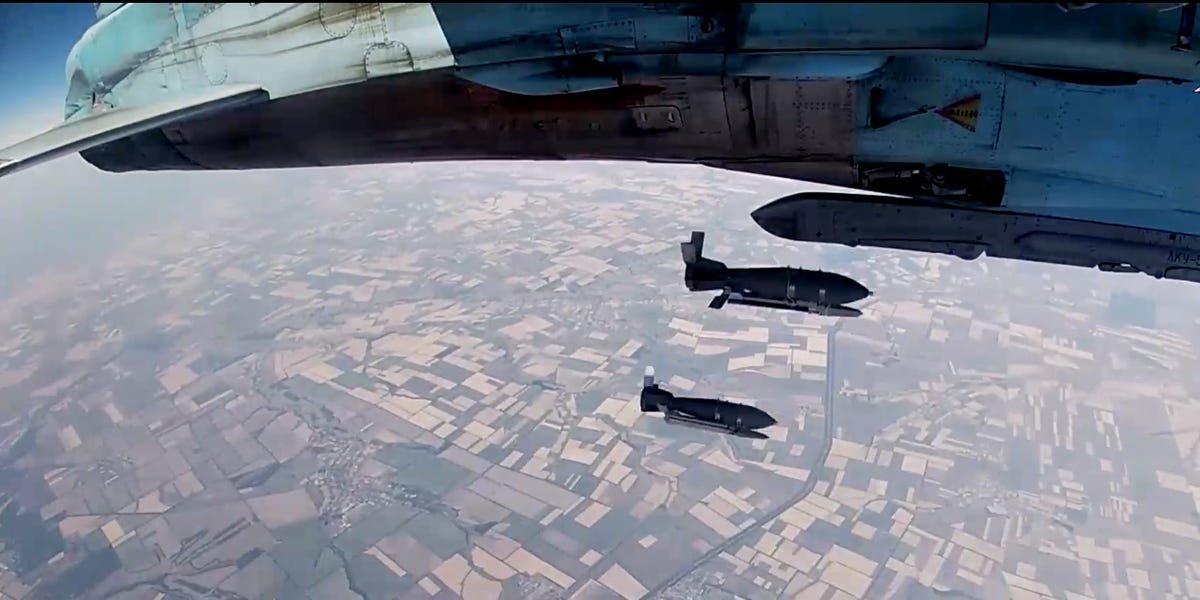
Russia has also developed stand-off airborne strike capabilities, from missiles to glide bombs, that not only complicate air defense but also allow it to strike from positions of relative safety. It’s been a problem in Ukraine.
Robinson said that being able to fire precision weapons without entering Ukrainian airspace is “an example of their tactics and their munitions and technology improving.”
In a potential future war, Bronk said, “NATO forces on the front lines could be intensively bombarded with glide bombs,” without Russian aircraft needing to risk flying beyond the protection of ground-based air defenses.
Russia’s defenses are more formidable
Russia’s already formidable air defense arsenal, on which its airpower partly depends, may also now pose a greater threat to NATO forces than it did before the war.
Ukraine has been able to damage and destroy a vast number of them, but Bronk warned that “several hundred batteries of assorted Russian surface-to-air missile (SAM) systems remain in service, and the primary threat systems are also still all in production in their latest variants.”
Mikhail Galustov/Bloomberg via Getty Images
Russia’s experience has also made it more effective at using its systems to shoot down Ukrainian aircraft and drones, and it has upgraded its systems with new hardware and software.
“Russian SAM systems not only remain numerous but are also likely to perform better against NATO aircraft and munitions in a hypothetical direct conflict than they would have before 2022,” Bronk said.
Russian forces have also shown improvement at coordinating the use of their aircraft and ground-based missile systems, Bronk said. That means a more coordinated threat to NATO aircraft if there were to be a direct conflict.
In a fight, though, as the Pentagon is fond of saying, the enemy gets a vote. While Russia may be more threatening than it was, NATO militaries are heavily armed with combat-proven equipment handled by skilled operators.
Russia doesn’t outmatch NATO, Bronk said, but “they are more of a credible threat.”
He predicted that Russia would still “struggle significantly in a direct air-to-air clash with Western forces. I think they would come off pretty badly.” But the problem is that the fight wouldn’t just be in the air; it would also have the power and effect of ground-based air defenses.
US and Western officials have said that Russia’s fighting style and formidable defenses show that the West may not be able to get control of the air in a future large-scale war, which would make the fight harder and riskier for aircraft and potentially drag Western forces into an attritional slog — Russia’s way of war.
Russia still has many problems, including a rigid command structure that limits flexibility and adaptation and limits on the Western technology it can access to build higher-end systems.
And NATO has learned a lot from the war, from Ukraine, for example, gaining more accurate data about Russia’s surface-to-air missile systems, including their strengths and weaknesses, than it had before 2022, Bronk said. NATO, he added, has the right weaponry to counter them, “albeit not in sufficient numbers in Europe yet.”