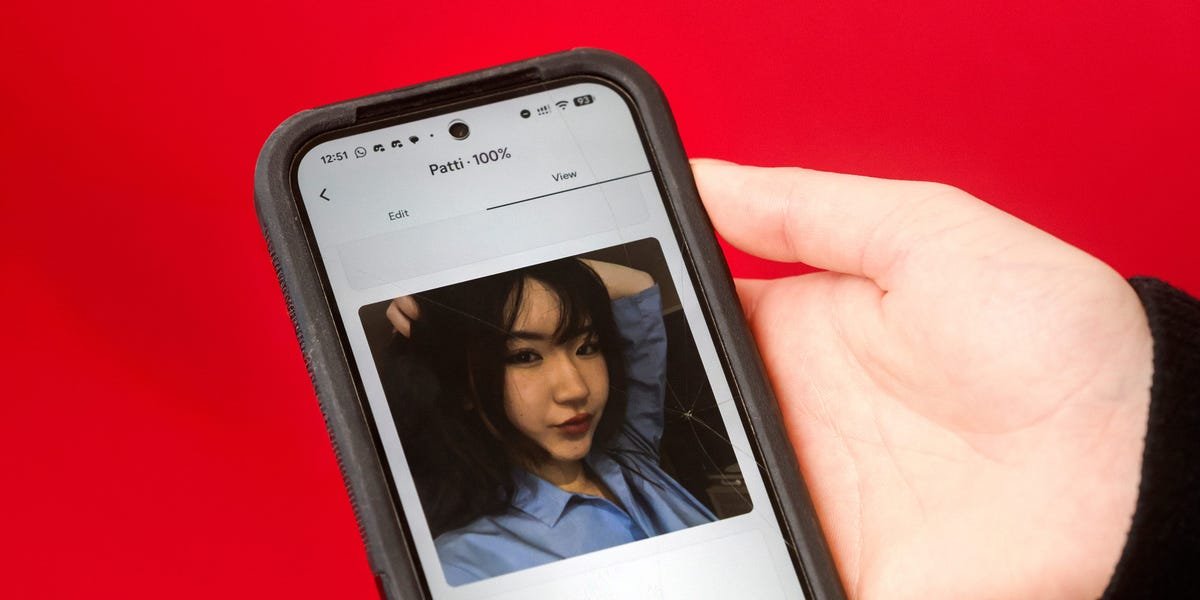
When Patricia Tani moved to San Francisco last year, she kept hearing a koan about the city’s dating scene: “The odds are good, but the goods are odd.”
“There’s all this talk online about how dating is cooked in SF, but I never really believed that, because there’s way more guys than women,” she tells me. “Shouldn’t it be easy to find a boyfriend?”
The answer was no. Tani, who is 21, tried Tinder, Bumble, and Hinge to no avail. San Franciscans were too locked in building the future to build futures with romantic partners; it was a city of situationships. Tani had a specific list of criteria — someone ambitious, someone loyal — but there was no good way to filter for that on the apps. There were plenty of in-person events and parties, but most of those felt like networking.
In early February, she decided to try a new tack. Tani is the cofounder of RentAHuman, a platform that allows AI agents to employ humans for gig work. She put up a “bounty” on her company’s website, offering $200 for someone to go on a Valentine’s Day date with her. She listed her requirements: a “sigma nerd” who would be willing to accompany her to a fancy restaurant, walk around the Embarcadero, and maybe hold hands while watching a sunset. Skills needed: “rizz” and “autizz.”
Jennilee Marigomen for BI
Of the 200 people who applied, about five met Tani’s prerequisites. One man stood out: Jonathan Liu, the 23-year-old creator of a “rizz keyboard” that helps people draft better messages in dating apps. Tani had previously met Liu at a party in San Francisco, where she said she had been too shy to make a move. Liu told me he would have “potentially” asked her out at that party, but didn’t because it looked like she was there with someone else. When he saw Tani’s call for submissions going viral on X, he thought it would be funny to apply.
On Valentine’s Day, Liu and Tani had a five-course meal at Copra, an upscale Indian restaurant in Japantown. Then they went to a club. To Tani, it felt like a reinforcement of something she already knew: Dating apps were broken. If this was the way to find a date, then so be it.
More than a decade after apps like Tinder revolutionized the way people meet, many young people are swiped out. Tinder and Bumble both reported a decline in paying users in the last quarter of 2025, even as the cost of retaining those users has gone up. And those who remain on the apps are, on average, spending less time swiping than they were before. “There’s a real backlash,” says Blaine Anderson, a matchmaker and dating coach. “I’ve certainly been hearing more and more people who are just throwing in the towels on apps altogether.”
In their place, new and unorthodox ideas are emerging. In San Francisco — where everything can be optimized — startups are selling singles on the promise of a swipeless future, where the infinite scroll of dating apps is replaced by artificial intelligence, dates-on-demand, and matchmaking at scale. Not everyone will be so bold as to offer a bounty for their dream date. But in this new frontier, young singles are signaling a shift away from the giant companies that dominated dating in the last decade, and toward concepts that promise better results with less effort. Can a dating culture ruined by technology be saved by more of it?
One theory of what’s wrong with dating apps is that there are just too many people on them. Tinder and Bumble each have more than 50 million monthly active users. Swiping through a catalog of humans, it can be difficult to differentiate. It’s even harder to commit to one choice when there are so many other options, all of which come with scant information. “Now we have a generation of people that has more optionality than anyone has ever had, and instead struggles with infinite indifference,” says Celeste Amadon, the cofounder of Known, a dating app that launched in February.
Don Feria for BI
Known uses a voice-based AI to interview users, similar to a matchmaker, then sets them up with each other using a proprietary algorithm. (Amadon says it is based on the work of several “very famous” love psychologists, who emphasized matching based on values rather than interests.) On the onboarding call, the soothing, female AI voice might ask about your ideal partner, and also what went wrong with your ex. This call lasts a minimum of 10 minutes but Amadon says most people spend significantly longer, offering way more information than a person would normally reveal on a dating app profile: How much do you like to party? Do you need someone who matches your energy, or complements it? Does it matter if your partner is not very successful in their career? Then, the AI looks for someone who fits the bill.
Crucially, Known only delivers one match at a time. “We’re not trying to provide you dozens, let alone hundreds, of matches,” Amadon says. A city like San Francisco — population 800,000 — might contain between five and 10 eligible matches for each person, by her estimate. If the goal of most dating apps is to infinitely expand the pool of people you could date, Known’s goal is to shrink it back to its original size. Amadon says the entire dating market in San Francisco is around 60,000 people; Known had more than 10,000 San Franciscans on its app as of March. It costs nothing to join, but if you want an introduction to the person Known selects for you, the company charges $15. The startup raised nearly $10 million last year.
As Amadon puts it, there is “no better thing than being set up by a friend,” even if that “friend” is AI. Other startups are making similar bets. Fate, an “agentic matchmaking” app that launched last year in London, also interviews users with voice AI and delivers matches without swiping. Ditto, a college-focused dating app, gives users one match every week, chosen for them by an AI matchmaker. Three Day Rule, yet another AI matchmaking app that launched last year, promises “guaranteed matches” and on-demand coaching in exchange for $25 a month. Each of these platforms is built on the idea of scaling the matchmaker model and eliminating the swipe; users feed data into the algorithm in exchange for curated dates. So far, reviews have been mixed. A reviewer for Wired who tried Three Day Rule said that “not a single person I was matched with would be someone I’d swipe right on if I saw them on a traditional dating app,” and that many matches responded to messages using AI prompts.
Don Feria for BI
While algorithms can be surprisingly good at finding two people who match on paper, human matchmakers like Blaine Anderson say that the delicate work of setting people up just can’t be automated. You can use technology to sift through quantifiable features — like height, religion, or interest in having kids — but an algorithm cannot filter for the je ne sais quoi that makes matches successful. Do these people have a similar sense of humor? Will there be banter on the date? What about chemistry? “For this type of matchmaking, at this level of service, there is no shortcut,” Anderson says.
Bring Me Bae features singles offering up rewards from $10,000 to $30,000 to be introduced to their girlfriend or boyfriend.
That type of matchmaking is also very expensive. Anderson’s packages start at $30,000 for a six-month contract; the fee can get as high as $100,000, depending on how hard it may be to set the client up. Last year, Anderson experimented with building her own AI matchmaking platform to bring her work “to the masses.” The idea was to codify her expertise into an algorithm and allow greater access to her services. She tested a prototype on a few thousand users in Austin, Texas, where she lives, and ended up shutting it down after realizing that the algorithm failed to find two people who equally wanted to date each other. “My biggest learning,” she says, “is that who a person wants to match with doesn’t usually want to match with them, too.” It’s one thing to deliver a client the exact profile of the person he’s looking for — and another thing entirely for that person to also want to date the client.
So Anderson pursued another idea. She had noticed a trend of people posting Date Me Docs — often a literal Google Doc that reads like a dating résumé — on social media. Sometimes these came with a finder’s fee. It inspired her to launch a new platform in February called Bring Me Bae, which features singles offering up rewards from $10,000 to $30,000 to be introduced to their girlfriend or boyfriend. The bounty is paid after the couple is in a relationship for a year; Anderson makes each person sign a contract with terms of service and put the money in escrow to make sure they’re good for it. The financial incentive is meant to bring in more applications, as well as signal that the person is “high intent,” not looking for a hookup or a casual fling.
When the platform launched, someone made a TikTok about one of the profiles, advertising that someone could win $10,000 to set him up with a girlfriend. “We got 20 applications, and two of those 20 were really good,” Anderson says. “One of them he went on multiple dates with.”
In other words, technology can play a role in getting more exposure. But overall, Anderson thinks most singles would rather find their partner offline and in the real world. She noted a rise in in-person dating events and a general desire to meet people off-screen. “People are realizing like, I can’t just rely on how I order my groceries or how I download a show,” she says. “I can’t download a girlfriend if I want her to be real.”
On Valentine’s Day, I set out to meet some of these real-life single people daring to meet other real-life single people in real life. Known was hosting a launch party, called “The Night We Met,” at the San Francisco Mint. It promised drinking, dancing, and the potential to fall in love. The party had a formal dress code and a strict 50/50 gender ratio.
I joked to a friend that, at 33, I might be the oldest person in attendance. This, unfortunately, appeared to be true. Waiting in line to get in, I struck up a conversation with the man next to me, who was 23, had just moved to San Francisco, and had no idea that Known was a dating app. “AI matchmaking? That’s a crazy concept,” he said, before disappearing to talk to girls his own age.
Don Feria for BI
I found Amadon inside, wearing a sparkly mini dress and beaming. More than 1,000 people had bought $20 tickets, and they were showing up in droves. It had been important to Amadon that the gender ratio was equal, since the epicenter of the tech industry famously has more young men than women, but the guest list turned out to have a surplus of women. To correct this, Amadon had tried to personally recruit a number of young men. She pulled out her phone and showed me the Tinder profile she had made to advertise tickets to the party. It featured a series of photos of her posed in a T-shirt that read “I’m on Known!”
He’d be interested in an app that matched him with someone based on his ChatGPT history, which he described as “the content of my soul.”
Whatever the marketing tactics had been, they appeared to work. I found plenty of young people roving, looking nervous and excited to be mingling off-screen. The space was divided into various rooms featuring an open bar, a photo booth, and a podium with a microphone and camera, where people could describe their dream date to produce an AI-generated image on a large screen for everyone to see. The place was buzzing with the energy of young people trying to lock eyes with each other. Nearly everyone I spoke to seemed eager to gauge their chemistry in person, rather than on an app. One man told me about a singles event that had recently taken place at a Trader Joe’s, where people were invited to exchange numbers while grocery shopping. A woman told me she hadn’t had any luck on the apps, but recently had a first date with someone she met at a bathhouse. I was struck by how much these people in their early 20s, who had spent formative years of high school and college on Zoom because of the pandemic, wanted liberation from screens. Touch-starved and tech-saturated, they yearned to date in person.
I wasn’t sure what this meant for Known. Another 23-year-old man told me he thought an AI matchmaker seemed “gimmicky,” and he didn’t believe current AI models were sophisticated enough to make intelligent pairings. Other dating apps, like Hinge, also purported to use AI to suggest the “most compatible” profiles for a given user, but those suggestions often made no sense or relied on superficial data. This man said he would be much more interested in an app that used AI to match him with someone based on his ChatGPT conversation history, which he described as “the content of my soul.”
At quarter to 11, just before a DJ called Noodles started playing, I approached a pair of men in their late 20s. Both were wearing wristbands that said “I’m on Known,” but neither had any interest in using the app, or any dating apps for that matter. “There have been a million dating apps. Everyone has fatigue,” one of them said. “I’m now trying out the organic channels.”
I asked if there was anyone at the party he was interested in meeting. “Definitely,” he said. Had he talked to anyone yet? No. He was still working up the courage.
If the first generation of dating apps faltered because they turned the search for a partner into a mobile game, the new guard is betting that the fix isn’t less technology, but more “agentic” technology — the kind that engineers away some of the inefficient parts of dating. In this world, single people no longer want to choose. They want to be told whom to choose, with confidence that the choice is correct.
Jennilee Marigomen for BI
Yet the most agentic technology does not create high-agency people: the kind who might approach a stranger at a party, or who might get by without the assistance of a “rizz keyboard.” A decade after the rise of dating apps and social media, a generation of single people is ill-equipped to talk to each other in the real world, find rejection unbearable, and would rather move on to the next thing than stay and work through conflict or miscommunication. It is possible that we are seeking a technological cure for the chronic loneliness that technology itself helped architect.
For all the talk of optimizing matches, it’s what happens after the match that remains the most difficult to solve. You can develop the most sophisticated algorithm in the world, or put a $10,000 bounty on finding a match, but you can never guarantee that two people will see the same future in each other’s eyes, or even the same evening.
After spending Valentine’s Day with Liu, Tani was hoping for a second date. “I thought he was really funny, really thoughtful, and kind,” she says. “I was scared that I wasn’t going to be able to find someone, or that it would be awkward, but it actually kind of went perfectly.”
Liu, on the other hand, tells me that while the date had been fun, it had felt “more like a networking thing.” When they went to the club after dinner, Liu says he and Tani had not danced together, and she seemed like she was trying to find someone else. Plus, he was moving to New York City soon. He hoped the dating scene would be better there.
Arielle Pardes is a reporter in San Francisco covering the business and culture of technology.
Business Insider’s Discourse stories provide perspectives on the day’s most pressing issues, informed by analysis, reporting, and expertise.