My-kids-dont-remember-living-in-New-York-so-I.jpeg

My kids don’t remember living in New York, so I retraced their earliest days with them

My kids were born in New York City, but don’t remember much about living there. Our family moved a decade ago, in the spring of 2016, from Manhattan’s Upper East Side to Houston when my daughter was a toddler and my son was starting pre-K. It feels like forever ago now.

The city held my first memories of motherhood and so much more. My time as a college student, aspiring model and writer, and held my Italian heritage from over 100 years ago. It has been very tough to adjust to being so far away from my roots while raising my kids.

As the 10-year mark approached, I was anxious to return. I had limited funds available for a trip like this, so I called my mom. I talked with her on the phone about this deep longing I carried, and she offered me a gift that would help me to afford the trip. With her generosity, some flight credits, and some savings, I felt grateful I could finally pull this trip off. I was going back home.


The writer's children eating ice cream on the streets of NYC before they moved to TX.

The author said she reminisced with her children about the last time they had ice cream on the streets of NYC when they were much younger. 

Courtesy of Isobella Jade.


New York felt like home

When we stood in the cab line outside of LaGuardia Airport, I immediately felt at peace. I still knew the city streets and subway routes by heart. I told the cab driver the location of our hotel, 23rd between 6th and 7th (avenue), with ease — as a true New Yorker would. My soul felt at home.

After dropping our bags at our hotel, our first stop was Madison Square Park, where I would often stroll with my son when he was a toddler. We would get Shake Shack, eat fries, and lie on a blanket in the grass while I admired the Flatiron building. So, of course, we had to get Shake Shack and stare at the buildings, just like before. Standing there with the Empire State Building in view, too, it felt full circle to be in the place that had always been there in my mind while raising my kids in Texas.

“I want to live here so bad,” my daughter said when we started walking uptown. Me too, I told her, although I knew the cost of living was enormous and unattainable. At least we had the next few days to immerse ourselves in the city I (and now my kids) love so much.

We mixed touristy and sentimental stops

Before the trip, I asked the kids what they wanted to see most. Of course, they both answered Times Square. My son wanted a steak and to visit Louis Vuitton on Fifth Avenue; my daughter wanted to visit a viral bakery and see “Hamilton.” Both of them wanted to shop.


The author's son enjoys a steak dinner in NYC.

The author said her son was looking forward to enjoying a dinner at a nice steakhouse in New York City. 

Courtesy of Isobella Jade.


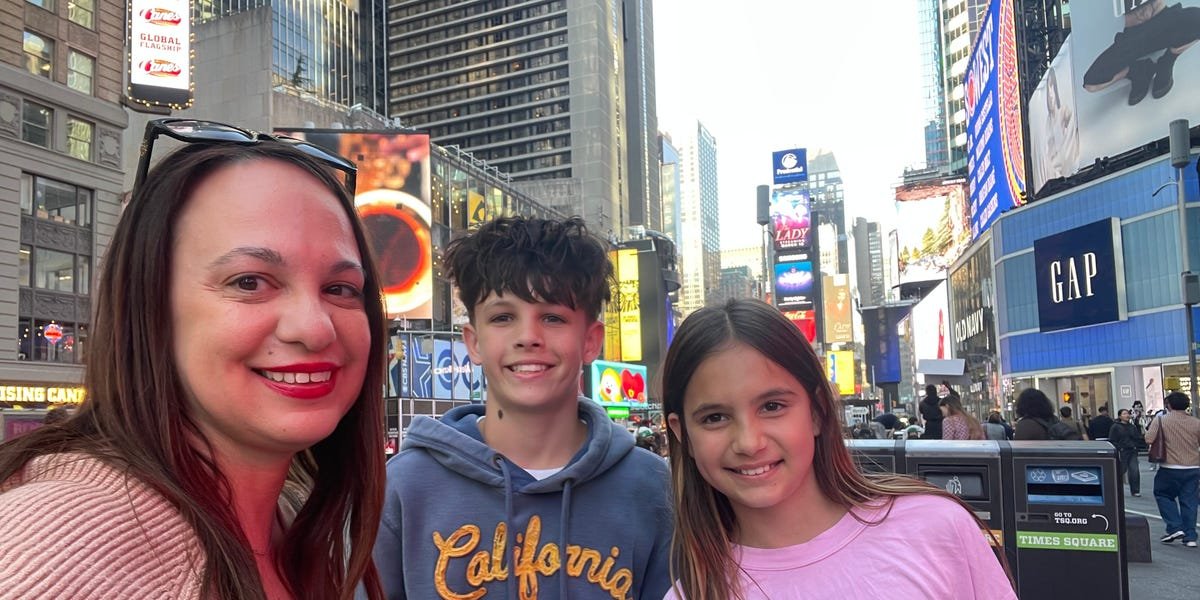
When we made it to Times Square, the lights were less annoying to see than when I was a resident. We did laps and took too many selfies, but it felt different to see this space through my children’s eyes. The blazing lights and crowds suddenly represented opportunity, possibility, and dreams. I wanted my kids to soak it up.

Atop The Summit, an observatory that’s situated 93-stories high, it was incredible to see my kids’ smiling faces against the skyline. I pointed north. We lived over there in the Upper East Side. Your great-grandfather lived there too when he was a kid, I told them. Across the East River is Queens, where your grandma lived, I told them, it’s where your grandparents met and fell in love. A part of your family history is right here, so close, I explained to them.

After that, we had ice cream from a street vendor, just like we had years ago when they tasted their very first ice cream from a Mister Softee truck.

The stories flowed out of me

The next day, we visited the building we lived in before moving to Texas on 1st Avenue between 80th and 81st streets. When we looked up at our previous home from the sidewalk, I ached to be a young city mom again. I wanted to rewind time so that I could be dashing with my kids to parks and museums, popping into cafes, and playspaces.


The author's chilcren look up to the apartment they once lived in.

The author’s children are shown looking up to the apartment they lived in before their family relocated to Texas. 

Courtesy of Isobella Jade.


My daughter’s eyes rose as she counted 26 flights up to our previous home. Standing there, I told them stories about their young lives as city kids, buckling them in the stroller and gliding us past Lexington, Park Avenue, and Madison, and on to 5th Avenue and then wheeling into Central Park to lay a blanket and watch them play near our favorite trees, like the park was their own backyard. This neighborhood had given my kids the best start, and I’m grateful for the memories we have of our time there.

As we left the 10 block radius that had held the first years of their lives, I hoped they would remember the view, the sidewalk under their feet, the sound of the construction and cabs, the cafés, brownstones, the trees that lined the streets, and my voice telling them how wonderful it was to be back to the place where they were born.

We’ll remember this trip

During our time in the city, I tried not to think about moving away, and the difficult years we’ve overcome as a family since then. I only focused on the three of us standing together in the city where their lives took root.

We walked miles and miles, and I hoped silently to myself that the sights, sounds, smells, food, architecture, shops, and beauty of the city was leaving a strong impression on my kids.

There’s always a place for you here, I told them when it was time to leave. I wanted them to know the world is big and that Texas isn’t all there is. They were born in a place where anything was possible, although I know it’s up to them to decide how they want to spend their future and create their memories. No matter where they end up, New York will always be a part of them.




Source link

My-husband-asked-for-a-divorce-A-few-days-later.jpeg

My husband asked for a divorce. A few days later, we went on vacation together.

Last June, my husband came back from a long surfing trip and asked me for a divorce. I was stunned. Confused. Heartbroken.

By then, we’d been married for nearly seven years — June 15th would’ve been our seventh wedding anniversary. To celebrate it, I had organized a short getaway.

We’d stay in a five-star hotel in Cascais, a gorgeous seaside just outside of Lisbon. Our schedule was packed with fun stuff like a helicopter tour, high-end massages, and lunch at a Michelin-starred restaurant by the beach.

Everything was locked in, and it felt far too late to cancel. So, a few days after the bombshell request, we went.

Our ‘perfect’ getaway felt confusing, tense, and awkward


View of chairs around body of water in front of hotel

We stayed in a beautiful hotel right along the beach.

Alix Campbell


As we embarked on the three-and-a-half-hour drive to our hotel, I brought up all the exciting activities awaiting us whenever the silence became uncomfortable.

I had pictured our anniversary getaway completely differently. I thought we’d be in a happy cloud of not having seen each other for weeks, ready for a little romantic adventure.

Instead, we were stuck in this weird place. I didn’t fully understand what was going on between us, and he wasn’t fully able to communicate his feelings. Although he seemed to have made up his mind about splitting, I still believed we could work things out.

For most of our four-day trip, I tried to pretend that everything was fine, but, of course, I felt it wasn’t.

The usual silly banter between us felt forced. When we sat in a restaurant after a full day of activities, we giddily chatted about the fancy dishes being served to us, but when we walked back to our hotel post-meal, we were mostly silent.

To put a cherry on top of this awkwardness, the hotel surprised us with a bottle of Champagne and chocolate-covered strawberries on the date of our anniversary. I didn’t know whether to laugh or cry as a staff member wheeled these goodies into our room.

The connection between us still felt undeniable — there were still the inside jokes we’d curated over the years, that familiarity, and a feeling of safety that I’d taken for granted over the years.

We both seemed to cycle through a bunch of emotions, ping-ponging between feeling like strangers wildly attracted to each other (especially after a few cocktails) and a couple grappling with the fact that their relationship was broken.

By the time we got home, it was clear that we’d take some time apart. He moved out and stayed with friends, while I remained in our home looking after our cats.

Looking back, I don’t regret going on the trip


Table set for dinner with view of beach behind it

Our Michelin-starred dinner was delicious, even if it was a bit awkward.

Alix Campbell


A few months after our vacation, we finally sat down together and really talked.

Having had more time to let everything settle, I reflected on our vacation during this turbulent time. I realized it was OK for me to feel confused in the middle of a breakup.

I could acknowledge that although we laughed and had romantic moments, I felt disillusioned. I felt nostalgic, but I also noticed a rift between us that made me incredibly sad.

He’d lost himself along the way as our relationship progressed, and whenever I noticed him withdrawing I wouldn’t dig too deep because I was afraid he’d tell me something I didn’t want to hear.

The pressure built up, and this lack of communication led to the very issues we were trying to avoid: Me, being left, and him, having to deal with all of these emotions instead of running from them.

Going on this trip was weird and uncomfortable; a desperate attempt to “fix” us. It didn’t. Instead, it provided the confined space away from home we needed to be confronted with issues we most likely would’ve kept avoiding.

In Cascais, I didn’t know where our relationship would end up. Now, we’re working on finalizing our divorce, and believe it or not, we’re on good terms.

I’m glad we went on the trip.


Source link

I-worked-14-hour-days-at-a-startup-A-cancer-diagnosis.jpeg

I worked 14-hour days at a startup. A cancer diagnosis changed how I succeeded at Netflix and Meta.

This is an as-told-to essay based on a conversation with David Ronca, a retired video systems engineer. He spent 12 years at Netflix and six years at Meta. This story has been edited for length and clarity.

My time at a startup in the early years of my engineering career was like a really bad relationship.

I joined a company that specialized in video playback around 2000. I loved working on video. I consider those seven years like going to school, and I came out with a Ph.D. in practical video systems. But it was the hardest seven years I’ve ever had in terms of work demands.

I was told when I joined that it would be really important that you’re seen around here a lot. So I would work until 7, 8, 9 — sometimes until 10 p.m. Then we started hitting delivery schedules, and I was getting to work around 10 in the morning and going home sometimes at 2:30 in the morning. We’re talking 14-hours days, six to seven days a week. Eighty hours a week would’ve been a break.

We didn’t have good direction. We’d be four or five months into solving a hard problem before leadership would stop us and say, “Go work on this instead.” It was madness.

We were using work hours to compensate for really bad decisions.

In January 2004, I started feeling ill. On a Sunday, I didn’t feel so good, and by midweek, I got worse.

On Friday night, January 17, my wife took me to the emergency room. The doctor told me, “This is likely colon cancer.” After the first surgery, he said, “There’s no way you have a tumor like this and it’s not cancer.”

Two weeks earlier, I had been running and feeling great. Within a week, I was in a hospital bed on machines.

It took another week before doctors could do the full surgery. And you spend that time with no idea what they’re going to find. That was a very dark week.

My mother died of breast cancer when she was 48. I was 16. Now, I’m in the hospital at 44. I remember thinking, “History doesn’t repeat, but it rhymes.”

My wife would bring the three kids. My oldest, who was seven, would sit quietly in the room with me. My youngest was two years old. He didn’t really know me.

I was looking at my young son, thinking he’s going to grow up without a dad.

After surgery, they told me it was stage 3 colon cancer. They removed 60% of my colon. There was lymph node metastasis. My five-year survival prognosis was about 25%.

‘I will not work like this’

I went back to work part-time at first.

I was told that I had used up all my sick leave and vacation and was put on California disability, which is around $200 a week.

By that time, this was a company I had spent four years working 24/7 for.

I told my boss, “I’m sorry, I will not do this. I still want to work here, but if I have to leave, I will quit. Because I will not work like this.”

From that point on, I didn’t. And that was the irony of it all.

I feel like I did some of my best engineering after that. The real change was that I was no longer wasting my brainpower and my thinking on junk.

You don’t do good work after 12 hours. You can’t work sustained all-nighters and be productive. The quality of your work is going to suck. I don’t care who you are. For most mere mortals, you try to work those hours, you’re just not going to be doing good work.

I also started making intentional decisions for life, not just work.

I coached soccer for all three of my kids. I went to their games. My daughter did ballet, and we were there all the time. We started planning and taking family vacations — hiking in the mountains, RV road trips, and Maui.

I realized you have to work to have a life, but you have to have a life to work. So you want to stand in the middle of those things.

Hours worked are not a performance metric

In 2007, after several clean scans, I joined Netflix. I delayed accepting the offer until I got my scan report. I didn’t want to change jobs yet because if you have positive liver metastasis, you’d be lucky to get two years.

In my interview, Patty McCord, the chief talent officer at the time, told me, “We don’t value 24/7 work. You won’t be successful here working all the time.”

That was almost foreign to me. But it also didn’t mean we didn’t work hard.

At Netflix, I was part of the early streaming team — maybe 12 to 16 people. We made aggressive schedules, and we didn’t miss them. We launched a Netflix app on the original iPad on Day One within two months.

The culture at the company was: If you have to work 24/7 for us to be successful, you’ve got a problem, and we’ve got a problem, and we’re going to fix it.

Even at Meta, my favorite poster had a silhouette of a rocking horse that said, “Don’t mistake motion for progress.”

In other words, high performance is not measured by how much work you do. It’s measured by how impactful your results are.

This is not to say that it’s wrong to work more than eight hours. Instead, you should understand why you’re working more hours. It should be intentional. Intentional exceptions.

If I were to tell my younger self anything, it would be to make work-life balance part of your DNA. Learn to take time off.

Don’t wait until you have cancer or some other near-death experience to realize this.


Source link

I-spent-50-days-on-the-same-Celebrity-cruise-ship.jpeg

I spent 50 days on the same Celebrity cruise ship in 5 different rooms. Here’s how they compare, and which is the best value.

  • I sailed on Celebrity Constellation in interior, ocean-view, veranda, and concierge-class cabins.
  • Some lower-tier rooms felt similar to me, mostly just differing in configuration and floorspace.
  • Concierge class was great, but if I were paying full price I’d go for a standard veranda room.

Last fall, my husband and I sailed on the Celebrity Constellation for 51 nights in a row on six back-to-back cruises.

We did so using offers for discounted sailings that we received while playing in the onboard casino on a Celebrity cruise we’d taken earlier that year.

Our almost two-month journey began in Rome and ended in Tampa, and we spent each sailing in a different cabin trying the various room classes Celebrity offers.

Ultimately, we were able to sail in interior, ocean-view (standard and deluxe), and concierge-class cabins. Here’s how they compared, and which I’d book next time if I were paying full price.

We started in a cozy interior cabin without windows.

Though it would’ve been nice to see the seas from our room, the lack of morning sunshine streaming in can be a blessing after a late night.

Tammy Barr

On every cruise ship, interior staterooms tend to be cheaper and smaller than the other cabin types.

Prices vary widely depending on demand, itinerary, and dates, but I’ve generally seen these rooms listed on the Constellation for about $550 to $700 per person.

It was a well-appointed and basic room of 171 square feet that included a small desk area, refrigerator, television, closet, bed, and bathroom.

The king-sized bed was comfortable and the bathroom felt spacious. I especially liked the generous counter space and large rectangular shower.

After a late night, our interior room’s the lack of morning sunshine was a blessing. It was always easy to sleep in without windows, but I did miss seeing the stellar sunsets at sea from my bed.

I spent two voyages in ocean-view staterooms.


Bed under window in ocean-view stateroom on Celebrity Constellation

I liked that the ocean-view rooms tended to be lower on the ship.

Tammy Barr

In my experience, upgrading from interior to ocean-view can add around $50 to $100 per person to the cost of the cruise.

This room was the same size as the interior one and elements of the space, from the bed to the nightstands, looked nearly identical.

However, the various ocean-view rooms can have different layouts. In one, the window was above the head of the bed, and in the other, we were able to use our window well as a bench or storage area.

These were appointed similarly to the inside cabin, but are located on the outside part of the lower decks, featuring windows of various sizes.

Lower floors tend to experience less movement, so these sailings felt especially quiet and smooth — this is one perk interior and ocean-view rooms tend to have over ones with balconies.

The deluxe ocean-view room offered more space and a larger window.


Large window in deluxe ocean view cabin next to bed on Celebrity Constellation

Our deluxe ocean-view cabin had a fairly large window.

Tammy Barr

A cut above the regular ocean-view cabins, the deluxe room size took us from 171 to 242 square feet.

In comparison, this room felt massive, and the (slightly bigger) window provided outstanding views of the sea. The bathroom was similar-sized to the other classes, and the bed and vanity appeared to be the same.

It was nice to have space for in-room yoga and additional chairs that I used to host friends in the room.

These typically cost about $100 per person more than standard ocean-view cabins. Though it was a pleasant week, I am not convinced the larger room and window are worth the extra cost.

The veranda room featured an outdoor balcony.


Sunset view off of balcony cabin on on Celebrity Constellation

I loved watching the sunset from our balcony.

Tammy Barr

On one voyage we stayed in a standard veranda room, which is also commonly referred to as a balcony cabin. It was slightly longer than the previous staterooms, but at 175 square feet, it was not as large as the deluxe ocean-view.

The setups were quite similar, though I liked that the outdoor balcony added another 40 square feet for relaxing.

The best part of a balcony room is the access to fresh, salty air. I loved leaving the door open to hear the waves lap against the side of the ship.

Again, prices can vary, but I’ve seen balcony rooms on this ship cost about $300 more per person than a typical ocean-view cabin.

The cabin we most enjoyed was the concierge class.


Concierge class room with full-sized couch for entertaining on Celebrity Constellation

The concierge-class room came with a full-sized couch for entertaining.

Tammy Barr

The room itself is a balcony cabin, but is slightly larger than the basic veranda level at 191 square feet plus a 42-square-foot balcony.

Some of that extra space was used for additional shelving, and an even longer couch that could fold out to a queen-size bed.

Most notably, though, this class comes with access to a dedicated concierge to assist us with anything we need around the ship, such as booking excursions.

Our bathroom looked the same as it did in the other rooms.


Bathroom in Concierge Class room on Celebrity Constellation

The bathroom in our concierge-class room wasn’t anything special.

Tammy Barr

The bathroom and closet we had in concierge class resembled the ones in the other rooms. All of them were simple and functional with a good amount of counter space and a decent-sized shower.

However, our bathrobes in here seemed to feel more plush than the ones in the regular cabins — but maybe we just imagined it.

Concierge class comes with many perks.


View of balcony and desk area Concierge Class cabin on Celebrity Constellation

Our concierge-class cabin felt quite spacious.

Tammy Barr

This room class comes with an abundance of perks like complimentary binoculars to use and a bottle of sparkling wine, plus a menu of pillow options to choose from for the bed.

Throughout our week sailing in concierge class, we were able to attend exclusive events, like a lecture on our upcoming ports and a party on the ship’s helipad, where we enjoyed complimentary drinks with the officers as we sailed out of port.

As much as I enjoyed the in-room benefits of concierge class (especially the plush pillows), I do think these exclusive events would get old on a repeat cruise.

This luxe-feeling class can get pricey — and it’s not even Celebrity’s top offering.


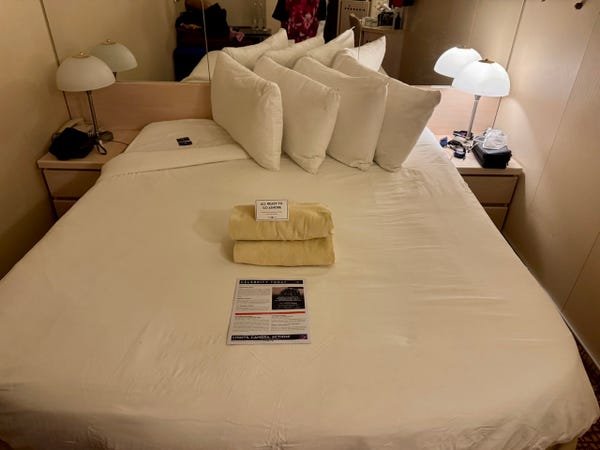
Bed in concierge class room on Celebrity Constellation

We stayed in a concierge-class room on the Celebrity Constellation.

Tammy Barr

Oftentimes, concierge class costs nearly twice as much as an interior cabin. I’ve seen rooms on this ship for about $928 a week per person to over $1,000.

Although the service we received felt like what we’d find at a fine hotel, this isn’t even the top class that Celebrity offers.

Next up is AquaClass, which offers similar balcony rooms, but with additional spa-related perks and better locations on the ship (like aft-facing balconies). I’ve seen these for a few hundred more than concierge.

Then, Celebrity has its highest-end suites in The Retreat, a ship-within-a-ship concept with a private restaurant, lounge, and team of dedicated employees. These can be double the price of a concierge room.

Ultimately, the sweet spot for me is the veranda room.


Woman's legs crossed in front of balcony on cruise ship at unset

If I’m factoring in cost and value, my top pick would be the standard veranda room.

Tammy Barr

Celebrity offers cabins for all budgets and I relished the opportunity to try several of them.

It’s no surprise that concierge class — the most expensive offering with the most luxurious perks — was my favorite. However, if I were paying full price for a sailing I’d book a standard veranda room.

In my opinion, it feels like a great value at a more reasonable cost, and paying a few hundred dollars to upgrade from ocean-view or interior room seems worth it.

And, at the end of the day, when the ship is sailing out of port, I just want to be able to watch from my private balcony — not looking through a window or crowding on a shared deck.


Source link

Hims-Hers-removes-a-knock-off-weight-loss-drug-days.jpeg

Hims & Hers removes a knock-off weight loss drug days after introducing it

Hims & Hers unveiled a once-a-day weight-loss pill this week, calling it an alternative for needle-averse customers and those looking for smaller doses.

It was essentially a cheaper copy of the Wegovy pill that the pharmaceutical company, Novo Nordisk, released earlier this year.

About 48 hours later, the telehealth company said it would stop selling it.

“Since launching the compounded semaglutide pill on our platform, we’ve had constructive conversations with stakeholders across the industry,” Hims & Hers said in a statement shared with Business Insider on Sunday. “As a result, we have decided to stop offering access to this treatment.

When Hims & Hers first made the compounded semaglutide pill available to customers on Thursday, the company said it met “rigorous clinical standards.”

“We adhere to all federal and state standards for compounding, and all active pharmaceutical ingredients (APIs) in compounded treatments are sourced exclusively from FDA-registered facilities,” the company said.

Compounding a new version of existing drugs typically occurs when those drugs are facing a shortage, which has periodically been the case in recent years for some of the most popular weight-loss and diabetes drugs on the market.

However, the Food and Drug Administration called out Hims & Hers in a statement issued the following day.

The agency said it intends to restrict certain ingredients used in non-FDA-approved compounded drugs that are “mass-marketed by companies — including Hims & Hers and other compounding pharmacies — as similar alternatives to FDA-approved drugs.”

“Entities engaged in the manufacture, distribution, or marketing of unapproved compounded GLP-1 products should be aware that failure to adequately address any violations may result in legal action without further notice, including, without limitation, seizure and injunction,” the agency said.

Although weight-loss medications aren’t new, Novo Nordisk breathed new life into the industry with its product, Ozempic, around 2022. The company marketed Ozempic as an injectable type 2 diabetes medication, but doctors began prescribing it to patients to address obesity. As a result of rising demands, Novo Nordisk developed Wegovy, a drug specifically geared toward managing weight.

Both those drugs were administered only by injection until Wegovy launched its oral version in January.

Many health-focused companies have developed off-brand versions of the medications to cash in on soaring demand.


Source link

Washington-Post-publisher-Will-Lewis-is-out-days-after-sweeping.jpeg

Washington Post publisher Will Lewis is out days after sweeping layoffs

  • The Washington Post’s chief executive, Will Lewis, announced his departure on Saturday.
  • Jeff D’Onofrio will serve as the interim CEO and publisher, effective February 7.
  • Lewis’ departure comes days after sweeping layoffs at the legacy publication.

Will Lewis is out as chief executive at the Washington Post, days after sweeping layoffs hit the legacy publication and following a rocky two-year tenure that saw the Post struggle to stabilize its business.

The newspaper said Saturday that Jeff D’Onofrio, CFO, would serve as the interim CEO and publisher, effective immediately.

Lewis’s departure comes after hundreds of Washington Post journalists were laid off across the company this week, in what executive editor Matt Murray described in a memo as part of a strategic reset. The cuts were felt across the newsroom, including the sports section, international, books, DC metro, and audio.

As news of the layoffs spread, Lewis came under widespread public criticism, both for the financial challenges at the Post and for not participating in the dissemination of the news. After Murray made the staff-cut announcements himself, Lewis was seen attending Super Bowl festivities.

In a note Saturday, Lewis said “now is the right time for me to step aside” and thanked Jeff Bezos, the paper’s owner.

D’Onofrio, who joined the Post in June 2025, said in an email to staffers on Saturday: “This is a challenging time across all media organizations, and The Post is unfortunately no exception.”

This is a developing story. Please check back for updates.


Source link

The-Senate-just-voted-to-fund-the-government-—-but.jpeg

The Senate just voted to fund the government — but it’ll still partially shut down for a few days anyway

The US federal government is shutting down again, but it won’t be like last time.

Funding for a slew of federal agencies runs out at midnight late on Friday, and lawmakers on Capitol Hill failed to send a series of bills to fund those agencies to President Donald Trump’s desk in time.

Even though the Senate passed a series of bills to fund the government on Friday, the House is not set to vote on them until late Monday at the earliest, meaning the shutdown will last at least a few days.

Some parts of the federal government have already been funded, meaning that the shutdown, even if it drags out, is only partial.

Additionally, it’s unlikely that this shutdown will last as long as the one that began in October, which stretched for 43 days and became the longest government shutdown in American history.

Here’s what could be affected — and what won’t be

In October, funding for the entire federal government was being held up, and the shutdown was far-reaching. This time, some parts of the federal government would remain operational.

That’s because Congress has already passed a series of spending bills that fund agencies and programs through September 30.

Among those programs are SNAP and WIC, which were notably affected by the previous shutdown. Additionally, national parks would likely remain open, veterans would continue to receive benefits through the Department of Veterans Affairs, and staff on Capitol Hill would continue to be paid.

But plenty of other government agencies and programs would be affected if the shutdown drags out, including the Department of Defense (including troops), the State Department, the Treasury Department, the Transportation Security Administration, and the Federal Emergency Management Agency.

Notably, Immigration and Customs Enforcement (ICE) and Customs and Border Protection would remain operational, even though it’s funded via the Department of Homeland Security.

That’s because DHS received $190 billion in funding via the “One Big Beautiful Bill Act” in July, including $75 billion for ICE and roughly $65 billion for CBP.

It’s unlikely to last as long as before

Unlike in the fall, lawmakers in both parties are working together to try to resolve the situation as quickly as possible.

The odds of a shutdown first rose following the fatal shooting of Alex Pretti by Border Patrol agents in Minneapolis on Saturday.

Democrats vowed to oppose a bill to fund the Department of Homeland Security, which oversees ICE and CBP, until reforms to immigration enforcement are made.

The House had already passed a package of six funding bills, including the DHS bill, and they had been stitched together into one package in the Senate.

The Senate has now passed a reformulated version of that package, with DHS funding continuing for only two weeks to allow for a renegotiation.

It’s unclear as of now whether that package will pass the House when lawmakers return to the lower chamber next week.


Source link