

Headshot photo of Laura Italiano

Alexander brothers found guilty on all counts. Wealthy siblings face potential life terms for a decade of rapes.

A trio of wealthy brothers was found guilty of federal sex-trafficking charges in Manhattan on Monday in a grand-slam verdict convicting them of each count they faced in a 10-count indictment.

The jury deliberated for three days before announcing a verdict for former luxury real estate brokers Tal Alexander, 39, and Oren Alexander, 38, as well as for Oren’s twin, Alon Alexander, a former executive in his parents’ private security firm.

The three brothers sat at the defense tables, shaking their heads as the verdict was read. Sentencing was set for August 6 for each defendant.

Any sex trafficking conviction, including for the top count of sex-trafficking conspiracy, carries a potential maximum sentence of life in prison.

The verdict follows a five-week trial in which prosecutors called 10 rape accusers to testify, none of whom had reported their incidents to police.

The women gave compelling, sometimes tearful testimony about attacks in luxe locations in Manhattan, the Hamptons, Aspen, and Tel Aviv stretching back to 2008, when the brothers were in their early 20s.

They said the brothers used false promises of “afterparties” or fun weekend getaways to lure them into the worst experiences of their lives — being sexually violated through violence or a drugged drink.

Two women told jurors that they were drugged and then attacked by two of the brothers at the same time.

One said the twins took turns raping her inside a cruise ship cabin in 2012. The other said she was attacked by Tal and Alon Alexander and two other men in the bedroom of a Southampton vacation home in 2009, when she was 16 years old.

“I was wondering why they hated me,” the woman recalled thinking as she fell in and out of consciousness on a bed.

All ten women told jurors that in the hours and days after they were attacked, shame and fear kept them from telling anyone but their closest friends.

Only when they saw that the brothers were being sued and arrested — over allegations like their own — did they find the courage to step forward, the women testified.

“Because this feels bigger than me,” one accuser explained of coming forward now, fourteen years after she said she was drugged and raped at age 20 after a party at the Manhattan penthouse of actor Zac Efron.

“I’m 34 years old now, and I know who I am,” another accuser explained of coming forward. “And I wanted someone to be held accountable for what happened to me.”

Defense lawyers maintained that any sex was consensual and that the accusations were the product of regret and faulty memories.

They pointed to inconsistencies about timing and the women’s failure to take drug tests or report the incidents to law enforcement, and noted that many of the women communicated with the brothers

The defense also challenged whether the accounts the women described added up to sex trafficking, the charge behind half the counts in the ten-count indictment.

To convict on sex trafficking, jurors needed to find that the brothers used force, fraud, or coercion — including by secretly drugging drinks — to cause a commercial sex act, defined as sex in return for something of value.

Prosecutors said that the “something of value” was the brothers’ promise of a beach weekend at a Hamptons mansion, or an invite to go from a club to a hotel room for a fun “after-party.”

Defense lawyers countered that what was described in testimony was not sex trafficking because, in their view, there was no quid-pro-quo relationship proven between the lure — the “something of value” — and the alleged sex.

“The commerce — the thing of value — must be a result of the sex,” argued Marc Agnifilo, defense attorney for Oren Alexander.

In July, Agnifilo won a partial acquittal in another high-profile Manhattan sex trafficking case, that of entertainment and lifestyle entrepreneur Sean “Diddy” Combs.

In that trial, Agnifilo similarly argued that the federal sex-trafficking statute was being stretched beyond its original purpose of protecting sex workers.

Combs was also acquitted of racketeering; he was convicted of transporting for purposes of prostitution and is serving a four-year prison term.



Source link

We-moved-to-Japan-after-nearly-a-decade-of-careful.jpeg

We moved to Japan after nearly a decade of careful planning. Living here is still nothing like we expected.

After a two-week trip in 2015, my husband and I came home completely hooked on Japan.

Reliability was the baseline; trains ran with a clockwork precision that transformed the daily commute into an exercise in discovery. We fell for the profound sense of safety that allowed small children to navigate the streets alone, the atmosphere of the neighborhood shrines, and the level of public order that made everything back home feel chaotic by comparison.

What began as a simple holiday evolved into a total life reset that would take over the next eight years of our lives. We decided Japan wasn’t just a spot to visit but the place we would raise our family.

We stopped saving for the “someday” dream of homeownership in New Zealand and instead invested in the present, putting our money toward several return trips to Japan to scout our new life.

In preparation for our move abroad, we researched local customs and dedicated ourselves to intensive language study. My husband and I enrolled in university-level courses, while we arranged private tutoring for our daughter to give her the best possible start.

We convinced ourselves that if we planned carefully enough, nothing would catch us off guard. By the time the move finally happened in 2023, my husband and I, along with my daughter, felt ready for anything.

We assumed the hardest part would be the logistics of moving and that first wave of culture shock. After two and a half years of actually living here, I’ve learned we weren’t even close.

You cannot plan for a change in identity


New Zealand passports

My husband and I spent almost a whole decade preparing to move to Japan.

Kerri King


I’ve always liked to feel prepared and in control, which is probably why it took me eight years to feel ready to leave New Zealand.

Before we moved, I researched everything I could think of, from how Japan’s specialized health clinics differed from our general practices in New Zealand to the specific paperwork required for city office registrations.

I watched vlogs of people sharing their grocery hauls in Tokyo, noting the prices of staples like milk and eggs, and read blog posts detailing a day in the life of expats in Japan.

Talk of culture shock and language barriers didn’t scare me, as practical problems often have practical solutions. What I couldn’t have anticipated was how living abroad would make me feel like an imposter.

On the surface, I looked confident and capable, sharing photos of our newest adventures with friends and family on social media. In reality, even small, daily interactions left me panicked and second-guessing myself.

My heart would race whenever someone asked me a question, and I couldn’t find the words to respond.

I felt embarrassed every time I had to rely on Google Translate at the supermarket or to make sense of yet another form. A parcel even sat on my bedroom floor, undelivered, for six months because I was too intimidated to figure out the local post-office process.

For someone who built her identity around independence, constantly needing help from others felt frustrating and humiliating.

Being the parent at school who needed things repeated, the customer holding up the line, or the one relying on her husband to translate slowly chipped away at my confidence.

Living without a support system is harder than I thought


Kerri and Dylan King at Kobe Steelers Rugby Game

As much as we love Japan, it’s tough to be far from home.

Kerri King


That same fierce independence I’d always been proud of also meant I didn’t prioritize building a support network when we arrived in Japan.

I assumed friendships would happen the way they always had — through school events, casual chats, and repeated proximity. I figured I’d naturally end up grabbing coffee with a few people, even if the coffee wasn’t quite as good as New Zealand’s.

It turns out friendships are harder to build when language and cultural barriers sit between every conversation.

So instead, I buried myself in work and told myself I was too busy to socialize. Our family travelled most weekends, which made it easy to stay occupied and harder to admit I felt lonely.

The few friends I have made, I love dearly. However, deep friendships take time, and life feels heavier when you don’t have someone nearby to lean on.

That absence felt sharpest when my grandmother passed away in 2024, and I couldn’t show up for my family. I wasn’t able to cook meals for my mum, sit with my grandfather, or say goodbye properly.

Grieving from afar isn’t something you can really plan for; you realize too late that a final goodbye is gated behind a 14-hour flight and a four-figure plane ticket.

Despite the small four-hour time difference, the geography of our new life meant I was out of reach when it mattered most.

Japan has made our lives easier in many practical ways. We save money, travel more, and have access to high-quality medical care whenever we need it.

However, all the convenience and travel in the world can’t replace community.

Even our best expectations didn’t survive real life


Man and woman smiling in front of temple in Japan

Japan gave us the frictionless life we dreamed of, but I’ve learned that convenience is a poor substitute for a sense of community.

Kerri King


Before we moved, we thought we’d covered the language gap: My husband completed a four-year Japanese degree, our daughter grew up exposed to the language, and I studied as much as I could.

We assumed that would be enough to get by, and from a practical point of view, it is. I can grocery shop, book appointments, and navigate daily life without much trouble.

However, existing within a community is not the same as belonging in one. At parent meetings and school events, conversations move too quickly for me to follow, and I rarely feel able to contribute anything meaningful.

Over time, I realized language wasn’t the only barrier to belonging.

Understanding the system’s gears didn’t mean I knew how to be one of them. I understood that Japan prioritizes the group over the individual, but adapting to this is a lot harder in practice.

Every time I asked school staff for an exception for my daughter — a quiet corner during assembly or permission for her to wear her noise-cancelling headphones during music classes — the smiles across the table turned thin and rigid. There was no argument, just a heavy, polite wall of silence that told me I’d stepped out of bounds.

It left me in an impossible spot: I was fighting to get her the support she needed, but by speaking up, I was highlighting the very differences I was trying to help her navigate.

Japan has still given us the life we planned for, just not in the ways we expected. Now, we have to decide if the life we worked eight years to build is worth the community we’re living without.

Read more stories about moving abroad


Source link

kristine villarroel author profile picture

After nearly a decade in Florida, these are the 7 underrated destinations I recommend to everyone

Some parts of the US might still be in the peak of winter, but down in the sunnier states, people are already bringing out their bathing suits.

As a Florida local of nearly a decade, some of my favorite days are the ones when I slow down, bask in the sun, and breathe in fresh air while tubing down a crystal-clear spring, surrounded by the peaceful sounds of nature.

Unlike the rowdy tourist beach towns or overcrowded theme parks, this is the Florida I’ve come to know and love.

Away from tourist hot spots such as Disney World or Miami Beach, Florida offers hidden gems for all tastes, whether you’re more nature-inclined or want to explore towns that will make you feel like you’re in Europe.

After living in the state for nearly a decade, I found that the best travel destinations in the state are far from the most famous.

Whether you’re escaping from cold weather or planning a summer trip to Florida, here are seven towns you should visit.

Ponte Vedra Beach


Beautiful Ponte Vedra Beach on the east coast of North Florida.

Ponte Vedra Beach is ideal for a quiet, secluded vacation.

Fotoluminate LLC/Shutterstock


When picturing a Florida beach vacation, you might think of Miami Beach or maybe Clearwater Beach if you’re aiming for the Gulf Coast. If you’re looking to avoid tourists, however, I recommend visiting the beaches near Jacksonville.

The North Florida shores in Ponte Vedra are mostly lined with single-family houses along the A1A road and can be far from downtown areas, making it the perfect escape if you’re looking to relax rather than party.

Many of these houses, which are often winter homes for their owners, can be rented as Airbnbs, making them ideal for family or group vacations.

The Guana Tolomato Matanzas National Estuarine Research Reserve, a 73,000-acre stretch of wild nature, is also the perfect spot to hike and kayak saltwater marshes while exploring Florida’s wildlife.

St. Augustine


Flagler Collage in St. Augustine with a fountain in the foreground

The historic streets of St. Augustine offer dozens of restaurants and vendors.

Mitch88/Shutterstock


The oldest town in the US, St. Augustine, was founded in 1565 by Spanish settlers. Today, the city offers a picturesque destination for those looking for history and charm.

Whether you’re enjoying its nearby beaches or immersing yourself in medieval Spanish culture in the city’s historic district, St. Augustine offers a wide range of activities for families and history enthusiasts.

During your time here, make sure to tour the Castillo de San Marcos National Monument, the oldest fort in the US, and walk along the cobblestoned streets of the historic downtown, like St. George Street, which features a 1716 schoolhouse and dozens of restaurants and boutiques.

Every holiday season, from November to January, the historic district is illuminated for the city’s “Nights of Lights” showcase. Walking through it feels like strolling through a Christmas postcard, only with palm trees and Spanish castles instead of snow.

Cedar Key


Cedar Key, Florida / United States, December 28th 2019: Waterfront buildings on stilts in Cedar Key tourist town, Gulf of Mexico

Cedar Key is a major producer of farm-raised clams.

JRP Studio/Shutterstock


Originally settled in the 1840s, this tiny community in Florida’s Nature Coast — the stretch of the Gulf Coast between Tampa and Pensacola — may not be on your travel radar, but if you enjoy fresh seafood and less crowded areas, it should be.

Cedar Key is a small island located about a 2 1/2-hour drive from Orlando and is one of the largest producers of farm-raised clams in the country. You can enjoy fresh, delicious seafood while sitting on the shore of Florida’s undiscovered coast.

The quiet town is often compared to the more touristy Key West, which was Jimmy Buffett’s home and inspiration. In Cedar Key, you can also enjoy some of the signature Key West attractions — such as key lime pies and small local boutiques — without dealing with the crowds.

As a foodie myself, I can only tell you how amazing the seafood in Cedar Key is. The rest you will have to experience for yourself.

Ocala


An arched wooden footbridge over the blue and emerald pools set amidst quiet and serene rich and lush tropical vegetation. Juniper Springs Florida. USA

Ocala is a great travel destination for those looking to immerse themselves in nature.

Rafal Michal Gadomski/Shutterstock


If you’re more of a nature person, head over to Ocala to enjoy clear freshwater springs and Florida forests.

The springs near Ocala are amazing for kayaking or just for taking a dip. While kayaking in the river streams, you might spot some alligators, manatees, and even monkeys.

Additionally, the area is home to one of America’s only elephant rescue farms, Two Tails Ranch, and the longest ziplines in the state at the Canyons Zip Line and Adventure Park.

Sarasota


Drone Fly view over beach in Siesta Key,  Florida. Beautiful Siesta Key beach on a sunny day. Turquoise transparent water and blue sea in Siesta Key beach.

Sarasota hosts the highest-rated beach in the US.

vmargineanu/Shutterstock


Some of the best beaches in Florida — and the world — are in Sarasota.

Siesta Key, which has been named as the best beach in the US and fourth best in the world, is a pristine white-sand, turquoise-water beach perfect for families or for relaxing.

The city also offers a variety of art sightseeing, such as Ca’ d’Zan, the Mediterranean-inspired mansion at the Ringling Museum.

If you’re driving from Tampa, prepare to cross the tallest bridge in the state, the Sunshine Skyway Bridge. At its peak height, I felt like I was flying on an airplane looking down.

Cocoa Village


Cocoa, Florida USA - October 8, 2022: Downtown Historic area of Cocoa Village.

This small historic town sits near the Kennedy Space Center in Cape Canaveral.

JennLShoots/Shutterstock


Near the space-themed attractions at Kennedy Space Center in Cape Canaveral is Cocoa Village, a small historic downtown filled with local vendors and plenty of art.

The small coastal town also has a variety of food spots for every occasion, including an English tavern, a French bistro, and a fully vegan New American restaurant.

And if you’re looking for a unique experience, you can kayak or paddle the bioluminescent waters of the Indian River Lagoon — you might see a few dolphins, too.

Sombrero Beach


Aerial view of Sombrero Beach with palm trees on the Florida Keys, Marathon, Florida, USA.

Sombrero Beach is one of the many underrated beaches down the Florida Keys.

Martin Valigursky/Shutterstock


If you’re making your way down the Florida Keys, you may as well stop to visit a couple of its gorgeous beaches.

While Key West deserves the hype it receives as a travel destination, some of the other spots in the Florida Keys are often overlooked.

South of Marathon Key and north of Key West is Sombrero Beach, one of the most underrated beaches in the US. On this white-sand beach, you can enjoy some of the calmest waters in Florida, perfect for families or for relaxing.

It’s also a turtle-nesting spot, so you might even see a few loggerhead turtles during nesting season.

For a fun historical sight, head a few minutes down the Overseas Highway, and you’ll see some of the remnants of the once-active Overseas Railroad in Bahia Honda Key.


Source link

12-high-paying-jobs-that-dont-need-a-college-degree-and.jpeg

12 high-paying jobs that don’t need a college degree and are projected to grow over the next decade

  • Business Insider looked at jobs projected to grow that typically pay at least $75,000 and don’t require a college degree.
  • First-line supervisors of construction trades and extraction workers ranked No. 1 based on our methodology.
  • Some of the jobs usually require related work experience.

Depending on the position, a high school diploma could be the ticket to a growing, high-paying job.

Business Insider looked at wages and growth projections for jobs that usually need a high school diploma, its equivalent, or a postsecondary nondegree award. We then took the geometric mean of the ones that pay at least $75,000, based on 2024 median annual wage data, and are expected to need more workers, based on projected employment growth from 2024 to 2034. We then ranked the jobs, with the larger the geometric mean, the better the rank.

Many of the top 12 fell into one of three job groups: construction and extraction; protective service; or installation, maintenance, and repair.

First-line supervisors of construction trades and extraction workers took the top spot. Employment of these supervisors is expected to grow by 49,000 from its 2024 level, and they typically make about $79,000 annually. It’s also one of the roles that typically don’t require a degree, but often require job seekers to have relevant experience.

Employers may be interested in candidates with higher educational attainment. The Bureau of Labor Statistics said commercial pilots usually need a postsecondary nondegree award, but some employers may prefer a degree or even require it.

Below are the top 12, along with information from the Bureau of Labor Statistics.

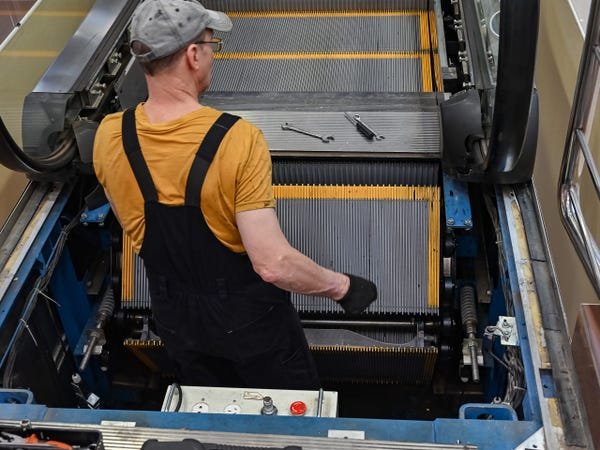
12. Elevator and escalator installers and repairers


Svetlana Verbitskaya/Getty Images

Median annual wage: $106,580

Job growth: 1,200

Typical education required: High school diploma or equivalent

11. Electrical and electronics repairers, powerhouse, substation, and relay


A worker with a hard hat is working in a power substation


Shinyfamily/Getty Images

Median annual wage: $100,940

Job growth: 1,300

Typical education required: Postsecondary nondegree award

10. Avionics technicians


Avionics technician checking an aircraft


Monty Rakusen/Getty Images

Median annual wage: $81,390

Job growth: 1,700

Typical education required: Postsecondary nondegree award

9. First-line supervisors of firefighting and prevention workers


Fire engine


carlofranco/Getty Images

Median annual wage: $92,430

Job growth: 3,400

Typical education required: Postsecondary nondegree award

8. Commercial pilots


Two pilots working


AlexeyPetrov/Getty Images

Median annual wage: $122,670

Job growth: 2,800

Typical education required: Postsecondary nondegree award

7. Aircraft mechanics and service technicians


Two people doing aircraft maintenance


Monty Rakusen/Getty Images

Median annual wage: $78,680

Job growth: 5,600

Typical education required: Postsecondary nondegree award

6. First-line supervisors of police and detectives


Yellow tape that says


kali9/Getty Images

Median annual wage: $105,980

Job growth: 4,600

Typical education required: High school diploma or equivalent

5. Electrical power-line installers and repairers


Electrical power line technician working outside and looking at a tablet


RyanJLane/Getty Images

Median annual wage: $92,560

Job growth: 8,400

Typical education required: High school diploma or equivalent

4. Transportation, storage, and distribution managers


People wearing hard hats are talking in a warehouse


MoMo Productions/Getty Images

Median annual wage: $102,010

Job growth: 13,100

Typical education required: High school diploma or equivalent

3. First-line supervisors of mechanics, installers, and repairers


Manager and technician with a vehicle


Nitat Termmee/Getty Images

Median annual wage: $78,300

Job growth: 19,100

Typical education required: High school diploma or equivalent

2. Police and sheriff’s patrol officers


Police vehicles


Douglas Sacha/Getty Images

Median annual wage: $76,290

Job growth: 22,000

Typical education required: High school diploma or equivalent

1. First-line supervisors of construction trades and extraction workers


Construction workers


Vukasin Stanojlovic/Getty Images

Median annual wage: $78,690

Job growth: 49,000

Typical education required: High school diploma or equivalent


Source link

My-partner-and-I-have-been-together-for-nearly-a.jpeg

My partner and I have been together for nearly a decade, but we still live apart. It’s been great for our relationship.

My partner was my first relationship and first love. I thought he would remain simply “first,” but we’re happily in love nine years later.

Yet, there’s one big milestone that we haven’t reached: our first time living together. Unlike most couples, we’ve never shared a space for more than a few weeks.

People are always shocked when they hear how long we’ve been together. The first question they usually ask is, “Why hasn’t he proposed yet?” Their eyes widen even more when they find out I’m not going home to him.

We feel great about our living dynamic, though: Living apart has helped us maintain the same spark at 27 that we had when we met at 19.

Living apart keeps our relationship exciting


The writer and her partner snorkeling and making a heart with their hands underwater.

Because we don’t share a space, we’re very intentional about spending time together.

Maya Kokerov


We met in our first year of college, when we both lived on campus but in different accommodations.

When we moved back home at 21, three years into the relationship, we continued living apart for practical reasons. Our goal was to live with our families until we saved up enough money to buy a more permanent home.

At first, I missed my partner a lot, and living with my parents felt a bit claustrophobic. After the initial adjustment, though, I began feeling happier than ever.

My family and I have always been close, but staying with them as adults made us cherish each other even more. The dynamic started to feel great for my romantic relationship, too: We realized that living apart helped us date with more intention.

My partner and I would — and still do — schedule regular dates, prioritizing novelty and adventure. We’d splurge on special nights out each month and meet up for weekly creative activities, like painting and cooking.

Since our time together is limited, even ordinary things like driving home feel sacred. Our independence keeps a steady drip of excitement into our partnership, and we don’t take each other’s presence for granted.

Six years into our relationship, we were almost ready to move in together. Then, my family life abruptly changed, and our circumstances shifted again.

Losing my dad reshaped my priorities


The writer and her family standing close together near ski lifts, wearing snow gear.

After I lost my dad, I felt grateful for the years I spent living at home.

Maya Kokerov


When my dad unexpectedly died four years after I moved back home, I had a new perspective on my choice to live with my parents after college.

I was angry at the world for cutting my time with him short, but my one salvation was all the time that we had spent together. If I had moved out after college, like I originally wanted, I never would have had these extra four years with my dad.

Now, it’s been one year since I lost him. Living with my mom and sister, and leaning on them for support, has been bittersweet but invaluable — even if it means my plans to move in with my partner are once again on the back burner.

We’ll move in together someday, but we’ve learned not to rush cohabitation


The writer and her partner holding up glasses of champagne at a restaurant.

We aren’t ready to move in together just yet, but we’re excited to eventually share a home.

Maya Kokerov


Now, I’ve finally saved up enough to buy a home, but I’m still not sure if it’ll be the place I share with my partner.

I’ve developed a different dream — securing a place for my mom and sister. My partner even suggested moving in with us and living as a unit to help us navigate our newfound fear of loss.

Some may say we’re delaying the inevitable, or that we can’t know if we’ll last if we don’t live together.

To that, I always say that cohabiting just doesn’t fit our lives yet. Life is as full of uncertainties as it is short. I found this out the hard way with my father.

Not only are we grateful to have nice places to live with our families as we wait for the right time to move in together, but by letting go of expectations, we’re still in the “honeymoon stage” almost a decade into our relationship.

One day, we plan to live together, get married, and start a family. For now, though, we’re building a partnership that keeps us close to both each other and the people we love.


Source link