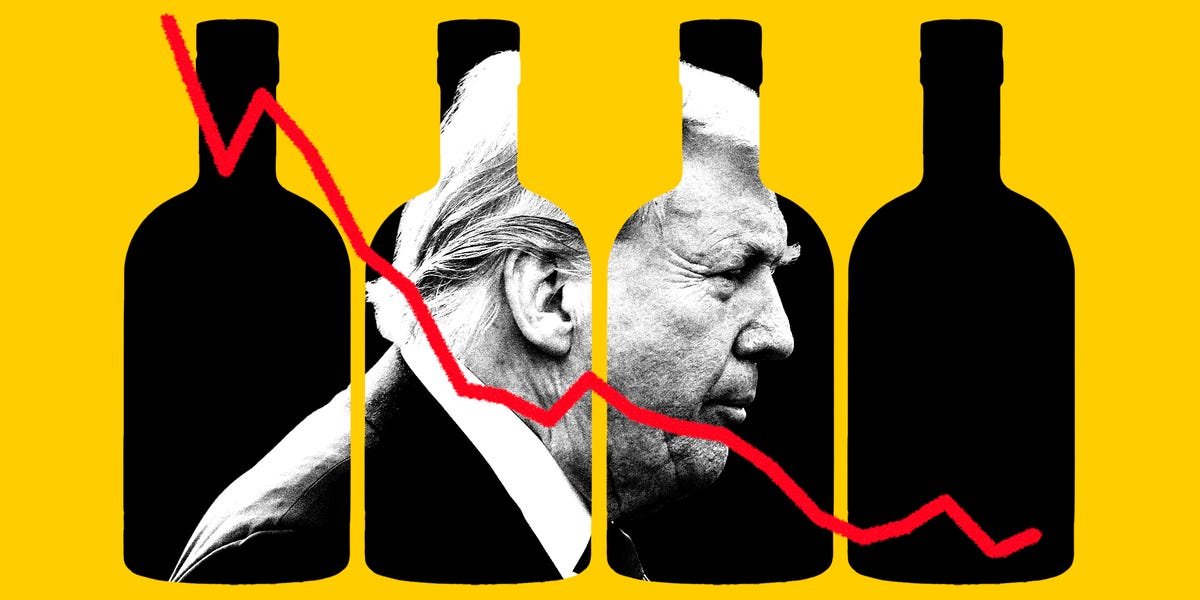
Donald Trump is giving Americans a fair amount of reasons to drink these days — threatening to obliterate Iran, or flirting with a takeover of Greenland. But the president is, perhaps counterintuitively, also part of why people are laying off the booze. Trump’s policies and rhetoric are killing America’s buzz.
Americans are drinking less than they have in decades. While a long-term cultural shift toward moderation is very real, the immediate cyclical indicators — meaning the regular ebbs and flows — are all pointing down. And Trump is nudging them in that direction.
The amount of alcoholic beverages consumed across major markets declined by 2% in 2025, according to data from drinks data company IWSR. In the United States, volumes were down by 5%. Consumption of beer, wine, and spirits all fell. (The only bright spot: ready-to-drink cocktails, which are getting more popular.)
A lot of what’s going on here isn’t about Gen Z being teetotalers or American adults being spooked about alcohol causing cancer — it’s about the economic and political environment. People are drinking less because of the ongoing affordability crisis. The Trump administration’s aggressive immigration policies have had a chilling effect on Hispanics’ consumption. All the tariff whiplash has been far from fun for the alcohol industry. Mounting uncertainty has consumers uneasy and, in turn, taking a break from the bar.
Marten Lodewijks, the president and managing director of IWSR, says the woes for the booze industry is an example of “death by a thousand cuts.”
It just so happens that the president of the United States is the one holding the knife.
Americans are forgoing adult beverages for a multitude of reasons, most of which boil down to pressures on their wallets. While the president says the economy is “roaring,” the data suggest otherwise. Prices have fallen as Trump promised — they’re up by some 25% since 2020, and the most recent inflation data show signs of reacceleration. The war in Iran has pushed average gas prices in the US above $4 a gallon. Consumer sentiment is at a record low. Student loan payments are ramping back up. Healthcare costs are through the roof.
“We are seeing the pressure on affordability escalate,” says Nadine Sarwat, an analyst who covers beverages and cannabis at Bernstein.
Now, everyone gets a single glass of wine with dinner and goes home.
Tariffs have been a complicated piece of the puzzle. On the corporate side, the will-he-or-won’t-he dance around import taxes has made planning and forecasting hard. Large manufacturers have largely managed to eat the varying tariff costs, aware that jerking around prices could turn off wary consumers. But even the Supreme Court striking down many of the president’s blanket tariffs hasn’t left the industry in the clear. Aluminum tariffs are still in place, which hurt beer brands that need it for their cans. They especially sting now that aluminum prices have skyrocketed, in part due to the Iran war.
“A fair amount of aluminum goes through the Strait of Hormuz, and it is very energy-intensive. So when energy prices go up, aluminum prices go up,” says Bart Watson, the president and CEO of the Brewers Association, a trade association that represents craft brewers. Some members have seen the price of their cans increase by 25-30% this year, he says.
Bloomberg/Getty Images
Alcohol is recession-resistant, but it’s not recession-proof. Drinkers are looking for ways to cut spending, and that Friday six-pack is discretionary-ish. Sarwat says this moment looks different than during, say, the Great Recession, when consumers traded down to cheaper brands and bought bigger pack sizes to get more bang for their buck. Instead, people are sticking to the more premium brand they like, but opting for smaller pack sizes to save money. Or they’re grabbing canned cocktails — the aforementioned bright spot for the industry — even if a bottle of wine or vodka may have been the more logical economic choice.
“This cycle is a lot more about cash outlay and perceived value for money as opposed to actual value per unit of alcohol,” she says.
Eye-popping prices at bars and restaurants are also prompting people to cut back. A night out with friends used to be a pre-dinner cocktail, a shared bottle of wine with the meal, and a nightcap. Now, everyone gets a single glass of wine with dinner and goes home.
Trump’s economy isn’t the only thing giving drinkers the heebie jeebies.
ICE crackdowns and tougher immigration enforcement, on top of economic concerns, have had a widespread chilling effect on Hispanic consumers. In January, Constellation Brands CEO William Newlands said on an earnings call that Hispanic consumers were the main reason its beer category was “challenged” as they were being much more careful about their spending. (Constellation’s portfolio includes Corona and Modelo.)
“There was just a reduction in foot traffic as Hispanic consumers went to places they felt safe, didn’t stretch out and take any risky trips or unnecessary trips, and that’s historically a very big beer-drinking cohort,” says Dave Williams, an alcohol industry analyst and consultant.
Hispanic consumers have also been more nervous about going to work, leading to reduced income and, in turn, less spending. It does, however, appear they are beginning to revert to the norm. In its April earnings call, Constellation said they’re buying again.
There was just a reduction in foot traffic as Hispanic consumers went to places they felt safe.
The decline in international tourism to the US has taken a bite out of sales for bars and breweries in areas that generally depend on those travelers for traffic. Watson, from the Brewers Association, says Canadians refusing to come south of the border is smarting for some of their members.
“Talk to breweries in Vermont, they’ll say, ‘Yeah, traffic’s down,'” he says. “For the national numbers, does it move them a ton? Probably not, but at the margins and for individual members matters a lot” He adds that “snowbird places,” such as California and Florida, have complained of people “just not showing up” this year and last from abroad.
Angry Canadians are hurting America’s whiskey industry, too. Many stores up north pulled US-made products off the shelves after Trump started talking about making Canada the 51st state and antagonizing the US’s ally, and they haven’t put those products back.
“The entire Canadian population basically said, ‘No, we’re not supporting this industry and this country,'” Lodewijks, from IWSR, says. Anecdotally, he’s heard similar things have happened in Germany and France.
To be sure, the Trump administration isn’t all bad for the alcohol industry. One important bright spot: The White House’s new dietary guidelines, released in January, were pretty ambivalent about alcohol and advised people to “limit” intake without offering specifics. Dr. Mehmet Oz, the administrator for the Centers for Medicare and Medicaid Services, was even more lenient. At a White House briefing, he said alcohol is a “social lubricant that brings people together,” and while ideally people probably wouldn’t drink, the health benefits of getting together with friends may mean that the deleterious effects of a few beers come out in the wash. “The implication is don’t have it for breakfast,” he said.
It may not be a ringing endorsement, Williams says, but the messaging from the White House “didn’t make it any worse than it was in the mind of the consumer.”
Consumers have a lot weighing on them, and the economy and the world feel increasingly uncertain. This level of uncertainty doesn’t usually bode well for alcohol. As a general rule, election years aren’t good for booze consumption, and while 2026 may not be a huge election year (though it’s not an insignificant one), it is one filled with a lot of unknowns.
“We can all agree that the political situation remains very tumultuous,” Lodewijk, putting it lightly, says. The conflict in Iran escalates and de-escalates by the hour. Rising oil prices threaten to put everything from grocery store staples to summer vacations out of reach. In the US and in the world, it’s a volatile moment, and much of that volatility is emanating from the Oval Office.
The alcohol industry has a lot of problems right now, and Trump is, indeed, one of them.
Emily Stewart is a senior correspondent at Business Insider, writing about business and the economy.
Business Insider’s Discourse stories provide perspectives on the day’s most pressing issues, informed by analysis, reporting, and expertise.