
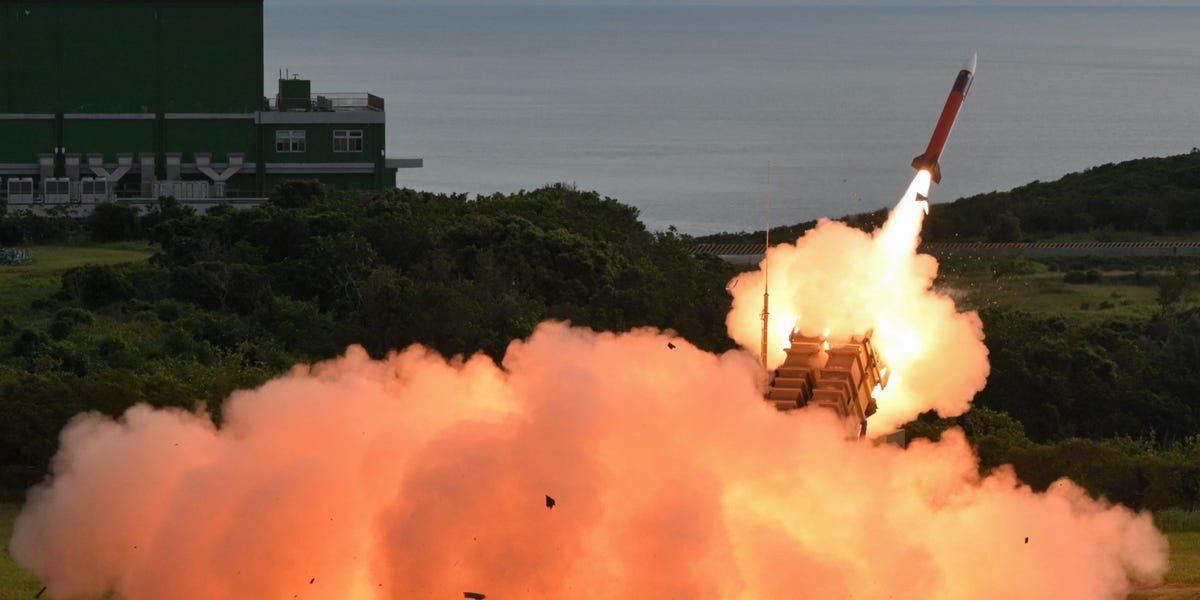
The-fight-with-Iran-shows-high-intensity-modern-wars-hinge-on.jpeg

The fight with Iran shows high-intensity modern wars hinge on having a substantial air defense arsenal

The US and Israel’s fight with Iran shows just how key air defenses have become in higher-intensity modern wars, conflicts increasingly defined by long-range missile and drone attacks.

The conflict, which killed Iran’s Supreme Leader, has been heavily focused on air defenses, either knocking them out to permit air operations or leaning hard on them to shield bases from retaliatory strikes.

The US and Israel said their strikes focused on Iran’s air defenses and missile launch sites, and US and partner forces in the countries attacked in response relied on a mix of air defenses to fend off Iranian weapons.

Kuwait, home to installations like Ali Al Salem Air Base that hosts US troops, reported on Sunday that it had faced 97 ballistic missiles and 283 drones. Defeating this kind of barrage demands deep air defense arsenals.

When air defenses fall short

US Central Command on Saturday said the strikes on Iran aimed to “dismantle the Iranian regime’s security apparatus” and prioritized locations “that posed an imminent threat,” listing Iranian air defense capabilities, missile and drone launch sites, and military airfields as targets.


Black and white aerial footage shows a large aircraft on tarmac with the word 'Unclassified' written on the top in large, neon-green letters

US Central Command shared footage of strikes on Iranian targets, including Iranian air assets.

US Central Command/X


The Israel Defense Forces said that they had “dismantled the majority of the aerial defense systems in western and central Iran” and are “paving the way towards establishing aerial superiority over the skies of Tehran.”

On Saturday, Israel used around 200 jets to drop hundreds of bombs on 500 targets on Saturday, including Iran’s air defense systems and missile launchers.

Having insufficient air defenses can leave a country severely vulnerable in a war of ranged strikes by creating a permissive environment for enemy airpower, as well as munitions, to find their targets, be they military installations or senior leadership. Over the past day, Iran has suffered serious losses to both.

Air defenses matter in a missile fight

Air defenses have been critical for the US and its allies this weekend.

CENTCOM said it was able to defend against hundreds of Iranian missile and drone attacks, with no casualties. A US official told Business Insider that US-made MIM-104 Patriot surface-to-air missile systems and Terminal High Altitude Area Defense, or THAAD, batteries were used to protect the Middle East from Iran’s retaliatory strikes. Warship-launched interceptors and aircraft were also involved, as they’ve been in other engagements involving big Iranian missile barrages.

Nations attacked by Iran, countries like Qatar, the United Arab Emirates, and Bahrain, said they were largely able to intercept Iran’s missiles, sometimes stopping entire waves. Details are still emerging, but damage appears minimal. Casualties, likewise, have been extremely limited thus far, at least compared to what they might have been otherwise.


Smoke rises in the sky after blasts were heard in Manama, Bahrain, February 28, 2026.

Some of Iran’s retaliatory strikes were successful, but countries reported intercepting entire waves of attacks with air defenses.

Stringer/REUTERS


That was only day one though. Iran has a large missile arsenal, and it has pledged to continue its attacks. Continued large barrages will put tremendous strain on air defense arsenals.

Along with other current and potential conflicts, Iran is yet more evidence that much of modern war has become ranged missile fights. If you don’t have good air defenses, you may very well lose.

This is a very different way of war compared to the fights against terrorists and insurgencies that the US and its allies waged for decades in the Middle East.

More would be needed for higher-end threats

China and Russia both field substantial missile arsenals that they are continuing to expand. The West is aware, but the war in Ukraine, where Russia bombards Ukrainian cities nightly with massive mixes of missiles and drones, has been a real wake-up call.

Ukraine has been developing its own air defenses while seeking additional options from partners. Each barrage is extremely demanding. In one engagement, Ukraine expended nearly $100 million in interceptors fighting off Russian attacks.

Much of the West has allowed air defense arsenals to atrophy, but there are significant new investments in air defense across the NATO alliance.

The NATO chief pledged a fivefold increase in air defenses, driven by the alliance’s increased spending. Established manufacturers are increasing production, and new systems are being created. President Donald Trump wants his Golden Dome missile defense system to protect against complex attacks from Russia and China.

But air defense systems and their missiles are expensive and time-consuming to make, and the industry is struggling to keep up with increasing demand, even with companies boosting output.

Mick Ryan, a retired Australian major general and strategist with a focus on future war, said that the heavier demand could cause new problems. Patriot interceptor missiles are critical to Ukrainian defenses, but are in heavy demand at present in the Middle East,” he wrote on Saturday.

Russia, he said, will want to “exploit any temporary Ukrainian capability gaps while American attention and production capacity focuses on Iran.”

The US will also need to maintain a strong air defense posture in both Europe and the Pacific as well, even as it fights Iran.

Ryan warned that concentrating US missile defense assets in the Middle East could degrade its deterrence in the Pacific: “Every carrier in the Gulf, every squadron in Europe, every missile defence battery protecting Middle Eastern countries represents capacity unavailable for containing Chinese expansion.”



Source link

Kelsey Baker, Military and Defense Reporting Fellow

Defense secretary says Scouts America must end ‘woke’ merit badges

The Pentagon is pulling back on plans to cut ties with Scouting America, as long as the nonprofit organization adopts policies that echo new military directives, including eliminating diversity, equity, and inclusion programs and banning transgender youth from the Scouts.

In a video posted to X Friday, Secretary of Defense Pete Hegseth said he had been “very seriously considering” cutting all military support to the organization, citing what he described as its failure to comply with President Donald Trump’s executive order aimed at ending “illegal discrimination and restoring merit-based opportunity.”

The move is part of a growing Pentagon campaign to pressure private institutions like AI giant Anthropic, journalists who cover the US military and universities attended by troops to accept the Trump administration’s policies and preferences. The move put the defense secretary in the position of telling a private youth organization who can join and what their application asks, and doing so amid a tense build-up in the Middle East that could see the US striking Iran within days or hours.

Military support for Scouts has traditionally included logistics to the group’s National Jamboree event (which is also a significant military recruiting event) and hosting of Scouts aboard military bases.

The Pentagon is essentially enforcing Trump’s executive order, applicable to government agencies, onto private institutions, said Dan Maurer, a retired Army lieutenant colonel and associate law professor at Ohio Northern University.

“The fact that they’re capitulating at all is a little weird to me, because they can withstand the loss of the connection, frankly,” Maurer, a former Eagle Scout, said of Scouting America, expressing astonishment that the defense secretary personally focused on this. “His attention could be focused on other things.”

Scout leaders agreed to “review and replace politicized, divisive, and discriminatory language throughout the organization,” Hegseth said in the video, adding, “no more DEI. Zero.”

Merit badges that “mask” DEI “activism” have been “discontinued,” he said, and a new military service badge will be added, in partnership with the Pentagon.

A spokesperson for the Defense Department did not immediately respond to a request for comment late Friday.


Soldiers took part in the 2023 National Jamboree held in West Virginia.

Soldiers took part in the 2023 National Jamboree held in West Virginia.

Edwin L. Wriston/West Virginia National Guard


Scout participants will only be allowed to join based on their birth sex, which may amount to a ban on transgender youth.

“That means that the application, any application, will have only two sex designations, male and female, and the application must match the applicant’s birth certificate,” the defense secretary said.

It is not clear how many Scouts would be personally affected by such a shift, and it remains to be seen how families will feel about the Pentagon’s involvement in setting terms of their organization.

Hegseth said he believed Scouting should return to being a boy-only group, but added that such a change is not imminent.

In November, an NPR report revealed the Pentagon was weighing whether to sever ties with the organization. As many as 16% of recent cadets at the US Military Academy have scouting in their backgrounds, a percentage that rivaled that of students from high school JROTC programs and reflected the Scouts’ deep military ties. Many cadets were also Eagle Scouts.

Beginning in 2012, “the Boy Scouts lost their way,” Hegseth said in the Friday post. “A once great organization became gravely wounded. Diversity, equity and inclusion, DEI, crept in. The name was changed to ‘Scouting America.’ Girls were accepted. The focus on God as the ruler of the universe was watered down to include openness to humanism and Earth centered pagan religions.”

“They even welcomed the destructive myth of gender fluidity and transgenderism to infiltrate their membership. Along the way, standards were lowered and merit destroyed in favor of an insidious, radical woke ideology that is anti-America and anti-American.”

The Scouts said they had made changes to comply with the Trump administration’s policies after months of discussion.

“Scouting America is proud to uphold our longstanding commitment to military families across the globe through a renewed, strengthened partnership with the Department of War,” Scouting America said in a statement to Business Insider, referring to the Trump administration’s unofficial name for the Defense Department that Congress has not approved.

“Over several months, we engaged in dialogue with Department leadership to align on how we could deepen our service to military families, while making programmatic updates to comply with Executive Order 14173.”

Hegseth did not specify what policy changes he was referring to in 2012, though in 2013 openly gay youth were allowed to join.

The Boy Scouts adopted changes to address declining participation that was caused, in part, by thousands of decades-old child sexual abuse cases finally made public in 2012, said David Chetlain, a Navy veteran and former Boy Scout, who expressed concern about the Pentagon’s pressure campaign.

The so-called ‘perversion files’ eventually contributed to Scouting America filing for bankruptcy in 2020. Opening ranks to a more diverse array of participants was part of the group’s attempt to maintain relevance and cleanse its reputation, Chetlain said.

Various religious merit awards have been around for decades, he added, and reflect the diversity of the group, which has foreign members across the world. Two Japanese exchange scouts were in his own troop, he said, recalling his time as a young Scout in the 1970s and 1980s, and as an occasional leader since then.

“It’s always been multicultural. It’s always been agnostic to religion or accepting of all religions,” said Chetlain, though he noted that Scouts previously barred atheists for decades. “Even as a kid, I loved that inclusivity and having a place where everybody belonged and we were all accepted. And it was a safe place for me.”


Source link

Madeline berg on grey background

Trump wants to cap defense CEO pay. Here’s how much they make now.

President Donald Trump is targeting the bank accounts of defense contractor CEOs.

On Wednesday, Trump signed an executive order outlining new rules for defense contractors that would ban stock buybacks and dividends “until such time as they are able to produce a superior product, on time and on budget” — as well as limit executive compensation.

The order stipulates that in future contracts, if the Secretary of War were unsatisfied with a company’s performance, executive base salaries would be capped at current levels. Future contracts would also ensure compensation “not be tied to short-term financial metrics” and instead be “linked to an on-time delivery, increased production, and all necessary facilitation of investments and operating improvements.”

The goal, per the executive order, is to increase the speed of innovation at defense companies, rather than focus on corporate profits.

Trump also took aim at the leaders of defense contractors in a series of posts on Truth Social on Wednesday.

“Executive Pay Packages in the Defense Industry are exorbitant and unjustifiable given how slowly these Companies are delivering vital Equipment to our Military,” Trump wrote. “Salaries, Stock Options, and every other form of Compensation are far too high for these Executives.”

He proposed that no executive should earn “in excess of $5 million” until their production speed and maintenance improve, though the executive order did not cap pay at that exact amount.

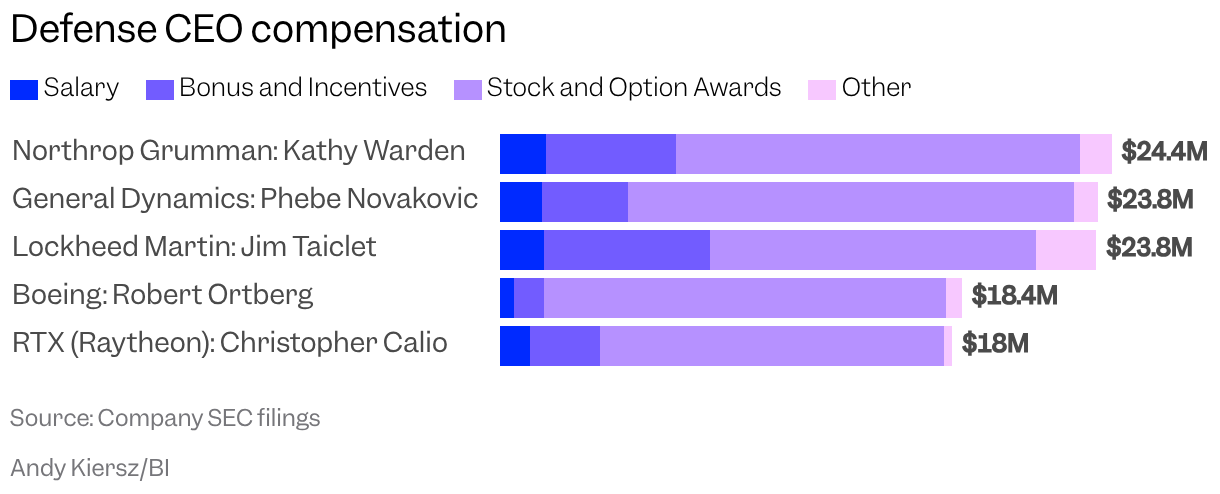
The leaders of the big five defense contractors — Lockheed Martin, RTX (formerly known as Raytheon), Northrop Grumman, Boeing, and General Dynamics — each earned more than $18 million in total compensation in 2024, the most recent year for which data is available. Their total income was a combination of salary, incentives, stock options, and other forms of compensation, including the value of security services and changes in the value of pension funds.

While exceeding the $5 million cap proposed by Trump by magnitudes, the CEOs’ compensation pales in comparison to that of some other business leaders.

Dozens of CEOs earned more than them in 2024. James Robert Anderson, who runs materials manufacturer Coherent, had a pay package of more than $100 million last year. The CEOs of Starbucks, GE, and Microsoft each made more than $75 million.

Executive pay and stock transactions are part of Trump’s larger plans for the military. On Wednesday evening, he said on Truth Social that America’s military budget should be increased to $1.5 trillion in 2027, up from the record 2026 defense budget of $901 billion.

That sent defense stocks climbing on Thursday morning, gaining back what they’d lost following the signing of the executive order.

In a statement to Business Insider regarding the order, a spokesperson for Lockheed Martin said the company “shares President Trump’s and the Department of War’s focus on speed, accountability, and results, and will continue to invest and innovate at scale to ensure our warfighters maintain a decisive advantage and are never sent into a fair fight.”

Boeing and General Dynamics declined to comment, and Northrop Grumman and RTX did not immediately respond to requests for comment.


Source link

China-is-going-after-US-defense-firms-and-execs-over.jpeg

China is going after US defense firms and execs over weapons sales to Taiwan — and Palmer Luckey’s on the list

China announced sanctions against 20 US defense companies and 10 senior executives on Friday, citing US arms sales to Taiwan as its motive.

In a statement, China’s foreign ministry said its assets within China, including movable and immovable properties, would be frozen and that domestic organizations and individuals would be prohibited from doing business with them.

Individuals named on the list would also be denied visas and entry to the country, the ministry added.

The sanctions list includes Northrop Grumman Systems Corporation, Boeing’s St. Louis branch, Epirus, and Anduril Industries founder Palmer Luckey.

In a statement, a spokesperson for the foreign ministry said: “We stress once again that the Taiwan question is at the very core of China’s core interests and the first red line that must not be crossed in China.”

“Any company or individual who engages in arms sales to Taiwan will pay the price for the wrongdoing,” they added.

When reached for comment, Anduril pointed Business Insider to an X post from Luckey in which the CEO joked that he was honored.

“I want to thank my family, my team, and my Lord Jesus Christ for this award,” Luckey wrote on X. “Anduril has been sanctioned for a while now, as have many of my peers, but it means so much to finally have my non-existent Chinese assets seized and repurposed.”

China’s sanctions follow the US announcement of a $11 billion military package for Taiwan last week.

The deal, which includes self-propelled Howitzers and HIMARS rocket launchers, still needs to be approved by Congress — but it drew a swift response from Beijing.

Lin Jian, a spokesperson for the foreign ministry, said in a statement at the time that China “strongly deplores and firmly opposes” the sales.

China regards Taiwan as a breakaway province that will one day come under Beijing’s control, and Chinese President Xi Jinping has refused to rule out an invasion of the island. Taiwan’s ruling Democratic Progressive Party views Taiwan as separate from China.

Under the Taiwan Relations Act, the US is obligated to assist Taiwan in defending itself.

Beijing has ramped up pressure around the island in recent years, holding frequent military exercises in the surrounding skies and waters.

A 2024 report by the Washington, D.C.-based think tank the Center for Strategic and International Studies suggested that China may be able to exert power over Taiwan without launching an invasion.

The report said China could impose a quarantine of the island using its coast guard.

“The purpose of a quarantine is not to completely seal Taiwan off from the world but to assert China’s control over Taiwan by setting the terms for traffic in and out of the island,” it argued.

“A key goal is to compel countries and companies to comply with China’s terms.”


Source link