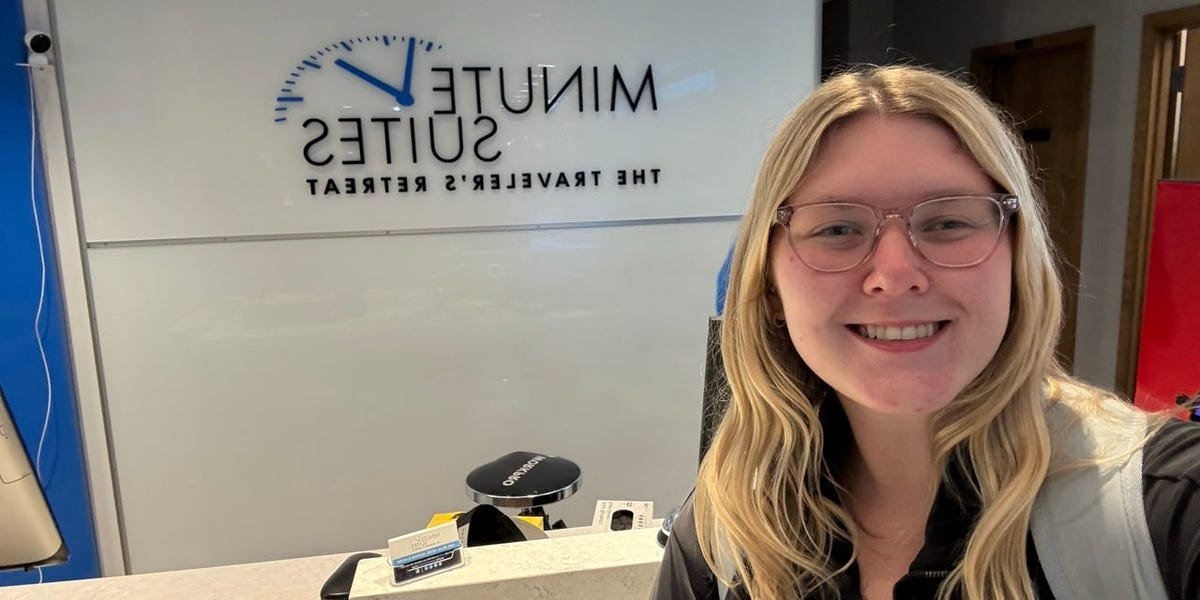
Compared to airport lounges like The Club or Amex’s Centurion Lounge, Minute Suites have far fewer included amenities. You should not, for example, expect complimentary snacks, soda, or alcoholic beverages — though they’re available for an extra cost.
Instead, the biggest perk is having a secluded retreat away from the hustle and bustle of the airport terminal.
Although we could have easily returned home for the night, staying in the Minute Suites room meant we didn’t have to worry about making it back in time for our early-morning departure or dealing with the hassle of going through security again.
We set our alarm for 3:50 a.m. and woke up just a short walk from our gate in Concourse B, which made the wake-up call somewhat more manageable.
The pricey experience felt worth the cost in this situation, but I don’t think I’d splurge on a private room regularly — especially during the day when I have access to other lounges.
However, when dealing with unexpected overnight delays, it’s a convenience I’d definitely pay for again.
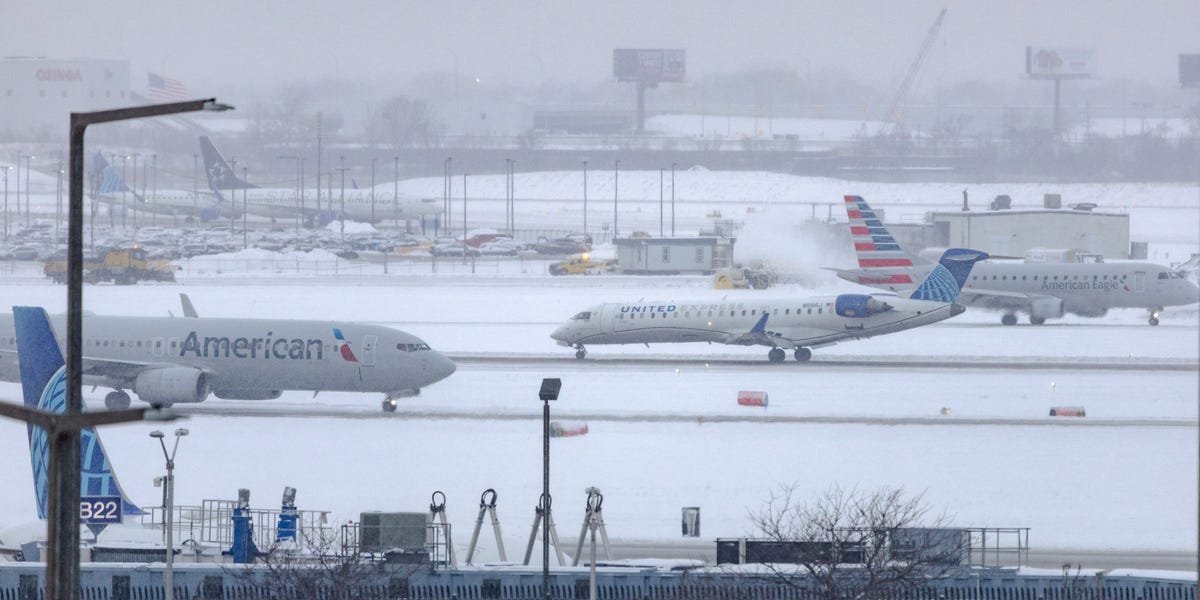
Snow and rainstorms hit multiple states on both coasts on Christmas Eve and Christmas Day, and are now heading for the Northeast, including New York, New Jersey, and Pennsylvania. Travellers are now having a difficult time getting home as major airports see mass delays and cancellations.
According to the “Misery Map,” published by FlightAware, which tracks real-time flight disruptions, there have been over 1,000 delays and more than 350 cancellations across the largest US airports as of 6:45 p.m. ET on Friday.
Here’s a look at the latest flight disruptions, and when you may expect to fly if your flight has been canceled.
The Midwest and the East Coast
JFK International Airport is experiencing more than 369 cancellations and 210 delays.
Screenshot
The storm that first hit the Midwest is coming for the East Coast. New York City is set to see the most snow it has seen in years, since the last time it saw at least 4 inches of snow was January 2022. New Jersey and upstate New York will see similar weather conditions.
The NYC Emergency Management said in a press release that “snow is expected to develop Friday afternoon and intensify into steady, accumulating snow Friday night.” The National Weather Service has forecast 3 to 7 inches of snow with locally higher amounts possible.
According to FlightAware, JFK International Airport is experiencing 369 cancellations, with 210 on Friday alone. The situation at Newark Liberty International Airport is also not optimistic, with 244 cancellations and counting.
Based on the Misery Map, flights from airports around NYC to Chicago, Detroit, and Denver are seeing the highest number of delays and cancellations.
The West Coast
Los Angeles International Airport is seeing a total of 283 delays and 41 cancellations.
Screenshot
The West Coast is slowly recovering from an exceptionally wet Christmas.
Over the past two days, most residents of California have received at least one weather warning as an atmospheric river accompanied by high winds, floods, and mudslides hit the Golden State. The NWS said that this Christmas season is the wettest one Los Angeles has experienced in 54 years.
The San Francisco International Airport said that 153 flights had been delayed on Friday morning due to windy conditions. To make matters worse, the police briefly shut down Terminal 1 due to a “suspicious package,” but then reopened it without explanation. By midday, FlightAware reports that a total of 381 flights from SFO have been delayed.
According to the Misery Map, flights from the Los Angeles International Airport to Seattle, Salt Lake City, Denver, and the East Coast are all experiencing disruptions. FlightAware counted a total of 283 delays and 41 cancellations.
The disruptions come at the end of a tough year for air travel.
High-profile plane accidents, including when an American Airlines Flight crashed into a Black Hawk helicopter, and the firing of hundreds of FAA employees by the White House DOGE office, triggered a newfound fear of flying among some Americans earlier this year.
The subsequent government shutdown also led to flying snags this year, as air traffic controllers who were left without pay called in sick, and some airports were paralyzed.
A winter storm expected to hit the Northeast is causing thousands of flight delays and cancellations.
The National Weather Service has issued a winter storm warning for areas around New York City, extending into Connecticut and New Jersey. The service expects heavy snow accumulations between six and nine inches.
About 1,400 flights in the US have been canceled, as of 2:20 p.m. ET, according to flight-tracking service FlightAware. Over 5,100 US flights have been delayed, per the service.
Some airlines have begun offering solutions to travelers affected by the storm. JetBlue, Delta, and Southwest have all waived fare differences for those changing flights from airports around the New York metropolitan area.
The delays and cancellations come during a high-density travel period around the winter holiday. AAA projected that 8.03 million Americans would fly domestically between December 20 and January 1.
Here is the best advice for what to do if your flight is disrupted.
1. Know your rights as an airline passenger in the US
Airline passengers have some customer rights in the US.
Li Rui/Xinhua via Getty Images
According to the Department of Transportation, there is no law requiring US airlines to compensate passengers for disruptions caused by uncontrollable events, such as weather. That also includes air traffic control delays.
The only rule carriers must follow is to refund customers in the event of cancellations, even for non-controllable events. And that does not mean travel credits or vouchers — it must be cash, and includes any add-ons, such as bags or seats.
But carriers do not owe meals, hotel rooms, or financial compensation for storm-related cancellations or delays — because the cause is the weather, not the airline.
Passengers are still entitled to a refund or rebooking on the same airline, but carriers are not required to provide additional accommodations or rebook on another airline.
If you choose to travel but your flight is delayed or canceled, ask the airline for the reason — ideally in writing — so you know what you’re entitled to. Airlines have different policies for disruptions they control, like crew or maintenance issues.
The DoT’s Airline Customer Service Dashboard — launched in 2022 — shows what the 10 largest US airlines promise in those cases, including rebookings, meal vouchers, and hotel accommodations.
2. Monitor your airline’s app for rebooking options
Most airlines allow customers to adjust their flights online.
Jaap Arriens/NurPhoto via Getty Images
When a flight delay or cancellation is announced, expect people to flock to the nearest customer service line for assistance, and for the phone lines to clog.
Wait times can be painfully long, and the best alternatives will likely go quickly. However, some airlines offer the option to rebook on their website or mobile app and waive any fees, making it sometimes easier to make changes online than in person.
If all available options are exhausted, have a plan B, such as waiting to speak with a live agent, contacting the airline through social media, or booking a hotel for the night.
Direct messaging on Facebook or Twitter can actually serve as a virtual placeholder, and you may hear back via chat before speaking to a live agent.
Here are the phone numbers for each airline:
Alaska: 1-800-252-7522 or text 82008
Allegiant: 1-702-505-8888
American: 1-800-433-7300
Avelo: 1-346-616-9500
Breeze: No phone number to call, but you can text the airline at 501-273-3931. If you call this number, it’ll tell you different ways to contact Breeze, like via email or Facebook Messenger.
Delta: 1-800-221-1212
Frontier: No phone number. The best way to contact Frontier is via online chat or email.
JetBlue: 1-800-538-2583
Southwest: 1-800-435-9792
Spirit: 1-855-728-3555
Sun Country: 1-651-905-2737
United: 1-800-864-8331
3. Ask for a hotel or meal voucher
The Hyatt hotel inside Orlando airport.
: Jeffrey Greenberg/Universal Images Group via Getty Images
For controllable delays or cancellations that result in a customer waiting at least three hours for a new flight or requiring an overnight stay, several airlines will offer meal or hotel vouchers.
Carriers offering both are Alaska Airlines, Allegiant Air, American Airlines, Delta Air Lines, Hawaiian Airlines, JetBlue Airways, Southwest Airlines, Spirit Airlines, and United Airlines, per the DoT dashboard.
Frontier Airlines is the only carrier that does not offer accommodations in the event of an overnight delay or cancellation, but it will provide a meal voucher.
For US airlines not listed on the dashboard, or in cases where the disruption is uncontrollable (like because of a winter storm), or if the compensation is unclear, simply ask.
It never hurts to request a meal or hotel during flight disruptions, and you might get lucky with a goodwill gesture from the carrier.
4. Check if your credit card company offers travel insurance
American Express and Chase have travel credit cards.
Illustration by Mario Tama/Getty Images
Several major banks offer credit cards that come with travel insurance, like Chase’s Sapphire Reserve or American Express’ Platinum Card. Both offer trip protection, meaning customers who purchased their flight with that specific card can reap the benefits.
For example, in the case of a major storm system, it’s likely many passengers will end up stranded in random cities across the US.
However, banks with travel insurance included can reimburse cardholders for unexpected expenses outside their control, including hotel, meal, and transportation costs.
Travel insurance does not apply in all circumstances, like short delays, so be sure to check your policy before making a claim — but it also doesn’t hurt to make the claim anyway, even if the answer is no.
5. Know when to walk away
Consider renting a car or taking the train.
Wang Ying/Xinhua via Getty Images
During the holidays, it’s easy to lose sight of your purpose — seeing friends and family or simply getting away from home for a few days.
However, delays and cancellations are inevitable. Don’t spend all day sitting around waiting — give yourself a cut-off time. Once that moment passes, consider alternative means of getting to your destination, such as driving or taking a bus or train (which may also be covered by travel insurance).
If you are stuck in another city and have no other option but to stay in a hotel or wait at the airport, decide how you want to spend your time and make a plan.
Editor’s note: This article was originally published in 2023 and has been updated.