
Photos-show-a-major-fire-at-a-key-UAE-oil.jpeg

Photos show a major fire at a key UAE oil port, a day after the US struck a major Iranian depot

  • A fire broke out near a key oil port in the United Arab Emirates on Saturday.
  • Officials said debris from an intercepted drone caused the fire and that operations were suspended.
  • The US attacked Kharg Island, a major oil depot in Iran, on Friday.

Fire erupted at a critical oil hub in the United Arab Emirates on Saturday amid the ongoing military conflict in the Middle East.

Plumes of dark black smoke billowed around the Port of Fujairah, the only multipurpose maritime facility on the UAE’s east coast. The Fujairah government’s media office said debris from an intercepted drone caused the fire. No injuries were reported.

The fire comes after Iran said it would retaliate against the US for attacking Kharg Island on Friday. Kharg Island, located about 300 miles from the Strait of Hormuz, is key to Iran’s oil industry and has refineries that process nearly all of the country’s oil exports.

President Donald Trump said the US had “totally obliterated” military targets on Kharg Island in a Truth Social post on Friday. In a Truth Social post on Sunday, Trump said he hoped other countries affected by the Strait of Hormuz closure would send warships alongside the US to help secure it.

War broke out in the Middle East last month when the US and Israel launched joint strikes against Iran. In response, Iran has targeted US military bases in neighboring countries like Qatar, Bahrain, Kuwait, and the UAE. The ongoing military conflict has shuttered airspaces and halted most traffic through the Strait of Hormuz. US strikes on Kharg Island and damage to the UAE’s Port of Fujairah could impact oil prices, which again surged past $100 on Friday, driving up gas prices around the world.

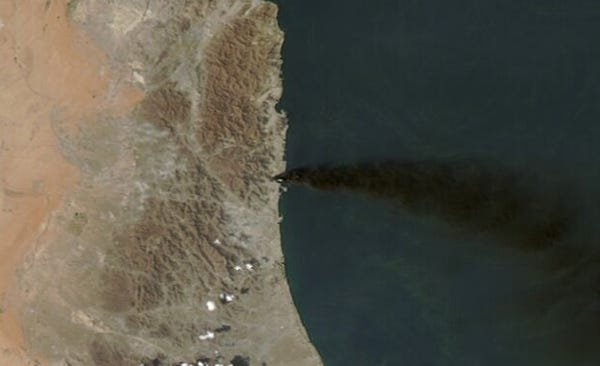
Smoke from the coast of Fujairah spread over the Gulf of Oman.

NASA MODIS satellite image of Fujairah on Saturday.

NASA Modis satellite image, November 14, 2026.

A satellite image taken on Saturday showed smoke from the fire spreading over the Gulf of Oman. The Port of Fujairah exported an average of 1.7 million barrels of crude oil and refined fuels each day in 2025, Reuters reported.

Some operations at the Port of Fujairah were suspended on Saturday.


Fujairah in the UAE on March 14, 2026.

Fire broke out in Fujairah on Saturday.

AP Photo/Altaf Qadri

Local outlets reported that some oil-loading operations were suspended on Saturday following the intercepted strike.

The Fujairah Oil Industry Zone can store millions of barrels.


Oil facility in Fujairah in the UAE on March 14, 2026.

The Fujairah Oil Industry Zone in Fujairah on Saturday.

AP Photo/Altaf Qadri

The Fujairah Oil Industry Zone, located near the port, is home to the largest commercial storage facility for refined oil products in the Middle East. The hub can store about 70 million barrels of oil.

The military conflict has sent oil prices skyrocketing.


Fujairah in the UAE on March 14, 2026

Oil prices have risen globally since the US and Israel launched attacks against Iran.

AFP/Getty Images

The ongoing war has disrupted the oil supply chain, sending oil prices over $100 a barrel this week. The International Energy Agency said it will release 400 million barrels from reserves in response, marking the largest coordinated release in the IEA’s history.

The International Energy Agency said the war has caused the largest oil market disruption in history.


Fujairah in the UAE on March 14, 2026.

Fujairah in the United Arab Emirates on Saturday.

AFP/Getty Images

The International Energy Agency said global oil supply will drop by 8 million barrels a day in March.

“Disruptions are not limited to upstream production and exports, with several refineries and gas processing facilities shut down due to attacks or for safety concerns,” the agency said in its monthly markets report. “The closure of the Strait is also forcing export-oriented refineries to cut runs or shut completely as product storage tanks top up.”

The UAE said it intercepted nine missiles and 33 drones launched from Iran on Saturday.


Fujairah in the UAE on March 14, 2026.

Iran launched over 30 drones at the UAE on Saturday, according to the UAE’s military defence.

AP Photo/Altaf Qadri

The UAE Defense Ministry said it intercepted nine ballistic missiles and 33 uncrewed aerial vehicles launched from Iran in an X post on Saturday.

“Since the onset of the blatant Iranian aggression, UAE air defences have engaged 294 ballistic missiles, 15 cruise missiles, and 1,600 UAVs launched from Iran,” it said.


Source link

Ukrainian-drone-pilot-found-hidden-Russian-depot-realized-it-was.jpeg

Ukrainian drone pilot found hidden Russian depot, realized it was filled with horses and cars

Cosmos floated his quadcopter over the ruined warehouse, guiding it through a corner of the roof where shattered metal sheets had collapsed to form a hole.

The drone pilot’s unit, the Wild Division, suspected that the building was a logistics hub for Russian soldiers, roughly 15 km, or about 9 miles, from the line of contact in southern Ukraine. These hidden locations often held ordnance or fuel stockpiles, and Cosmos’ fiber-optic drone was armed with explosives to destroy them.

Yet inside, the drone rotated its camera to reveal what looked more like a farmer’s garage: Four civilian cars, a pair of motorcycles, and two bridled horses.

“We had not expected to see this. It was unusual,” Cosmos told Business Insider, speaking on condition that he be identified only by his call sign.

“We were expecting to find some armored vehicles,” he added.

Video of the discovery went viral last week in Ukraine, as the war has increasingly seen Russian soldiers using unconventional transport tools, such as pack animals and bicycles, to conduct assaults or logistics missions. Cosmos said his drone mission was conducted in early February.

The smaller profile of a horse or civilian car might be harder for a drone to spot, though Russia’s repeated use of them has also raised questions about the viability of its tactics and whether it’s been producing enough military equipment to sustain its invasion.

Cosmos’ squad mates and officers at the Wild Division, a first-person-view drone company in the 82nd Air Assault Brigade, had seen clips of Russian soldiers riding on horses to attack Ukrainian positions before.

One famous example they remember was in Zaporizhzhia, when a Ukrainian drone crew attacked Russian infantry crossing the front lines on horseback last month.

Cosmos, who’s been piloting drones for a year, said it was the first time he’d personally seen the animals on the front lines.

He flew his explosive-laden drone straight into the back of one of the cars, and said his crew later struck several other vehicles inside. When Russian troops moved their transport assets, the Wild Division found the next warehouse and attacked that one, too, Cosmos said.

“The enemy usually lives in hiding close to these places,” Cosmos said of the warehouse. “It’s common for us to check all targets. Sometimes we can see the enemy infantry, or you can see their vehicles.”

Russia calculates war differently

The Wild Division declined to say where exactly the warehouse was located, but its brigade is generally deployed in the Donbas.

The commander of Cosmos’ battalion told Business Insider that the discovery of the horses surprised him, too.

“I thought it had been a location for transport vehicles, sort of a transfer hub,” said the major, whose call sign is Fizruk.

Fizruk said the appearance of horses and cars in his area of the front line could be a sign that Russian forces are running low on standard resources, but also reflects Moscow’s attritional nature of fighting.

The cars discovered by Cosmos appear to be Nivas, inexpensive civilian off-road vehicles from the Russian Lada car brand.

“They treat these like they will be losses anyway, that they will be destroyed anyway,” he said. “Look, a Niva costs, let’s say, $2,000. A Hummer, which the Armed Forces of Ukraine uses in many places, costs $20,000, maybe more.”

“Since they lose their equipment in assaults, from that point of view, why pay $20,000 for one vehicle if you can buy 10 Nivas for $20,000?” Fizruk added.

The Kremlin is known to pressure the front line with repeated ground assaults, sending small groups of infantry to approach Ukrainian positions on foot or in cheap vehicles. The strategy has been costly, with NATO now saying that up to 25,000 Russian troops are dying each month.

Sustaining that style of war has pushed Moscow to informal means of recruitment and weapons procurement, including hiring troops from overseas and receiving ammunition from North Korea.


Source link