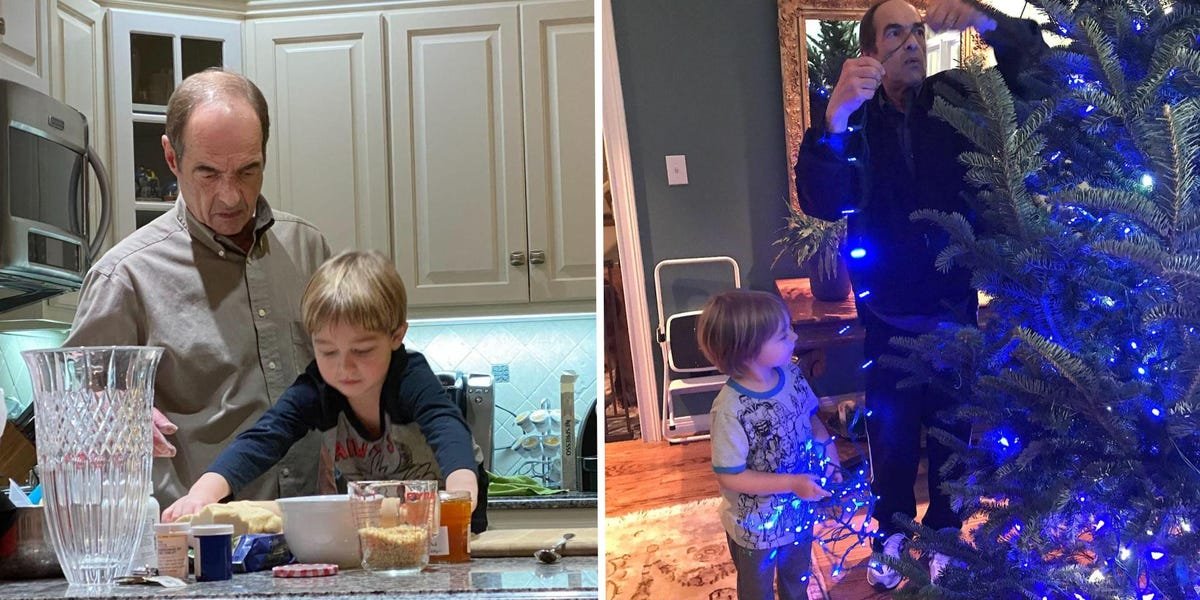
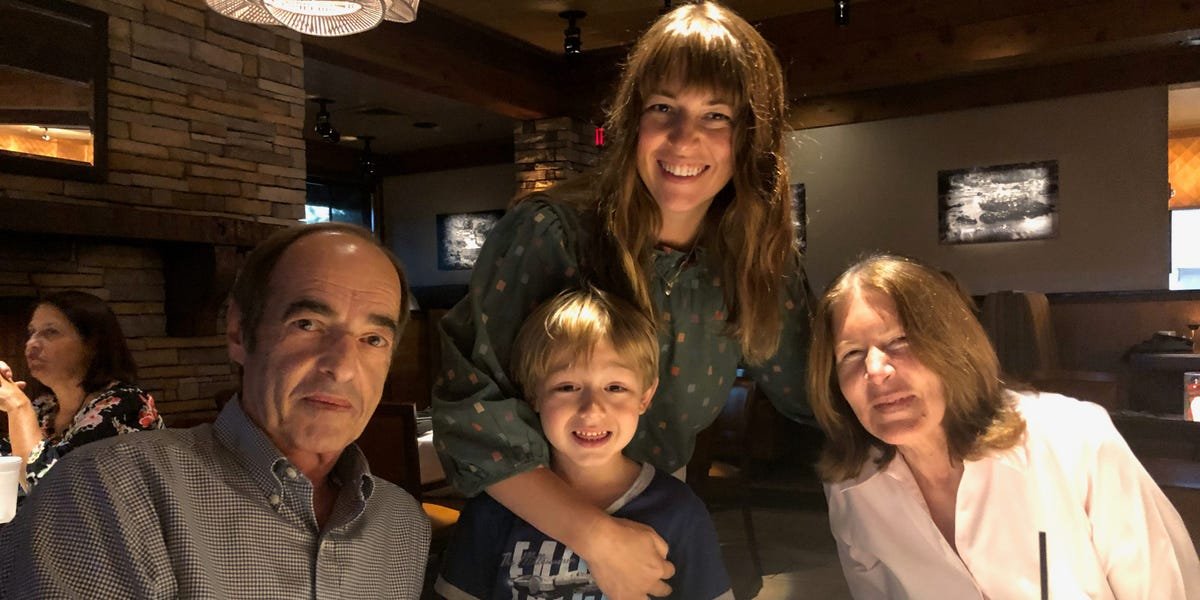
My-dad-died-at-56-and-never-made-it-to.jpeg

My dad died at 56 and never made it to retirement. The 3 lessons he taught me changed my own plans and perspective.

In 2023, my dad called to tell me he’d dropped down to four days a week at work.

He’d had a long career as an insurance underwriter, though it didn’t define him. At one point, he even left the profession to become a plasterer for a decade to better balance out his schedule. Still, it served him well enough.

“You really are getting old, then,” I joked. Dad laughed — he was only in his 50s.

We talked about his retirement and how he planned to wind down gradually over the next few years, before pulling the trigger and paying a full-time job’s worth of attention to the golf course.

That step was the first, and last dad took toward retiring. A year later, he told me he had cancer.

His diagnosis marked the beginning of a period in which I spent every day with him. He had been exceptionally fit, competing in triathlons, marathons, and Ironman races, but went from Hyrox to hospice care in just eight weeks.

Then on June 19, 2024, at the age of 56, Dad’s oesophageal cancer snatched away his future, and any prospect of a retirement.

I later realized our conversations during his illness were a textbook of the values by which he had lived his life. I’d heard him talk along similar lines in the past, but it wasn’t until I was lucky enough to spend each day for two months with him as his peer that I was able to distill them into three lessons.

Now, at the age of 32, these guide me in my career and life, and frame the way I think about retirement.

Live as if you might never make it


Man jumping in the air in front of a mountain

Dad while doing the Tour De Mont Blanc.

Callum Macauley-Murdoch


It may sound a morbid start, but I see this principle as both pragmatic and a call to action.

I see it as pragmatic because, of course, it is true: You might very well not make it to your retirement. And thinking about death in this way can help you take important practical steps, like ensuring you have an updated will and, at the very least, start thinking about granting powers of attorney.

And I see it as a call to action because, when loss helps you understand that life is precarious, it shines a light on how we often live without confronting the inevitability of death.

With that understanding, a more fulfilling life can emerge years earlier than it might otherwise have; one that, perhaps, you dreamed might come in retirement.

This principle led my dad to travel widely, a habit he passed to me. I’m due to visit New Zealand soon, the place he unknowingly took his final big trip. It also led him to take up the sports that piqued his interest over the years, and achieve a genuine sense of contentment.

It took me a lesson in the brutality of life, and the illuminating chaos of grief, to truly understand the importance of living it.

Build a life that gives you choices


Man on a bicycle

Dad finishing an Ironman in Wales.

Callum Macauley-Murdoch


One of the pitfalls of the first lesson is that, if taken literally, it could lead to financial ruin.

If it were a certainty I’d never make it to retirement, I’d spend everything I had now. However, in a classic catch-22, living life like I’d never make it there would delay my retirement in perpetuity.

So instead, I keep an eye on the future and try to resist the urge to part with all my money in exchange for experiences now, so that I can have some freedom of choice when I retire.

For Dad, working hard and getting an education meant having choices, and that influenced many of my decisions in life, including the one to pursue a career in corporate law.

In the end, that didn’t align with the life I wanted, but the experience gave me the skills and financial backing to choose a different legal career for myself.

Because of my job and savings I’ve built up from it, I had choices when Dad died. I was able to pause, reassess my life, and temporarily step away from my busy career.

During that time, I thought about how he used to ask me about work and I’d sometimes tell him how I wished I could just retire now to travel the world and write. He’d remind me I had a long way to go.

But now, those passions I always thought I’d save for later, like planning a trip to New Zealand or getting my master’s in creative writing, have become present pursuits.

Soon enough, though, I’ll pick up some legal work again. Why? Because unless I write a bestselling novel by the end of the year, I still want choices in retirement, should I make it there.

Find the adventure in everything


Man with hat on a mountain leaning on a stone

My dad on a hike at Arthur’s Pass in New Zealand.

Callum Macauley-Murdoch


Dad took a keen interest in all aspects of life, and didn’t take much of it seriously — because of that, not in spite of it, he was still successful in much of what he did.

This lesson applies to every aspect of life, including retirement, which I’m viewing as simply another opportunity to experience a new pocket of life.

It even applies to terminal illness. When my dad was nearing the end of his life, he said something in an attempt to comfort me, which has ended up being the most transformative lesson of the three.

“Life is one series of adventures. This is just another one.”

That impacted me profoundly, and taught me to seek joy even in life’s darkest corners.

These days, I view my retirement, career, and life much differently


Author Callum Macauley-Murdoch and his dad

Dad and I at my wedding.

Callum Macauley-Murdoch


Losing Dad changed how I think about my life, career, and the very concept of retirement.

Most of all, it prompted me to stop deferring what I truly wanted to my final years while still setting myself up to have choices in the future.

Now that I’m taking incremental steps towards something I’d be happy to do well into my old age, the dream of retirement crosses my mind less often.



Source link

John F. Kennedy Jr. and Carolyn Bessette Kennedy in black tie attire

JFK Jr. and Carolyn Bessette died in a plane crash 27 years ago. It fueled rumors of a ‘Kennedy curse.’

John F. Kennedy Jr. and his wife, Carolyn Bessette Kennedy, attended the Municipal Art Society Gala in 1998.

  • John F. Kennedy Jr., his wife, and her sister died in a 1999 plane crash near Martha’s Vineyard.
  • Rumors of a “Kennedy curse” were fueled by multiple family tragedies over the decades.
  • JFK Jr. and Carolyn Bessette’s relationship is now the topic of an FX series, “Love Story.”

The Kennedy family has been subjected to many tragedies over the years, including two assassinations and a plane crash that took the lives of John F. Kennedy Jr. and two other passengers.

Nearly 27 years ago, on July 16, 1999, John F. Kennedy Jr., his wife Carolyn Bessette-Kennedy, and her older sister Lauren Bessette were killed in a plane crash off the coast of Martha’s Vineyard in Massachusetts. There were no survivors from the accident.

The relationship between John F. Kennedy Jr. and Carolyn Bessette-Kennedy is now the topic of an FX series executive-produced by Ryan Murphy, “Love Story.”

Their deaths became a major news story and perpetuated rumors of a “Kennedy curse.”

JFK Jr.’s father, former President John F. Kennedy, was assassinated in 1963. His uncle, Robert “Bobby” Kennedy, was assassinated five years later in 1968. And two years before JFK Jr.’s death, his cousin Michael Kennedy also died after hitting a tree while skiing in Aspen, Colorado.

Here’s what we know about the plane crash that killed John F. Kennedy Jr. and two others.

John F. Kennedy Jr. frequently made headlines throughout the 1990s.
John F. Kennedy, Jr. addresses the Democratic National Convention in 1988
John F. Kennedy, Jr. at the Democratic National Convention in 1988.

As the son of a president and a member of one of America’s most prominent political dynasties, John F. Kennedy Jr. was destined for the spotlight.

JFK Jr. was born on November 25, 1960, just two weeks after his father was elected president. His father was assassinated on November 22, 1963, just three days shy of JFK Jr.’s third birthday.

JFK Jr., affectionately nicknamed “John-John” by the public, attended the funeral on his birthday and was famously photographed saluting his father’s casket.

Throughout much of his adolescence and adulthood, he mostly remained out of the public eye.

However, his public image began to change after he introduced his uncle, Ted Kennedy, at the Democratic National Convention in 1988.

In September 1988, People named Kennedy, who was then a 27-year-old third-year law student at NYU, the “Sexiest Man Alive.”

JFK Jr. also dated a few celebrities throughout the 1990s, including “Sex and the City” star Sarah Jessica Parker, Cindy Crawford, and Daryl Hannah.

John F. Kennedy Jr. began dating Carolyn Bessette, a publicist for Calvin Klein, in 1994.
John F. Kennedy Jr. and Carolyn Bessette-Kennedy in 1995
John F. Kennedy Jr. and Carolyn Bessette-Kennedy in 1995.

They met in the fitting room at Calvin Klein, where Bessette helped JFK Jr. pick out wardrobe items, Elizabeth Beller wrote in “Once Upon a Time: The Captivating Life of Carolyn Bessette-Kennedy,” cited by People.

Tall, sophisticated, and beautiful, JFK Jr.’s new girlfriend captivated the public.

After two years of dating, the pair married in an intimate ceremony on Cumberland Island, Georgia, People reported.

While their wedding ceremony was private, their relationship was anything but, thanks to the prying eyes of the paparazzi.
John F. Kennedy Jr. and Carolyn Bessette in New York City and the front cover of the October 7, 1996, Daily News picturing the couple and the headline

The media attention may have even inspired Kennedy to get his pilot’s license in 1998.

“That was some of the happiest times he ever had. Floating around with the buzzards in his Buckeye [plane]. It was the freedom,” his close friend Robbie Littell told “JFK Jr: An Intimate Oral Biography” author RoseMarie Terenzio, according to People.

“He said, ‘It’s the only place I can go where no one is bothering me. I have complete silence, and no one can get to me except the air traffic controllers.’ Maybe that gives you insight into what he was really dealing with on the ground,” his college friend Gary Ginsberg said, People reported.

John F. Kennedy Jr. was traveling to Martha’s Vineyard with his wife and her older sister when their plane was reported missing.
The hangar where John Kennedy Jr. kept his Piper Saratoga airplane and a similar model plane.
The hangar where John Kennedy Jr. kept his Piper Saratoga airplane.

The Washington Post reported that Kennedy departed Essex County Airport near Fairfield, New Jersey, at around 8:38 p.m. on Friday, July 16, 1999. The sun was already beginning to set and “hazy conditions,” which had been reported earlier in the evening, were getting worse, People reported.

Kennedy planned to drop his sister-in-law Lauren Bessette on Martha’s Vineyard before traveling to his family’s compound in Hyannis Port with Carolyn. The couple was due to attend his cousin Rory Kennedy’s wedding the following day, according to People.

However, the plane never landed in Martha’s Vineyard.

An unidentified driver reported the plane had failed to arrive at Martha’s Vineyard Airport as expected, according to the Post, citing an NBC report. It kicked off a search for the missing aircraft in the early hours of July 17.

The Kennedy family notified the Cape Cod Coast Guard that the couple had not made it back to Hyannis.
A Coast Guard helicopter lifts a rescue swimmer after the swimmer jumped into the water on July 17, 1999, to look for debris from John Kennedy Jr.'s plane
A Coast Guard helicopter searching for debris from John Kennedy Jr.’s plane.

The Washington Post reported that the Coast Guard then began investigating whether the plane had landed at another airport.

By 4 a.m., the Coast Guard began searching for the missing plane, and by 7:30 a.m., the Air Force and Coast Guard had launched 20 aircraft vehicles and two boats to search the area between Long Island and Martha’s Vineyard, according to the Post’s timeline.

On Sunday afternoon, what was presumed to be debris from the plane was found on Philbin Beach on Martha’s Vineyard. Among the debris was a headrest that was later concluded to be from the missing aircraft and a black suitcase that contained Lauren Bessette’s business card.

Rory Kennedy’s wedding, scheduled for 6 p.m. that night, was put on hold as the family awaited more news.

The Washington Post reported that after more debris was found in the days to follow, the search-and-rescue mission became a search-and-recovery mission.

All three of the plane’s passengers were now presumed dead. John F. Kennedy Jr. was 38 years old. Carolyn Bessette-Kennedy was 33, and her sister Lauren Bessette was 34.

Five days after the crash, the bodies of John F. Kennedy Jr., Carolyn Bessette-Kennedy, and Lauren Bessette were recovered.
Massachusetts State Police divers left Menemsha on Martha's Vineyard on July 19, 1999.
Massachusetts State Police divers left Menemsha on Martha’s Vineyard on July 19, 1999.

The debris field was identified off the coast of Martha’s Vineyard, relatively near the estate once owned by Jacqueline Kennedy Onassis, Kennedy’s mother, The New York Times reported. (Kennedy Onassis died in 1994.)

The bodies of John F. Kennedy Jr., Carolyn Bessette-Kennedy, and Lauren Bessette were discovered by Navy divers on July 22, 1999, after an extensive search approved by President Bill Clinton.

The bodies of the crash victims, which were ”near and under” the main body of the aircraft, were still strapped in, according to the Times.

Details began to emerge about what led to the crash.
A television technician holds up the official handout map of the search and rescue area off Martha's Vineyard
A television technician holds up the official handout map of the search and rescue area off Martha’s Vineyard.

Kennedy had only flown about 72 hours without a flight instructor, and had only about 300 total hours of flying experience, The New York Times reported in July 2000. He had reportedly rejected an offer to have a flight instructor accompany the group on their journey.

As a newly trained pilot, Kennedy was not licensed to fly and navigate the air using flying instruments. Instead, he had only trained to fly using sight alone, which would have been extremely difficult in dark or hazy conditions such as those on the night of July 16.

Warren Morningstar, a spokesman for the Aircraft Owners and Pilots Association, told the Times that “flying at night over featureless terrain or water, and particularly in haze or in overcast, is a prime setup for spatial disorientation.”

About an hour into the trip, the plane’s flight path became irregular as it began its descent into Martha’s Vineyard, indicating that the pilot may have become disoriented by the darkness of the sky and the water, the National Transportation Safety Board concluded.

“His flight path into the water is consistent with what is known as a graveyard spiral,” Jeff Guzzetti, an NTSB investigator in the accident, told Terenzio, according to People. “The airplane makes a spiral nose down … kind of like going down a drain. The plane went into one final turn and it stayed in that turn pretty much all the way down to the ocean.”

The aircraft went down in the water about 7 miles from its intended destination of Martha’s Vineyard.
A mourners cries as people pay respects at the floral shrine outside of the building where John F. Kennedy Jr. and Carolyn lived in 1999.
Mourners pay respects at the floral shrine outside of the building where John F. Kennedy Jr. and Carolyn lived in 1999.

The Washington Post reported that the plane did not send out a distress call. Instead, it made its final descent and crashed into the Atlantic Ocean in under 30 seconds.

Kennedy, Kennedy-Bessette, and Bessette’s bodies were cremated and buried at sea off the coast of Martha’s Vineyard on July 22, 1999.

“We are filled with unspeakable grief and sadness by the loss of John and Carolyn and Lauren Bessette,” Ted Kennedy said in a statement on behalf of the Kennedy family. “John was a shining light in all our lives and in the lives of the nation and the world that first came to know him as a little boy.”

As the country mourned the loss, rumors of a “Kennedy curse” were reignited.
John F. Kennedy, Jr. gives his wife Carolyn a kiss on the cheek during the annual White House Correspondents dinner
John F. Kennedy, Jr. and Carolyn Bessette-Kennedy attended the White House Correspondents dinner in 1999.

The extensive search captured the nation’s attention, as did the tragedy of the three young passengers’ deaths. Yet another tragic accident for the Kennedy family, the plane crash only added to rumors of a Kennedy family curse.

“I’ve looked high and low and cannot find another family since the ancient Greek House of Atreus that has suffered more calamities and misfortunes than the Kennedys,” Edward Klein, the author of “The Kennedy Curse: Why Tragedy Has Haunted America’s First Family for 150 Years,” said, according to The Washington Post.

While there are many logical reasons for the fateful plane crash, it’s nevertheless poignant that the Kennedy family, one of the wealthiest and most influential political families in the world, has suffered so much tragedy throughout the last 100 years.

“The humanity of their story is what keeps us engaged,” Kennedy family biographer J. Randy Taraborrelli told NBC News in 2019.

“We peer behind the scenes of their wealthy lifestyle, and we see, for all the advantages they have, tragedy can still happen.”

Read the original article on Business Insider

Source link

Catherine-OHara-has-died-at-71-See-her-career-in.jpeg

Catherine O’Hara has died at 71. See her career in photos.

  • Comedy legend Catherine O’Hara has died at 71.
  • O’Hara was known for her many roles, including Schitt’s Creek,” “Home Alone,” and “Beetlejuice.
  • Her final public appearance was at the Emmys last year.

Catherine O’Hara, two-time Emmy Award winner and beloved movie star, has died at the age of 71.

A representative for O’Hara confirmed the news to Business Insider on Friday afternoon. Her agency said in a statement that her death on Friday came after a “brief illness,” per The Associated Press.

O’Hara has been a fixture of TV and movies since breaking out on the Canadian sketch comedy series “SCTV” in the early ’80s alongside John Candy, Eugene Levy, Martin Short, Andrea Martin, and Rick Moranis.

Since then, she’s become beloved to audiences for her roles in
“Beetlejuice,” “Home Alone,” “Schitt’s Creek,” “The Studio,” “Best in Show,” “The Last of Us,” and many voiceover roles, including Sally in “The Nightmare Before Christmas” and Susan Frankenstein in “Frankenweenie.”

See her legendary career in photos.

Catherine O’Hara’s breakout was performing with the Canadian comedy troupe Second City in the ’70s and ’80s.

Catherine O’Hara during a taping of “SCTV.”

Reg Innell/Toronto Star/Getty Images

“SCTV,” a sketch series about a fictional TV network, ran on Canadian television from 1976 to 1984 and on NBC from 1981 to 1983.

O’Hara was just one of the many Canadian comedians who were introduced to American audiences through “SCTV,” which was something of a cult classic.

She won her first Emmy, for writing on “SCTV,” in 1982.

She met many of her longtime collaborators there, including Eugene Levy.


John Candy, Catherine O'Hara, Andrea Martin, and Eugene Levy.

John Candy, Catherine O’Hara, Andrea Martin, and Eugene Levy.

John Mahler/Toronto Star/Getty Images

“You’re lucky to work with friends, and I think it’s nice to see friends together. I like knowing when people know each other and have a history; that comes across on screen. I think it’s fun for people to see. It is for me,” O’Hara told BuzzFeed about working with Levy in 2014.

Her first major film role was 1988’s “Beetlejuice,” sparking another long collaboration between O’Hara and director Tim Burton.


catherine o'hara in beetlejuice

O’Hara in “Beetlejuice.”

Warner Bros.

The “Day-O” scene in “Beetlejuice” is perhaps the most iconic in a film filled with iconic scenes, and it all starts with O’Hara’s character.

O’Hara went on to work with Burton in “The Nightmare Before Christmas,” “Frankenweenie,” and “Beetlejuice Beetlejuice.”

“Beetlejuice” was also important for her personal life — she met her husband, production designer Bo Welch, on the set.


bo welch and catherine o'hara in 1989

Welch and O’Hara in 1989.

Ron Galella, Ltd./Ron Galella Collection/Getty Images

They were married from 1992 until her death. They shared two sons.

O’Hara will always be known for playing Kate McAllister in 1990’s “Home Alone” and its 1992 sequel.


catherine o'hara in home alone

O’Hara in “Home Alone.”

20th Century Fox

O’Hara has been a staple in homes around the world every December for 35 years due to her role as Kevin’s mom, Kate, in “Home Alone” and “Home Alone 2: Lost in New York.”

She also appeared in multiple mockumentaries written and directed by Christopher Guest in the ’90s and 2000s.


eugene levy and catherine ohara in best in show

Levy and O’Hara in “Best in Show.”

Warner Bros. Pictures

Specifically, she was in “Waiting for Guffman” in 1996, “Best in Show” in 2000, “A Mighty Wind” in 2003, and “For Your Consideration” in 2006.

Starting in 2015, she became known to an entirely new generation as Moira Rose in “Schitt’s Creek.”


cast of schitts creek

The cast of “Schitt’s Creek.”

Andrew Lipovsky/NBC/NBCU Photo Bank /Getty Images

“Schitt’s Creek” became a full-blown phenomenon across its run from 2015 to 2020, and many of the show’s most memorable moments came from her character, Moira.

She won an Emmy for her performance as the lovably kooky Rose matriarch.


catherine o'hara with her emmy

O’Hara with her Emmy Award.

Frank Ockenfels/ABC/Getty Images

She won in 2020 after receiving a nomination for the prior year, as well. It was her second win from eight nominations.

Her last public appearance was the 2025 Emmys, where she was nominated for her performances in “The Last of Us” and “The Studio.”


catherine o'hara at the 2025 emmys

Bo Welch and O’Hara at the 2025 Emmys.

Unique Nicole/WireImage/Getty Images

O’Hara was a double nominee at last year’s Emmys: she was nominated for outstanding supporting actress in a comedy series for “The Studio” and outstanding guest actress in a drama series for “The Last of Us.”


Source link

Tatiana-Schlossberg-granddaughter-of-JFK-and-climate-journalist-has-died.jpeg

Tatiana Schlossberg, granddaughter of JFK and climate journalist, has died at 35

  • Tatiana Schlossberg, granddaughter of JFK and climate journalist, has died at age 35.
  • Schlossberg recently revealed her acute myeloid leukemia diagnosis in a New Yorker essay.
  • “She will always be in our hearts,” her family wrote in a post on Instagram.

Tatiana Schlossberg, a granddaughter of President John F. Kennedy and a prominent climate activist and environmental journalist, died on December 30 at age 35, her family announced through a social media post.

“Our beautiful Tatiana passed away this morning,” the post, signed by her family and posted to Instagram, read. “She will always be in our hearts.”

Schlossberg, a mother of two children, recently revealed in an essay for the New Yorker that she had been diagnosed with acute myeloid leukemia shortly after her daughter’s birth in May 2024.

This is a developing story. Please check back for updates.


Source link

Business Insider BI breaking blue logo

Lou Gerstner, the former IBM chief credited with turning the company around, has died at 83

Lou Gerstner, the former CEO of IBM who led the company through one of the most consequential turnarounds in corporate history, died on Saturday at the age of 83, the company said.

Gerstner ran IBM from 1993 to 2002, arriving at a time when the company was under severe pressure, and its future was in doubt. IBM was losing money, the tech industry was shifting rapidly, and there was widespread expectation that the company would be broken up.

Instead, Gerstner chose to keep IBM together. He pushed the company to organize around customer needs rather than internal divisions, helping reposition IBM as a provider of integrated technology and services for large enterprises. That decision became central to IBM’s recovery and renewed relevance.

Gerstner also drove cultural change inside the company. He emphasized direct decision-making, accountability, and execution, while insisting that innovation mattered only if it translated into real value for clients. The approach marked a sharp break from IBM’s inward-looking habits that had taken hold before his arrival, IBM said in its announcement of Gerstner’s death.

His tenure included painful restructuring. IBM abandoned long-standing traditions, including its decades-long “cradle to grave” no-layoff policy, as it sought to stabilize its finances and compete more aggressively. Many credit those moves, along with Gerstner’s strategic focus, with saving the company from collapse.

Before joining IBM, Gerstner built a high-profile career in corporate America. He was a partner at McKinsey & Company, later served as president of American Express, and was CEO of RJR Nabisco. After leaving IBM, he chaired the Carlyle Group and focused on philanthropy, particularly in education and biomedical research.

A native of Long Island, New York, Gerstner earned a degree from Dartmouth College and an MBA from Harvard. IBM said it plans to hold a celebration of his legacy in the new year.

This story was written using Business Insider’s AI tools and edited by a Business Insider editor.


Source link

My-dad-died-3-years-ago-Im-learning-how-to.jpeg

My dad died 3 years ago. I’m learning how to celebrate the holidays without him.

Walking by the holiday decorations, I see the lights. It’s hard to miss them since they’re everywhere — blinking from plastic trees and dangling from the ceiling. It’s undoubtedly a well-lit wonderland, but I don’t stop to look. That is, I can’t stop.

The colored lights are an instant reminder of my dad. Memories of him carefully placing his favorite strings of blue lights on our tree bring a jagged emptiness. It’s been three years since my father died unexpectedly, and the holidays continue to deliver quite the gut punch.

I’m learning what to do with my holiday grief

Holiday grief is something I didn’t anticipate unwrapping every year. When my father passed away from a sudden heart attack, my family fell into a kind of shock. He was in good health and only a few months before, had a routine checkup with no abnormalities. His passing didn’t make sense.

In the weeks after he left us, we did all the things you do, helping my mom as best we could, but we weren’t prepared. Now, I’m a statistic fitting in with the 76% of adults who’ve lost a parent before age 59, and the 36% who don’t want to celebrate the holidays due to feelings of grief. I am 100% certain that I haven’t figured out how to do the holidays without him.

It’s the seemingly insignificant things that sneak up and trigger my grief: My first Christmas without him, I walked past the kitchen counter and, without thinking, looked for my great-grandmother’s cookie cutter. My dad used it to shape Oma’s cookies, and while he was cutting the dough, I’d hear him ask with a grin, “Did I ever tell you the story about when I was in high school, and Oma made me a secret plate of cookies?” Yes, every Christmas.

Then there were the batteries. As my dad tells it, when I was around 8, and my younger sister was 4, “Santa” forgot to buy batteries for our electronic presents. Batteries were definitely not included, and my dad drove to all the gas stations and grocery stores within a 30-mile radius only to find them closed, because, well, it was Christmas morning. “And that’s why I always have extra batteries,” Dad would explain as he slid open the stuffed-full (but well-organized) battery drawer.

These memories of cookies, batteries, and family stories all play on repeat in my head. The emptiness follows suit, and then the sadness takes its place. I can’t untangle my dad’s memories from any of our holiday rituals. So, how do I celebrate without him?

By telling family stories, I’m staying connected to my dad

Last year, my 11-year-old and I were enjoying the stillness by the Christmas tree when it occurred to me to ask: “Did you know Papa’s favorite colored lights were blue?” I told him how I grew up with all blue lights because Papa loved them so much. “And he had a system for stringing them closer to the trunk because Papa said, ‘It made the tree glow.'”

We sat together for a breath staring at the lights, and out of nowhere, my son flung his arms around my neck and gave me a surprise hug. “I like Papa’s stories,” he whispered. And just like that, a new tradition was born. My dad told the stories that meant the most to him, and now I have ones to add — all about my father. Family stories keep us connected, and it’s this ritual that helps me through the holidays. So, I’ll keep going.

“Did you hear the one about the time Oma made a secret plate of cookies for your Papa,” I asked. When my son looked up, the glow of the blue lights reflected in his eyes, and for an instant, I felt like maybe Papa wasn’t as far away as I thought.


Source link

My-dad-died-unexpectedly-It-taught-me-that-I-needed.jpeg

My dad died unexpectedly. It taught me that I needed to plan for my funeral ahead of time.

Sitting across from the funeral director, I held my husband’s hand. I needed to feel something real while my body moved between sadness and shock. I glanced at my mom to steady her and at my husband for support. There was one person noticeably missing from our group: my dad.

The day before, I wouldn’t have guessed I’d be spending my afternoon at a funeral home. I had talked to my dad that night and made plans for our weekly dinner. When I hung up the phone, I had no clue that was the last time I’d speak to him. There was no inner hunch that doom was on the horizon, and nothing that said he wasn’t feeling well. So, the next morning, when the ER doctor told my mom, husband, and me that they tried to revive him and failed — I didn’t know how to process the information. Dying of a heart attack made no sense. I thought we had plenty of time.

Throughout my life, we had relied on him to answer the hard questions, and we desperately needed him now. It had only been three hours since his unexpected passing, and here we were planning his funeral. I had no idea what he wanted.

He was healthy and active

I recall sitting at my parents’ dinner table with my then-9-year-old son. He drank his milk while my dad gestured to the desk behind him. The white stack of papers (the size of a small novel) stood out against the stack of magazines. “Do you want to read my will?” my dad asked with a wink.


Grandfather with grandchild

The author’s dad was healthy and active before he died.

Courtesy of the author


I paused.

Not really what I’d call an uplifting dinnertime read. At 71 years young, he was active and in good shape — a recent retiree ready to travel and spend time with his grandkids. I didn’t want to think about his potential decline — my dad was invincible.

He never caught the colds and stomach flus I brought home from school. He rarely missed work, and I figured I wouldn’t have to deal with this anytime soon. My grandparents lived well into their 80s — my great-grandmother until 100. I did the quick math — that was at least another 10 years or more.

I politely declined the read, telling him there’d be plenty of time to cover that another day. “That’s all right,” he began with a smirk,” I fell asleep when I tried to proofread it.” And that was that. There was no talk of caskets or whether he preferred The Beatles or the Rolling Stones to be played at his funeral.

No reason to discuss his death when he was so full of life. That night, we finished our hamburgers, and his will stayed on the desk, gathering dust, for the next year. And then time ran out.

Not knowing what my father wanted made it hard to grieve

This memory ran through my mind as I tried to answer the questions the funeral director asked. It was hard to concentrate with this huge lump in my stomach. Mostly, I wanted to cry and run away. Even hiding under the covers right now sounded like a good option.

I concentrated on the warmth of my husband’s hand and answered some basic questions, such as where my dad was born and his age. I failed when asked for his Social Security number. My mom tried to take over, but she was so distressed that her answers were slow and hard to access. I wanted to talk to my dad. I wish I had. This would be so much easier.

Looking at my husband, I immediately thought about my son sitting in a similar seat for us. My shoulders tensed. My tears started again, but this time because I imagined an older version of my kid stumbling through unknown answers with no space to feel his feelings. I did not want this overwhelming ordeal for him. If I could make it easier or eliminate this step completely, I would.

My husband and I made plans so my son doesn’t have to

Later that night, when my husband and I had a quiet moment alone, I told him I wanted to write out our death details for our son. He looked surprised and whispered, “We have plenty of time.” I’m sure that was meant to reassure me, but it was exactly what I said to my dad not that long ago. My mom heart would do anything to protect our son’s space to grieve. I wanted cozy childhood memories to comfort him when one of us couldn’t — not images of his mom or dad in a casket.

A few weeks later, as I processed my dad’s passing, my husband and I talked about our own. We created a checklist of what we wanted, including which funeral home and cemetery to contact. My husband and I added doodles and love notes to the list and made sure our will was in order, too. Instead of freaking my 9-year-old with more morbid information, we told trusted family members where to find all the papers. Fingers crossed, it will sit in my desk drawer gathering dust for many more years to come.


Source link