
Chong Ming Lee, Junior News Reporter at Business Insider's Singapore bureau.

Drunken boxing and backflips: China put on a robot kung fu display that shows how fast its robotics industry is growing

China didn’t just celebrate Lunar New Year this week. It staged a robotics flex.

At the annual Spring Festival Gala, the Lunar New Year show in China, humanoid robots from Chinese startup Unitree Robotics flipped, lunged, and swung swords and nunchucks just feet from child performers in a tightly choreographed kung fu routine.

In one sequence inspired by “drunken boxing,” a traditional Chinese martial arts style, the robots staggered, fell backward, then rose again — showcasing advances in control and coordination.

Clips circulating online quickly drew comparisons to last year’s broadcast, which featured Unitree humanoid robots performing a Chinese folk dance. The choreography then was noticeably simpler.

The gala, often likened to the US Super Bowl for its massive audience, also featured other Chinese robotics firms, including MagicLab, Galbot, and Noetix, in separate segments throughout the broadcast on Monday evening.

Reactions on Chinese social media showed viewers being struck by how quickly the technology has advanced.

On RedNote, a user who goes by Ma Xiao said in a video posted on Wednesday that during last year’s performance, the robots were only “doing very simple things.”

“Now, they’re doing kung fu, they’re doing flips, they’re doing synchronized dancing,” he said. “Everybody’s shocked.”

“Now the rest of the world knows what China’s speed is,” he added.

Another RedNote user, DKKD, posted a video of friends reacting to the performance on Tuesday, captioning it: “Three Americans were scared by the Spring Festival robot.”

“They were all shocked by the robot’s level of evolution (including me),” the user wrote.

One viewer in the video can be heard saying: “It’s way more impressive than last year. It’s crazy.”

Unitree CEO Wang Xingxing said in an interview with Chinese media following the gala that the company expects to ship up to 20,000 humanoid robots this year, up from about 5,500 in 2025.

Global shipments of humanoid robots could reach “tens of thousands” this year, with Unitree potentially contributing between 10,000 and 20,000 units, Wang said on Tuesday.

China’s push in robotics

Chinese companies developing humanoid robots and autonomous systems are racing to outdo global rivals.

In September, Ant Group, an affiliate of Alibaba Group, unveiled R1, a humanoid robot that drew comparisons to Tesla’s Optimus. Two months later, EV and robotics maker XPeng introduced the latest version of its humanoid, Iron, which the company described as “highly human-like.”

China’s elite universities are also moving to build talent for the sector. In November, China’s Ministry of Education issued a notice stating that top institutions are preparing to launch a new undergraduate major in “embodied intelligence,” a field that combines AI with robotics.

Still, China’s rapid push into robotics hasn’t been seamless.

XPeng’s Iron fell face-first during its first public appearance in China earlier this year. Its CEO, He Xiaopeng, later wrote on Chinese social media that the mishap was part of “learning to walk.”

Last month, a Unitree humanoid kicked an engineer in the groin during a test. Humanoid robots stumbled and fell while racing against humans in a half-marathon in Beijing in April last year.


Source link

Inside-the-restoration-hangar-where-the-National-Air-and-Space.jpeg

Inside the restoration hangar where the National Air and Space Museum repairs and preserves historic aircraft for display

When a one-of-a-kind aircraft from World War II needs work done, not just any body shop will do.

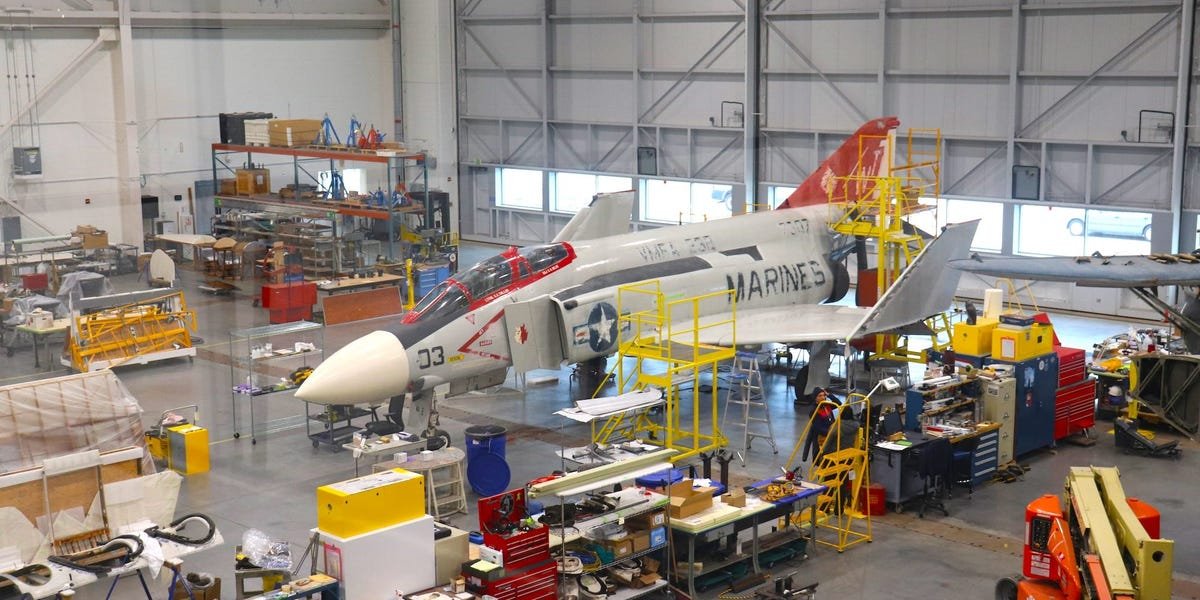
At the National Air and Space Museum’s Steven F. Udvar-Hazy Center in Chantilly, Virginia, staff members repair and preserve historic aircraft in an in-house restoration hangar that offers a behind-the-scenes look at the work that goes into maintaining the museum’s collection.


The Mary Baker Engen Restoration Hangar at the National Air and Space Museum's Steven F. Udvar-Hazy Center in Chantilly, Virginia.

The Mary Baker Engen Restoration Hangar at the National Air and Space Museum’s Steven F. Udvar-Hazy Center in Chantilly, Virginia.

Talia Lakritz/Business Insider


The Smithsonian museum’s second location, situated about 30 miles from the National Air and Space Museum’s flagship site in downtown Washington, DC, offers an expansive setting with 340,000 square feet of exhibit space.

The Mary Baker Engen Restoration Hangar, which is connected to the exhibits, can accommodate several aircraft at a time and houses everything workers might need, including a sheet-metal shop, a welding room, a paint room, and a fabric shop.

It also features floor-to-ceiling windows overlooking the hangar, allowing visitors to watch the work happening in real time.


Observation windows overlook the Mary Baker Engen Restoration Hangar at the National Air and Space Museum.

Observation windows overlook the Mary Baker Engen Restoration Hangar.

Talia Lakritz/Business Insider


Holly Williamson, public affairs specialist at the National Air and Space Museum, told Business Insider that visitors shouldn’t expect to see planes being built with the speed of a factory assembly line. Progress can be slow, with some restoration projects spanning months or years.

“This kind of will look like paint drying if you just sit here for the whole day,” Williamson said. “It’s a lot of research. It’s very detail-oriented.”

Despite the slow pace, there’s still plenty to see. One of the museum’s longer-term projects is “Flak-Bait,” a Martin B-26 Marauder that flew 202 combat missions during World War II, including D-Day.


“Flak-Bait,” a Martin B-26 Marauder.

Talia Lakritz/Business Insider


When the museum first opened in 1976, visitors were allowed to touch the aircraft’s nose, which wore down the paint. Workers have focused on restoring its appearance while preserving its authentic combat damage.

“It flew more missions than any other aircraft in World War II for the US, so we want it to look like it’s been through hundreds of missions,” Williamson said.

Another striking display is a Sikorsky JRS-1 seaplane, the only aircraft in the museum’s collection that was present at Pearl Harbor when it was attacked on December 7, 1941. After Pearl Harbor, the Sikorsky JRS-1 patrolled for Japanese submarines. It arrived at the Mary Baker Engen Restoration Hangar in 2011.


A Sikorsky JRS-1.

A Sikorsky JRS-1.

Talia Lakritz/Business Insider


Staff members are also working to restore a McDonnell F-4S Phantom II, a fighter and bomber that shot down an MiG-21 during the Vietnam War. After the Vietnam War, it underwent modernization and was redeployed in 1983, remaining in service until its last squadron duty in 1987.


A McDonnell F-4S Phantom II in the Mary Baker Engen Restoration Hangar.

A McDonnell F-4S Phantom II.

Talia Lakritz/Business Insider


The rest of the hangar floor is a maze of tools, machinery, aircraft parts, and storage bins, indicators of just how intricate the museum’s restoration efforts are.

Certainly more interesting than watching paint dry.


Source link