

Amanda Goh

Olympic skier Tess Johnson, 25, says one simple daily habit powers her performance — and it doesn’t involve the gym

Olympic skier Tess Johnson, 25, starts and ends every day with the same ritual that helps her perform under pressure.

In an interview with Town & Country Magazine published on Wednesday, the American mogul skier said she always packs her journal when she travels for competitions.

“I do a little bit of journaling in the morning to set my day, set my goals for the day and a little bit of gratitude, but then in the evening I let it all out and it’s a little bit like word vomit, but whatever I need to just get out to get a good night of sleep,” Johnson said.

Johnson made the US national team at 14 — the youngest athlete to do so at the time — and later became the youngest American freestyle skier to medal at the World Championships.

She debuted at the 2018 PyeongChang Olympics and reached the finals at the 2026 Milan Cortina Games, where she finished 10th.

Johnson, whose grandfather was a former Sports Illustrated writer who covered the Olympics, said journaling plays a key role in her mental preparation.

She believes she inherited her love of writing from her grandfather and now uses journaling as a practical training tool to track her progress in skiing.

“And also an emotional tool to just work through whatever anxieties are happening because this is a very intense sport and process that we’re going through,” Johnson said.

“It’s really helpful to get it all out on paper and sift through it just by putting pen to paper. So it does a lot for me. And at the very least, it’s just a way to stay present and get off my phone from time to time,” she continued.

Johnson added that she occasionally rereads her old journals, including those from the 2018 Olympics.

“It’s really cool to see the progress I’ve made over the years,” she said.

Apart from being a part of her daily routine, journaling is also a key part of her pre-race ritual.

“The night before I like to journal, whatever in training that day, any other thoughts that I need to get out. Then the morning of, I’ll write down three goals for the day, usually relating to my skiing or a mental performance goal, or just something even maybe not related to skiing, just that I have for the day, and then I’ll write down a couple things that I’m grateful for as well,” Johnson said, adding that she does her warm ups after that.

Johnson isn’t the only elite athlete who has embraced journaling as part of their routine.

Michael Phelps told Business Insider in 2023 that he uses writing to reflect and unwind, while WNBA star Caitlin Clark has incorporated journaling into her pregame ritual to clear her head and stay focused.

Meanwhile, other Olympians are leaning into surprisingly old-school hobbies in their downtime, including cross-country skier Ben Ogden, who said knitting helps him relax.


Source link

The-economy-is-growing-That-doesnt-mean-companies-are-hiring.jpeg

The economy is growing. That doesn’t mean companies are hiring more.

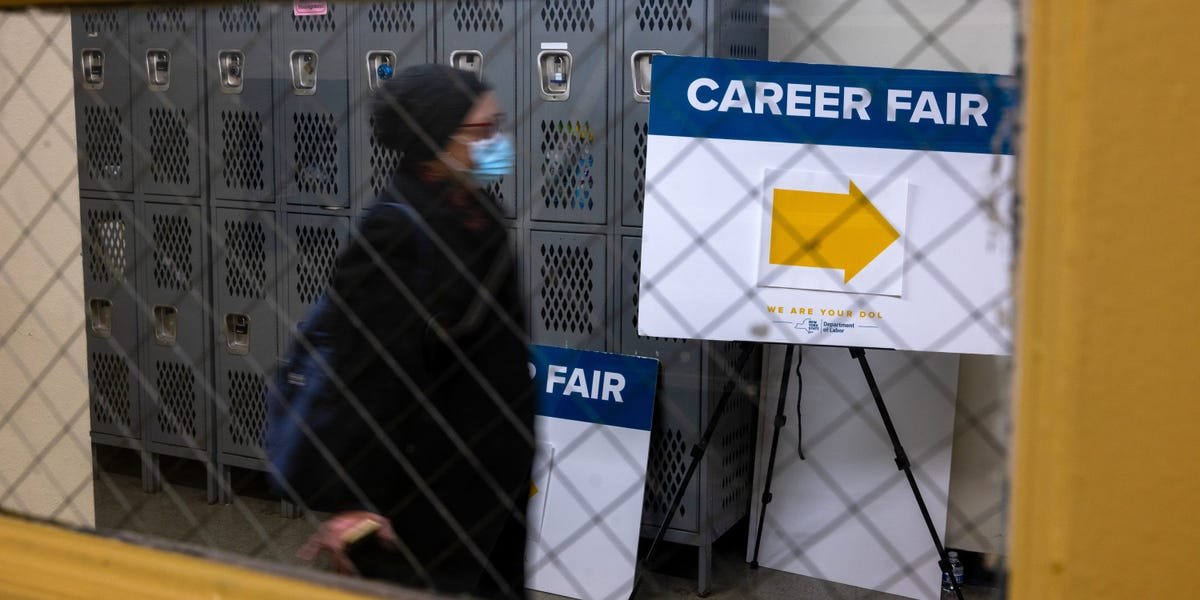
The US economy continues to surprise on the upside — except when it comes to jobs.

Hot growth, as seen in this week’s GDP report, typically corresponds to stronger hiring and personal earnings, which then enable consumers to continue spending. However, this year, the trend has been the opposite. Spending is driving the economy, but the job market is stuck in a “Great Freeze.”

As KPMG’s chief economist Diane Swonk wrote on Tuesday, “Growth and labor market outcomes have decoupled.”

It’s shaping up to be the story of 2026. The US has found itself in what some are calling a “jobless boom.” Money is flowing in and out of the economy at a healthy clip, but it’s not going toward creating a new job for you.

Instead, all eyes are on artificial intelligence, investment in which drove much of the year’s economic growth, along with still-strong consumer spending. The big AI investors were larger companies, including those that have led white-collar job cuts. In some cases, their profits have skyrocketed, and “do more with less” has been the mantra of the year.

“Firms are doing more with fewer workers,” Swonk wrote. “Many overshot on staffing during the hiring frenzy and are now using attrition or layoffs to bring staffing levels more in line with demand. Others are offsetting the squeeze on profit margins due to tariffs with layoffs and hiring freezes.”

Spend on essentials powered growth

Economists are still grappling with how the US ended up in this rare scenario. This year, although overall layoffs have crept up, they remain relatively low. Corporate America and Big Tech were the exceptions, with companies such as Amazon, Microsoft, Meta, Google, and Tesla announcing big cuts.

Business Insider has heard from dozens of white-collar job seekers who said that finding a new role has felt “impossible,” and those with jobs have, in many cases, held onto them for dear life.

In addition to a tough job market, consumers had no income growth last quarter. However, spending held strong — despite tariff uncertainty and stubborn inflation still above the Federal Reserve’s 2% target. A large percentage of this spending uptick was in healthcare and medical services, as costs for hospital and nursing services climbed. This year marks the most Americans have spent on healthcare services since 2022, when the Omicron wave of COVID-19 spread.

This suggests that, despite strong spending by affluent households, much of this rise in consumer spending wasn’t necessarily powered by confidence. In fact, consumer sentiment levels are among the lowest they have ever been, and many Americans have been cautious about spending because of tariff uncertainty.

The tough job market isn’t helping. Unemployment is at 4.6%, the highest since 2021. Total job growth has stayed slow.

Dozens of job seekers across generations told Business Insider this year that they were frustrated about suspected ageism, cumbersome hiring processes, competition with hundreds of others for a single role, and the suspected role of AI in screening out their applications. Some told reporters they’ve applied for thousands of roles with no interviews, while others said it took well over a year to get a single offer, often at a lower pay than their previous job.

2026 could be the year we see AI payoff — which may fuel an even bigger jobless boom

In his 2026 wish list for the business world, Business Insider’s Dan DeFrancesco asked for “ROI for AI.”

“I just want to see some noticeable returns on all these massive AI projects,” he wrote, referring to the eye-popping AI spending from Big Tech — and their plans for even more next year.

If that does come, the jobless boom may only grow. Companies want to use AI to boost productivity without hiring more people, which would only exacerbate a sluggish job market.

Although it’s difficult to determine if this year’s investments in AI have yielded results, the GDP’s spike to 4.3% in the third quarter is an encouraging sign overall. The largest growth since the third quarter of 2023 prompted President Donald Trump to say that the “Trump Economic Golden Age is FULL steam ahead.”

Still, many Americans may worry about what this means for their jobs. Some companies have cited the need to be efficient in an AI-driven future as justification for layoffs. The US already operates with fewer jobs than it had pre-COVID, and Federal Reserve Chair Jerome Powell has recently said that the grim jobs data may be overstating this year’s deflated gains.


Source link

Some-Tesla-shareholders-say-diverting-Nvidia-chips-is-further-proof.jpeg

Some Tesla shareholders say diverting Nvidia chips is further proof that Elon Musk doesn’t deserve a multibillion-dollar pay package

Several institutional shareholders of Tesla told Business Insider that Elon Musk’s decision to redirect a shipment of valuable Nvidia chips away from the EV company is further proof the CEO doesn’t deserve a multibillion-dollar pay package.

In May, a group of eight Tesla shareholders wrote a letter urging other investors to vote against Musk’s compensation package. The group is just one faction of a growing number of investors who said they plan to vote against the deal.

This package, now roughly worth $46 billion, was struck down in January by Delaware Chancery Court Chancellor Kathaleen McCormick, who said that the process to reach this “unfair price” for Musk was “deeply flawed.”

Tesla shareholders will vote on June 13 on whether to reinstate Musk’s deal.

But less than two weeks ahead of the shareholder vote, CNBC reported that Musk diverted a $500 million shipment of Nvidia chips, which are essential for powering artificial intelligence technology, away from Tesla and to his social media platform X instead.

The internal memo from Nvidia indicating Musk’s delay of the Nvidia chips procurement was from December, CNBC reported — months before the April earnings call in which the Tesla CEO insisted the automaker is an AI company. He also stated in the call that he would aggressively expand the number of Nvidia chips at Tesla from 35,000 to 85,000 units by the end of 2024.

In response to the CNBC report, Musk said on X that “Tesla had no place to send the Nvidia chips to turn them on, so they would have just sat in a warehouse.”

“The south extension of Giga Texas is almost complete. This will house 50k H100s (Nvidia chips) for FSD training,” Musk added, referring to Tesla’s Full Self-Driving feature — a key component of the company’s promise to deliver autonomous taxis.

But some of the shareholders behind the effort to strike down Musk’s big payday are not convinced.

“The diversion of Nvidia’s processors to X and xAI is just another example of Tesla’s CEO reallocating Tesla’s resources in favor of his other businesses and treating Tesla as though it is his own coffer as a result of the lack of oversight by Tesla’s board,” Tejal Patel, the executive director of SOC Investment Group, wrote in an email to BI.

Patel added: “The key questions are why were these valuable processors ‘just sitting there’ in the first place, and if it was an operational issue, why was that not foreseen by management? Whatever decision-making there was for the processors to go unused by Tesla would have been up to CEO Musk.”

Musk did not respond to a request for comment from Business Insider.

SOC Investment Group is one of the eight shareholders that co-signed a letter urging investors to vote against the ratification of Musk’s stock options package and against the reelection of Musk’s brother, Kimbal, and James Murdoch for seats on Tesla’s board.

The group — made up of pension fund managers, an asset management firm, and a bank — also includes Amalgamated Bank, AkademikerPension, Nordea Asset Management, New York City Comptroller Brad Lander, SHARE, Unison, and United Church Funds.

In a statement to BI, Lander wrote that Musk’s decision to divert Nvidia chips away from Tesla “should be a “red flag to investors.”

“This sudden move adds to the growing concerns about Musk’s commitment to Tesla and highlights his glaring conflicts of interest,” he wrote. “There is a pressing need at Tesla for a genuinely independent board that will ensure Musk prioritizes company interests.”

Matthew Illian, the director of responsible investing for United Church Funds, similarly criticized Musk’s move to delay the shipment of Nvidia chips, stating that it was “further evidence” that the pay package “never achieved its purpose of maintaining the attention of Tesla’s CEO.”

“This is all about Elon building an empire for himself with investor money and we can’t let this happen,” he wrote in an email to BI.

It’s not immediately clear how much Tesla stock the eight shareholders own altogether.

Five of the eight shareholders, including Amalgamated Bank, Unison, Nordea, the New York City Retirement System, and United Church Funds, represent more than 4.9 million shares of Tesla stock.

As of Thursday, those shares are worth more than $878 million.

Spokespersons for SHARE, Nordea, and Unison could not be reached for comment or did not immediately respond for comment.

In addition to the eight shareholders, the California Public Employees’ Retirement System (CalPERS), which owns about 9.5 million shares of Tesla stock, signaled it would vote against Musk’s pay package.

“We do not believe that the compensation is commensurate with the performance of the company,” CalPERS CEO Marcie Frost told CNBC.

A CalPERS spokesperson declined to comment when asked about Musk’s decision to divert the shipment of Nvidia chips.


Source link