
White-House-pushes-ahead-on-Golden-Fleet-and-the-new.jpeg

White House pushes ahead on Golden Fleet and the new Trump-class battleship with a request for billions of dollars for shipbuilding

President Donald Trump’s massive $1.5 trillion defense budget request includes $65.8 billion for Navy shipbuilding. It also establishes the new Golden Fleet, providing funding for the new Trump-class battleship, the White House said.

The fiscal year 2027 shipbuilding request is a marked increase over last year, underscoring the Trump administration’s push to expand the fleet and industrial base.

On Friday, the White House released its budget proposals for the upcoming fiscal year beginning in October. The $1.5 trillion request is a 44% increase and the highest in decades

“The budget restores the readiness and lethality of the force by ensuring America’s warfighters are trained, equipped, and medically ready to fight and win,” the White House’s overview says.

Key to that is more funding for shipbuilding. “As waters around the world become increasingly contested, it is imperative that the United States be able to efficiently deliver the various naval platforms it requires, including both battle force and auxiliary vessels, to ensure maritime domain awareness and deterrence,” the overview document said.

The White House shipbuilding request supports the construction of 18 battle force ships and 16 non-battle force ships, twice the number requested last year.

The budget request includes initial funding for the Golden Fleet, its centerpiece Trump-class battleship, and next-generation frigates. The new funding request also supports work on the Columbia-class and Virginia-class submarines, critical naval capabilities. It’s unclear where these vessels fit into the procurement plan.

The broader White House plan also funds sealift and hospital ships, tankers, submarine tenders, and shipyard upgrades aimed at easing production delays.


A Virginia-class submarine sits in ice with people standing on top of it.

The budget also includes current vessels being built, such as Columbia-class and Virginia-class submarines. 

US Navy photo by Mass Communication Specialist 1st Class Bryan Mai


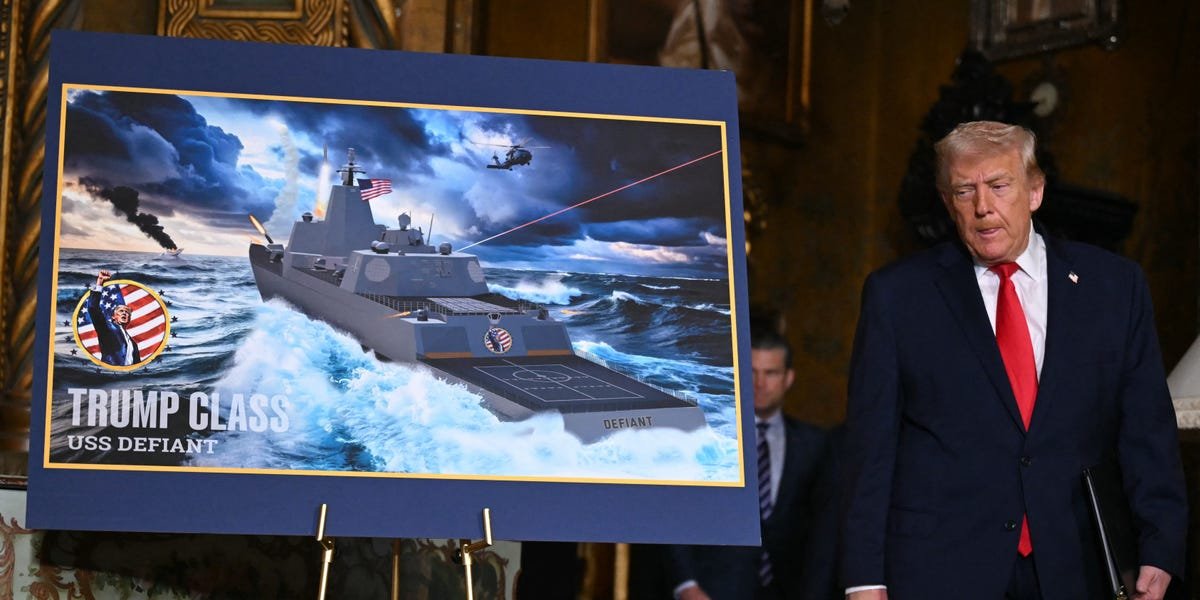
The Trump administration announced its plans for the “Golden Fleet” last December, as well as its desire to construct a new Trump-class battleship as flagship vessels. These ships are intended to deliver “dominant firepower and a decisive advantage over adversaries by integrating the most advanced deep-strike weapons of today with the revolutionary systems of the years ahead,” the Navy said.

John Phelan, the secretary of the Navy, said last December that “the future Trump-class battleship, the USS Defiant, will be the largest, deadliest and most versatile and best-looking warship anywhere on the world’s oceans.”

The White House budget request also funds the Golden Dome missile defense system and artificial intelligence adoption and continues the development of the Air Force’s F-47 sixth-generation fighter, with a first flight planned for 2028.

Additionally, the request points to 12 “critical munitions” that it plans to procure. One of DoD’s highest funding priorities, the overview said, these munition investments “would generate expanded capacity in America’s defense industrial base, providing a foundation for future scalable munitions production.”

The White House didn’t respond to a request on what those munitions are. Recent deals between industry and the Pentagon have expanded and accelerated orders for more Tomahawk cruise missiles, as well as Standard Missile-6 interceptors, Patriot Advanced Capability-3 (PAC-3) interceptors, and Precision Strike Missiles. These weapons have gotten a workout in the Middle East.

Drones and counter-drone technologies are also listed in the budget as priorities, with the White House saying it is seeking “unprecedented investments” in these systems.

The request said “this funding would arm America’s military combat units with drones while also providing protection against the proliferation of inexpensive and proliferated unmanned systems by near-peer competitors, rogue states, and non-state actors.”


Source link
Read-46-pitch-decks-that-creator-economy-startups-used-to-raise.jpeg

Read 46 pitch decks that creator-economy startups used to raise millions of dollars

The creator economy has bred a generation of startups — from influencer-marketing companies to new social-media experiences.

These startups have captured the attention and wallets of influential venture capitalists and angel investors over the last several years, giving rise to several unicorn valuations in the space.

Check out 16 VC firms investing in creator economy startups

Even as the economy has weathered changing tides and investments have cooled across industries, some startups in this sector are still raising money.

In 2024, three trends drove some of the largest deals in the creator economy: AI, social commerce, and newsletters. Several startups raised at least $10 million in new funding last year, such as AI startup Captions or newsletter platform Beehiiv.

Here are 17 creator-economy startups that raised more than $10 million in 2024

AI is continuing to fuel investor interest in the creator economy in 2025, too. For instance, Hedra, a generative AI startup used by some creators to make viral content, announced a $32 million Series A led by A16z in May.

Creators themselves, like Emma Chamberlain and MrBeast, are also raising venture capital for their businesses.

See the leaked pitch deck Chamberlain Coffee used

So, how do creator-economy startups land those investments? Often, it starts with a pitch deck. 

Lumanu, a creator-focused financial startup, uses a simple pitch deck that’s more of a “conversation guider,” its cofounder and CEO, Tony Tran, told Business Insider.

“My pitch is always why, what, how, and why now?” Tran said. (Read the full pitch deck here.)

Skye, a career-coaching startup, had different pitch decks depending on the type of investor or fund they pitched to.

“I had two different versions, depending on the fund,” said Jessica Wolf, Skye’s CEO and one of its cofounders. “If I knew a fund was more into pre-seed, all about the founder, I had one deck. But if I knew that they were a numbers person, I would use another one.”

Every startup has a different approach.

Some, such as Throne, even ditch the pitch deck altogether and opt for an email or Notion document.

Read the email template creator-economy startup Throne used to secure its seed investment.

We talked with founders who’ve pitched their startups to investors about their process. They broke down the pitch decks they used to secure millions of dollars in funding.

Read the pitch decks that helped 46 creator-focused startups fundraise millions of dollars:

Note: Pitch decks are sorted by investment stage and size of round.

Series A

  • Restream, a livestreaming alternative to platforms like the Amazon-owned Twitch: $50 million Series A (14 pages)
  • Hedra, a generative AI video platform: $32 million Series A (9 pages)
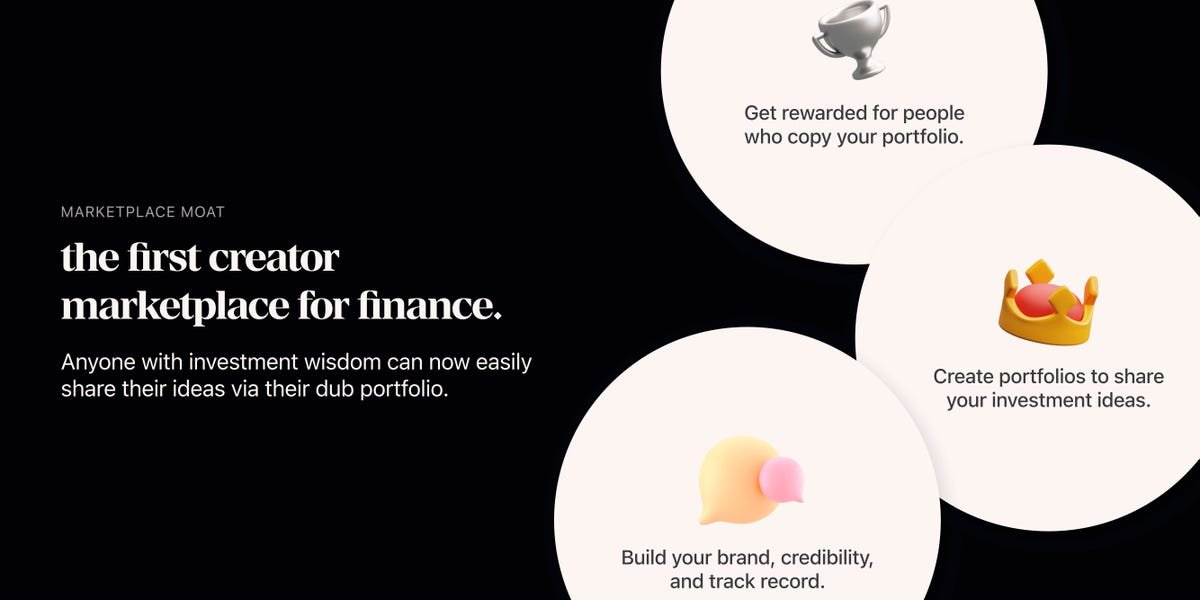
  • Dub, a fintech startup that lets people copy influencers’ stock trades: $30 million Series A (15 pages)
  • ShopMy, an affiliate platform that lets creators earn commissions through shoppable landing pages: $26.5 million Series A (23 pages)
  • Posh, an IRL events startup: $22 million Series A (12 pages)
  • Pearpop, a creator-marketing platform: $18 million Series A (18 pages)
  • Spoon Radio, a social-audio startup: $17 million Series A (15 pages)
  • Kyra, a content studio, talent-management firm, and influencer-marketing platform: $15 million Series A (20 pages)
  • Allstar, a startup helping gamers become social-media creators: $12 million Series A (6 pages)
  • Lumanu, a business-solutions platform for creators: $12 million Series A (8 pages)
  • Hype, a platform for link-in-bio and other creator-monetization tools: $10 million Series A (13 pages)
  • Catch+Release, a startup that helps creators and everyday social-media users license their content to brands: $8.8 million Series A (12 pages)
  • Slip.stream, a music startup focused on gamers: $7.5 million Series A (13 pages)
  • Brag House, an esports startup: $5 million Series A (24 pages)
  • CreatorDB, an influencer marketing company: $4.7 million Series A (13 pages)

Seed

  • Linguana, an AI video translation startup that is targeting YouTubers: $8.5 million (13 pages)
  • AvatarOS, a startup building virtual avatars for social media, gaming, and other immersive experiences: $7 million (11 pages)
  • Hypernatural, a generative AI startup that wants to be the Canva for video: $6.8 million (14 pages)
  • Scenario, a generative AI startup to create gaming art and assets: $6 million seed (8 pages)
  • Sesh, a music startup that connects artists and fans using their mobile wallets: $5 million seed (13 pages)
  • Authoritive, an online course-development startup: $5 million seed (11 pages)
  • Dstlry, a comic-book creator startup: $5 million seed (26 pages)
  • Dharma, a travel startup for creators and brands: $4.7 million pre-Series A (17 pages)
  • Glystn, an AI-powered community-management platform: $4 million seed (15 pages)
  • Daisy, an influencer marketing startup that launched in 2024: $3.9 million (9 pages)
  • Anima, an augmented-reality startup: $3 million (15 pages)
  • Grandstand, a sports startup working with athlete creators: $2.75 million
  • Seam Social, a new Web3 social-media platform: $2.5 million (10 pages)
  • Spark, a digital art platform from the YouTuber Moriah Elizabeth: $2.5 million seed (9 pages)
  • Insense, a startup helping e-commerce brands get low-cost ads: $2.5 million pre-Series A (9 pages)
  • Supercast, a podcast subscriptions startup: $2 million seed (20 pages)
  • Chartmetric, a music-data and -measurement company: $2 million seed (46 pages)
  • Ultimate Playlist, a music-marketing startup: $2 million round (9 pages)
  • Magroove, a music-distribution and -discovery platform: $1.6 million seed (21 pages)
  • Stagetime, a professional-networking startup for performing artists: $1.5 million seed (13 pages)
  • Jubilee Media, a content studio looking to expand beyond YouTube and TikTok: $1.1 million seed-plus (12 pages)

Pre-Seed

Other


Source link