
EV-owners-are-taking-a-victory-lap-as-gas-prices.jpeg

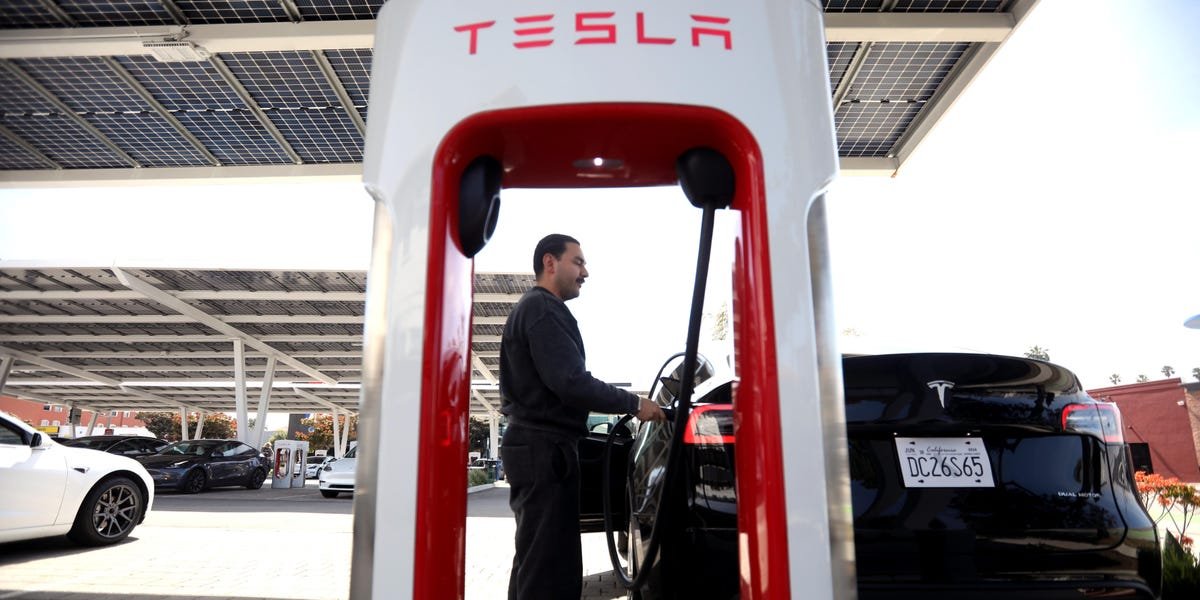
EV owners are taking a victory lap as gas prices skyrocket: ‘I had no idea, I drive a Tesla’

Tickers above American gas stations are flashing higher prices.

EV owners, meanwhile, are plugging in — and laughing about it online.

Across social media, electric-vehicle drivers are touting their savings as fuel costs climb during the US and Israel’s military interventions in Iran.

Many have posted meme-filled victory laps about the price of “filling up.”

One shared a compilation of a mustached Tom Selleck turning toward the camera with a smug grin in Magnum P.I.” Others are posting screenshots of their cheap charging sessions. Some are sharing gleeful TikToks while plugging their EVs into a home charger.

Juicy J — the cofounder of Three 6 Mafia and a producer of the Academy Award-winning song “It’s Hard out Here for a Pimp” — also weighed in, saying it was “time to go full electric.”

Gas prices have surged as military strikes in the Middle East disrupted oil production and heightened fears about tanker traffic through the Strait of Hormuz — a key artery for an estimated 20% of global oil and liquified natural gas shipments.

Brent crude climbed over $100 a barrel Sunday night as traders reacted to the instability. By Monday afternoon, the price had dropped back to the low $80s.

American drivers are paying more at the gas station. On February 21 — before tensions escalated — the average price of a gallon of regular gas in the US was $2.93, according to AAA.

By Monday, it had risen to $3.48, an 18.7% jump in 15 days.

In some areas, the increases have been even steeper. A Los Angeles gas station advertised prices above $8 a gallon, according to local ABC affiliate KABC.

Public EV charging rates, by contrast, have risen far less.

Over the same period, the national average price per kilowatt-hour at public charging stations increased from $0.39 to $0.42 — a 7.6% bump, according to AAA data.

And most EV owners charge at home, where electricity rates are typically lower and less directly tied to crude oil prices than gasoline.

“I had no idea,” one driver wrote on X about oil prices. “I drive a Tesla.”

Some users on X pointed out that charging costs vary widely by state and utility provider.

In regions where electricity generation relies heavily on natural gas, power prices could rise if energy markets remain volatile.

For example, in Kansas, EV charging costs about $0.30 per kilowatt-hour, according to AAA. In Louisiana — where charging stations are more sparse — the average is $0.47.

The online gloating comes at a complicated moment for the EV market. Even as gas prices heat up, sales of electric vehicles have cooled.

In January 2026, sales of EVs at American dealerships fell by 53.5% compared to the same month last year, per CarGurus’ data shared with Business Insider.

Even as EV sales shrink, Americans who have traded in the gas tank for the battery are taking this time to bask in their money-saving glory.

“Who’s glad to have an EV during this time of high gas prices?” one person wrote on Reddit. “I guess not having to deal with the ups and downs of gas prices is one of the benefits of owning an EV.”

Are gas prices affecting your daily travel? We want to hear from you. Contact Ben Shimkus at bshimkus@insider.com or Signal at bshimkus.41. Use a personal email address and a nonwork device; here’s our guide to sharing information securely.




Source link

I-have-the-best-talks-with-my-preteen-son-when.jpeg

I have the best talks with my preteen son when I drive him to school in the morning. I hope he knows I’m always here for him.

When my son was still under 5, I worked at the local library. In my free time, my son was basically my best buddy. My supervisor at the time had teenagers, so she was in a different parenting stage than I was.

I remember her saying that the secret to keeping her kids close was to drive them around as much as possible. This kept her kids talking to her and enabled her to maintain close relationships with them.

She was so right with her advice.

My son is now a tween

My son just turned 12, and the shift from boy to teenager seems to have happened overnight. He is becoming more independent and less talkative — with me, but not his social circle.

I know it’s the natural order of things for him to spread his wings and to push back a bit against me. But sometimes I just really miss my best buddy and all the fun we had spending time together when he was little. Now, when he’s home from school, he’s often in his room talking on the phone with his friends or playing games online with them.

I think my former boss’s wisdom stuck with me, because the idea of my son growing up and not wanting to talk to me scared me. I’ve come to realize that driving my son around whenever I get the chance is basically priceless. Right now, drives with him are primarily to and from school, but during football or basketball seasons, all of the practices and games really add up. This year, sixth grade has really felt like a turning point, because I’ve noticed an increase in invites to parties, hangouts, and sleepovers.

I realize that as he gets older, these social outings will only increase. And then one day, when he’s closer to age 16, he’ll likely have a part-time job to add to his schedule. As long as he doesn’t have a car, I know I’ll be his main source of transportation. Instead of dreading, I know these are actually the hidden opportunities, like diamonds in the rough, to remain connected to him as he grows up.

It’s best to allow our conversations to flow naturally

I never try to force a topic on him, because I have found that it’s not the best timing for discipline-based or serious talks. I’m sure he feels trapped, so he shuts down, and it ruins the safe space I’m trying to develop out of our car rides. Allowing the conversation to flow organically is when he’ll surprise me and ask me something random or open up about something that’s been bothering him.

Even if he doesn’t open up every time, I know I’m giving him the space to do so. Often, after a few minutes of being stuck in the car together, one of us will start talking about something. I think having the music on and sightseeing on our way everywhere gives our brains distractions and talking points. It feels like the car is sometimes the white flag zone, where we stop arguing and start talking again.

While he’s mostly reserved, there are other times when he’s more open and chatty, and I just let him vent and do my best to listen. It’s likely therapeutic to have someone who will just listen to him at his age, but it might also be easier for him to open up to me side-by-side instead of face-to-face. Knowing there’s an endpoint, such as knowing we’ll be at his school in five minutes, likely helps too.

I hope I’m also sending him the message that I won’t stop showing up

Willingly taking him everywhere he needs to go daily, I think, is communicating to him that I’m not going to stop showing up for him. That no matter how tense things may be at times between us, I’m going to continue to be there for all of it.

I think it reassures him that I’m not going to give up on my job as his mom, even when things get tough. I’ll be sitting there in silence if that’s what he needs, but the message I hope to send him is: I’m still here.


Source link

Rivian-CEO-says-it-may-be-inconceivable-to-buy-a.jpeg

Rivian CEO says it may be ‘inconceivable’ to buy a car that can’t drive itself by 2030

Rivian CEO RJ Scaringe said self-driving capabilities will be a “must-have” in a car in the “very near future.”

Speaking on a “No Priors” podcast interview, released on Thursday, Scaringe talked about how autonomous cars would become the norm by the end of the decade.

“I think by 2030 it’ll be inconceivable to buy a car and not expect it to drive itself,” Scaringe said. “Maybe that’s sooner. We hope it’s sooner, we’re targeting a little sooner than that.”

He added that today, it is hard to imagine buying a car without airbags or air conditioning, which “at one moment in time were optional.”

“I think in not too much time, a couple of years, it’ll be hard to conceive of buying a car that can’t drop you at the airport or pick up your kids from school,” Scaringe said.

Scaringe previously said that, beyond just being able to drive themselves, autonomous vehicles should progress to a point where they can run errands, such as getting items from the store or ordering spare car parts.

Rivian is one of the handful of US-based automakers making inroads into the self-driving vehicle space, along with Tesla, Alphabet’s Waymo, and Ford. They face strong competition in markets outside the US, where Chinese competitors like BYD, XPeng, and Baidu have gained market share.

Rivian, based in Irvine, California, is expected to start delivering its R2 SUV later in the year. This model is its cheapest EV to date, priced at $45,000.

Rivian released earnings on Thursday, reporting a full-year 2025 revenue of $5.39 billion, which was an 8% increase from 2024. The company said in the earnings report that it had delivered 42,247 vehicles to customers in 2025.

The company’s stock price dropped 5% after earnings but rose about 15% in after-hours trading. It’s up about 12% in the past year.


Source link