
Americans-are-drinking-less-than-they-have-in-decades-Trump.jpeg

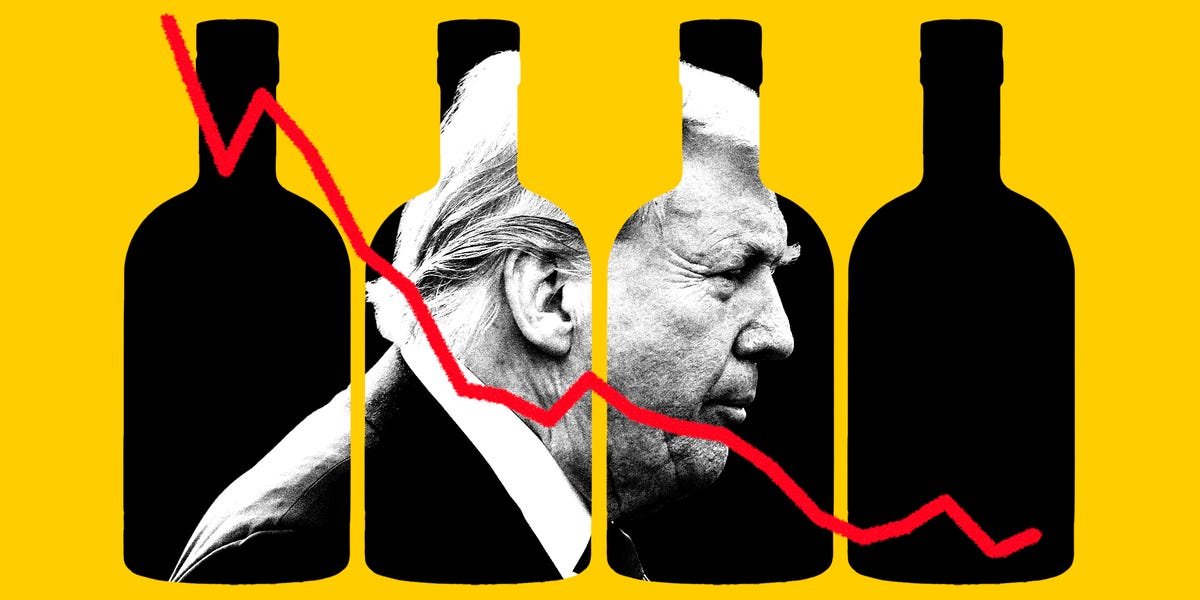
Americans are drinking less than they have in decades. Trump policies are driving the slowdown.

Donald Trump is giving Americans a fair amount of reasons to drink these days — threatening to obliterate Iran, or flirting with a takeover of Greenland. But the president is, perhaps counterintuitively, also part of why people are laying off the booze. Trump’s policies and rhetoric are killing America’s buzz.

Americans are drinking less than they have in decades. While a long-term cultural shift toward moderation is very real, the immediate cyclical indicators — meaning the regular ebbs and flows — are all pointing down. And Trump is nudging them in that direction.

The amount of alcoholic beverages consumed across major markets declined by 2% in 2025, according to data from drinks data company IWSR. In the United States, volumes were down by 5%. Consumption of beer, wine, and spirits all fell. (The only bright spot: ready-to-drink cocktails, which are getting more popular.)

A lot of what’s going on here isn’t about Gen Z being teetotalers or American adults being spooked about alcohol causing cancer — it’s about the economic and political environment. People are drinking less because of the ongoing affordability crisis. The Trump administration’s aggressive immigration policies have had a chilling effect on Hispanics’ consumption. All the tariff whiplash has been far from fun for the alcohol industry. Mounting uncertainty has consumers uneasy and, in turn, taking a break from the bar.

Marten Lodewijks, the president and managing director of IWSR, says the woes for the booze industry is an example of “death by a thousand cuts.”

It just so happens that the president of the United States is the one holding the knife.


Americans are forgoing adult beverages for a multitude of reasons, most of which boil down to pressures on their wallets. While the president says the economy is “roaring,” the data suggest otherwise. Prices have fallen as Trump promised — they’re up by some 25% since 2020, and the most recent inflation data show signs of reacceleration. The war in Iran has pushed average gas prices in the US above $4 a gallon. Consumer sentiment is at a record low. Student loan payments are ramping back up. Healthcare costs are through the roof.

“We are seeing the pressure on affordability escalate,” says Nadine Sarwat, an analyst who covers beverages and cannabis at Bernstein.

Now, everyone gets a single glass of wine with dinner and goes home.

Tariffs have been a complicated piece of the puzzle. On the corporate side, the will-he-or-won’t-he dance around import taxes has made planning and forecasting hard. Large manufacturers have largely managed to eat the varying tariff costs, aware that jerking around prices could turn off wary consumers. But even the Supreme Court striking down many of the president’s blanket tariffs hasn’t left the industry in the clear. Aluminum tariffs are still in place, which hurt beer brands that need it for their cans. They especially sting now that aluminum prices have skyrocketed, in part due to the Iran war.

“A fair amount of aluminum goes through the Strait of Hormuz, and it is very energy-intensive. So when energy prices go up, aluminum prices go up,” says Bart Watson, the president and CEO of the Brewers Association, a trade association that represents craft brewers. Some members have seen the price of their cans increase by 25-30% this year, he says.


beer manufacturing cans

Trump’s tariffs on aluminum have increased the cost of cans for beermakers. 

Bloomberg/Getty Images


Alcohol is recession-resistant, but it’s not recession-proof. Drinkers are looking for ways to cut spending, and that Friday six-pack is discretionary-ish. Sarwat says this moment looks different than during, say, the Great Recession, when consumers traded down to cheaper brands and bought bigger pack sizes to get more bang for their buck. Instead, people are sticking to the more premium brand they like, but opting for smaller pack sizes to save money. Or they’re grabbing canned cocktails — the aforementioned bright spot for the industry — even if a bottle of wine or vodka may have been the more logical economic choice.

“This cycle is a lot more about cash outlay and perceived value for money as opposed to actual value per unit of alcohol,” she says.

Eye-popping prices at bars and restaurants are also prompting people to cut back. A night out with friends used to be a pre-dinner cocktail, a shared bottle of wine with the meal, and a nightcap. Now, everyone gets a single glass of wine with dinner and goes home.


Trump’s economy isn’t the only thing giving drinkers the heebie jeebies.

ICE crackdowns and tougher immigration enforcement, on top of economic concerns, have had a widespread chilling effect on Hispanic consumers. In January, Constellation Brands CEO William Newlands said on an earnings call that Hispanic consumers were the main reason its beer category was “challenged” as they were being much more careful about their spending. (Constellation’s portfolio includes Corona and Modelo.)

“There was just a reduction in foot traffic as Hispanic consumers went to places they felt safe, didn’t stretch out and take any risky trips or unnecessary trips, and that’s historically a very big beer-drinking cohort,” says Dave Williams, an alcohol industry analyst and consultant.

Hispanic consumers have also been more nervous about going to work, leading to reduced income and, in turn, less spending. It does, however, appear they are beginning to revert to the norm. In its April earnings call, Constellation said they’re buying again.

There was just a reduction in foot traffic as Hispanic consumers went to places they felt safe.

The decline in international tourism to the US has taken a bite out of sales for bars and breweries in areas that generally depend on those travelers for traffic. Watson, from the Brewers Association, says Canadians refusing to come south of the border is smarting for some of their members.

“Talk to breweries in Vermont, they’ll say, ‘Yeah, traffic’s down,'” he says. “For the national numbers, does it move them a ton? Probably not, but at the margins and for individual members matters a lot” He adds that “snowbird places,” such as California and Florida, have complained of people “just not showing up” this year and last from abroad.

Angry Canadians are hurting America’s whiskey industry, too. Many stores up north pulled US-made products off the shelves after Trump started talking about making Canada the 51st state and antagonizing the US’s ally, and they haven’t put those products back.

“The entire Canadian population basically said, ‘No, we’re not supporting this industry and this country,'” Lodewijks, from IWSR, says. Anecdotally, he’s heard similar things have happened in Germany and France.


To be sure, the Trump administration isn’t all bad for the alcohol industry. One important bright spot: The White House’s new dietary guidelines, released in January, were pretty ambivalent about alcohol and advised people to “limit” intake without offering specifics. Dr. Mehmet Oz, the administrator for the Centers for Medicare and Medicaid Services, was even more lenient. At a White House briefing, he said alcohol is a “social lubricant that brings people together,” and while ideally people probably wouldn’t drink, the health benefits of getting together with friends may mean that the deleterious effects of a few beers come out in the wash. “The implication is don’t have it for breakfast,” he said.

It may not be a ringing endorsement, Williams says, but the messaging from the White House “didn’t make it any worse than it was in the mind of the consumer.”

Consumers have a lot weighing on them, and the economy and the world feel increasingly uncertain. This level of uncertainty doesn’t usually bode well for alcohol. As a general rule, election years aren’t good for booze consumption, and while 2026 may not be a huge election year (though it’s not an insignificant one), it is one filled with a lot of unknowns.

“We can all agree that the political situation remains very tumultuous,” Lodewijk, putting it lightly, says. The conflict in Iran escalates and de-escalates by the hour. Rising oil prices threaten to put everything from grocery store staples to summer vacations out of reach. In the US and in the world, it’s a volatile moment, and much of that volatility is emanating from the Oval Office.

The alcohol industry has a lot of problems right now, and Trump is, indeed, one of them.


Emily Stewart is a senior correspondent at Business Insider, writing about business and the economy.

Business Insider’s Discourse stories provide perspectives on the day’s most pressing issues, informed by analysis, reporting, and expertise.


Source link

Im-at-CES-in-Las-Vegas-to-check-out-the.jpeg

I’m at CES in Las Vegas to check out the latest in autonomous driving. Here’s what I’ve learned so far.

  • Robotaxis and autonomous cars once again have a large presence at CES 2026.
  • Several companies, including Amazon’s Zoox, are providing off-site demos.
  • Business Insider is providing an on-the-ground look at the latest in the advanced mobility space.

Business Insider is taking on CES 2026.

I’m on the ground in Las Vegas from Tuesday to Thursday, taking in all there is to know about the latest in the driverless space.

Robotaxis and self-driving cars have already had an outsize presence at the tech conference, especially in the previous hype cycle of the late 2010s and early 2020s.

Things have changed since then. The industry has largely moved on from mere concepts and technology validation to: How are we going to realistically scale autonomy?

It’s day one of the conference, and there’s already a lot to take in.

Nvidia CEO Jensen Huang unveiled the Alpamayo family, which will serve as an autonomous-driving stack for OEMs to deal with those stubborn edge cases — or the “long tail” of self-driving.

Uber and Nuro showed off an early look at the Lucid Gravity SUV that the companies hope public riders will be able to take by late 2026.

I’ll be spending less time at keynotes and speaker events and more on real-life demonstrations and meetings with industry leaders and commentators in autonomy

Think of this as my personal notebook, where I jot down everything I’ve learned and seen at the conference.

Check back in for more updates.

Amazon-backed Zoox is unlike any other robotaxi.

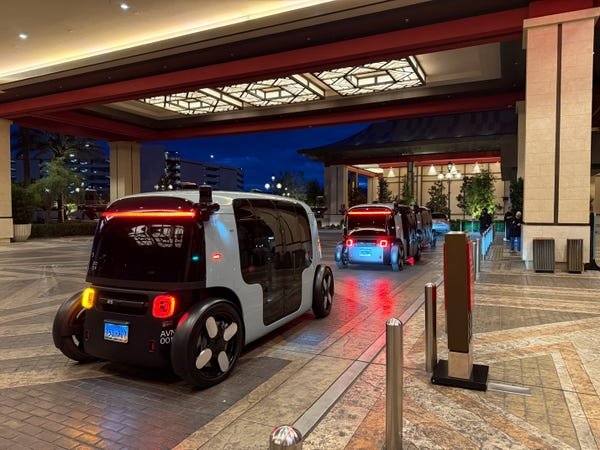
Zoox robotaxis line up in front of Resorts World Las Vegas

Lloyd Lee/BI

This is the first year Zoox, an Amazon-backed robotaxi company, will be giving live demonstrations of its service during CES.

I got to take a ride in one on Monday night in front of Resorts World. (The company tagline that I saw from an ad at the Harry Reid International Airport was: “Don’t just do the Strip. Zoox it.”)

My immediate thoughts were that Zoox feels unlike any other robotaxi or pseudo-robotaxi on the market. It felt more like I was on a theme park ride than in an everyday car we’re familiar with.

Unlike Waymo’s robotaxis, Zoox is not a regular car you could buy that’s been retrofitted with sensors. The Zoox car is bi-directional — meaning there’s no real front or back of the car — and the inside has no steering wheel, just seats.

The robotaxis were clearly a great tourist attraction from what I saw. My Uber driver wasn’t too happy about them.

Uber, Lucid, and Nuro have big plans to scale.


Uber, Lucid, Nuro

Left to right: Uber’s Sarfraz Maredia, Lucid interim CEO Marc Winterhoff, and Nuro cofounder Dave Ferguson.

Lloyd Lee/BI

Uber, Lucid, and Nuro had a swanky cocktail hour at Fontainebleau Las Vegas, where they quite literally wined and dined a room full of reporters, analysts, and investors: endless glasses of wine and an open bar, lobster tails, jumbo shrimp, too many appetizers to count, and a giant charcuterie board — the works.

Maybe understandably so? 2026 will be a big year for the three companies.

Uber’s plan is to roll out a robotaxi service by late 2026. The first market is San Francisco, where Uber will directly compete with Waymo. These two companies are partners in other markets, like Austin.

“We’ve been moving very, very quickly,” Nuro’s co-CEO and cofounder Dave Ferguson said. “We signed this partnership last July. We’re already testing the production-intent vehicles on public roads. And very soon, we’re going to have tens of thousands of them worldwide.”

Here’s a 60,000-pound John Deere combine for scale.


John Deere

John Deere’s X9 combine.

Lloyd Lee/BI

A quick image to get a sense of how big CES’s mobility division is at West Hall of the convention center: There’s a 60,000-pound combine from John Deere that’s sitting in the middle of the showroom.

The combine is one of the world’s largest on the market, according to Julian Sanchez, an engineer at the machinery company.

Even so, John Deere doesn’t even have the largest footprint on the floor. This year, it’s Hyundai.

The combine isn’t autonomous in the way we think about self-driving cars, Sanchez told me, but it is self-steering.

The world got a reality check on self-driving cars since the last hype cycle.


Tensor

Tensor aims to sell a personally-owned vehicle that will have Level 4 driving.

Lloyd Lee/BI

There’s a lot of talk of self-driving cars in the automotive industry, but the scope of what it can realistically achieve has narrowed down in the last decade or so.

Paul Costa, an ex-Apple veteran of 25 years who worked on the company’s abandoned self-driving car project, gave me a bit of interesting color from what he saw at CES in 2015 — when the driverless car hype was reaching its peak — and what’s different now.

“My sense at the time was that people really wanted to focus on Level 5 autonomy,” Costa, who now leads Ford’s electrical engineering team, told me. Level 5 is the highest level of autonomous driving set forth by the Society of Automotive Engineers. That means full autonomy in all weather conditions and no geofences. Waymo is currently Level 4.

The tone has been brought down to reality, according to Costa. The focus is on highly advanced driver assistance systems and eyes-off driving or Level 3 systems, he said.

“Now, I feel like here in 2026, L3 is extremely interesting,” Costa said. “It’s interesting for me to see how the industry — its focus has changed over the years.”

Signup Today: Connectivity and Tech Pro by Business Insider Intelligence


Source link

Americas-economy-is-getting-swallowed-up-by-middlemen-—-and.jpeg

America’s economy is getting swallowed up by middlemen — and it’s driving people crazy

Bill Gates has been right about a lot of things over the years — Microsoft, mosquito nets, the risk of pandemics. One thing he was not so right about: the idea that the internet would cut out the economy’s middlemen. In his 1995 book “The Road Ahead,” Gates predicted that the information highway would “extend the electronic marketplace and make it the ultimate go-between,” leading to a scenario where the only humans often involved in a transaction would be the actual buyer and seller. Given that you are alive in this current time, you already know that is not what happened. Instead, the internet gave way to a new class of commercial go-betweens. Amazon connects gift givers to makers of novelty socks that the recipient will almost surely never wear. Uber serves as the conduit between driver and rider. DoorDash connects (and takes a hefty fee from) the begrudging restaurant and the lazy eater. And while some more analog middlemen — sorry, travel agents — have withered, others in industries from pharma to meatpacking have tightened their grips.

Middlemen are a necessary evil in many parts of the modern economy. Supply chains are increasingly complex, so someone has to manage coordination and logistics. Consumers demand convenience, which middlemen provide. Suppliers don’t have a choice — they have to go where the people are, even if that means signing up for a delivery app or e-commerce platform that gives them a raw deal. The result: an economy where the real power doesn’t lie with the businesses making goods or performing services but instead with the intermediaries that control access and quietly set tolls.


The problem with middlemen isn’t their existence. If I’m in the mood for chicken for dinner, I don’t want to drive out to the chicken farm to pick a little guy out — that would take a lot of time, and I am not an expert in what makes a good chicken. I want to be able to go buy it from the grocery store, which relies on Tyson and other middlemen to pick it up and process it. Everyone has a part to play in getting the fowl from the farm to my face. The issue is that middlemen gain so much bargaining power that both the chicken farmer and I are in a bind in terms of the conditions of his contract with Tyson and my ability as a consumer to shop around, and neither of us has full visibility into the steps along the supply chain.

“What these intermediaries do is they try to stand between buyer and seller, and the way that they impose their taxes or take rates on, typically, the sellers is very opaque to the buyers,” says Hal Singer, the managing director of Econ One, an economic consulting firm.

Opacity is a middleman’s superpower. Most consumers have no idea how much Amazon charges sellers on its platform, what Apple or Google skim off the top of app sales, or what amount a pharmacy benefit manager is keeping for itself. This hidden tax is often ultimately passed on to the consumer because the seller increases prices to offset it. And, it’s hard, if not impossible, to get around. Amazon and Apple deter sellers and developers from steering customers to cheaper channels. Credit card companies try to compel merchants to accept all of their cards, regardless of the swipe fee. Food distributors allow farmers little leverage over contracts and pay, and some consumers come to suspect they’re not playing fair, price-wise.

In this day and age, if you sell stuff online, you can’t not be on Amazon.

Across industries, the pattern plays out — middlemen lock in customers with convenience and lock in suppliers with access. Intermediaries merge or acquire each other until they become entrenched or leave people with few other options.

“Once a platform aggregates millions of buyers and sellers, whether it’s Amazon’s marketplace, a PBM’s drug formulary, or a ride-hail app, over time, contracts, software, and even regulations get written around those intermediaries, turning them from optional helpers into infrastructure,” says Anindya Ghose, a business professor at NYU’s Stern School of Business, in an email.

In this day and age, if you sell stuff online, you can’t not be on Amazon. And if you manage to avoid buying anything as a consumer on Amazon, bless you.


Some of the ways middlemen become so big and powerful can feel almost inevitable. Supply chains are long and convoluted. Consumers value ease. Suppliers want to offload their products quickly. Economies of scale are an advantage. Middlemen can connect buyers and sellers who wouldn’t otherwise find each other, developing niche expertise that has value for both ends of the equation.

“The way that they’ve grown is not that they were kind of started with this evil intent of taking over the economy. No, they grew in power because they were providing a very real service, but in the process of providing that service, they are very often also erecting blinders that limit us and our ability to see the effects of the decisions that we’re making,” Kathryn Judge, the author of “Direct: The Rise of the Middleman Economy and the Power of Going to the Source,” told me in a 2022 podcast interview.

A lot of what middlemen solve for are fixed costs, explains Matthew Grant, an assistant professor of economics at Dartmouth College. They make investments to set up and maintain infrastructure and markets that smaller businesses can’t undertake as one-offs on their own. If you’re a bookseller or a small farmer, owning and operating a global transportation network, writing up hundreds of contracts, and building out extensive legal and accounting teams isn’t really feasible. To offset those costs and generate meaningful profits for taking on all that work, middlemen gain significant market share and leverage it to recoup their expenses.

“In practice, there aren’t too many other companies that are trying to be Amazon because they know if they tried it, it would not make money,” Grant says.

High fixed costs foster high barriers to entry, which lead to a handful of dominant intermediaries. It’s central to the business model.

Middlemen come with trade-offs. Walmart has cheap prices, but if it squeezes local retailers, it also means fewer choices. Sysco is a convenient partner for restaurants and other food service operations, but it gets to call a lot of shots with suppliers and buyers if it’s the only game in town. Uber is nice for users who want to avoid flagging down vehicles in the street, and its drivers get an extra way to make money. But it’s killed off how we used to do this — taxis — and a lot of drivers and riders feel like ultimately they’re getting screwed.

If there aren’t many other competitors, or none at all, middlemen get to charge whatever they want. People on both sides start grumbling about how they’re either paying too much or not getting paid enough, and it feels like neither side is getting a good deal. That’s where you get complaints about fees on ticketing platforms while artists bemoan how unsustainable a music career is. Mystery charges on food delivery frustrate both eaters and restaurants. Both guests and hosts on vacation rental websites realize this would be a better deal for both parties if they could negotiate directly.

Consumers and producers end up griping about each other while the middlemen quietly skate on by.

“A very simple way to think about it is that a middleman increases the size of the pie,” says Marina Krakovsky, the author of the book “The Middleman Economy: How Brokers, Agents, Dealers, and Everyday Matchmakers Create Value and Profit.” “But then how big a slice do they take for themselves?”

In many cases, it’s a pretty big one, as being a behemoth middleman is a lucrative endeavor. Amazon booked $638 billion in sales in 2024, Uber generated $44 billion in revenue, and Sysco reported $80 billion in sales. Pharmacy benefits managers, which sit between health insurers and drug manufacturers, rake in billions of dollars a year through a web of fees, price spreads, and rebate sharing that’s almost impossible for a layperson to untangle, and they often drive up prices, too.

“Collectively, these intermediaries sit on top of major money flows,” Ghose says.

Parties on either side of the transaction the middleman is facilitating might not always know who to blame. Buyers on a secondary ticket market get mad at the seller when their tickets don’t come through, when in reality, it’s the platform itself that failed to do its due diligence. The delivery guy thinks the customer is a cheapskate after driving through a storm for a minuscule tip, without realizing the platform prompted that option. The restaurant patron is appalled by the menu’s high prices, while the restaurant owner is barely making it through the month. Consumers and producers end up griping about each other while the middlemen quietly skate on by.


The answer isn’t that there should be no middlemen — again, I am not interested in making weekly trips to the chicken farm, or any farm, for that matter. But it would be better if there were more rules of the road to ensure they don’t turn convenience into oversize markups and exorbitant profits. That could take a lot of different forms — increased transparency, more regulatory oversight and enforcement, new laws, or different efforts to ensure competition. Perhaps disclosure requirements for platform fees or restrictions on anti-steering clauses. But given how entrenched — and opaque — these go-betweens can be, wrangling their power has proven to be a tough task.

If an industry has one middleman, it’s a problem. The same goes for if it’s four and they’re all colluding.

“One of the problems and probably a predicate is how concentrated all these markets are,” Singer says.

“It would be great if we had a choice of middlemen and they were competing with each other to be the best middleman they can be on price, on quality, on ethics, and everything,” Krakovsky says. “And often we lose that.”

And so, here we sit, in an economy dominated by middlemen, telling ourselves we’ll do better this holiday season and not rely so much on Amazon, and then deciding maybe that’s better as a New Year’s resolution.


Emily Stewart is a senior correspondent at Business Insider, writing about business and the economy.

Business Insider’s Discourse stories provide perspectives on the day’s most pressing issues, informed by analysis, reporting, and expertise.


Source link