
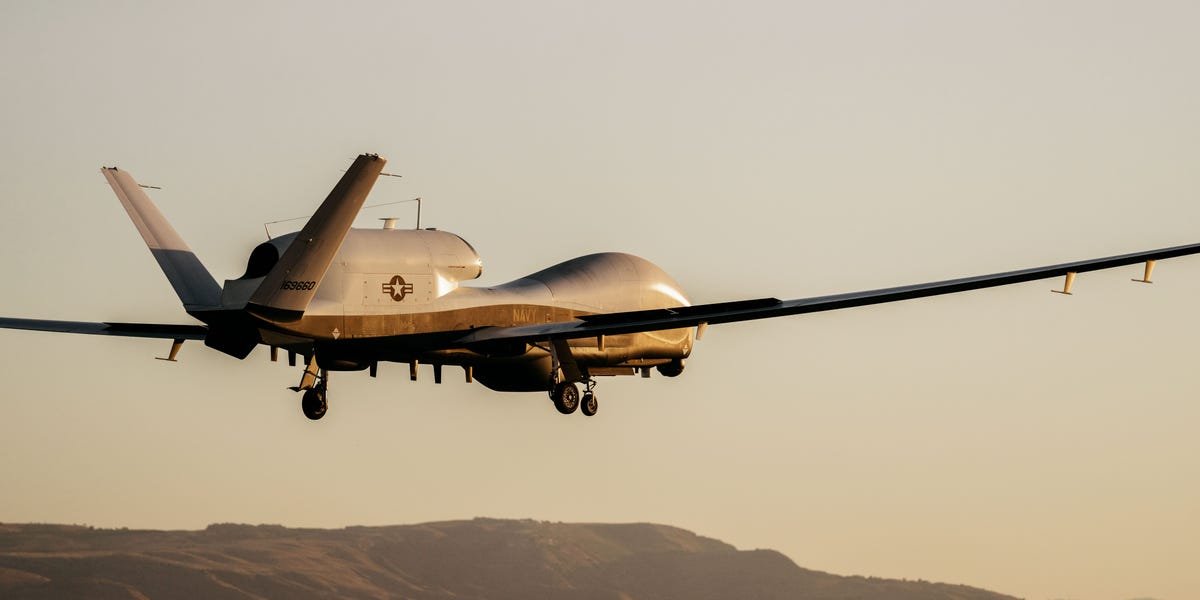
US-Navy-reveals-it-lost-a-240-million-spy-drone.jpeg

US Navy reveals it lost a $240 million spy drone during the Iran war

The US Navy has confirmed the loss of an expensive spy drone amid the Iran war, its first known loss of this particular uncrewed aircraft.

Naval Safety Command revealed in a new aviation mishaps report that an MQ-4C Triton crashed on April 9, with no injury to personnel. The document did not specify where the drone went down, citing operational security.

Last week, an MQ-4C out of Naval Air Station Sigonella in Italy was flying a mission over the Persian Gulf when it suddenly and rapidly descended and disappeared from flight-tracking sites, leading to speculation that it had crashed in the Middle East.

The Navy report listed the MQ-4C under “Class A” mishaps, meaning the incident caused more than $2.5 million in damage and/or destroyed the aircraft. The designation is also used to indicate that an accident caused a fatality or permanent total disability, though that doesn’t appear to apply in this case.

Neither US Central Command, which oversees American operations in the Middle East, nor the Navy provided a comment on or an explanation for the MQ-4C crash. The War Zone, a military news site, first reported the drone’s inclusion in the mishap report.


Aviation Electronics Technician Second Class Matt Belvery, assigned to Unmanned Patrol Squadron (VUP) 19, conducts post-flight checks on an MQ-4C Triton at Naval Air Station (NAS) Sigonella, Italy, Jul. 2, 2024.

MQ-4Cs are estimated to cost $240 million apiece. 

US Navy photo


The MQ-4C, manufactured by American defense contractor Northrop Grumman, is an advanced high-altitude, long-endurance drone designed for maritime intelligence, surveillance, and reconnaissance missions. The aircraft can operate for more than 24 hours and fly at up to 50,000 feet.

As of last year, the Navy was operating 20 MQ-4Cs, making the loss of one significant. These drones are estimated to cost $240 million apiece, roughly eight times more expensive than the Air Force’s MQ-9 Reaper, a combat drone that has also seen losses during the US war with Iran.

The US has lost a number of crewed and uncrewed aircraft during Operation Epic Fury. Three F-15 fighter jets were shot down by Kuwait in a friendly fire incident, while a fourth Strike Eagle and an A-10 Thunderbolt II attack aircraft were downed by Iran. A KC-135 refueling plane also crashed in Iraq, killing all six crew members.

Iranian strikes have also damaged support aircraft on the ground at US bases in the Gulf region, including a high-value E-3 Sentry command plane.

The US and Iran agreed to a brief ceasefire last week, but the conflict has moved into a new phase. The American military said last weekend that it would start clearing naval mines from the Strait of Hormuz and block maritime traffic from entering or leaving Iranian ports.

CENTCOM said on Tuesday that the blockade involves more than a dozen US warships, as well as drones and surveillance aircraft.




Source link

Headshot of Chris Panella.

Top American admiral in the Middle East says the US struck an Iranian drone carrier. He said ‘it’s on fire.’

The US struck an Iranian drone carrier, and the vessel is currently on fire, the top American admiral in the Middle East said.

Iran’s drone carriers are specialized crewed combat vessels capable of launching a mix of one-way attack drones and uncrewed reconnaissance and strike platforms. Destroying Iran’s naval forces, including warships, has been named a priority by US President Donald Trump and other officials in Operation Epic Fury.

On Thursday afternoon, Adm. Brad Cooper, commander of US Central Command overseeing the Middle East, said, “In just the last few hours, we hit an Iranian drone carrier ship, roughly the size of a World War II aircraft carrier, and as we speak, it’s on fire.”

Cooper didn’t elaborate on where the carrier was located or what it kind of munition hit it. He said that US forces have sunk over 30 Iranian vessels since the start of Operation Epic Fury last weekend.

Tehran has multiple vessels capable of serving as launch platforms for drones, including a former tanker converted into a forward base ship that was seen smoking at its home port in recent satellite images, but Iran’s dedicated, purpose-built drone carrier is the IRIS Shahid Bagheri.

Cooper didn’t identify the targeted Iranian vessel.

The Shahid Bagheri, formerly a container ship before it was reworked and commissioned into the navy last year.

The Iranian vessel features a ski jump-style ramp, one similar in some respects to those on Soviet-built carriers like the Russian Admiral Kuznetsov or Chinese derivatives, that are used to launch aircraft. The vessel can launch a mix of different drones.

During Thursday’s briefing, Cooper also offered several other updates on the US war in Iran. He said that within the last 72 hours, US bombers had struck nearly 200 targets “deep inside of Iran, including around Tehran.” In the last hour, he said at the 5 pm EST event, US Air Force B-2 Spirit bombers dropped “dozens” of 2,000-pound penetrative bombs on buried ballistic missile launchers.

The last day of operations, compared to the start of the conflict, has seen dramatic decreases in Iranian attacks beyond its borders, Cooper said. Ballistic missile attacks are down by 90% and the drone attacks are down by 83%. Reductions in these attacks reduces the strain on air defenders and interceptor stockpiles.

US forces have also targeted Iran’s equivalent of US Space Command, Cooper said, “which degrades their ability to threaten Americans.”


Source link

Matthew Loh Headshot

Ukraine’s drone guru says the future of Russia’s Shahed warfare will be focused on speed

Ukraine has enough interceptor drone manufacturers, and now needs to prepare for the next phase of defending against Russia’s Shaheds, a prominent drone analyst said on Tuesday.

The new tech battle is going to be all about speed, said Serhii “Flash” Beskrestnov, an influential Ukrainian drone expert, in a Telegram post.

“There is no need to become the ‘one hundred and first’ manufacturer of drones against the current Shaheds,” he wrote. “We need to work for the future.”

Beskrestnov, who was recently appointed an advisor to Ukraine’s defense ministry, said the race would emerge as Ukraine gradually improves the effectiveness of its interceptor drones.

Interceptor drones are small uncrewed aerial systems primarily designed by Ukrainians to fly into the Kremlin’s Gerans, Russia’s mass-produced versions of the Iranian Shahed drone.

The interceptors have become a core pillar of Ukraine’s air defense network, offering a more cost-effective way to counter hundreds-strong waves of Gerans. Popular types of interceptor drones can cost around $2,500 to $6,000 each.

Beskrestnov predicted that Russia would soon adapt in three ways: installing evasion systems on its Gerans, building reliable flight corridors for the loitering munitions, and manually piloting them at extremely low altitudes to evade air defenses.

“We will cope with this and all the enemy’s bets will be on speed,” Beskrestnov wrote.

Russia’s most commonly used Geran is the Geran-2, based on the Shahed-136 and capable of about 115 mph. However, Moscow is. increasingly deploying jet-powered versions of the drone, dubbed Geran-3s, that can fly at speeds of up to 200 mph.

Now, Beskrestnov says it’s likely Russia will try to push those Geran-3s to 250 mph. The newer Geran-5, which is similar to Iran’s Karrar drone, is also feared to be capable of reaching 370 mph.

“At one point, all our interceptor drones may turn out to be useless,” the analyst warned.

Ukraine’s interceptor drones are typically first-person-view propeller-driven systems. Local engineers incrementally improved their designs to fly reliably at around 220 mph, but will likely be limited in how far they can push these aircraft, which are often built with inexpensive off-the-shelf parts.

“If you are a manufacturer, I ask you to begin developing interception systems for strike UAVs at such speeds right now, while we still have time,” Beskrestnov wrote.

His call echoes Ukraine’s initial research into interceptor drones in early 2024, when the tech was primarily used to destroy Russian reconnaissance drones.

As drone engineers realized at the time that Ukraine needed an answer to Russia ramping up Geran production, they spent months preparing their designs in anticipation of the growing threat.

By 2025, their present form began to emerge on Ukrainian drone markets, until Kyiv eventually set a production goal of at least 1,000 a day. As 2026 rolls on, it remains to be seen whether that could drastically change.


Source link

Amazon-says-3-data-centers-damaged-by-drone-strikes-in.jpeg

Amazon says 3 data centers damaged by drone strikes in Middle East

Amazon said three of its data centers in the Middle East were damaged by drone strikes due to the US-Iran conflict in the region.

Two facilities in the United Arab Emirates sustained direct hits, while a third facility in Bahrain was damaged by a drone strike “in close proximity,” the company said in an update on its AWS cloud service dashboard on Monday afternoon.

“These strikes have caused structural damage, disrupted power delivery to our infrastructure, and in some cases required fire suppression activities that resulted in additional water damage. We are working closely with local authorities and prioritizing the safety of our personnel throughout our recovery efforts,” the company added in the update.

Have a tip? Contact this reporter via email at ekim@businessinsider.com or Signal, Telegram, or WhatsApp at 650-942-3061. Use a personal email address, a nonwork WiFi network, and a nonwork device; here’s our guide to sharing information securely.


Source link

Exploding-drone-boats-have-entered-the-Iran-fight-Oman-says.jpeg

Exploding drone boats have entered the Iran fight. Oman says one hit a tanker in a fatal blow.

Exploding drone parts are now part of the growing fight between the US and its partners and Iran. Oman said one struck a tanker and resulted in the death of a crew member.

Oman News Agency, the state news agency of the Sultanate of Oman, said on Monday that an oil tanker flagged to the Republic of the Marshall Islands “was attacked by an unmanned surface vessel.”

It said “the attack triggered a fire and explosion within the main engine room, resulting in the fatality of one crew member of Indian nationality.”

The tanker, MKD VYOM, was around 52 nautical miles off the coast of Oman and had 21 crew members on board: 16 Indian nationals, four Bangladeshi nationals, and one Ukrainian national. They were evacuated by commercial vessel MV SAND, which flies Panama’s flag, the report said.

It said that a vessel from Oman was monitoring the condition of the tanker that was hit and that it was giving navigational warnings to ships nearby. The hit tanker was carrying an estimated 59,463 metric tons of cargo.

The use of drone boats adds to what was already a growingly precarious situation in highly strategic waters, with reports of vessels being targeted and hit by incoming munitions.

Oman did not say who the drone boat belonged to. Iranian officials have said that Iran has them in its arsenal, and Iran has also repeatedly tried to steal US drone boats. The Iranians and their proxies in the region have also previously threatened and attacked merchant vessels.

No naval force operating in the region has said it is using the technology in the conflict that boiled over this past weekend.

Drone boats are an increasingly prominent warfighting technology. They gained notoriety as Ukraine used them against Russia’s Black Sea Fleet, leveraging the low-cost assets to damage and destroy expensive Russian warships. Russia has since adopted the tech. Other actors, like the Houthi rebels, an Iranian proxy group in Yemen, have used them in attacks as well. Western militaries are using this technology too, but primarily for reconnaissance.

The waters around Oman and Iran are hugely important to global trade. They include the Strait of Hormuz, where around 20% of the world’s daily oil supply passes through.

Multiple ships came under fire in this area over the weekend and on Monday, with crews evacuated and some injured. Several major shipping companies have said that they are avoiding the area to keep crews safe.

The US and Israel launched attacks on Iran on Sunday, hitting aircraft, command and control centers, warships, missile sites, and killing Iran’s Supreme Leader. Iran retaliated by firing towards a host of nearby countries that have US bases. Fighting continues.


Source link