The US Army is deploying an American-made counter-drone system that has intercepted more than 1,000 Shahed-type drones in Ukraine to the Middle East, two defense officials confirmed on Saturday to Business Insider.
One of the US officials, who spoke on the condition of anonymity to discuss military developments, said that the Merops system will arrive in the Middle East within a week. Once it arrives, it’ll be ready for combat in a matter of days.
They declined to say how many systems the US is sending to the Middle East, only that the deployment will include a large quantity of interceptors.
The Associated Press first reported the Merops deployment.
The counter-drone system, which uses a roughly $15,000 interceptor, would give US and allied forces a much cheaper air defense option against Iranian drones, compared to expensive surface-to-air missiles.
The weapon’s deployment to the region comes as Iran has launched thousands of cheap attack drones at the US military and its allies across the Middle East after the US and Israel began Operation Epic Fury on February 28.
The Shahed drones, which cost roughly $20,000 to $50,000 according to available estimates, complicate the air defense picture.
In significant quantities, they can overwhelm even advanced air defense systems, or at the very least force Patriot and Terminal High Altitude Area Defense (THAAD) crews to expend millions of dollars in interceptors to defeat a threat only a fraction of that cost.
How the Merops works
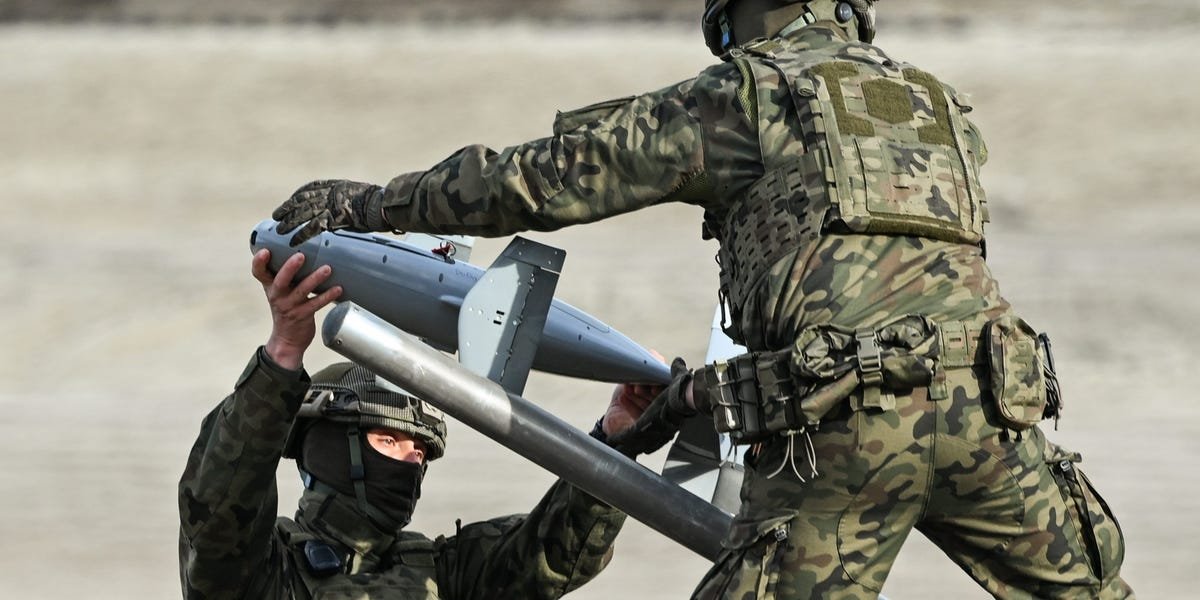
The Merops counter-drone system launches a propeller-driven drone called the Surveyor, which is a few feet long, can be carried by a single soldier, and uses artificial intelligence to navigate in jammed environments.
The overall system includes the Surveyor interceptor, a ground control station, and launch stations — all operated by a four-man crew with a commander, a pilot, and two technicians.
Its developer, the American initiative Project Eagle, says the Merops is tailor-made for taking down propeller-driven and jet-powered drones like the Shahed. So far, it’s logged over 1,000 kills against such uncrewed aircraft.
The Surveyor can fly at speeds of over 175 mph, meaning it’s more than fast enough to catch Iran’s commonly used propeller-driven Shahed-136, which flies at around 115 mph. Jet-powered versions of the Shahed reportedly fly as fast as 230 mph and are more challenging threats.
If the Surveyor, which can be mounted with a small explosive warhead, fails to hit its target, it can deploy a parachute to allow retrieval and relaunch of the drone.
Artur Widak/NurPhoto via Getty Images
When Business Insider observed a demonstration of the Merops in Poland last year, one of the launchers was mounted on the back of a pickup truck.
A push for interceptor drones
According to one of the defense officials Business Insider spoke with, US forces in the Middle East are to be trained by Army soldiers from Europe to operate the Merops. The system is also being sent to countries in the region where US troops are not deployed.
The second defense official said that Merops’ use in Ukraine has provided the Army with air defense information that has already proven valuable in Eastern Europe and will now be useful for the Middle East.
US Army soldiers in Europe have taught NATO allies how to operate the Merops system, which was deployed to the alliance’s eastern flank following Russian drone incursions into Polish airspace.
Meanwhile, Ukrainian President Volodymyr Zelenskyy said on Thursday that his country had received a direct request from the US for help with countering Shahed drones.
Zelenskyy shared that he “gave instructions to provide the necessary means and ensure the presence of Ukrainian specialists who can guarantee the required security.”
Over the past year, Kyiv has focused heavily on building and deploying an arsenal of cheap interceptor drones to counter Russia’s versions of the Shahed, which the Kremlin launches in hundreds-strong waves at times.
Ukrainian interceptor drones cost around $2,500 each, and Zelenskyy has said that his country makes 1,000 of them a day.
All of these broader developments come amid the backdrop of President Donald Trump saying in an early morning TruthSocial post on Saturday that Iran had agreed to stop attacking US allies in the region.
“Iran, which is being beat to HELL, has apologized and surrendered to its Middle East neighbors, and promised that it will not shoot at them anymore,” he wrote. The president also threatened additional action against Iran, warning that the US is going to hit it harder.