
A-Google-engineer-whose-job-is-changing-due-to-AI.jpeg

A Google engineer whose job is changing due to AI explains how she’s learning without burning out

This as-told-to essay is based on a conversation with Pratiksha Patnaik, a 30-year-old cloud infrastructure engineer at Google Cloud Consulting, based in Seattle. Her identity and employment have been verified by Business Insider. The following has been edited for length and clarity.

I’ve been with Google for around three years and I started as an infrastructure engineer. I’m still an infrastructure engineer and on a day-to-day basis, I work with customers to build different solutions, depending on the needs of the customer.

At first, I was mostly involved with networking security and infrastructure customers. But as we saw the AI wave come in, we started focusing more on customers that want to adopt gen AI products and solutions.

I didn’t transition into an AI role, but I’m working with a lot of AI services, and AI engineers who are working on features for those services. My job is a combination of working with customers and the product team, to provide technical solutions for customers. It’s a constant feedback loop to figure out if the solution we’re building is right for the customer we’re working for.

Our job is to know how these products work. Sometimes when we work on the products, we identify feature gaps or bugs, so we need to work with the product team or engineering team.

I’ve been in the same role the whole time, but the nature of my job is changing because of everything going on in the AI space. We get a lot of demand in AI products and we have to do a lot of trainings on it to deliver.

I spend an hour or two weekly on trainings

The more AI progresses, the more difficult it’s become to keep up. As the rate of AI innovation gets quicker, the role of engineers has transitioned from mastery to continuous adaptation at scale.

Just being aware of everything that’s happening in the tech industry, along with what we have to do with the customer, has changed dramatically from what it was like a year ago. Back then, we had to execute within known constraints. But as time passes and AI evolves rapidly, those perimeters have dissolved and we have to invest much more time to learning about changes in this space. We now have to navigate an ever-expanding problem space alongside our customers.

I spend around one to two hours a week up-skilling on new concepts. We have a lot of internal trainings that we can utilize. So I see if there is something new that I’m interested in learning about and that can help me do my job.

I am gaining a deeper level of understanding in high-performance computing, AI observability, model performance benchmarking, and the underlying architecture of GPUs and TPUs.

It can get overwhelming

The culture at Google is very much about constantly learning. Every day we learn about a new tool or model version. That motivates me to keep learning. We also have to skill up in order to put our best foot forward in front of the customers.

But with the pace of technology nowadays, I feel like I need to know everything — and if I don’t learn, I might be left behind.

The reality is that it’s not practically possible to know everything with the changes that are coming out at an exponential rate. To remain effective without burning out, I prioritize intentional depth over exhaustive consumption. By focusing on what really interests me, I can make sure that my learning is not just a chore of “keeping up,” but an investment in expertise.

When I read too much, I get overwhelmed and it’s not possible to retain all of the information I’m consuming. We’re at a point where the amount of information we have is huge and we have to figure out where to spend our time and what’s the most beneficial for us.

Are you an engineer experiencing changes in your job? We’d love to hear from you. Email the reporter from a non-work device via email at aaltchek@insider.com or secure-messaging platform Signal at aalt.19.


Source link

Photos-show-chaos-at-airports-as-passengers-are-left-stranded.jpeg

Photos show chaos at airports as passengers are left stranded due to canceled flights

  • Airports across the Middle East have suspended all flight operations until further notice, leaving many stranded.
  • The US and Israel launched strikes against Iran on Saturday, with Iran launching retaliatory strikes across the region.
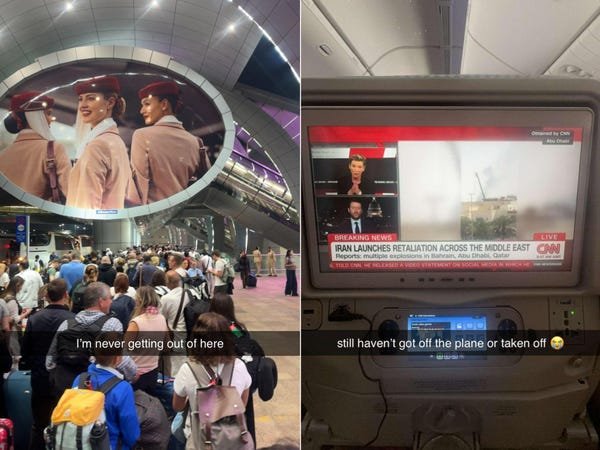
  • One Emirates passenger told Business Insider he was stuck on a plane for five hours without food before everyone was deplaned.

Travelers are in limbo as airport departure boards flip to red after air strikes in Iran resulted in closed airspace and triggered mass flight cancellations.

The heart of the chaos is in the Middle East, where airports in Dubai, Doha, and Abu Dhabi serve as megahubs for global connecting traffic. Data from the aviation analytics firm Cirium shows their home airlines — Emirates, Qatar Airways, and Etihad Airways — carry a combined 90,000 transit passengers a day.

That figure does not include the thousands of travelers whose final destination is the Middle East.

Emirates passenger Jaiveer Cheema, who was set to fly back home to the US on Saturday, told Business Insider that he was stuck on his plane for five hours with no food before everyone was deplaned and shuffled into the crowded terminal at Dubai International.

“The next several hours at the airport were chaos as no one knew what to do,” he said. “We spoke to several security guards and Emirates employees, and they all gave us different answers.”

Cheema said they stood in line after line until they eventually got a hotel voucher and took a bus to the lodging. He was still waiting for a room 90 minutes after arriving — it’s after midnight in Dubai; nearly 20 hours after he initially showed up for his 9 a.m. flight.

While many passengers are stranded within the region’s closed airspace, shuttered until further notice, the disruption has rippled far beyond it.

Flights to the affected region from places like London and the US have been canceled outright or diverted mid-journey — leaving travelers far from home in crowded airport terminals and uncertain when they will be able to depart.

Airlines have told passengers on social media to expect long wait times at airports and on customer-service phone lines as they try to manage the abrupt disruptions.

The sheer number of displaced people and planes on Saturday alone is expected to snowball worldwide if airports are unable to restart operations soon.

Passengers in Dubai were funneled into long snaking lines.

Jaiveer Cheema is one of the thousands of people stranded in limbo.

Courtesy of Jaiveer Cheema

Cheema spent hours in line but managed to secure a hotel voucher — though he had yet to secure a room when talking with Business Insider. He said he did not have answers from Emirates on what’s next.

An Emirates spokesperson did not immediately respond to a request for comment from Business Insider.

Passengers at Beirut Rafic Hariri International Airport in Lebanon are stranded.


Stranded passengers at Rafik Hariri International Airport

Passengers are stranded at Beirut Rafic Hariri International Airport on Saturday.

Anadolu/Anadolu via Getty Images

Airlines are pivoting their operations in response to the strikes. Lufthansa Group said it is suspending flights to Beirut, Tel Aviv, Amman, Erbil, and Tehran until March 7.

Airlines are suspending flights across the region, including Lebanon.


Cancelled flights at the Rafik Hariri International Airport on February 28.

Flight operations at the Beirut Rafic Hariri International Airport in Lebanon on Saturday.

Anadolu/Anadolu via Getty Images

In a statement shared on the Lufthansa Group’s website, the company said it would also suspend flights in additional areas.

“The following airspaces will also not be used until March 7: Israel, Lebanon, Jordan, Iraq, Qatar, and Iran,” the aviation corporation said. “In addition, Lufthansa Group airlines will suspend flights to and from Dubai and Abu Dhabi, Riad, and Dammam until March 1. Furthermore, the airspace of the United Arab Emirates will not be used until March 1.”

International flights at Tribhuvan International Airport in Nepal were disrupted.


Stranded passengers at Tribhuvan International Airport in Nepal.

Passengers waiting at Tribhuvan International Airport in Nepal on Saturday.

Navesh Chitrakar/REUTERS

The Tribhuvan International Airport shared a passenger advisory on Saturday, saying international flights “may be subject to delay, rescheduling, or cancellations” due to airspace restrictions.

Passengers flying with major airlines were told to check their flight status.


Passengers stranded at Tribhuvan International Airport in Nepal on February 28

Passengers at Tribhuvan International Airport in Nepal on Saturday.

Navesh Chitrakar/REUTERS

The Tribhuvan International Airport told passengers flying with major airlines — including Qatar Airways and Turkish Airlines — to coordinate with those companies to navigate travel issues.

Qatar’s airspace closure caused flight disruptions at Hamad International Airport.


Passengers at the Hamad International Airport in Qatar on February 28.

Passengers at the Hamad International Airport in Qatar on Saturday.

Stringer/REUTERS

Qatar’s Hamad International Airport said all aircraft movement has been temporarily suspended due to the country’s closed airspace.

“Our priority is always the safety of our passengers and employees. We are working closely with government stakeholders and airline partners to look after passengers that have been impacted,” the airport wrote in an advisory.

In London, flights to the countries Middle East were canceled.


A check-in counter for Emirates at London Gatwick Airport shows cancelled flights on February 28.

The Emirates check-in counter at London Gatwick Airport shows that flights are cancelled on Saturday.

Ben Stansall / AFP

Flights heading to the Middle East were also canceled at the London Gatwick Airport in England on Saturday.

London Gatwick Airport told some passengers to expect travel interruptions.


Passenger at London Gatwick Airport on February 28.

Passengers at London Gatwick Airport on Saturday.

Ben Stansall / AFP

A London Gatwick Airport spokesperson told Sky News it’s “expecting disruption to our Qatar and Emirates flights.”

Are you a stranded traveler with a story to share? Contact the reporters at ledmonds@insider.com and trains@insider.com along with your preferred contact information.


Source link

Google-warns-some-visa-employees-not-to-leave-the-US.jpeg

Google warns some visa employees not to leave the US due to ‘significant’ return delays of up to a year

Google has advised some employees on visas not to travel outside the US due to delays at embassies, Business Insider has learned.

The company’s outside counsel BAL Immigration Law sent an email on Thursday advising staff who require a visa stamp to re-enter the US not to leave the country because visa processing was taking longer than usual, according to a copy of the memo reviewed by Business Insider.

“Please be aware that some US Embassies and Consulates are experiencing significant visa stamping appointment delays, currently reported as up to 12 months,” the memo read. It was recommended that employees avoid international travel as they would “risk an extended stay outside the US.”

American consulates and embassies around the world are seeing delays with routine visa appointments following the introduction of a new social media screening requirement, which applies to H-1B visa workers and their dependents, as well as students and exchange visitors.

On Friday, a spokesperson for the Department of State told Business Insider it was conducting “online presence reviews for applicants.” The department said it may move appointments as resources change, with applicants able to request expedited slots on a case-by-case basis.

“While in the past the emphasis may have been on processing cases quickly and reducing wait times, our embassies and consulates around the world, including in India, are now prioritizing thoroughly vetting each visa case above all else,” the State Department spokesperson said. Appointments in Ireland and Vietnam have also been postponed, according to immigration firm Reddy Neumann Brown PC.

Google’s lawyers said in the memo that the delays were affecting H-1B, H-4, F, J, and M visas. The advisory did not specify what anyone on a visa already outside the country with a postponed appointment should do.

A Google spokesperson declined to comment.

How enhanced visa vetting can complicate a routine trip abroad

Google’s warning echoes a wave of internal travel advisories that swept through corporate America in September, as the Trump administration imposed a $100,000 fee on new H-1B visas.

The H-1B visa typically lasts up to three years and can often be extended. If someone needs a new H-1B visa stamp, they typically must apply at a US embassy or consulate in their home country or a country where they have lawful residence.

As a general matter, said immigration attorney Jason Finkelman, who focuses on employment and family immigration, foreign nationals should be able to return to the US after travel abroad if they have a valid visa stamp and aren’t subject to any entry restrictions, including the Trump administration’s expanded travel ban, which the White House says takes effect January 1.

That’s where enhanced vetting can complicate an otherwise routine trip. If an H-1B worker leaves the US to get a new visa stamp and their consular appointment is canceled or delayed — sometimes by months — they can be stuck abroad until the visa is issued.

“My advice to clients is that if travel isn’t essential right now, better to stay put,” Finkelman said.

A spokesperson for the Department of State said consular officers “do not issue a visa unless the applicant can credibly demonstrate they meet all requirements under US law — including that they intend to engage only in activities consistent with the terms of their visa.”

The H-1B program, which is capped at 85,000 new visas a year, serves as a core pipeline for employers hiring skilled foreign workers. Tech giants have long been among the largest users of the visa, with companies such as Amazon, Google, Microsoft, and Meta topping the lists of approved new H-1B petitions in recent years. 

Under the Trump administration, the program has become a political flash point, with the White House framing H-1Bs as a threat to American jobs and rolling out measures that critics and employers say make it harder and more expensive to hire new workers.


Source link