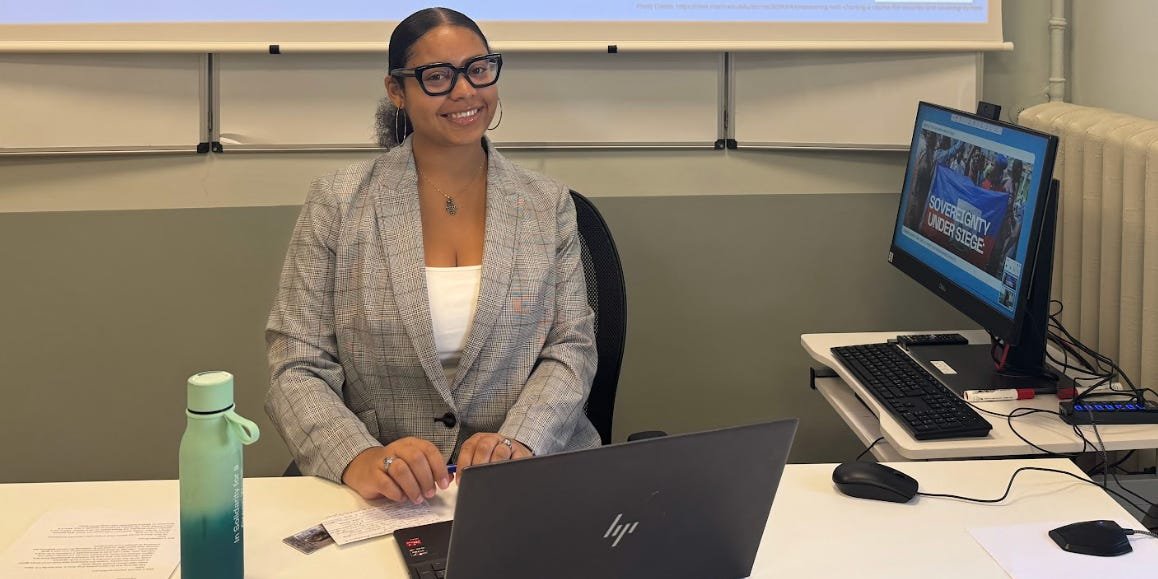
For most of my life, I believed in a very specific formula: work hard in school, build a strong résumé, study abroad, learn languages, get a master’s degree, and be globally aware.
I studied journalism and media, and I leaned into storytelling early on. I spent time abroad multiple times in Rome, Florence, Kuwait, and Scotland. I learned how to navigate new cultures, new systems, and new expectations. I became fluent in spaces that were not designed for a first-generation student like me.
After graduating, I went on to earn my master’s degree in international affairs as part of the inaugural cohort at John Cabot University in Rome (again). I focused on global justice, human rights, and representation. I contributed to research on the gig economy, attended UN conferences both in Italy and Azerbaijan, and built what I thought was a strong, competitive profile.
I completed my MA degree early, believing I had done everything right. But I still can’t find a job.
I applied everywhere, across countries and industries
Since graduating, I’ve applied to over 1,000 jobs.
That includes roles in Rome with UN agencies, NGOs, and humanitarian organizations. It also includes jobs across the US — in-person, hybrid, and remote roles. I applied to communications positions, research roles, media jobs, and anything that aligned with my background in storytelling and global affairs.
I tailored résumés. I wrote cover letters that took hours. I researched organizations, memorized their missions, reached out to every connection, and prepared for interviews like they were exams.
Out of all those applications, I’ve gotten 15 interviews. Only two of those moved me to a second round. Less than five of the roles I interviewed for were actually filled.
For the rest, I watched the same job postings reappear weeks or months later. Were those even real positions?
It started to feel like I wasn’t competing for jobs. I was competing for the possibility of a job.
The hardest part is not knowing what I’m doing wrong
Rejection is one thing. Uncertainty is another.
When you don’t get a job, you can usually point to something. Maybe someone had more experience. Maybe you didn’t interview well. Maybe the role just wasn’t the right fit.
Courtesy of Nicolette Alexandra Brito-Cruz
But what do you do when there’s no outcome at all? When positions stay open indefinitely. When companies repost roles without hiring. When you make it through multiple steps and still hear nothing back.
It creates this constant loop in your mind. You start questioning everything: your degree, your experience, and the choices you made.
I did everything I was told would make me employable. Yet, I’ve never felt more unsure about where I stand.
Freelancing became my way of earning
At some point, I had to shift my focus from waiting to building.
During undergrad, I spent four years working in publicity and creative marketing. That became the one thing I could return to when the job market kept shutting me out.
Now, I freelance as a creative director and marketing professional. I design campaigns, create visual content, and work with clients to build cohesive brand identities. I’ve worked on everything from social media strategy to email marketing to photoshoots to editorial visuals.
It’s not stable or the full-time role I desire for myself. But it’s something I built myself.
Freelancing has taught me how to trust my skills in a different way. It’s shown me that I don’t need permission to create meaningful work.
Still, there’s a difference between surviving and feeling secure. I’m still trying to figure out how to bridge that gap.
Not having stability forced me to rethink what I actually want
For a long time, I was chasing stability as it was defined for me: a full time job, steady paycheck, and clear title. But not having that has pushed me to ask a different question. What kind of work do I actually want to be doing?
The answer keeps bringing me back to storytelling.
I want to be a creative director who focuses on telling BIPOC stories with care and accuracy. I want to create media that doesn’t flatten people into stereotypes or reduce cultures into trends. I want to build projects that feel honest, layered, and intentional.
That’s the work I’ve been drawn to for years. It’s also the work I kept putting off because I thought I needed something more “stable” first.
Now, I’m starting to see that maybe the path I was following was never designed to lead me there.
I’m still figuring it out
I don’t have a clean ending to this story.
I’m still applying for jobs while freelancing, and trying to make sense of a system that feels unpredictable and, at times, impossible to navigate.
But I also know this: the effort I’ve put in hasn’t been wasted. It just didn’t lead me where I expected. Maybe that means I have to build something different instead.