
NATO-allies-are-linking-their-defenses-together-to-better-hunt.jpeg

NATO allies are linking their defenses together to better hunt and kill drones on its eastern edge

The US and its NATO allies are boosting their ability to detect, track, and target drone threats along the alliance’s eastern edge, its border with Russia.

Through rapid 90-day testing cycles designed to replicate real situations, US forces, Baltic allies, and defense companies are building a shared data network for faster decision-making. The effort links sensors that detect aerial threats with counter-drone systems that can destroy them, aiming to improve defenses against Russian-style drone attacks, including Shahed-type systems.

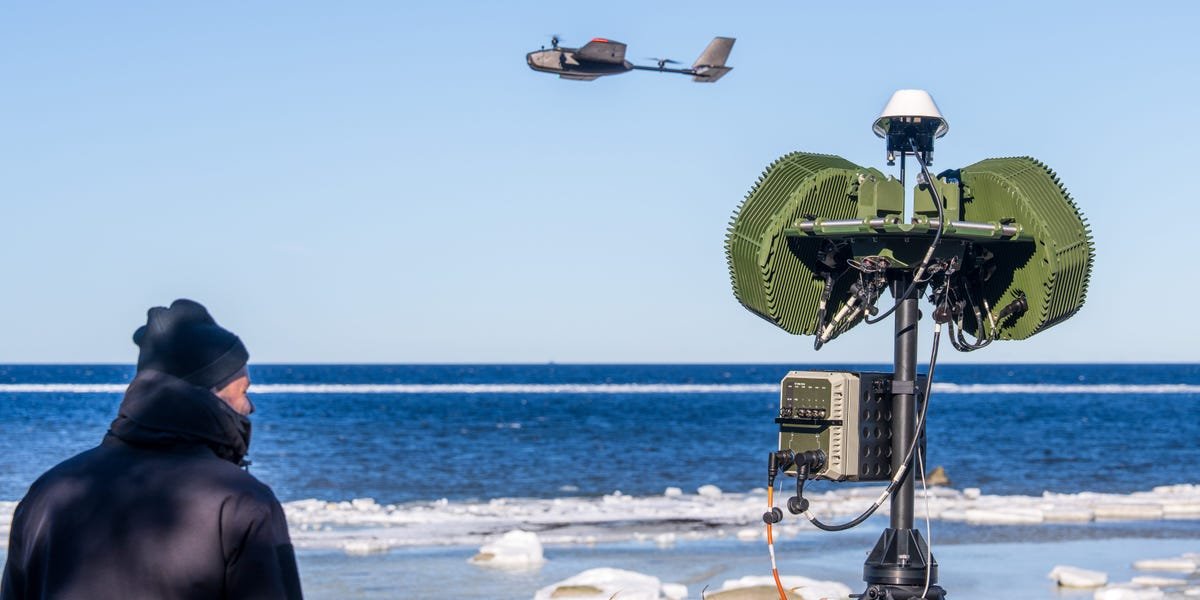
US and Estonian forces executed exercise Digital Shield 2.0 earlier this month, the second stage in an ongoing testing series.

The exercise “was really born from an initiative to integrate different sensor types into an easily accessible and shareable integrated sensor architecture, or an air picture,” US Army Capt. Micah Maule, plans officer for the 10th Army Air and Missile Defense Command, told Business Insider.

While the first Digital Shield proved the concept, the second expanded the scale, adding more sensors to detect larger uncrewed aerial systems such as Shahed-type drones and additional air-defense and counter-UAS radars to sharpen the picture of incoming threats.

Those systems feed into a common command-and-control network using commercially developed software, creating a streamlined flow of surveillance data that operators can view in a single air picture before deciding how to respond.

“So you could actually task effectors to go out and destroy drones from the same common operational picture,” Maule said.

Digital Shield 2.0 included several simulated scenarios that could become real-world threats, including cyberattacks disrupting operations, high-stress conditions with lots of drone targets, and a live-fire situation running the entire process against Shahed replicators.


A man wearing camouflage stands next to a tall radar. A small white drone stands sits on the beach.

The second testing involved various sensors, counter-drone interceptors, and Shahed replicators.

US Army photo by Maj. Alexander Watkins


Adding more sensors layers the defenses, but it also increases the volume of incoming data. Maule said the goal of the shared command-and-control system is to merge those inputs into one clear picture, reducing the cognitive burden on operators.

An advantage of the design is that the system can be operated farther from the front, out of range of many types of drones, and that it feeds data to multiple partners for heightened awareness.

The rapid pace of the Digital Shield testing reflects the Pentagon’s Silicon Valley-style “move fast, fail fast, fix fast” approach for developing new technology. It also pressures industry partners to keep up. Vendors must meet strict integration requirements, and the swift development cycle forces faster fixes and upgrades based on field feedback.

Digital Shield is an example of the work being done as part of the new Eastern Flank Deterrence Line initiative, which is led by the US and NATO. The effort is intended to build a robust defense against Russia that can detect drones across wide areas and counter them with lower-cost solutions.

Artificial intelligence is also being integrated into the initiative to analyze sensor data faster and speed up decisions on how to respond.

One persistent problem remains the cost of stopping cheap drones.

“We have to beat the cost curve,” Maule said. “If the UAS is a couple or tens of thousands of dollars, you can’t be using extremely expensive interceptors.” The US and its allies have learned that lesson from Ukraine and in the Middle East.




Source link

NATO-is-deploying-a-drone-carrier-to-its-eastern-edge.jpeg

NATO is deploying a drone carrier to its eastern edge after repeated Russian airspace incursions

NATO is deploying a Turkish drone carrier to the Baltic Sea to boost its surveillance and defense in response to “repeated” Russian airspace violations, the alliance announced on Friday.

The TCG Anadolu will support Eastern Sentry, a defensive operation the alliance launched in September after Russian drones crossed into Polish airspace, forcing a military response.

The Turkish drone carrier is deploying toward the coast of Latvia, where it will contribute to air surveillance and defense along NATO’s eastern edge. Allies have been surging fighter jets and warships to the Baltic region in response to Russian drone incursions.

Allied Joint Force Command Brunssum, one of three operational-level NATO headquarters, said in a statement on Friday that the deployment of the Anadolu follows “repeated airspace violations” that have been attributed to Russia.

JFC Brunssum called the deployment “a clear signal to the east” and said that it “sends an unmistakable message” that NATO is prepared to defend its territory.


A Bayraktar TB3 drone during the NATO Steadfast Dart 2026 drill in the Baltic Sea on February 17, 2026.

A Bayraktar TB3 drone lands on the flight deck of the TCG Anadolu earlier this month.

Dursun Aydemir/Anadolu via Getty Images


It’s unclear when the carrier will arrive on station and how long it will remain there. The Turkish defense ministry could not immediately be reached for comment, and neither JFC Brunssum nor NATO’s Allied Air Command responded to a request for additional information.

The first-of-its-kind TCG Anadolu is the Turkish Navy’s only drone-carrying amphibious assault ship. It was commissioned in 2023 and is now Ankara’s most advanced vessel and flagship.

The 750-foot-long vessel was originally intended to carry helicopters and F-35B fighter jets, but after Turkey was kicked out of the F-35 program over its purchase of Russian surface-to-air missile systems, Ankara decided to repurpose the Anadolu for fixed-wing drones.

The Anadolu can carry Bayraktar TB-3 and Bayraktar Kızılelma combat drones, systems made by the Turkish company Baykar, as well as attack helicopters.

JFC Brunssum said the carrier is the largest ship in NATO’s Steadfast Dart fleet, which is comprised of 17 vessels, including amphibious landing ships, frigates, destroyers, and submarines.

Iran and China have also built their own drone carriers, and Portugal expects to receive one later this year.


Source link

Paramount-wanted-to-use-24-billion-in-Middle-Eastern-money.jpeg

Paramount wanted to use $24 billion in Middle Eastern money to help buy WBD. That’s not why Netflix won.

Larry and David Ellison, who own Paramount, want to use $24 billion in Middle Eastern money to finance their bid for Warner Bros. Discovery. Is that a problem for WBD?

You might think so — especially since $10 billion of that came from the Saudi government. That’s the same government that US intelligence said killed a Washington Post journalist in 2018. The kind of partner you might think a major American media conglomerate would want to keep at arm’s length.

But that’s not a problem WBD raises in its newest communication to shareholders, where it urges them to take the deal offered by Netflix instead.

What actually worries WBD about the Ellisons’ bid isn’t the Ellisons’ particular partners. It’s that the Ellisons had partners.

In a regulatory filing that tells the backstory of the proposed WBD sale, WBD execs and their reps repeatedly told the Ellisons they wanted a firm commitment that Larry Ellison — currently the world’s 5th-richest man, with an estimated net worth of $243 billion — would guarantee the deal himself.

Instead, WBD argues, the Ellisons never gave them the assurances they wanted.

The filing does bring up the fact that money from Middle Eastern sovereign wealth funds would likely complicate regulatory issues for a proposed Ellison/Paramount deal. (Ditto for a proposed $1 billion investment from China’s Tencent, which the Ellisons later took out of their proposal.) But those are presented as technical hurdles. Not moral or patriotic dealbreakers.

And they’re just part of a laundry list of complaints WBD makes about the Ellisons. Among them: A December 2 tweet from New York Post reporter Charlie Gasparino, which WBD said violated a confidentiality agreement Paramount had signed.

And when it comes to the main pitch WBD is making to investors, all of that stuff disappears. It just boils down to “we did our homework, and the Netflix deal is better.”

That’s not shocking: If you’re a WBD investor, you are (supposedly) only interested in getting the maximum value for shares. And WBD’s filing argues that Netflix is the one that can pay the most.

Now we’re waiting to see what the Ellisons do next: Many observers believe they’ll return with yet another, higher bid. Will this one have Gulf money, too?


Source link