I-eat-the-same-dietitian-approved-lunch-almost-every-day-Its.jpeg

I eat the same dietitian-approved lunch almost every day. It’s got protein and fiber — and it’s a breeze to prep in advance

When I lived in a big city, I used to love treating myself to lunches at trendy salad spots. Tasty as these take-out meals were, they were terrible for my wallet, and I didn’t have full visibility into or control over the ingredients that went into them.

I’ve since turned into an avid meal-prepper and make my own lunch — almost always a fiber- and protein-packed grain bowl — for a fraction of the price.

It’s a recipe that aligns with the 80/20 nutrition principle I follow, meaning I eat nutrient-dense foods 80% of the time and don’t worry about nutrition for the other 20%.

The grain bowls are so nourishing that I feel relaxed about occasionally going out for a slightly less nutrient-dense lunch, since I know I’m hitting my nutrition goals most of the time.

Here’s how to make the everyday lunch that helps me stay on track.

The grain bowl is easy to prep and customize


rachel hosie grain bowl recipe

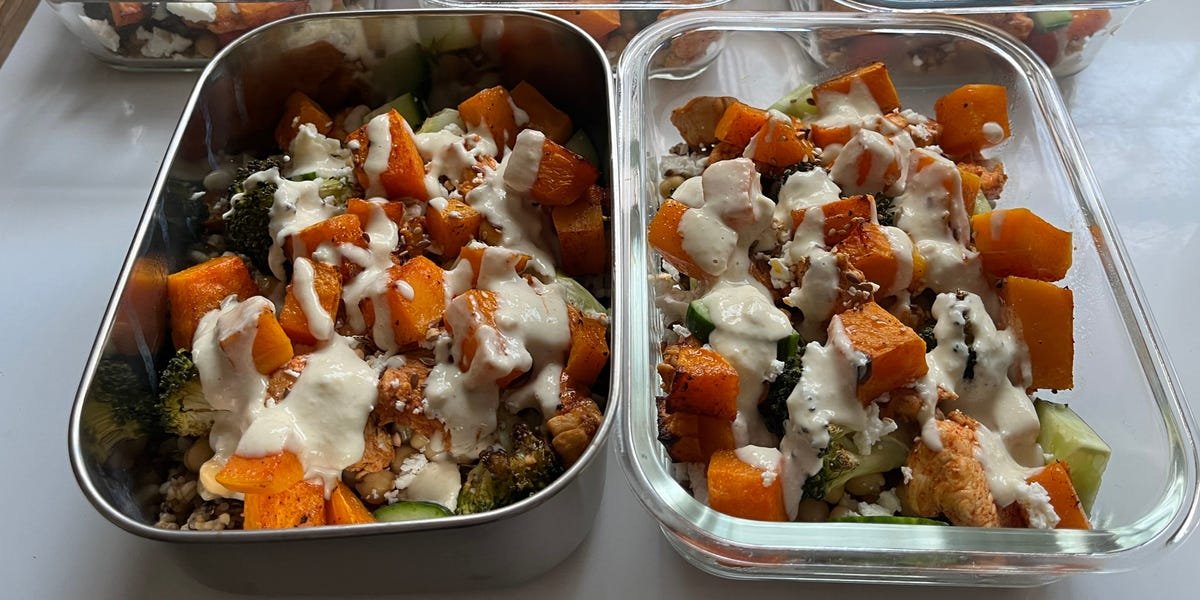
The grain bowls are nearly impossible to mess up and highly customizable.

Rachel Hosie


I play around with the ingredients I put in my grain bowls every week, but they always follow the same formula:

  • Grains, such as quinoa, buckwheat, or wholegrain rice
  • Beans or pulses, such as edamame, chickpeas, or lentils
  • A protein source, such as tofu or chicken
  • Roasted vegetables, such as butternut squash, bell peppers, cauliflower, broccoli, or zucchini
  • Raw vegetables, such as chopped cucumber, tomatoes, beetroot, or scallions
  • A flavorful add-in, such as crumbled feta, avocado, or hummus
  • Greens, such as lettuce or spinach
  • Seeds and nuts of choice
  • Spices and herbs of choice
  • A dressing of choice

The recipe is flexible, so there’s no need to add ingredients in a specific order. It’s truly hard to mess up.

You can also adjust the quantity based on your needs. I typically make six portions — three for me, and three for my husband — because there’s usually a day or two during the week when we eat with colleagues or friends.

Plus, after three days of eating the same meal, I’m typically ready to mix it up.


rachel hosie grain bowl recipe

I drizzle a tahini mixture on top of my bowl for added flavor.

Rachel Hosie


To add variety to my days, I prep these with dressings and protein sources.

When it comes to dressings, my favorite is a creamy tahini mixture. Combine tahini, Greek yogurt, lemon juice, garlic granules, salt, pepper, olive oil, and water until you get a dressing-like consistency.

I also make a satay-style sauce with crunchy peanut butter, soy sauce, garlic, ginger, lime, and sesame oil.


rachel hosie grain bowl recipe

Chickpeas and avocado are delicious, filling protein sources.

Rachel Hosie


There’s also flexibility when it comes to protein source. Nichola Ludlam-Raine, a dietitian and the author of “How Not to Eat Ultra-Processed,” recommends adding oily fish, such as salmon or tinned mackerel, for omega-3s, which support heart and brain health.

When I include meat in the grain bowls, I typically use a modest portion since I always throw in plenty of plant-based protein. This approach provides a fiber boost from plant-based proteins and keeps the ingredient list affordable.

If you’re predominantly eating plant-based, make sure you’re getting enough iodine by using dairy yogurt in your dressing or swapping in the occasional white fish.

Having a balanced lunch prepped and ready to go helps me stay consistent


rachel hosie grain bowl recipe

Incorporating a mix of roasted and raw vegetables gives the bowls texture.

Rachel Hosie


My grain-bowl formula has lean proteins, produce, legumes, and whole grains — all the workings of the Mediterranean diet.

According to Ludlam-Raine, “It’s essentially a Mediterranean-style pattern of eating in bowl form, which is linked with better cardiometabolic and long-term health outcomes.”

She added that it delivers “an abundance of plant diversity,” which is beneficial for gut health.

The well-rounded meal also has fiber-filled whole grains, slow-release carbohydrates, pulses for plant protein and additional fiber, protein for satiety and muscle maintenance, vegetables for polyphenols and micronutrients, and healthy fats from seeds, nuts, and olive oil.


rachel hosie grain bowl recipe

We store the bowls in our refrigerator throughout the week.

Rachel Hosie


Strategizing my meals in advance helps me maintain a healthy, balanced diet throughout the week, and this grain bowl is the backbone of my meal plan.

“Overall, what you’ve got is a brilliant example of a practical and sustainable approach to meal prep. It’s balanced, fiber-rich, protein-sufficient, and easy to adapt week to week, which is key for long-term adherence,” Ludlam-Raine said. “You’re making the healthy choice into the easy choice.”

The best part? I don’t get bored with eating the same thing on repeat.



Source link

Ray-Dalio-says-AI-is-eating-everything-—-and-it.jpeg

Ray Dalio says AI is ‘eating everything’ — and it might ‘eat itself’

Ray Dalio warned that AI is “eating everything” — but said the boom could also “eat itself” if the money doesn’t add up.

The Bridgewater founder said in an episode of the “All-In Podcast” published Tuesday that AI may not be producing “adequate profits” even as it rapidly reshapes industries across the economy.

Investors often confuse betting on a breakthrough technology with betting on the companies trying to monetize it, Dalio said.

“The technologies will go on, but the companies won’t necessarily go on,” he said, adding that it’s “the norm” for many firms to fail to make money from the hype.

During the dot-com boom, the internet transformed the world, but many early internet companies collapsed, he said.

The billionaire investor also said that with countries like China releasing powerful AI tools at very low cost, it could put pressure on US companies that are spending billions on the technology in hopes of earning large returns.

His comments come as a February report circulating online from investment firm Citrini Research reignited fears about the economic impact of AI, rattling investors and contributing to a sell-off in stocks.

Citri laid out a speculative scenario examining how the AI boom could unfold over the next few years. In the report — written as if looking back from 2028 — the firm imagines a future where AI adoption accelerates rapidly but ultimately proves damaging to the broader economy.

In that hypothetical timeline, the widespread rollout of AI tools leads to a sharp drop in white-collar employment. As companies automate more tasks previously done by professionals, job losses mount, reducing consumer spending and slowing economic growth. The resulting shock eventually culminates in a stock market crash.

The AI boom itself continues, but not in the transformative way many technology optimists, including Elon Musk, have predicted.

“By the end of 2027, it threatened every business model predicated on intermediation. Swaths of companies built on monetizing friction for humans disintegrated,” Citrini wrote.

Some experts have said investors may be overreacting to what is essentially a hypothetical worst-case scenario.


Source link

You-cant-cop-Jensen-Huangs-GPUs-but-you-can-eat.jpeg

You can’t cop Jensen Huang’s GPUs but you can eat the same cake he got for his birthday at work

Nvidia’s GPUs may be hard to snag, but Jensen Huang’s birthday cake might just be sitting in a display case at your local mall.

A strawberry soft cream cake from Korean bakery brand Paris Baguette was served at a birthday dinner for the Nvidia CEO near the company’s Santa Clara headquarters last Saturday, according to The Korea Times, which cited an interview with the bakery brand’s operator, Paris Croissant.

Huang, who turned 63 on Feb 17, invited about 30 engineers involved in South Korea’s SK Hynix DRAM and high-bandwidth memory for a dinner party at a fried chicken restaurant called 99 Chicken.

Korean business newspaper Hankyung reported that Huang had instructed Nvidia employees to “organize a dinner to encourage SK Hynix HBM engineers.”

“Please supply the highest-performance HBM4 without a hitch,” he told SK Hynix engineers that day, according to Hankyung.

SK Hynix is one of Nvidia’s key suppliers of high-bandwidth memory chips, or HBM chips — the advanced chips that sit alongside GPUs and feed them data at extreme speeds. Memory chips have become one of the biggest choke points in the AI boom.

At one point, Huang personally prepared and served somaek — a mix of soju and beer — to guests at each table.

For about two hours, Huang went table to table thanking his guests, according to Hankyung.

Huang’s cake is a huge marketing win for the bakery brand.

“It was all about the symbolic moment — our brand’s cake being present at a birthday party for the current leader of the global AI industry. It was a total boon without costing us anything,” a Paris Croissant official told The Korea Times.

Paris Croissant operates about 280 Paris Baguette locations across the US, including several in Silicon Valley. It aims to expand to 1,000 outlets in North America by 2030.

The bakery chain is a household name in South Korea, with about 3,400 stores there. Since making its first push overseas in 2004, the Paris Baguette brand has expanded to 15 countries.

The Paris Baguette cake is described as a “vanilla cake filled with soft cream and fresh strawberries, topped with more berries.”

A global AI superstar

Huang has become something of a spectacle wherever he goes.

In October, Huang sat down for fried chicken in Seoul with the heads of Samsung and Hyundai. The casual meal quickly turned into a media event.

A crowd of journalists, photographers, and fans gathered outside the restaurant, while national broadcasters aired live footage of the executives eating and talking inside.

Photos from the evening also captured reflections in the restaurant windows, showing fellow diners lifting their phones to snap pictures.

Following Huang’s visit to the Seoul restaurant, crowds lined up before opening hours, hoping to dine at the same table occupied by the Nvidia chief and his high-profile guests, Korean media outlets reported.

The restaurant has imposed a one-hour time limit on the table used by Huang and the Korean business leaders, the reports added.


Source link

GabbyLandsverkpic

A weight loss doctor, who specializes in helping high performers, shares her favorite hack to eat healthy without tracking every bite

On a recent trip to France, Dr. Meghan Garcia-Webb was struck by an age-old paradox.

Everywhere she looked, she saw people enjoying cheese, wine, and bread — yet the average person seemed much healthier than the typical American.

In France, despite their reputation for rich cuisine, the obesity rate is a fraction of what we see in the United States, for all our calorie-counting and protein maxxing.

“There isn’t this pervasive diet culture of going to a restaurant and seeing how many calories are in this and how many carbs,” Garcia-Webb told Business Insider. “I do find it is refreshing in the sense that there’s not this fear around food, and the food is very satisfying.”

It’s just one example of how stressing less about your diet can lead to better weight loss and long-term health, she said.

In her concierge medicine practice, Garcia-Webb specializes in helping high achievers, such as CEOs and attorneys, manage their weight. A lot of her job is pushing back on extreme diet fads, including the trend of tracking everything.

“I really enjoy food and the more I do this work, the more compelled I feel to show people that it actually is possible to be healthy and really like to eat,” she said.

Garcia-Webb said her favorite food hack makes it easy to eat well without turning your food journal into a full-time job. Here’s how to try it at home for more nutritious meals.

A stress-free guide to healthy eating

Everyone loves a food hack, and Garcia-Webb said hers is simple: when you prepare a meal, start by making half the plate fruits and non-starchy vegetables.


A colorful salad with greens, nuts, peppers, and grilled chicken.

Filling half your plate with produce is a simple way to eat well without measuring each bite, calorie, or gram of protein.

Magda Tymczyj/Getty Images


“It’s actually very easy,” she said. “You don’t even have to cook them if you don’t want to.”

Think carrots, cucumbers, peppers, greens, tomatoes, berries, grapes, citrus — anything you’d find in the produce aisle (except potatoes). To make it even easier, opt for pre-cut options that are ready to eat or frozen produce, which is as healthy as fresh.

From there, Garcia-Webb builds a full meal by adding a source of protein, like lean meats or fish, to fill another quarter of the plate. The last quarter of the plate is for starchy foods like whole grains, pasta, rice, or potatoes.

The strategy makes it simple to get five servings a day of fruits and veggies. Each serving is about a handful when you’re eyeballing it.

As you fill up on produce, the high-volume, high-fiber food keeps you full and satisfied after eating, so you’re less likely to reach for junk food later. That means you’ll find yourself eating healthier without having to count a single calorie or even measure a portion.

When to track your food for weight loss

There’s nothing inherently wrong with tracking your eating habits, and calculating every gram of protein is fine if that works for you.

Still, for most people, too much tracking can be a burden, taking away the enjoyment of food and making you less likely to stick to your healthy habits long-term.

Instead of trying to track everything you eat forever, Garcia-Webb recommends keeping a food log for a few days: it can give you a baseline sense of your current habits and what you can change to move toward your goals.

“You build this intuitive knowledge, and then you have a rough sense of what it looks like for you,” she said.

A temporary habit of food tracking can be helpful if you feel like you’re doing everything right and wonder why you aren’t losing weight.


A woman in a grocery store comparing two cartons of dairy

Food labels can mislead you by making a processed snack seem healthy because of added protein, but sneaking in extra sugars.

Luke Chan/Getty Images


Garcia-Webb said if you’ve never tracked your habits, it’s common to eat more and exercise less than you realize.

These days, plenty of convenience foods disguise ultra-processed junk with a “health halo” of added protein or other nutrients to make you believe you’re making a nutritious choice.

“People think that they’re eating healthier than they are,” Garcia-Webb said. “Something that we can all fall prey to is very good marketing.”


Source link

Amanda Goh

Sarah McLachlan, 58, says she had to ‘eat a lot of humble pie’ to repair her relationship with her older daughter

Sarah McLachlan, 58, says she had to rethink how she was parenting her daughter to rebuild their bond.

“I would have been softer on her in a different way. I was a hard ass,” McLachlan told Amy Poehler on Tuesday’s episode of “Good Hang with Amy Poehler.”

McLachlan shares two daughters with ex-husband Ashwin Sood: India Ann, born in 2002, and Taja Summer, born in 2007.

“It’s funny because I thought so clearly in my own mind that I was being the antithesis of my mother. And I looked at the way she parented, and I thought, ‘I’m going to do everything completely different,'” McLachlan said. “Then her words come spewing out of your mouth in a moment of anger and frustration, and you’re like, ‘Oh my God, I can’t believe I did that.'”

She said her older daughter would sometimes shut down or lash out when things got hard, and at the time, McLachlan didn’t fully understand what was behind it.

“I looked at that and went, ‘How do I help you with this? How do we move past this, because the world out there is scary and big, and you have to have some grit, and you have to do hard things so that you know you can,'” McLachlan said, describing the tough approach she took with her daughter.

It was only after they went to family counseling that she realized her daughter was experiencing a lot of anxiety.

“The way I was communicating to her was just making her feel shitty about herself instead of building her up, which was completely the opposite of what I thought I was doing,” McLachlan said.

“I had to eat a lot of humble pie and take stock and go, ‘OK, look, I want a relationship with my kid. So, I need to learn how to communicate differently with her,'” she said.

Through the process, she said her daughter also learned how to take responsibility for her own reactions.

“It was a long process, but it was beautiful and powerful. And we have such an open, loving relationship now because of that,” McLachlan said.

This isn’t the first time McLachlan has spoken about her relationship with her firstborn. In August, she told Variety that the chapter of their relationship inspired the second single, “Gravity,” on her latest album, released last year.

“It feels really sweet to be able to sing this song and know that we’re in such a better place, having come through this really challenging time together,” she said.

In September, McLachlan told People that therapy gave her a “safe environment” to connect with her daughter.

“What I realized is the way I was communicating my love to her, she was not hearing it, not feeling it,” McLachlan said. “I was not reaching her. And for me as a parent, that’s devastating because you just want to take your kid in your arms and hold them and keep them in.”

India Sood did not respond to a request for comment from Business Insider.


Source link

Nathan Rennolds

Trump threatens Canada with 100% tariffs over Beijing trade deal: ‘China will eat Canada alive’

President Donald Trump on Saturday threatened to impose 100% tariffs on all Canadian goods and products exported to the US should Ottawa make a trade deal with China.

In a post on Truth Social, Trump warned Canadian Prime Minister Mark Carney, whom he called “Governor Carney,” against making a “drop off” deal with Beijing or face the levies.

“If Governor Carney thinks he is going to make Canada a ‘Drop Off Port’ for China to send goods and products into the United States, he is sorely mistaken,” Trump wrote.

“China will eat Canada alive, completely devour it, including the destruction of their businesses, social fabric, and general way of life,” he added.

Carney made an official visit to China last week — the first by a Canadian leader since 2017 — meeting with Chinese leader Xi Jinping to discuss economic and trade opportunities between the two countries.

In a joint statement following the meeting, Ottawa and Beijing said they had committed to expanding bilateral trade and investment, as well as building cooperation in areas such as energy and agriculture.

Carney also announced that Canada would now allow up to 49,000 Chinese electric vehicles into the Canadian market on the “most-favoured-nation tariff rate of 6.1%.” In return, he said Canada expected China to lower tariffs on Canadian canola seed to around 15% by March 1.

Trump had initially said that the deal was what Carney “should be doing” and that it was “a good thing for him to sign a trade deal.”

Trump’s changing tone comes days after Carney delivered an impassioned speech at the World Economic Forum in Davos, where he opined on the changing face of global politics since Trump’s election.

“We are in the midst of a rupture, not a transition,” Carney, who did not explicitly name Trump, said, adding that “middle powers must act together because if we’re not at the table, we’re on the menu.”

Trump did not miss the opportunity to snap back at Carney during his own speech at Davos, saying the prime minister “wasn’t so grateful.”

“Canada lives because of the United States. Remember that, Mark, the next time you make your statements,” he added.


Source link

The-government-wants-you-to-eat-more-butter-Heres-how.jpeg

The government wants you to eat more butter. Here’s how we got here.

Dairy started to roar back into fashion in 2025 — and if the Trump administration’s new dietary guidelines are anything to go by, it could be about to reach new heights.

The 2025-2030 Dietary Guidelines, which provide Americans with a framework for what the government considers a healthy diet, advise people to aim for three servings of full-fat dairy per day. The document, released on Wednesday, name-checks butter, whole milk, and “real” cheese.

In the past two years, dairy has had a glow-up as innovative products, blending health and food trends with dairy staples, hit the market. Think indie brands selling cinnamon bun butter and mint chocolate-chip probiotic ice cream, and Fairlife Ultra-filtered milk becoming more popular than ever. Dairy is typically minimally processed, high in protein, and fermented versions are good for gut health.

But the new guidance contradicts a strong body of evidence linking a diet high in full-fat dairy products and red or processed meat, which are high in saturated fats, to cardiovascular disease.

Recommending full-fat dairy like butter is a big pivot from the 2020 to 2025 Dietary Guidelines for Americans, which encouraged us to “move to low-fat or fat-free dairy milk or yogurt or lactose-free dairy or fortified make half soy versions.”


new pyramid

“Whole milk” features high up in the US government’s food pyramid, released Wednesday.

realfood.gov


This was partly why plant-based diets and alt-milks became hot commodities in the 2010s. Then, some shoppers started to wonder if some of types of products were high enough in protein and more processed than they’d realized.

In 2024, the organic dairy sector grew by 9.8% up from 5.6% the previous year, according to data shared with Business Insider last year by New Hope Network, an organic-focused consultancy firm. This is far higher than the one or two percent a year increase seen since around 2015.

During this time, whole dairy products like raw milk and home-churned butter have become synonymous with the Make America Healthy Again movement helmed by the health secretary Robert F. Kennedy Jr., an architect of the new guidelines. It’s all part of the conservative vibe shift of the past year.

RFK Jr. said Wednesday these new guidelines are “how we Make America Healthy Again,” but public health experts have been quick to point out their contradictions.

Neal Barnard, president of the Physicians Committee for Responsible Medicine, said that the guidelines recommend limiting cholesterol-raising “bad” or saturated fat, while simultaneously promoting red meat and full-fat dairy products.

Proceed with caution.


Source link