
Scatter Plot

The one number driving Americans’ frustration with the economy

Americans are feeling despondent about gas.

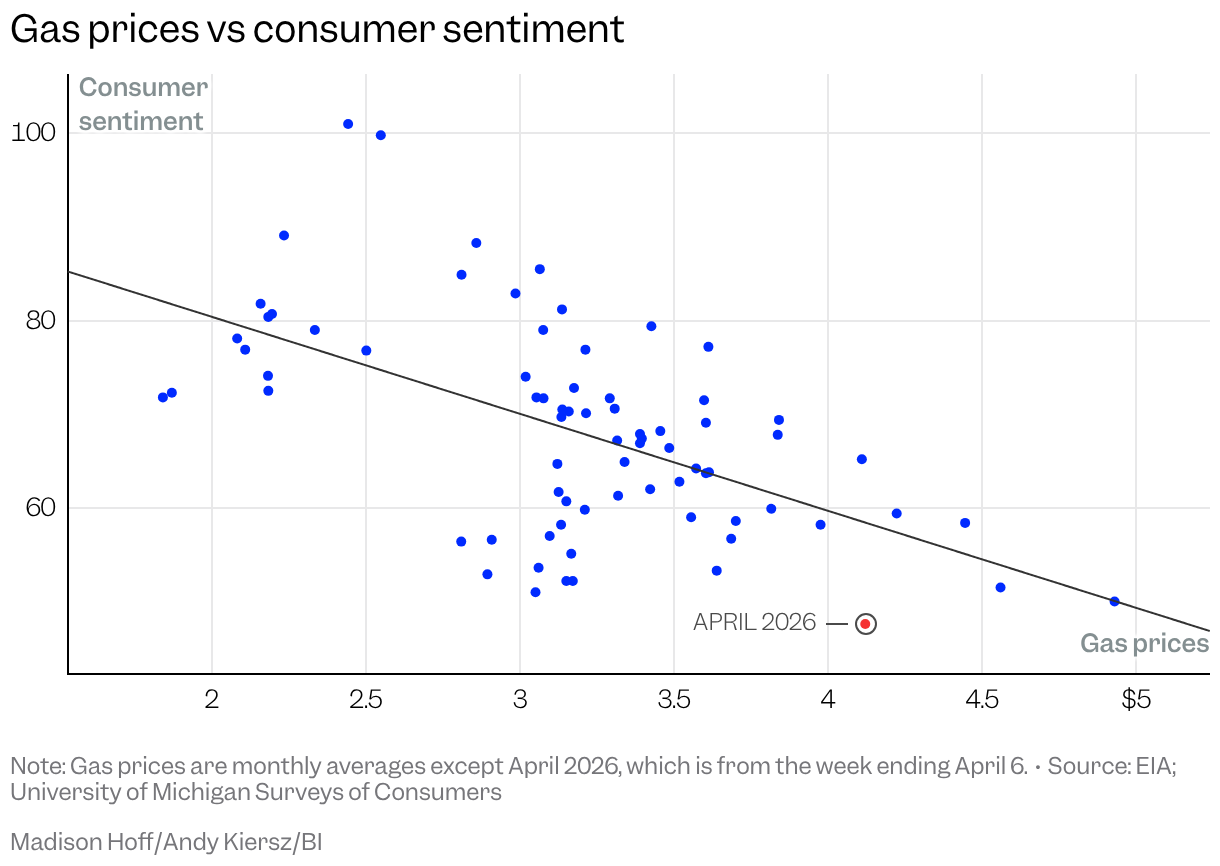
It’s a dour time for consumers — in April, the University of Michigan’s Consumer Sentiment Index, which surveys consumers on how they feel about current and future economic conditions, hit an all-time low.

It turns out that one small (or not-so-small) number has a lot of sway over how Americans feel about the economy: Gas prices. In recent years, there’s been a pretty solid relationship between gas prices and consumer sentiment: When it’s more expensive to fill up the tank, Americans tend to report more dire feelings about economic conditions and where they’re going. A Business Insider analysis of retail gas prices from the Energy Information Administration and consumer sentiment from the University of Michigan showed a moderate negative correlation between the two.

Gas prices are a hyper-visible economic marker for many Americans, who might experience immediate sticker shock every time they drive past their local gas station or stop to refill on the way to work. After all, only a small share — under 4% — of Americans use public transportation to get to work, according to Census Bureau data on commuting. A touch over 69% of workers drove alone to work in 2024, meaning that gas prices are likely omnipresent in calculating their commutes and daily expenses.

“Prices at the pump hold a very uniquely salient point in people’s minds,” Matt Colyar, an economist at Moody’s Analytics, told Business Insider. “Maybe it’s the big signs with the big luminescent numbers that everyone drives by constantly. They’re very aware of these prices.”

The last time sentiment was close to being this low was in June 2022. That might seem counterintuitive; it would stand to reason that the depths of the COVID-19 pandemic or the 2008 financial crisis and its aftermath might trump the current fluctuations. But June 2022 marked record-high gas prices amid soaring inflation and the fallout from Russia’s war in Ukraine.

Now, as sentiment hits that record low, gas prices are rising at the fastest pace on record, with last week’s consumer price index report showing a 21% month-over-month increase. As of the week ending April 6, the most recent date for which the Energy Information Administration has data, gas prices hit $4.12 a gallon; as of April 13, they were hovering around the same level, and up 50 cents over the month, per AAA.
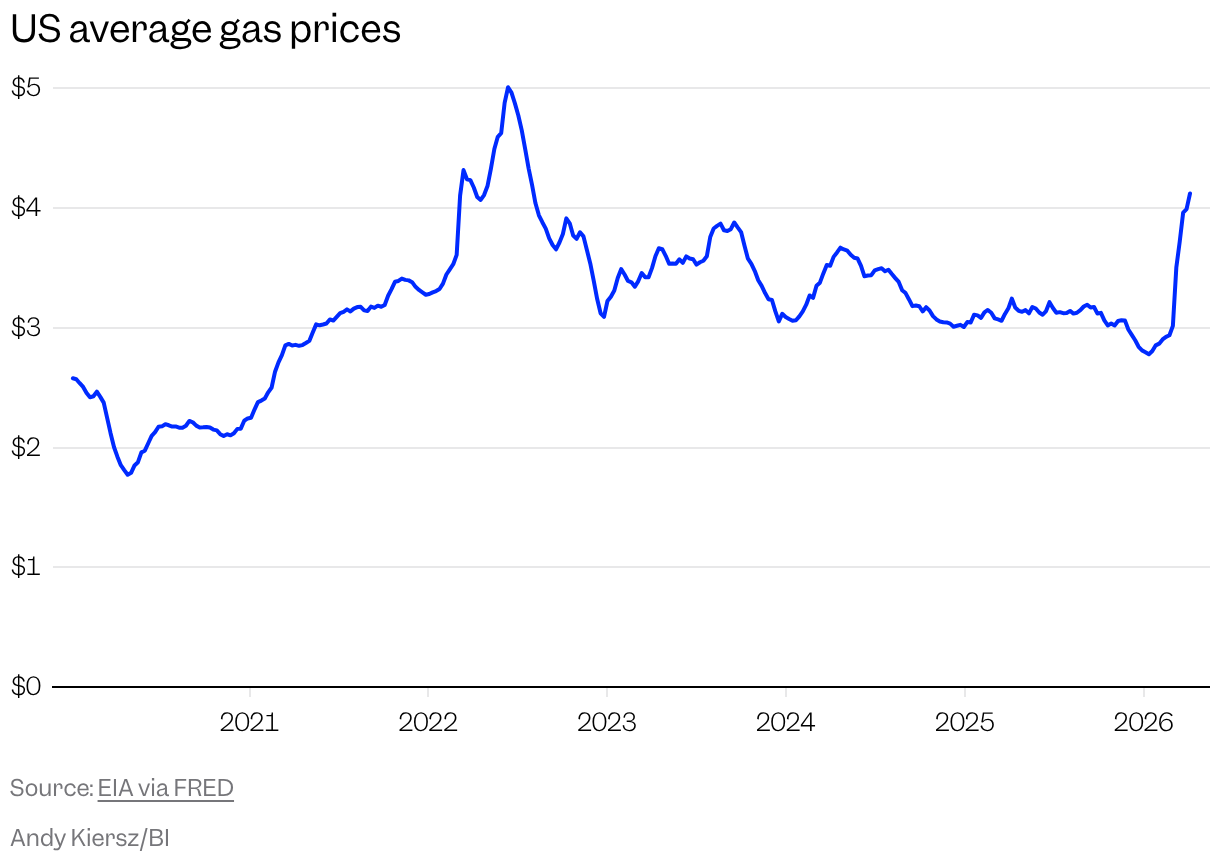
The bad vibes might only continue, especially as President Donald Trump signaled that prices might remain high through the November 2026 midterms and tensions between the US and Iran remain high over the Strait of Hormuz and the roughly 20% of global oil production that passes through it.

“Gas prices are highly visible, highly salient prices that consumers use to gauge their feelings about the economy,” said Alex Jacquez, the chief of policy and advocacy at the left-leaning think tank Groundwork Collaborative. “People have to fill up weekly; they often don’t have much of a choice whether they pay or not.”

Indeed, pump prices are top of mind for Americans as the Iran conflict drags on: 69% of 3,507 Americans surveyed by the Pew Research Center at the end of March said they were very or extremely concerned about higher gas or fuel prices when thinking about US military action in Iran.

That’s already led to changes in how American workers are navigating daily life — rideshare drivers, for instance, are prioritizing the most profitable trips to make their gas expenditures worthwhile. EV owners have taken a victory lap as they plug in. One Business Insider reporter strategically switched to the Costco credit card for gas savings.

Of course, there are plenty of factors that weigh on how Americans view the overall economy, and gas prices alone don’t determine sentiment. For example, the job market has been locked in a low-hire, low-fire “great freeze” for over a year, and the difficult prospects for job seekers are likely weighing on economic opinion as well.

Gas is still likely a looming factor, though. Jacquez said research has shown that “gas prices, consumer sentiment, and political approval all tend to move together, so it’s not surprising to see a sudden rise in gas prices coincide with a crash in consumer sentiment.”

Do you have a story to share about how rising prices and volatility are affecting your economic outlook? Contact these reporters at jkaplan@businessinsider.com and mhoff@businessinsider.com.



Source link

Aditi Bharade

Welcome to Singapore’s hustle economy

“We’re the same age,” I told Ernest Ang, a 24-year-old who opened an eatery two years ago with his grandmother’s recipes.

And yet, it feels like we live in different worlds.

Every day, he whips up large batches of fried chicken and beef rendang in Singapore’s 90-degree tropical heat. On the other side of the island, in the glitzy financial district, I write about the Trump administration and the general chaos of the world.

I started my first job in a newsroom after graduating from college in 2024, diving headfirst into the corporate grind. I sign off at 5:30 p.m. and value the work-life balance my writing job offers.

Last year, I started collecting stories of Singaporean Gen Zers and millennials shunning the comfort and stability of the 9-5 in favor of starting their own food businesses — ventures that come with backbreaking long hours. I was humbled.


Au Hui Her preps loaves of sourdough bread before opening her bakery in the morning.

Au Hui Her, a millennial bakery owner, starts prepping loaves of sourdough bread at 4 a.m.

Aditi Bharade


Hawker centers, like where Ang set up shop, are the go-to for budget meals in Singapore. They’re cheap, hearty, and convenient, and I’ve eaten from them as long as I can remember.

There are 123 hawker centers in the country, managed by the National Environment Agency. On average, each center has about seven to 10 individual stalls.

Traditionally, they sell dishes like Hainanese chicken rice, bak kut teh, a peppery and flavorful pork soup, or nasi lemak, aromatic rice served with dishes. The stalls are typically run by middle-aged to senior hawkers.


A hawker center in Singapore

Hawker centers in Singapore are typically run by older business owners who sell traditional fare.

Aditi Bharade


But as younger hawkers join the business, there’s been an increase in specialty stalls selling matcha, craft beer, baked goods, and fusion dishes.

Success is an uphill battle, with a massive failure rate due to rising store rents and a frugal consumer base. In 2025, 3,074 food and beverage businesses in Singapore closed their doors, per statistics from the Accounting and Corporate Regulatory Authority of Singapore.

This has not deterred hopeful entrepreneurs — 4,103 new food businesses opened last year.


Ernest Ang, 24, is plating a dish in his restaurant.

Ernest Ang, 24, opened a restaurant featuring his grandmother’s recipes, and said he prefers the life to working in an office.

Aditi Bharade


Most of the young chefs I interviewed work six to seven days a week, getting up well before the sun rises to prep ingredients for the day and retiring late into the night after feeding hungry dinner crowds.

I spoke with eight Gen Z and millennial F&B owners across the country about what makes them tick, what fears give them chills at night, and if they regret choosing a risky career path.

Spoiler: They don’t.


Source link

Chipotle-is-targeting-the-top-of-the-K-shaped-economy.jpeg

Chipotle is targeting the top of the K-shaped economy

Chipotle Mexican Grill plans to raise menu prices by 1-2% this year — and leadership is betting that its core consumer segment, digital natives who earn over $100k, won’t mind.

Speaking during Tuesday’s fourth-quarter earnings call, interim CEO Scott Boatwright said Chipotle is focusing on boosting foot traffic and revenue amid weak comparable sales. To do that, they’re targeting their core customer, who sits firmly at the top end of the K-shaped economy.

Chipotle recently conducted a “deep dive” of consumer research to identify the demographics and desires of its core audience and refine its strategy accordingly, Boatwright said.

“What we’ve learned is the guest skews younger, a little higher income, is typically a digital native, and that their grounded purpose aligns with our North Star as a brand, around clean food, clean ingredients, high protein,” Boatwright said. “We are the way they want to eat, and we’re going to lean into that in the most meaningful way.”

“After looking at the data last week, we learned that 60% of our core users are over $100,000 a year in average household income,” he added. “That gives us confidence that we can lean into that group in a more meaningful way, whether it’s the solo occasion and/or group occasions to really drive meaningful transaction performance in the year.”

Chipotle beat revenue estimates in 2025, its earnings report released on Tuesday showed, despite comparable restaurant sales decreasing 1.7%. The company projected its comparable sales in 2026 would be “about flat,” accounting for the openings of between 350 and 370 new restaurants.

In 2026, Chipotle’s margins will remain “under pressure,” Chief Financial Officer Adam Rymer said during the call, so consumers can expect pricing to increase 1-2% to narrow the gap between rising expenses and menu prices.

The broader restaurant segment is struggling with slumping sales as the K-shaped economy has upended the typical playbook for value deals and marketing campaigns. Lower-income consumers have been cutting back on spending, especially dining out, as they face rising costs across the board, while higher-income households show no signs of slowing their spending.

To draw in traffic, Chipotle recently launched its new protein snack menu, allowing customers to purchase a single taco or a side of meat (either chicken or steak) in a cup. It has also sped up the cadence of its limited-time offer releases, such as the recent promotions for chicken al pastor and red chimichurri sauce.

Those promotions seem to be working, and are proof that Chipotle’s core customer isn’t particularly price-sensitive, Boatwright said during Tuesday’s call.

Prior to the protein snack menu debut, Boatwright said leadership considered whether the launch would result in a “consumer trade-down” effect, a common phenomenon in which price-sensitive consumers opt for a discount deal or a lower-cost menu item than they’d usually order to find better value — but “frankly, we just didn’t see it.”

Instead of becoming a cheaper alternative to their usual favorite, customers are frequently purchasing the protein side as an add-on to their typical order, which Boatwright said “gives us confidence that the core consumer is not necessarily looking for a smaller, lower price-pointed component to the menu.”

Boatwright added that Chipotle will continue to test ideas to keep consumers coming back, including more limited-time offers and drink innovations. He also teased a “Happier Hour” deal specifically to re-engage younger and lower-income customers, but he added, “I don’t know if it’ll be a meaningful unlock for Chipotle.”

Chipotle’s stock sank by more than 6% in after-hours trading.


Source link