
NATO-allies-are-linking-their-defenses-together-to-better-hunt.jpeg

NATO allies are linking their defenses together to better hunt and kill drones on its eastern edge

The US and its NATO allies are boosting their ability to detect, track, and target drone threats along the alliance’s eastern edge, its border with Russia.

Through rapid 90-day testing cycles designed to replicate real situations, US forces, Baltic allies, and defense companies are building a shared data network for faster decision-making. The effort links sensors that detect aerial threats with counter-drone systems that can destroy them, aiming to improve defenses against Russian-style drone attacks, including Shahed-type systems.

US and Estonian forces executed exercise Digital Shield 2.0 earlier this month, the second stage in an ongoing testing series.

The exercise “was really born from an initiative to integrate different sensor types into an easily accessible and shareable integrated sensor architecture, or an air picture,” US Army Capt. Micah Maule, plans officer for the 10th Army Air and Missile Defense Command, told Business Insider.

While the first Digital Shield proved the concept, the second expanded the scale, adding more sensors to detect larger uncrewed aerial systems such as Shahed-type drones and additional air-defense and counter-UAS radars to sharpen the picture of incoming threats.

Those systems feed into a common command-and-control network using commercially developed software, creating a streamlined flow of surveillance data that operators can view in a single air picture before deciding how to respond.

“So you could actually task effectors to go out and destroy drones from the same common operational picture,” Maule said.

Digital Shield 2.0 included several simulated scenarios that could become real-world threats, including cyberattacks disrupting operations, high-stress conditions with lots of drone targets, and a live-fire situation running the entire process against Shahed replicators.


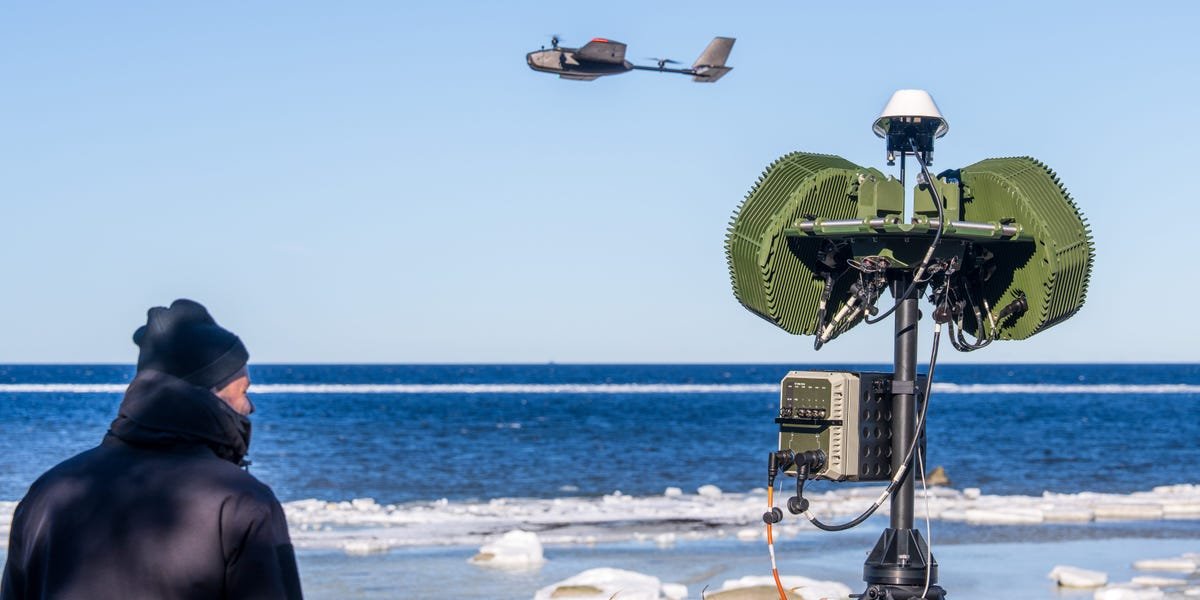
A man wearing camouflage stands next to a tall radar. A small white drone stands sits on the beach.

The second testing involved various sensors, counter-drone interceptors, and Shahed replicators.

US Army photo by Maj. Alexander Watkins


Adding more sensors layers the defenses, but it also increases the volume of incoming data. Maule said the goal of the shared command-and-control system is to merge those inputs into one clear picture, reducing the cognitive burden on operators.

An advantage of the design is that the system can be operated farther from the front, out of range of many types of drones, and that it feeds data to multiple partners for heightened awareness.

The rapid pace of the Digital Shield testing reflects the Pentagon’s Silicon Valley-style “move fast, fail fast, fix fast” approach for developing new technology. It also pressures industry partners to keep up. Vendors must meet strict integration requirements, and the swift development cycle forces faster fixes and upgrades based on field feedback.

Digital Shield is an example of the work being done as part of the new Eastern Flank Deterrence Line initiative, which is led by the US and NATO. The effort is intended to build a robust defense against Russia that can detect drones across wide areas and counter them with lower-cost solutions.

Artificial intelligence is also being integrated into the initiative to analyze sensor data faster and speed up decisions on how to respond.

One persistent problem remains the cost of stopping cheap drones.

“We have to beat the cost curve,” Maule said. “If the UAS is a couple or tens of thousands of dollars, you can’t be using extremely expensive interceptors.” The US and its allies have learned that lesson from Ukraine and in the Middle East.



Source link

Money-managers-are-hungrier-than-ever-for-obscure-data-to.jpeg

Money managers are hungrier than ever for obscure data to give them an edge

Sophisticated money managers have long turned to intel from credit-card receipts or satellite images of retailers’ parking lots into an investing edge, but this data is increasingly becoming table stakes.

Hedge funds and other money managers spent $2.8 billion on alternative data in 2025, according to a new report from consultancy Neudata, a 17% jump from the year before. It’s more than double what asset managers spent on alternative data in 2021, which includes a wide range of non-traditional information sources.

The report projects that the total spend on alternative datasets could jump to more than $23 billion in the consultancy’s bull case in 2030 and just under $8 billion in the bear case. The driver for this growth — and how much will come over the rest of the decade — will be based on how many new entrants, both buyers and sellers, enter the market, Daryl Smith, head of research at Neudata, said.

“Plenty of funds have only stuck their toes in,” Smith said, and “several hundred” new datasets were launched last year alone.

AI is also changing how funds consume and ingest alternative data sources, the report notes.

Now that structuring and cleaning raw data has become a faster, cheaper task thanks to AI tools, asset managers are looking for direct hook-ups to alternative data vendors’ feeds. It’s also opened up alt data to a range of managers that were once unable to pull meaningful insights from the data because of technical challenges.

These new funds could be a big driver of the industry’s growth in the coming years, from the demand side, Smith said.

More companies could be selling data

Some new data vendors might not be start-ups that stumbled onto something intriguing, but instead familiar brand names. Established corporations that have seen web-scraping bots take their data to sell are now getting into the game, Smith said.

He said Neudata’s consulting team, which helps new buyers and sellers navigate the market, has gotten outreach from big-name companies recently, though he said he couldn’t reveal the names of the potential sellers. Trustpilot, the consumer review website, is one example of a firm that has begun selling its data and has presented at Neudata conferences in the past, Smith said.

Unsurprisingly, data sources tracking the growth of artificial intelligence were in high demand last year. The report points out vendors such as Aterio, which track data center construction and power usage, for example.

Still, the most popular type of dataset, of which there are thousands, is web-scraping offerings, which accounted for 15% of the total spend in 2025, roughly in line with 2024.


Source link

NATO-is-deploying-a-drone-carrier-to-its-eastern-edge.jpeg

NATO is deploying a drone carrier to its eastern edge after repeated Russian airspace incursions

NATO is deploying a Turkish drone carrier to the Baltic Sea to boost its surveillance and defense in response to “repeated” Russian airspace violations, the alliance announced on Friday.

The TCG Anadolu will support Eastern Sentry, a defensive operation the alliance launched in September after Russian drones crossed into Polish airspace, forcing a military response.

The Turkish drone carrier is deploying toward the coast of Latvia, where it will contribute to air surveillance and defense along NATO’s eastern edge. Allies have been surging fighter jets and warships to the Baltic region in response to Russian drone incursions.

Allied Joint Force Command Brunssum, one of three operational-level NATO headquarters, said in a statement on Friday that the deployment of the Anadolu follows “repeated airspace violations” that have been attributed to Russia.

JFC Brunssum called the deployment “a clear signal to the east” and said that it “sends an unmistakable message” that NATO is prepared to defend its territory.


A Bayraktar TB3 drone during the NATO Steadfast Dart 2026 drill in the Baltic Sea on February 17, 2026.

A Bayraktar TB3 drone lands on the flight deck of the TCG Anadolu earlier this month.

Dursun Aydemir/Anadolu via Getty Images


It’s unclear when the carrier will arrive on station and how long it will remain there. The Turkish defense ministry could not immediately be reached for comment, and neither JFC Brunssum nor NATO’s Allied Air Command responded to a request for additional information.

The first-of-its-kind TCG Anadolu is the Turkish Navy’s only drone-carrying amphibious assault ship. It was commissioned in 2023 and is now Ankara’s most advanced vessel and flagship.

The 750-foot-long vessel was originally intended to carry helicopters and F-35B fighter jets, but after Turkey was kicked out of the F-35 program over its purchase of Russian surface-to-air missile systems, Ankara decided to repurpose the Anadolu for fixed-wing drones.

The Anadolu can carry Bayraktar TB-3 and Bayraktar Kızılelma combat drones, systems made by the Turkish company Baykar, as well as attack helicopters.

JFC Brunssum said the carrier is the largest ship in NATO’s Steadfast Dart fleet, which is comprised of 17 vessels, including amphibious landing ships, frigates, destroyers, and submarines.

Iran and China have also built their own drone carriers, and Portugal expects to receive one later this year.


Source link

Screen Shot 2020 09 04 at 6.22.07 PM

DoorDash’s CEO says he’s got an edge on Amazon in groceries

DoorDash CEO Tony Xu says that his company’s grocery offering has a key advantage over Amazon: choice.

Amazon is doubling down on grocery delivery, especially perishables like produce and ice cream. The retail and tech giant said last month that it’s expanding same- and next-day grocery delivery to more parts of the US this year, adding to the thousands of towns and cities it already serves — news that sent shares of Instacart and DoorDash tumbling at the time.

DoorDash, though, has something that shoppers want and that Amazon isn’t replicating, Xu said on the company’s fourth-quarter earnings call on Wednesday.

Unlike Amazon, which owns Whole Foods and several of its own food brands, DoorDash works with existing grocery chains. The delivery service has struck deals in recent years. Last year, it expanded its partnership with Kroger and signed new deals with regional chains, including Schnucks in the Midwest.

Few customers complete all their grocery shopping at a single chain, Xu said. Many stop at multiple stores each week, especially to find specific fresh groceries, such as produce, meat, and seafood.

“Consumers prefer choice,” Xu said on the call, adding that he expects there to “continue to be very strong interest in the DoorDash product” as a result.

DoorDash is also expanding its services for retailers, such as fulfillment through its DashMarts, convenience store-sized retail spaces designed for picking and delivering orders.

Xu said DoorDash is “doing that for every single grocer so that they have the capability to compete against companies like Amazon.”

DoorDash shares rose as much as 14% in after-market trading on Wednesday, despite disappointing fourth-quarter earnings and guidance for 2026. The company’s stock took its biggest one-day hit in November after it unveiled plans to spend hundreds of millions of dollars on tech improvements.

While DoorDash has become known for restaurant deliveries, its gig workers are increasingly making grocery deliveries — many of which make more financial sense for DoorDash.

Xu said DoorDash has attracted more big grocery orders from customers, not just small fill-in trips. That matters in the grocery industry, where grocers tend to make more money when customers buy a wider range of goods.

“People use us for both the quick runs as well as the stock-up use cases,” he said.

Ravi Inukonda, DoorDash’s CFO, said on the call that DoorDash’s retail and grocery business expects to “be unit-economic positive” in the second half of 2026.

Have a tip? Contact this reporter at abitter@businessinsider.com or via encrypted messaging app Signal at 808-854-4501. Use a personal email address, a nonwork WiFi network, and a nonwork device; here’s our guide to sharing information securely.


Source link

Screen Shot 2020 09 04 at 6.22.07 PM

CEO Dara Khosrowshahi says Uber has a quiet edge in the robotaxi wars

Uber Eats might end up playing a key role in its parent company’s robotaxi business, Uber CEO Dara Khosrowshahi said.

The ride-hailing app is working with multiple companies, such as Alphabet-backed Waymo, to make self-driving cars available through its app. Waymo’s robotaxis have already proven more efficient than most human Uber drivers in cities such as Atlanta and Austin, Uber has said.

One big question hanging over robotaxis, though, is what happens to the vehicles during times of the day when demand for rides is low, Khosrowshahi said on Uber’s fourth-quarter earnings call on Wednesday.

He pointed to one solution: Have them drive orders to customers through Uber’s food delivery and freight businesses.

Some delivery services, such as DoorDash, are also experimenting with robotaxis for food deliveries. Uber offers both ride-hailing and delivery, meaning robotaxis on its network could shift between the two as demand for each changes, Khosrowshahi said on Wednesday.

“Having delivery and freight as part of our logistics ecosystem gives us an opportunity to actually use these vehicles at a structurally higher utilization than anyone else,” Khosrowshahi said.

While ride-hailing accounted for over half of Uber’s revenue in the fourth quarter, its delivery business grew by 29%, a faster clip than the 18% growth rate its ride-hailing segment posted in the same period.

How efficiently companies use the autonomous vehicles that they put on the streets is one of the challenges hanging over the technology.

Safety is another. Last month, a Waymo car injured a child near a school in Santa Monica, California, the latest in a series of accidents involving self-driving cars. Waymo said it is cooperating with a federal probe into the accident.

While it doesn’t operate self-driving cars directly, Uber is experimenting with ways to train the AI behind robotaxis using data it collects from human drivers, Khosrowshahi said. Uber has a partnership with Nvidia to collect that data, for instance. Last month, Uber said it would launch AV Labs, an arm focused on similar training efforts.

Khosrowshahi said the goal is to make self-driving cars more reliable and avoid situations such as last year’s Waymo blackout in San Francisco, when a power outage prompted the company to suspend services. “The real world can create unexpected circumstances,” he said.

Robotaxis also require infrastructure to store, charge, and repair. Some companies, such as startup Voltera, are building depots for those purposes in anticipation of a robotaxi boom in the coming years.

Have a tip? Contact this reporter at abitter@businessinsider.com or via encrypted messaging app Signal at 808-854-4501. Use a personal email address, a nonwork WiFi network, and a nonwork device; here’s our guide to sharing information securely.


Source link